Hydrostatic Test Pump
ProductOverview
Before a new pipeline or pressure vessel enters service, it must be hydrostatically tested, pressurized with water to 1.25–1.5 times its design operating pressure for a specified hold time (typically 10 minutes to 1 hour per ASME standards). This proof test verifies structural integrity: if any joint, weld, or material defect exists, it will leak or burst under hydrostatic load, signaling failure before the system is filled with hazardous fluid or pressurized gas.
The hydrostatic test pump is a mobile unit that generates the high pressure needed for this proof test. It consists of a Prime Mover Unit (diesel or electric), a Positive Displacement Pump (triplex or quintuplex piston pump), a Water Supply Tank (500–5,000 gallons), a Main Pressure Gauge Assembly (0–5,000 psi readout), a Main Relief Valve (overpressure protection), and a High-Pressure Test Line Hose (5,000 psi SAE hose with quick-disconnects).
How It Works: Hydrostatic Proof Test Procedure
Setup: The pump unit is positioned near the test article (pipeline section, boiler, tank, or manifold). The High-Pressure Test Line Hose is connected from the pump discharge to the inlet of the test article via the Quick-Disconnect Coupler and In-Line Shut-Off Valve. A vent line (small hose) is attached to the test article outlet, routed back to a collection tank, permitting air to escape as water fills the system.
Water Fill: The operator opens the Control and Isolation Valve solenoid (via a hand-held pushbutton), allowing water from the Water Supply Tank to flow through the Inlet Check Valve and into the pump cylinders. The pump is running at low speed (~600–1,200 rpm), generating low flow (50–100 gpm) at low pressure (<100 psi). Water fills the test article and air vents are open, purging air from the piping.
Pressure Build: Once the system is full of water and air-free (vent line flows pure water), the operator closes the vent line valve. Further pump discharge now pressurizes the test article. The Main Pressure Gauge Assembly reads increasing pressure (100 → 500 → 1,000 → target psi). The pump displacement and speed are held constant, so pressure rises smoothly.
Target Pressure Hold: When the Main Pressure Gauge Assembly approaches the target pressure (e.g., 1,500 psi for a 1,000 psi design piping system), the operator reduces motor speed (RPM) or partially closes the Control and Isolation Valve throttle to achieve exact target pressure. Once stabilized at target ±10 psi, the operator stops further pump flow via the control valve.
Pressure Maintenance: The Main Relief Valve is set to crack at ~1,505 psi (just above target). Any leakage from the test article causes a slight pressure drop; the pump's displacement is small enough that if the relief doesn't open, the test article will hold steady pressure for 10–60 minutes without the pump running. If the relief opens, it indicates either the test article is leaking excessively or the relief setting is too low, and the operator rechecks the situation.
Observation Period: During the hold time (typically 10 minutes), crew personnel visually inspect the test article for leaks at welds, fittings, and connections. Any visible weeping or spray indicates a defect. If no leaks occur, the test article passes the proof test.
Depressurization: After the hold time, the operator slowly opens the Manual Bypass Valve (manual bypass valve) or energizes the Control Solenoid Coil to vent position, gradually reducing pressure at ~100 psi/minute (fast venting can cause shock and pipe hammering). The Main Pressure Gauge Assembly falls back to zero.
Drain and Disconnect: Once depressurized, the operator closes the In-Line Shut-Off Valve and disconnects the quick-couplers. The test article is now ready for service (gas fill, startup procedures, etc.).
Pump Displacement and Pressure Balance
The Positive Displacement Pump is a positive displacement pump: each revolution displaces a fixed volume of water. A triplex pump with 30 cc displacement at 1,800 rpm flows:
30 cc/rev × 1,800 rpm ÷ 1,000 = 54 gpm
If the test article volume is 1,000 gallons and the pump flows 54 gpm, fill time is ~18.5 minutes.
To pressurize from 0 to 1,500 psi, the pump must overcome fluid resistance (flow restriction). As pressure rises, the pump's motor must deliver increasing torque to compress the water. A typical diesel Diesel Engine or Electric Motor (100 hp) driving a Positive Displacement Pump (triplex 30 cc) reaches maximum pressure ~2,000 psi before motor speed drops or stalls from load.
If the test requires 2,500 psi, a higher-displacement pump (60 cc triplex) or a larger motor (150 hp) is needed.
Pressure Gauge Accuracy and Recording
The Main Pressure Gauge Assembly (mechanical Bourdon tube) is typically accurate ±1.6% of full scale (for a 5,000 psi gauge, ±80 psi). For regulatory compliance, ASME B31.1 requires the test pressure to be recorded; some modern test pumps include electronic Pressure Gauge (0–4–20 mA transducers with data loggers) that record pressure vs. time throughout the test, proving pressure was held at setpoint for the required duration.
The Pulsation Snubber (sintered bronze restrictor) dampens pump discharge pulsation, stabilizing the gauge needle for easier reading and reducing stress on the gauge mechanism.
Safety Considerations
High-pressure water testing is hazardous: a 5,000 psi jet can slice skin or cause severe trauma. Safety practices include:
- Pressure Isolation: The In-Line Shut-Off Valve must be closed before disconnecting hoses, preventing sudden depressurization and hose whip.
- Relief Valve Testing: Before each test, the Main Relief Valve is verified by slowly increasing pressure while watching the gauge; if relief doesn't crack by ±5% of setpoint, the valve must be serviced.
- Hose Inspection: The High-Pressure Test Line Hose must be visually inspected for bulges, cracks, or separation; hoses are replaced annually or after visible wear.
- Personnel Exclusion: During pressurization, crew members stand clear of the test article and hose connections, away from blast zone.
Cooling and Heat Rejection
Pressurizing water generates heat from fluid viscous shear and relief valve bypass. A Water Supply Tank sized at ~2–3 times the pump flow per minute allows 5–10 minutes residence time, dissipating heat into the tank walls and air. For long tests (>1 hour) or large volumes in hot climates, a separate radiator or recirculation chiller may be added to maintain water temperature <100°C (boiling point at atmospheric pressure).
Trailer Mobility and Deployment
The Trailer Chassis and Frame and Trailer Axle Assembly allow towing by a standard farm or construction tractor. Typical deployment: pump is towed from a central shop to the pipeline right-of-way (5–50 miles), positioned at the test section, and remains on-site for 1–4 weeks while a crew tests successive pipe joints. Once testing is complete, the pump is towed to the next section or back to the shop.
Maintenance and Service Life
The Positive Displacement Pump piston and cylinder wear with each test cycle; wear is accelerated if water quality is poor (sediment or salt). The Suction Strainer must be cleaned or replaced every 50 hours to prevent sediment from entering and scoring the pump. The Main Relief Valve cartridge is reconditioned (polished and re-seated) every 2–5 years. The Diesel Engine or Electric Motor is serviced per manufacturer schedule (oil change every 250 hours).
A well-maintained hydrostatic test pump can operate 20,000+ hours over 15–20 years, with typical overhauls (pump head rebuild, relief valve service) every 5,000 hours.
Hydrostatic Test Pump parts and their functions
8 top-level parts · 30 parts in total · full bill of materials below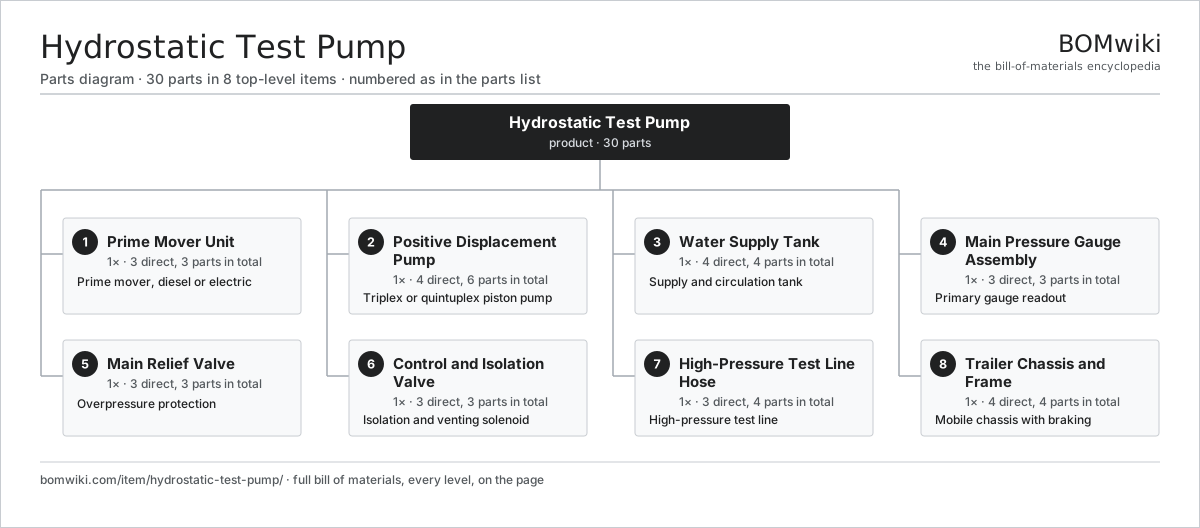
| # | Part | Qty | What it does |
|---|---|---|---|
| 1 | Prime Mover Unit 3 parts | 1× | Prime mover, diesel or electric |
| 2 | Positive Displacement Pump 4 parts | 1× | Triplex or quintuplex piston pump |
| 3 | Water Supply Tank 4 parts | 1× | Supply and circulation tank |
| 4 | Main Pressure Gauge Assembly 3 parts | 1× | Primary gauge readout |
| 5 | Main Relief Valve 3 parts | 1× | Overpressure protection |
| 6 | Control and Isolation Valve 3 parts | 1× | Isolation and venting solenoid |
| 7 | High-Pressure Test Line Hose 3 parts | 1× | High-pressure test line |
| 8 | Trailer Chassis and Frame 4 parts | 1× | Mobile chassis with braking |
3D model
No 3D model yet. Have a CAD file of this? Add a 3D model. STL renders right on this page; STEP, FreeCAD, and OpenSCAD sources are welcome too (openly licensed, like all 3D models on BOMwiki).
Build & assembly graph
expand / collapse · shared sub-assemblies converge · links to related products · est. labourTap an assembly to expand/collapse · tap a part to open it · use “Open page” for any node · drag to pan, scroll to zoom.
Bill of materials for Hydrostatic Test Pump
8 top-level lines · 35 rows shown · 30 parts total · indented to 3 levels| # | Item / sub-assembly | Part no. | Qty/assy | Ext. qty | Parts | Type |
|---|---|---|---|---|---|---|
| 1 | Prime Mover Unit 3 parts | hydrostatic-test-pump-motor-unit | 1× | 1 | 3 | assembly |
| 1.1 | Diesel Engine or Electric Motor | hydrostatic-test-pump-diesel-or-electric-motor | 1× | 1 | · | part |
| 1.2 | Motor Cooling System | hydrostatic-test-pump-motor-cooling-system | 1× | 1 | · | part |
| 1.3 | Flexible Motor Coupling | hydrostatic-test-pump-motor-coupling | 1× | 1 | · | part |
| 2 | Positive Displacement Pump 4 parts | hydrostatic-test-pump-pump-head | 1× | 1 | 6 | assembly |
| 2.1 | Piston-Cylinder Stage | hydrostatic-test-pump-piston-stages | 3× | 3 | · | part |
| 2.2 | Piston Rod and Crosshead | hydrostatic-test-pump-piston-rod | 1× | 1 | · | part |
| 2.3 | Inlet Check Valve | hydrostatic-test-pump-piston-inlet-check | 1× | 1 | · | part |
| 2.4 | Discharge Check Valve | hydrostatic-test-pump-piston-discharge-valve | 1× | 1 | · | part |
| 3 | Water Supply Tank 4 parts | hydrostatic-test-pump-water-reservoir | 1× | 1 | 4 | assembly |
| 3.1 | Tank Shell | hydrostatic-test-pump-tank-shell | 1× | 1 | · | part |
| 3.2 | Suction Strainer | hydrostatic-test-pump-tank-inlet-strainer | 1× | 1 | · | part |
| 3.3 | Water Level Gauge | hydrostatic-test-pump-tank-level-indicator | 1× | 1 | · | part |
| 3.4 | Tank Drain Valve | hydrostatic-test-pump-tank-drain-valve | 1× | 1 | · | part |
| 4 | Main Pressure Gauge Assembly 3 parts | hydrostatic-test-pump-pressure-gauge | 1× | 1 | 3 | assembly |
| 4.1 | Pressure Gauge | hydrostatic-test-pump-gauge-instrument | 1× | 1 | · | part |
| 4.2 | Pulsation Snubber | hydrostatic-test-pump-gauge-snubber | 1× | 1 | · | part |
| 4.3 | Needle Stop Pin | hydrostatic-test-pump-gauge-needle-stop | 1× | 1 | · | part |
| 5 | Main Relief Valve 3 parts | hydrostatic-test-pump-relief-valve | 1× | 1 | 3 | assembly |
| 5.1 | Relief Cartridge Valve | hydrostatic-test-pump-relief-main-cartridge | 1× | 1 | · | part |
| 5.2 | Pilot Control Valve | hydrostatic-test-pump-relief-pilot-valve | 1× | 1 | · | part |
| 5.3 | Relief Return Manifold | hydrostatic-test-pump-relief-return-line | 1× | 1 | · | part |
| 6 | Control and Isolation Valve 3 parts | hydrostatic-test-pump-control-valve | 1× | 1 | 3 | assembly |
| 6.1 | Control Solenoid Coil | hydrostatic-test-pump-control-solenoid | 1× | 1 | · | part |
| 6.2 | Control Spool Valve | hydrostatic-test-pump-control-spool | 1× | 1 | · | part |
| 6.3 | Manual Bypass Valve | hydrostatic-test-pump-control-manual-override | 1× | 1 | · | part |
| 7 | High-Pressure Test Line Hose 3 parts | hydrostatic-test-pump-hose-bundle | 1× | 1 | 4 | assembly |
| 7.1 | Main Test Hose | hydrostatic-test-pump-hose-main | 1× | 1 | · | part |
| 7.2 | Quick-Disconnect Coupler | hydrostatic-test-pump-hose-quick-disconnect | 2× | 2 | · | part |
| 7.3 | In-Line Shut-Off Valve | hydrostatic-test-pump-hose-shut-off-valve | 1× | 1 | · | part |
| 8 | Trailer Chassis and Frame 4 parts | hydrostatic-test-pump-trailer-frame | 1× | 1 | 4 | assembly |
| 8.1 | Trailer Axle Assembly | hydrostatic-test-pump-trailer-axles | 1× | 1 | · | part |
| 8.2 | Trailer Frame | hydrostatic-test-pump-trailer-frame-steel | 1× | 1 | · | part |
| 8.3 | Trailer Braking System | hydrostatic-test-pump-trailer-brakes | 1× | 1 | · | part |
| 8.4 | Trailer Hitch and Safety | hydrostatic-test-pump-trailer-hitch | 1× | 1 | · | part |
Something wrong in this list? Report a problem with this BOM.
Sourcing: possible vendors
Browse the supplier directory → Prices, MOQ, and lead times are algorithmic estimates, not quotes, and not claims about these companies. Company mappings are curated by keyword; est. price band $15k–$2M. How estimates work| Vendor | HQ | Specialty | MOQ | Lead time |
|---|---|---|---|---|
| caterpillar.com ↗ | Irving, US | Construction & mining equipment | made to order | 16–28 wks |
|
🇯🇵Komatsu
komatsu.com ↗
|
Tokyo, JP | Construction & mining equipment | made to order | 16–28 wks |
|
🇸🇪Volvo CE
volvoce.com ↗
|
Gothenburg, SE | Construction equipment | made to order | 16–28 wks |
|
🇨🇭Liebherr
liebherr.com ↗
|
Bulle, CH | Cranes & heavy equipment | made to order | 16–28 wks |
|
🇨🇳XCMG
xcmg.com ↗
|
Xuzhou, CN | Construction machinery | made to order | 16–28 wks |
1,333-word article