Ice Hockey Skates
ProductOverview
Ice hockey skates are purpose-engineered footwear combining a protective padded boot with a sharpened steel runner secured to the sole. Unlike figure or recreational skates, hockey skates prioritize speed, agility, and durability for the high-impact and fast-paced demands of hockey play. The boot is typically stiffer than figure skates to support powerful lateral movements and quick edge transitions, while the Steel Runner is curved with a tight rocker radius to enable rapid turning and acceleration on ice.
The modern hockey skate design emerged in the early 20th century from adaptations of leather work boots fitted with metal blades. Contemporary hockey skates combine thermoformed or injected plastic and leather uppers with padded liners for comfort and thermal protection. Professional-grade hockey skates employ stiffer materials and tighter tolerances than recreational models, reflecting the demands of elite-level play.
How it works
The skater laces the Boot Assembly around their foot and ankle, using the ski-boot-lacing eyelets for a secure, customized fit. The padded Boot Lining provides thermal insulation and cushioning. The Insole Assembly distributes the skater's weight across the foot.
The Blade Holder is rigidly fastened to the boot sole using Mounting Rivets, creating a fixed platform. The Steel Runner projects downward from the sole, with its edges in contact with the ice. The skater propels themselves forward by pushing ice away laterally with the blade edges; the Blade Rocker allows the skater to rock forward and backward on the blade for balance and agility.
The sharpened Blade Edge provides grip and prevents sideways slipping. The blade's longitudinal curve (rocker) and crosswise profile are precision-honed to narrow edges (approximately 1 mm thick where they contact ice), allowing the blade to cut into soft or rough ice for grip without excessive friction.
The Heel Counter provides lateral stability during lateral movements and reduces stress on the Achilles tendon. The Toe Cap protects the foot and boot from direct impacts against boards, pucks, or other skates.
Materials and construction
The Boot Assembly consists of a thermoformed or injection-molded outer shell made from composite materials (fiberglass-reinforced plastic, EVA foam, or hybrid constructions) bonded with a soft inner Boot Lining. Recreational skates often use leather uppers with synthetic linings; professional hockey skates typically use advanced composites offering greater stiffness-to-weight and durability.
The Outer Leather in hockey skates is often synthetic or a blend with synthetic overlays, as authentic leather absorbs water and provides less lateral support than composites. The Quarters wrap around the sides and ankle, reinforced with Quarter Stiffener inserts to resist lateral collapse during hard turns and stops.
The Heel Counter is a rigid thermoplastic structure molded into the rear of the boot, providing a cup that cradles the heel and Achilles tendon. The Heel Padding inside the counter cushions the back of the foot and distributes pressure from the Achilles tendon. Professional hockey skates have taller, stiffer heel counters than recreational models.
The Blade Holder is precision-machined from stainless or carbon steel. The holder is bolted or riveted to an aluminum or steel plate under the sole using Mounting Rivets, typically 4–6 fasteners. The blade is either permanently riveted to the holder or bolted on with cap screws, allowing blade replacement when worn or damaged.
The Steel Runner is forged or extruded from high-carbon or stainless steel. Stainless steel blades are corrosion-resistant and low-maintenance; carbon steel blades are slightly sharper when honed but require drying and occasional light oil to prevent rust. The blade's profile is typically a shallow curve with a slight forward lift at the toe (a toe rocker of 1–3 mm), and a longitudinal rocker radius of 3–8 m depending on skating style.
The Blade Edge is sharpened to a V-shaped cross-section, typically 1–2 mm at the apex. The sharpening angle is usually 45° per side for recreational skates and slightly steeper for hockey and speed skates. Sharp edges cut into ice and soft snow, providing grip; dull edges slip sideways, requiring more effort to accelerate or execute sharp turns.
The Boot Lacing uses brass or steel eyelets (fastened or crimped into the boot) through which waxed nylon laces pass. The lacing system provides micro-adjustments for fit, tightening the toe box, midfoot, and ankle independently.
The Insole Assembly consists of a rigid or semi-rigid Insole Base (often EVA or polyurethane foam bonded to a thin plastic sheet) with additional Insole Cushion under the heel and arch. The Insole Grip is a textured or adhesive-backed surface preventing foot slip inside the boot.
Thermal properties and maintenance
The Boot Lining is typically fleece (polyester or wool blended) or a synthetic thermal material, providing insulation down to approximately −15°C. Recreational skates often have thinner linings; professional hockey skates may have thicker linings or be compatible with custom insoles and heating inserts. Most ice hockey skates are not rated for extreme cold beyond −20°C; arctic and speed skates designed for outdoor speed skating use thicker insulation.
Blade maintenance is critical for performance and safety. After each use, the skater should dry the blades thoroughly with a cloth to prevent rust on carbon steel. Blades should be sharpened every 10–20 hours of skating, depending on ice quality and use intensity. Professional hockey players sharpen before each practice or game. Sharpening is performed by a specialist using a stationary grinder or rocker, maintaining the cross-sectional edge profile and longitudinal rocker curve.
Blade edges can dull, chip, or flatten with use. Small chips can be filled by honing the entire blade; larger chips or cracks require blade replacement. Blades typically last 1–2 seasons for recreational use, or 1–2 months for professional hockey.
Boot maintenance involves periodic cleaning and inspection. Leather or synthetic uppers can be cleaned with a soft brush and damp cloth; linings should be air-dried after each use to prevent bacterial growth and odor. The Blade Holder and Mounting Rivets should be inspected for rust or loosening; loose rivets can be re-set by a skate technician. The laces should be replaced if they fray or break.
Proper storage involves keeping the skates in a dry, cool environment. Many skaters use a boot tree or shoree to maintain boot shape during off-season storage. Well-maintained skates can last 3–5 seasons for recreational use, or 1–2 seasons for intensive competitive play.
Ice Hockey Skates parts and their functions
8 top-level parts · 30 parts in total · full bill of materials below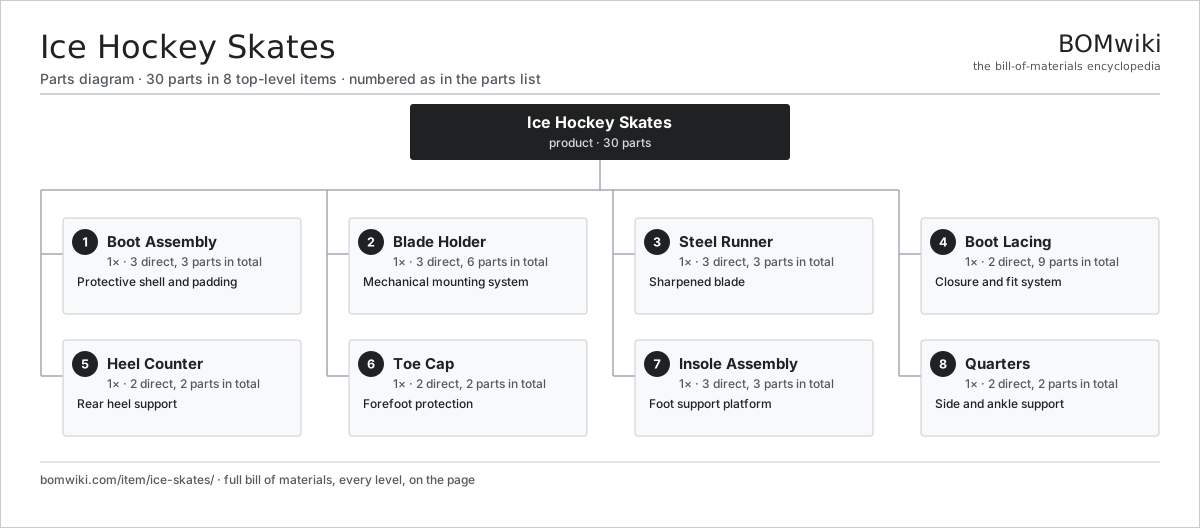
| # | Part | Qty | What it does |
|---|---|---|---|
| 1 | Boot Assembly 3 parts | 1× | Protective shell and padding |
| 2 | Blade Holder 3 parts | 1× | Mechanical mounting system |
| 3 | Steel Runner 3 parts | 1× | Sharpened blade |
| 4 | Boot Lacing 2 parts | 1× | Closure and fit system |
| 5 | Heel Counter 2 parts | 1× | Rear heel support |
| 6 | Toe Cap 2 parts | 1× | Forefoot protection |
| 7 | Insole Assembly 3 parts | 1× | Foot support platform |
| 8 | Quarters 2 parts | 1× | Side and ankle support |
3D model
No 3D model yet. Have a CAD file of this? Add a 3D model. STL renders right on this page; STEP, FreeCAD, and OpenSCAD sources are welcome too (openly licensed, like all 3D models on BOMwiki).
Build & assembly graph
expand / collapse · shared sub-assemblies converge · links to related products · est. labourTap an assembly to expand/collapse · tap a part to open it · use “Open page” for any node · drag to pan, scroll to zoom.
Bill of materials for Ice Hockey Skates
8 top-level lines · 28 rows shown · 30 parts total · indented to 3 levels| # | Item / sub-assembly | Part no. | Qty/assy | Ext. qty | Parts | Type |
|---|---|---|---|---|---|---|
| 1 | Boot Assembly 3 parts | ice-skates-boot-assembly | 1× | 1 | 3 | assembly |
| 1.1 | Outer Leather | ice-skates-outer-leather | 1× | 1 | · | part |
| 1.2 | Boot Lining | ice-skates-boot-lining | 1× | 1 | · | part |
| 1.3 | Structural Inserts | ice-skates-structural-inserts | 1× | 1 | · | part |
| 2 | Blade Holder 3 parts | ice-skates-blade-holder | 1× | 1 | 6 | assembly |
| 2.1 | Holder Material | ice-skates-holder-material | 1× | 1 | · | part |
| 2.2 | Mounting Rivets | ice-skates-mounting-rivets | 4× | 4 | · | part |
| 2.3 | Holder Plate | ice-skates-holder-plate | 1× | 1 | · | part |
| 3 | Steel Runner 3 parts | ice-skates-steel-runner | 1× | 1 | 3 | assembly |
| 3.1 | Blade Steel | ice-skates-blade-steel | 1× | 1 | · | part |
| 3.2 | Blade Rocker | ice-skates-blade-rocker | 1× | 1 | · | part |
| 3.3 | Blade Edge | ice-skates-blade-edge | 1× | 1 | · | part |
| 4 | Boot Lacing 2 parts | ice-skates-boot-lacing | 1× | 1 | 9 | assembly |
| 4.1 | Lace Eyelets | ice-skates-lace-eyelets | 8× | 8 | · | part |
| 4.2 | Boot Laces | ice-skates-boot-laces | 1× | 1 | · | part |
| 5 | Heel Counter 2 parts | ice-skates-heel-counter | 1× | 1 | 2 | assembly |
| 5.1 | Heel Plastic | ice-skates-heel-plastic | 1× | 1 | · | part |
| 5.2 | Heel Padding | ice-skates-heel-padding | 1× | 1 | · | part |
| 6 | Toe Cap 2 parts | ice-skates-toe-cap | 1× | 1 | 2 | assembly |
| 6.1 | Toe Material | ice-skates-toe-material | 1× | 1 | · | part |
| 6.2 | Toe Padding | ice-skates-toe-padding | 1× | 1 | · | part |
| 7 | Insole Assembly 3 parts | ice-skates-insole-assembly | 1× | 1 | 3 | assembly |
| 7.1 | Insole Base | ice-skates-insole-base | 1× | 1 | · | part |
| 7.2 | Insole Cushion | ice-skates-insole-cushion | 1× | 1 | · | part |
| 7.3 | Insole Grip | ice-skates-insole-grip | 1× | 1 | · | part |
| 8 | Quarters 2 parts | ice-skates-quarters | 1× | 1 | 2 | assembly |
| 8.1 | Quarter Material | ice-skates-quarter-material | 1× | 1 | · | part |
| 8.2 | Quarter Stiffener | ice-skates-quarter-stiffener | 1× | 1 | · | part |
Something wrong in this list? Report a problem with this BOM.
Sourcing: possible vendors
Browse the supplier directory → Prices, MOQ, and lead times are algorithmic estimates, not quotes, and not claims about these companies. Company mappings are curated by keyword; est. price band $20–$2k. How estimates work| Vendor | HQ | Specialty | MOQ | Lead time |
|---|---|---|---|---|
|
🇺🇸Coleman
coleman.com ↗
|
Chicago, US | Camping gear | 1,000 units | 6–10 wks |
| thenorthface.com ↗ | Denver, US | Outdoor apparel & gear | 1,000 units | 6–10 wks |
|
🇺🇸YETI
yeti.com ↗
|
Austin, US | Coolers & drinkware | 1,000 units | 6–10 wks |
| decathlon.com ↗ | Villeneuve-d'Ascq, FR | Sporting goods | 1,000 units | 6–10 wks |
|
🇺🇸Garmin
garmin.com ↗
|
Olathe, US | GPS & wearables | 1,000 units | 6–10 wks |
1,133-word article