Iced Tea Brewer
ProductOverview
The iced tea brewer is a batch-and-serve system designed for quick-service restaurants, casual dining chains, and fountain beverage stations. It produces fresh iced tea on-demand by heating water, steeping tea leaves or bags, cooling the concentrate, and then mixing with ice and cold water for final service.
The machine has three main functional zones: a hot water boiler maintaining 170–180°F for tea extraction; a brew basket where loose tea or tea bags steep; and a cooling system that chills brewed concentrate using an ice bath or mechanical chiller. A dispense pump and proportioning solenoids mix chilled concentrate with cold water in precise ratios, delivering finished iced tea through a tap.
This approach yields superior flavor compared to instant mixes, while maintaining production speed superior to manual brewing. A batch of tea concentrate can be brewed once per hour or less frequently, depending on demand, while the chilled concentrate allows near-instantaneous dispense.
How It Works
The operator begins by loading the brew basket with loose-leaf tea or tea bags, typically 1–3 ounces for a full 2–3 gallon batch. The basket is closed and positioned over the boiler.
The boiler maintains a steady 170–180°F via its immersion heater and thermostat. This water temperature is optimal for tea extraction, hot enough to dissolve flavor compounds rapidly, but cool enough to avoid over-extraction and astringency. Some brewers use 180–200°F for robust black teas, while delicate whites and greens steep at 160–170°F. The operator adjusts the temperature dial per the tea varietal.
The operator presses the brew button on the control panel. A control relay opens a solenoid valve on the boiler outlet, allowing hot water to flow into the brew basket. The hot water contacts the tea leaves, and steeping begins. The control panel lights indicate "brewing" status.
The brew cycle typically lasts 4–6 minutes (adjustable by operator). During this time, the tea leaves release flavor, tannins, and color into the water. At the end of the brew cycle, a timer on the control panel automatically closes the hot-water solenoid. The brew basket now contains a rich brown concentrate. Gravity or a small pump drains the brewed concentrate into the cooling system.
If the machine uses an ice-bath cooling method, the operator adds ice to a jacket or insulated container around the cooling coil. The brewed concentrate flows through the coil, exchanging heat with the ice, and emerges chilled to 40–50°F. The chilled concentrate is held in an insulated tank.
If the machine uses a mechanical chiller (an electric cooling unit), the chiller pump circulates refrigerated glycol or water through a coil immersed in the concentrate reservoir. The cooling thermostat cycles the chiller on and off to maintain 40–50°F. Mechanical chillers are more reliable and require no ice replenishment, but cost more than ice baths.
Once the concentrate is chilled, the machine is ready to dispense. The operator (or customer, if self-serve) presses a dispense button. The pump motor energizes, and the pump head draws chilled concentrate from the reserve tank and pressurizes it.
Simultaneously, the concentrate solenoid and water solenoid on the proportioning valve are energized. The concentrate solenoid opens a passage allowing concentrate to flow into the mixing manifold. The water solenoid opens a passage allowing cold tap water (or ice-chilled water) to flow in parallel. The two streams mix in the manifold and flow toward the nozzle.
The ratio of concentrate to water is typically 1:4 to 1:8 (one part concentrate to four to eight parts water), adjusted by the operator via flow restrictors or solenoid pulse width. A portion timer on the control panel controls how long the solenoids remain open, determining the final cup volume (typically 8–20 ounces).
When the timer expires, both solenoids close, the pump motor stops, and the anti-drip check valve at the nozzle closes, preventing drips. The customer removes the filled cup. The machine is ready for the next dispense.
As demand continues throughout the shift, the brewed concentrate in the reserve tank gradually depletes. Once the concentrate level drops below a usable level (signaled by a status light on the control panel), the operator initiates a new brew cycle, repeating the process.
Tea Selection and Brewing
Most commercial iced tea brewers work best with black tea blends (English Breakfast, Assam, Ceylon) or green tea blends formulated for mass production. These have robust flavor that survives dilution with water (typically 5–8 times concentration). Delicate white or herbal teas may under-extract or over-extract in the quick 4–6 minute cycle, yielding flat or astringent results.
Some brewers include sweetener dispensers (separate from the tea concentrate system) to add sugar or syrup during the dispense cycle. This allows operators to offer both sweetened and unsweetened options from a single concentrate.
Loose-leaf tea requires periodic replacement of the brew basket strainer as leaves can clog the mesh. Pre-packaged tea bags simplify operation but add cost and waste.
Maintenance
Daily cleaning involves discarding the spent tea leaves from the brew basket. The basket is rinsed thoroughly to remove tea residue, which can become moldy if left overnight. The cooling coil (if mechanical) should be rinsed with cold water to remove any sediment.
Weekly, the entire pump and solenoid valve assembly is flushed with fresh water to prevent concentrate from caking inside. The boiler is drained and rinsed; a weekly vinegar soak (1:1 white vinegar and water) descales mineral buildup that slows heating.
Monthly, the sight glass on the boiler is inspected for mineral scale; the shutoff valves are opened and closed to verify free operation. The pump is inspected for leakage; if found, seals may require replacement.
The boiler heater element typically lasts 12–24 months before scaling or failure. The boiler thermostat may drift and require recalibration every 18–36 months. If a mechanical chiller is used, it requires annual servicing (refrigerant top-up, compressor check).
Standards and Safety
Commercial iced tea brewers comply with NSF/ANSI 4 (sanitation) and UL 197 (electrical safety). All product-contact surfaces are food-grade stainless steel or aluminum. The boiler operates at low pressure (atmospheric + minimal steam), so no pressure vessel certification is required in most jurisdictions.
The boiler thermostat prevents overheating. The pump has a relief valve preventing excessive discharge pressure. The dispense tap is designed to prevent scalding, cold water and chilled concentrate ensure no portion of the dispensed beverage exceeds safe drinking temperature.
All electrical circuits include proper grounding and, if installed near water sources, ground-fault protection. The drip pan prevents pooled water from creating electrical hazards.
Iced Tea Brewer parts and their functions
8 top-level parts · 34 parts in total · full bill of materials below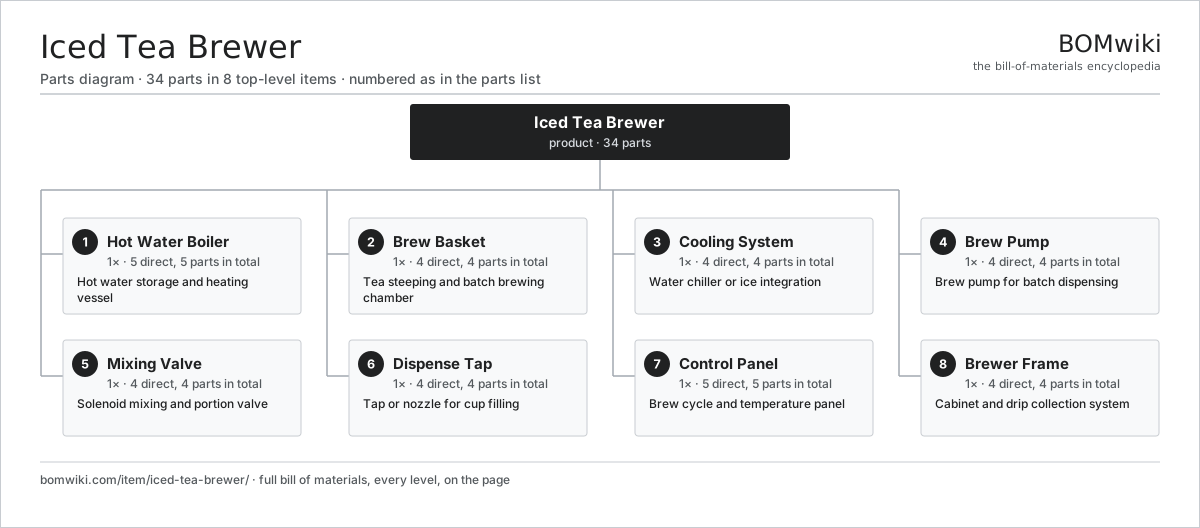
| # | Part | Qty | What it does |
|---|---|---|---|
| 1 | Hot Water Boiler 5 parts | 1× | Hot water storage and heating vessel |
| 2 | Brew Basket 4 parts | 1× | Tea steeping and batch brewing chamber |
| 3 | Cooling System 4 parts | 1× | Water chiller or ice integration |
| 4 | Brew Pump 4 parts | 1× | Brew pump for batch dispensing |
| 5 | Mixing Valve 4 parts | 1× | Solenoid mixing and portion valve |
| 6 | Dispense Tap 4 parts | 1× | Tap or nozzle for cup filling |
| 7 | Control Panel 5 parts | 1× | Brew cycle and temperature panel |
| 8 | Brewer Frame 4 parts | 1× | Cabinet and drip collection system |
3D model
No 3D model yet. Have a CAD file of this? Add a 3D model. STL renders right on this page; STEP, FreeCAD, and OpenSCAD sources are welcome too (openly licensed, like all 3D models on BOMwiki).
Build & assembly graph
expand / collapse · shared sub-assemblies converge · links to related products · est. labourTap an assembly to expand/collapse · tap a part to open it · use “Open page” for any node · drag to pan, scroll to zoom.
Bill of materials for Iced Tea Brewer
8 top-level lines · 42 rows shown · 34 parts total · indented to 3 levels| # | Item / sub-assembly | Part no. | Qty/assy | Ext. qty | Parts | Type |
|---|---|---|---|---|---|---|
| 1 | Hot Water Boiler 5 parts | iced-tea-brewer-boiler | 1× | 1 | 5 | assembly |
| 1.1 | Boiler Tank | iced-tea-brewer-boiler-tank | 1× | 1 | · | part |
| 1.2 | Boiler Heater | iced-tea-brewer-boiler-heater | 1× | 1 | · | part |
| 1.3 | Boiler Thermostat | iced-tea-brewer-boiler-thermostat | 1× | 1 | · | part |
| 1.4 | Boiler Gauge | iced-tea-brewer-boiler-gauge | 1× | 1 | · | part |
| 1.5 | Boiler Supply | iced-tea-brewer-boiler-supply | 1× | 1 | · | part |
| 2 | Brew Basket 4 parts | iced-tea-brewer-brew-basket | 1× | 1 | 4 | assembly |
| 2.1 | Brew Container | iced-tea-brewer-brew-basket-container | 1× | 1 | · | part |
| 2.2 | Brew Strainer | iced-tea-brewer-brew-basket-strainer | 1× | 1 | · | part |
| 2.3 | Brew Basket Lid | iced-tea-brewer-brew-basket-lid | 1× | 1 | · | part |
| 2.4 | Brew Discharge | iced-tea-brewer-brew-basket-valve | 1× | 1 | · | part |
| 3 | Cooling System 4 parts | iced-tea-brewer-cooling | 1× | 1 | 4 | assembly |
| 3.1 | Cooling Coil | iced-tea-brewer-cooling-coil | 1× | 1 | · | part |
| 3.2 | Cooling Pump | iced-tea-brewer-cooling-pump | 1× | 1 | · | part |
| 3.3 | Cooling Lines | iced-tea-brewer-cooling-lines | 1× | 1 | · | part |
| 3.4 | Cooling Thermostat | iced-tea-brewer-cooling-thermostat | 1× | 1 | · | part |
| 4 | Brew Pump 4 parts | iced-tea-brewer-pump | 1× | 1 | 4 | assembly |
| 4.1 | Pump Motor | iced-tea-brewer-pump-motor | 1× | 1 | · | part |
| 4.2 | Pump Head | iced-tea-brewer-pump-head | 1× | 1 | · | part |
| 4.3 | Pump Discharge | iced-tea-brewer-pump-discharge | 1× | 1 | · | part |
| 4.4 | Flow Control | iced-tea-brewer-pump-flow-meter | 1× | 1 | · | part |
| 5 | Mixing Valve 4 parts | iced-tea-brewer-valve | 1× | 1 | 4 | assembly |
| 5.1 | Concentrate Solenoid | iced-tea-brewer-valve-solenoid | 1× | 1 | · | part |
| 5.2 | Water Solenoid | iced-tea-brewer-valve-water-solenoid | 1× | 1 | · | part |
| 5.3 | Mixing Manifold | iced-tea-brewer-valve-manifold | 1× | 1 | · | part |
| 5.4 | Portion Timer | iced-tea-brewer-valve-timer | 1× | 1 | · | part |
| 6 | Dispense Tap 4 parts | iced-tea-brewer-dispense | 1× | 1 | 4 | assembly |
| 6.1 | Dispense Nozzle | iced-tea-brewer-dispense-nozzle | 1× | 1 | · | part |
| 6.2 | Anti-Drip Valve | iced-tea-brewer-dispense-anti-drip | 1× | 1 | · | part |
| 6.3 | Nozzle Bracket | iced-tea-brewer-dispense-bracket | 1× | 1 | · | part |
| 6.4 | Drip Tray | iced-tea-brewer-dispense-collection | 1× | 1 | · | part |
| 7 | Control Panel 5 parts | iced-tea-brewer-controls | 1× | 1 | 5 | assembly |
| 7.1 | Control Faceplate | iced-tea-brewer-controls-faceplate | 1× | 1 | · | part |
| 7.2 | Brew Button | iced-tea-brewer-controls-brew-button | 1× | 1 | · | part |
| 7.3 | Temp Dial | iced-tea-brewer-controls-temp-dial | 1× | 1 | · | part |
| 7.4 | Status Lights | iced-tea-brewer-controls-lights | 1× | 1 | · | part |
| 7.5 | Portion Dial | iced-tea-brewer-controls-portion-dial | 1× | 1 | · | part |
| 8 | Brewer Frame 4 parts | iced-tea-brewer-frame | 1× | 1 | 4 | assembly |
| 8.1 | Cabinet Body | iced-tea-brewer-frame-body | 1× | 1 | · | part |
| 8.2 | Frame Base | iced-tea-brewer-frame-base | 1× | 1 | · | part |
| 8.3 | Frame Drip Pan | iced-tea-brewer-frame-drip-pan | 1× | 1 | · | part |
| 8.4 | Main Wiring | iced-tea-brewer-frame-wiring | 1× | 1 | · | part |
Something wrong in this list? Report a problem with this BOM.
Sourcing: possible vendors
Browse the supplier directory → Prices, MOQ, and lead times are algorithmic estimates, not quotes, and not claims about these companies. Company mappings are curated by keyword; est. price band $1k–$500k. How estimates work| Vendor | HQ | Specialty | MOQ | Lead time |
|---|---|---|---|---|
| gea.com ↗ | Düsseldorf, DE | Process technology | 20 units | 12–20 wks |
| buhlergroup.com ↗ | Uzwil, CH | Food & materials processing | 20 units | 12–20 wks |
| tetrapak.com ↗ | Pully, CH | Food packaging & processing | 20 units | 12–20 wks |
| jbtc.com ↗ | Chicago, US | Food processing equipment | 20 units | 12–20 wks |
| alfalaval.com ↗ | Lund, SE | Heat transfer & separation | 20 units | 12–20 wks |
1,372-word article