Impact Crusher
ProductOverview
An impact crusher reduces stone via repeated high-velocity collisions between rotating impact bars (blow bars) mounted on a rotor and fixed impact surfaces (aprons) within the crusher chamber. The rotor, typically 0.6–1.2 m diameter, spins at 600–1200 rpm, accelerating material to high velocity before striking the aprons. This impact-based crushing mechanism produces highly angular, shaped aggregate with fewer fines than other secondary crushers. Impact crushers are preferred when sharp, angular product is desired (e.g., rock-facing aggregate) or when the feed material is soft to moderately hard.
How it works
Stone fed into the hopper falls into the path of the spinning rotor. As the rotor rotates, the impact bars (blow bars) mounted on hubs strike the incoming material with tremendous force. Material accelerates outward and hits the fixed aprons, where it breaks apart and is struck again by the rotor bars as they circle. This multiple-impact action quickly reduces material to the target size. A removable discharge grate (parallel steel bars, 10–30 mm spacing) sits below the rotor chamber, passing material smaller than the grate opening while rejecting larger particles for re-crushing. Crushed material is discharged onto a conveyor and transported away.
Components and subsystems
Impact Crusher Body
The main chamber is a welded steel or ductile cast iron body (30–80 tons) that houses the rotor and impact surfaces. The design is boxy with heavy ribbing internally to resist the intense impact forces generated during crushing. A removable top plate allows access for rotor replacement and maintenance. Bearing pedestals on both sides of the chamber support the rotor shaft. The chamber is divided into primary crushing zone (where material enters) and secondary impact zones (where material circulates before final size reduction).
Rotor Assembly
A shaft (50–100 mm diameter, forged alloy steel) rotates at 600–1200 rpm. Two or three hubs are welded to the shaft, and replaceable impact bars (blow bars) are bolted to these hubs using high-tensile bolts. A typical rotor has 4–8 impact bars total, spaced 100–200 mm apart around the circumference. Each bar is 200–350 mm long and hardened steel (300+ HB hardness) to resist wear. As bars wear (dulling and losing mass), they are replaced; typical bar life is 200–500 operating hours depending on feed hardness. Large rotors can require 30+ bolts for bar mounting.
Impact Apron Assembly
Fixed wear-resistant surfaces bolted to the chamber walls position themselves opposite the rotor bars. Typical designs have three apron surfaces: upper (primary), lower (secondary), and back (tertiary). Each apron is a replaceable manganese-steel or composite liner bolted to mounting brackets. Aprons absorb the impact energy and help shape the product. Like rotor bars, aprons wear gradually and are replaced when sufficiently eroded; typical apron life is 500–1500 hours. Different apron configurations allow operators to change product gradation.
Motor and Drive System
A three-phase AC motor (30–75 kW, 900–1500 rpm) provides input power. This is typically connected to the rotor via a V-belt or ribbed belt drive, allowing the rotor to run at higher speed (600–1200 rpm) than the motor. Direct drive (motor connected directly to rotor) is used in some designs but is less common due to alignment issues and bearing loads. The motor is mounted on isolation feet to reduce vibration transmission to the frame.
Feed Hopper and Chute
A large hopper (5–10 ton capacity) receives material. A tapered feed chute directs material into the crushing chamber. Some designs include a deflector baffle in the chute to evenly distribute incoming material across the rotor and prevent bridging. Even feed distribution improves crusher efficiency and product quality.
Discharge Grate
A removable steel grate sits below the rotor chamber, spanning the discharge opening. The grate consists of parallel hardened steel bars spaced 10–30 mm apart (depending on desired product size). Material smaller than the grate opening exits to the conveyor; larger particles fall back into the rotor chamber for re-crushing. The grate is hinged on one side and latched on the other, allowing quick removal (5–10 minutes) for size changes or maintenance.
Side Wear Liners
Manganese-steel or composite wear plates bolted to the left and right chamber walls. These liners protect the structural chamber and are replaceable. They also play a role in shaping the flow of material through the crusher.
Discharge Conveyor
A heavy-duty inclined belt conveyor (1–1.5 m wide, 15–30 m long) removes crushed product. Impact crusher discharge is typically very angular and hard, requiring robust conveyor design with impact-rated idlers and strong support frames.
Engineering considerations
Product shape and cubicity: Impact crushers produce highly angular (cubical) particles due to the breaking action of the impact bars. This shape is superior for concrete strength and paving applications compared to compression crushers (jaw, cone). However, some material segregation occurs, fines accumulate near the discharge while coarse particles circulate in the upper rotor zone.
Impact bar wear: Wear rates are high (200–500 hours per set) because bars strike material millions of times per minute. Regular monitoring and planned replacement (rather than unexpected bar failure) prevents downtime. Harder feeds (granite, basalt) wear bars faster than softer materials (limestone). Some operators use composite (polyurethane + carbide-tipped) bars for extreme-wear applications.
Fines generation: Impact crushers produce more fines (dust) than compression crushers, partly due to the shattering action. Fines content (particles <1 mm) typically ranges from 10–20% depending on feed gradation and crusher design. Wet feeds may require dewatering or dust collection.
Power consumption: Impact crushers are power-intensive because the rotor must accelerate all incoming material to high velocity. Throughput and power increase together; a 100 t/h crusher requires about 30 kW, while a 300 t/h design needs 75+ kW.
Maintenance intervals: Scheduled maintenance typically includes impact bar replacement (6–12 months), apron liner change (1–3 years), bearing inspection (annually), and gearbox/belt service (annually). Modern designs allow bar and apron changes without removing the rotor, reducing downtime.
Vibration control: Impact crushers are highly vibratory due to the cyclic impact action. Foundation design is critical: a 75 kW crusher can generate 1–2 ton peak forces at the rotor frequency (10–20 Hz). Isolation springs or elastomer mounts beneath the crusher frame are standard. Sound pressure levels are 95–105 dB, requiring noise enclosures in populated areas.
Material selectivity: Impact crushers are ideal for materials that fracture cleanly (stone, concrete rubble) but less suitable for tough, fibrous materials (wood, plastic-contaminated waste). Conversely, jaw and cone crushers tolerate tougher feeds better.
Discharge grate: The grate is the key to controlling product size. Fine grates (10–15 mm) produce smaller, more uniform product but reduce throughput by 20–30% compared to coarse grates (25–30 mm). Grate optimization balances product quality and production rate.
Impact Crusher parts and their functions
8 top-level parts · 99 parts in total · full bill of materials below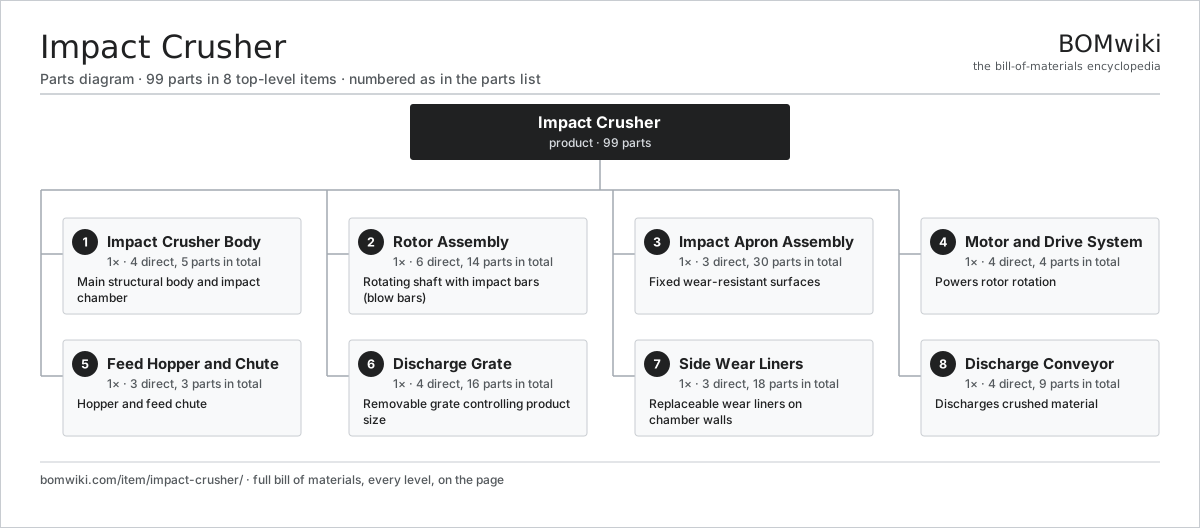
| # | Part | Qty | What it does |
|---|---|---|---|
| 1 | Impact Crusher Body 4 parts | 1× | Main structural body and impact chamber |
| 2 | Rotor Assembly 6 parts | 1× | Rotating shaft with impact bars (blow bars) |
| 3 | Impact Apron Assembly 3 parts | 1× | Fixed wear-resistant surfaces |
| 4 | Motor and Drive System 4 parts | 1× | Powers rotor rotation |
| 5 | Feed Hopper and Chute 3 parts | 1× | Hopper and feed chute |
| 6 | Discharge Grate 4 parts | 1× | Removable grate controlling product size |
| 7 | Side Wear Liners 3 parts | 1× | Replaceable wear liners on chamber walls |
| 8 | Discharge Conveyor 4 parts | 1× | Discharges crushed material |
3D model
No 3D model yet. Have a CAD file of this? Add a 3D model. STL renders right on this page; STEP, FreeCAD, and OpenSCAD sources are welcome too (openly licensed, like all 3D models on BOMwiki).
Build & assembly graph
expand / collapse · shared sub-assemblies converge · links to related products · est. labourTap an assembly to expand/collapse · tap a part to open it · use “Open page” for any node · drag to pan, scroll to zoom.
Bill of materials for Impact Crusher
8 top-level lines · 39 rows shown · 99 parts total · indented to 3 levels| # | Item / sub-assembly | Part no. | Qty/assy | Ext. qty | Parts | Type |
|---|---|---|---|---|---|---|
| 1 | Impact Crusher Body 4 parts | impact-crusher-frame | 1× | 1 | 5 | assembly |
| 1.1 | Top Frame Cover | impact-crusher-frame-top | 1× | 1 | · | part |
| 1.2 | Main Body Casting | impact-crusher-frame-main | 1× | 1 | · | part |
| 1.3 | Discharge Bottom Plate | impact-crusher-frame-bottom | 1× | 1 | · | part |
| 1.4 | Rotor Bearing | impact-crusher-rotor-bearings | 2× | 2 | · | part |
| 2 | Rotor Assembly 6 parts | impact-crusher-rotor | 1× | 1 | 14 | assembly |
| 2.1 | Rotor Main Shaft | impact-crusher-shaft | 1× | 1 | · | part |
| 2.2 | Impact Bar Hub | impact-crusher-hub | 2× | 2 | · | part |
| 2.3 | Impact Bar (Blow Bar) | impact-crusher-impact-bars | 6× | 6 | · | part |
| 2.4 | Rotor Bearing | impact-crusher-rotor-bearings | 2× | 2 | · | part |
| 2.5 | Shaft Oil Seal | impact-crusher-shaft-seal | 2× | 2 | · | part |
| 2.6 | Thrust Roller Bearing | impact-crusher-thrust-bearing | 1× | 1 | · | part |
| 3 | Impact Apron Assembly 3 parts | impact-crusher-impact-aprons | 1× | 1 | 30 | assembly |
| 3.1 | Apron Mounting Bracket | impact-crusher-apron-bracket | 3× | 3 | · | part |
| 3.2 | Impact Apron Liner | impact-crusher-apron-liner | 3× | 3 | · | part |
| 3.3 | Apron Liner Bolt | impact-crusher-apron-bolts | 24× | 24 | · | part |
| 4 | Motor and Drive System 4 parts | impact-crusher-drive-motor | 1× | 1 | 4 | assembly |
| 4.1 | Drive Motor | impact-crusher-motor | 1× | 1 | · | part |
| 4.2 | Drive Pulley | impact-crusher-pulley | 1× | 1 | · | part |
| 4.3 | Drive Belt | impact-crusher-drive-belt | 1× | 1 | · | part |
| 4.4 | Motor Base Mount | impact-crusher-motor-mount | 1× | 1 | · | part |
| 5 | Feed Hopper and Chute 3 parts | impact-crusher-feed-system | 1× | 1 | 3 | assembly |
| 5.1 | Receiver Hopper | impact-crusher-hopper-bin | 1× | 1 | · | part |
| 5.2 | Feed Chute | impact-crusher-feed-chute | 1× | 1 | · | part |
| 5.3 | Chute Deflector | impact-crusher-chute-deflector | 1× | 1 | · | part |
| 6 | Discharge Grate 4 parts | impact-crusher-discharge-grate | 1× | 1 | 16 | assembly |
| 6.1 | Grate Frame | impact-crusher-grate-frame | 1× | 1 | · | part |
| 6.2 | Grate Bar | impact-crusher-grate-bars | 12× | 12 | · | part |
| 6.3 | Grate Hinge Pin | impact-crusher-grate-hinge | 1× | 1 | · | part |
| 6.4 | Grate Quick Latch | impact-crusher-grate-latch | 2× | 2 | · | part |
| 7 | Side Wear Liners 3 parts | impact-crusher-side-liners | 1× | 1 | 18 | assembly |
| 7.1 | Left Side Liner | impact-crusher-liner-left | 1× | 1 | · | part |
| 7.2 | Right Side Liner | impact-crusher-liner-right | 1× | 1 | · | part |
| 7.3 | Side Liner Bolt | impact-crusher-liner-bolts | 16× | 16 | · | part |
| 8 | Discharge Conveyor 4 parts | impact-crusher-conveyor | 1× | 1 | 9 | assembly |
| 8.1 | Conveyor Belt | impact-crusher-conveyor-belt | 1× | 1 | · | part |
| 8.2 | Conveyor Motor | impact-crusher-conveyor-motor | 1× | 1 | · | part |
| 8.3 | Conveyor Frame | impact-crusher-conveyor-frame | 1× | 1 | · | part |
| 8.4 | Conveyor Idler Roller | impact-crusher-conveyor-idlers | 6× | 6 | · | part |
Something wrong in this list? Report a problem with this BOM.
Sourcing: possible vendors
Browse the supplier directory → Prices, MOQ, and lead times are algorithmic estimates, not quotes, and not claims about these companies. Company mappings are curated by keyword; est. price band $15k–$2M. How estimates work| Vendor | HQ | Specialty | MOQ | Lead time |
|---|---|---|---|---|
| caterpillar.com ↗ | Irving, US | Construction & mining equipment | made to order | 16–28 wks |
|
🇯🇵Komatsu
komatsu.com ↗
|
Tokyo, JP | Construction & mining equipment | made to order | 16–28 wks |
|
🇸🇪Volvo CE
volvoce.com ↗
|
Gothenburg, SE | Construction equipment | made to order | 16–28 wks |
|
🇨🇭Liebherr
liebherr.com ↗
|
Bulle, CH | Cranes & heavy equipment | made to order | 16–28 wks |
|
🇨🇳XCMG
xcmg.com ↗
|
Xuzhou, CN | Construction machinery | made to order | 16–28 wks |
1,151-word article