In-Ground Uplight
ProductOverview
In-ground uplights are powerful LED fixtures installed flush into landscape surfaces, typically around architectural monuments, trees, or building facades, to project dramatic upward illumination for accent and visual drama. Unlike bollard lights, which illuminate pathways with downward light, uplights are designed to illuminate vertical surfaces (building facades, tree canopies, statuary) from below, creating depth, texture, and visual interest in nighttime landscapes.
The sealed stainless or cast-iron body is buried with only a flush tempered-glass lens visible at landscape grade. The high-power LED engine (5–20 W) sits beneath the lens, backed by a parabolic reflector that concentrates light into a tight, controllable beam. The ball-joint aiming mechanism allows on-site adjustment of the beam's angle to precisely illuminate the target surface.
Installation and burial
In-ground uplights are installed by cutting a circular hole in the landscape (grass, soil, or gravel) approximately 150–200 mm in diameter and 75–150 mm deep. A stainless or cast-iron burial ring is set in concrete at grade level, serving as a permanent anchor. The fixture's main body is inserted into the ring and locked in place via a retaining collar. Underground landscape cable supplies 12 or 24 VDC power to the fixture's integrated driver, which steps down or regulates the low-voltage input to deliver precise current to the LED array.
Once installed, the flush glass lens sits flush with or slightly recessed below the landscape surface. This design prevents tripping hazards and allows routine landscape maintenance (mowing, raking) without damage or disruption.
Sealed design and weatherproofing
The entire uplight fixture is rated IP67: the enclosure is sealed against sustained water jets, and the lens gasket prevents water from seeping into the optical cavity. This weatherproofing is critical, as uplights are permanently buried in soil that may remain saturated for weeks after heavy rain or snow melt.
The main body casting is stainless steel (316 grade) or ductile iron with protective finish, chosen for corrosion resistance in moist soil conditions. The O-ring seal around the lens uses food-grade silicone or EPDM, materials that maintain elasticity and sealing force across -30 to +60 °C temperature cycles without cracking.
Internal moisture is also managed: the driver cavity is either potted (filled with silicone or polyurethane resin) or sealed with desiccant packets to absorb any ambient humidity that enters during installation. Modern in-ground uplights rarely fail due to water ingress if properly installed.
Optical design and beam control
The LED engine sits behind a parabolic reflector that transforms the LED's omnidirectional light into a tight, upward-directed beam. The reflector's geometry determines the beam angle: a deep parabola produces a narrow 15° beam (ideal for spotlighting distant trees), while a shallow parabola produces a wider 40° beam (better for uniform facade illumination of nearby buildings).
Field designers often stock multiple beam-control reflector modules, allowing quick aiming optimization on-site. Instead of installing a fixture and finding weeks later that the beam angle is wrong, technicians can swap reflector cartridges in minutes, choosing the optimal beam angle for the specific application.
The tempered glass lens serves dual purposes: it protects the optical path from dirt and debris, preserving beam quality over years of outdoor exposure, and it refracts light slightly, softening the beam's edge to prevent visible sharp cutoffs that appear unnatural to the eye.
Adjustable aiming
The ball-joint aiming mechanism allows the fixture to be tilted ±30° from the vertical upward direction, enabling precise targeting of vertical surfaces. Once the target angle is found, a friction collar locks the aiming, preventing drift from thermal expansion, vibration, or vandalism.
Aiming is performed during installation and occasionally fine-tuned seasonally: deciduous tree uplighting may require adjustment as the canopy grows or shrinks. A technician can access the fixture's access plate (which sits just above grade), loosen the friction collar, re-aim the fixture, and re-tighten, all without excavation or power-down.
Thermal management and buried operation
The 5–20 W LED generates 5–20 W of waste heat, all of which must dissipate through the internal aluminum heatsink into the surrounding soil and air. Soil is actually an excellent thermal conductor compared to air, saturated soil conducts ~2 W/(m·K), far better than still air at ~0.025 W/(m·K). This makes in-ground installation paradoxically advantageous for thermal management: the fixture sinks heat efficiently to the cool earth even during hot summer months.
The internal finned structure maximizes contact area with the housing walls, and the entire casting acts as a radiator. Modeled thermal resistance is typically 1–2 K/W from LED junction to ambient soil temperature, allowing the LED junction to remain at 50–60 °C even on hot days when ambient soil temperature is 30 °C.
This passive cooling enables long operational life: the LED is rated 100,000+ hours L70, translating to 20+ years of continuous 12-hour-nightly operation before lumen depreciation becomes visible.
Drive-over capability
Landscape designers sometimes position in-ground uplights in vehicle-access areas: driveway edges, parking lot accents, or service road intersections. For these applications, uplights must survive being driven over, not regularly, but occasionally.
The casting is engineered with walls 10–15 mm thick and internal reinforcement, rated to support >500 kg point loads without crushing. The tempered glass lens is similarly rated for drive-over impact. This design allows the fixture to remain operational even if a vehicle inadvertently drives over it, a significant durability advantage compared to standard landscape lights.
The ground ring is set in concrete at least 6 inches below the fixture lens, preventing direct load transfer to the fixture body during occasional drive-overs. The fixture can shift slightly within the ring without exceeding its structural limits, absorbing impact forces.
Architectural lighting applications
In-ground uplights are a cornerstone of architectural lighting design, used in several signature applications:
Facade uplighting: Warm-white (2700 K) uplights positioned 5–10 feet from a building facade create dramatic shadow patterns, emphasizing wall texture and architectural features. Cooler white (4100 K) produces a crisper, more formal appearance.
Tree canopy highlighting: Positioned at the base of large deciduous or evergreen trees, uplights illuminate the canopy from below, creating a dramatic silhouette or interior glow depending on beam angle and color temperature.
Pathway borders: A row of warm-white uplights along a garden path provides both ambient light and visual guidance, subtly marking the route without the obtrusive appearance of bollard or overhead lighting.
Monument and statuary: Historical or sculptural features are uplighted to become visual focal points in the nightscape, drawing attention and creating sense of arrival or significance.
Step and grade edge definition: Uplighting the edges of terraces, berms, or hardscape levels defines spatial boundaries and aids wayfinding without harsh shadows or visual flattening.
Integration with landscape design
Color temperature selection is critical: warm white (2700 K) uplight creates an inviting, intimate atmosphere suited to residential and hospitality landscapes. Neutral or daylight (4100 K or 5000 K) uplight is colder and more institutional, appropriate for commercial or security lighting. Premium installations use tunable uplights capable of switching color temperature via a secondary control signal, allowing seasonal ambiance adjustments or event-based effects.
Beam angle is dictated by target distance and coverage: a narrow 15° beam concentrates light on a distant tree canopy, while a 40° beam spreads light evenly across a nearby building facade. Large landscapes often use a mix: narrow-beam uplights for distant focal points, wider-beam uplights for near-field accent lighting.
Spacing and density are aesthetic decisions: dense arrays of warm-white uplights create a continuous glowing ambiance, while sparse, strategically placed uplights emphasize specific architectural features. Overly dense uplighting can appear garish or light-polluting; professional designs balance visual drama with restraint.
Maintenance and longevity
In-ground uplights buried in soil rarely require maintenance beyond occasional lens cleaning (removal of dirt, algae, or leaf debris). The sealed, potted driver is completely passive, no electrolytic capacitors to dry out, no thermal cycling stress, enabling 15+ years of continuous operation without service.
LED lumen depreciation is the primary failure mode: after 100,000 hours, the LED will have degraded to 70% of initial output. At typical 12-hour/day operation, this occurs after ~23 years. In practice, ground-level aesthetics may warrant replacement after 10–15 years before lumen depreciation is visually obvious, allowing proactive system refresh cycles.
Individual fixture replacement is straightforward: loosen the retaining collar, lift the old fixture out of the burial ring, and insert a new fixture. The ring remains permanently in place, simplifying future replacements.
Standards and regulatory
- IEC 62471 (photobiological safety; warm and cool white LEDs at typical uplight intensities are safe)
- IEC 60598 (general safety of luminaires)
- NFPA 20 (installation of centrifugal fire pumps; uplights used in fire-pump access areas must meet specific corrosion and impact ratings)
- Dark-sky guidelines: Many municipalities restrict uplighting to minimize light pollution. Proper aiming and beam angle selection, avoiding straight-up waste light, is essential to regulatory compliance.
In-Ground Uplight parts and their functions
7 top-level parts · 21 parts in total · full bill of materials below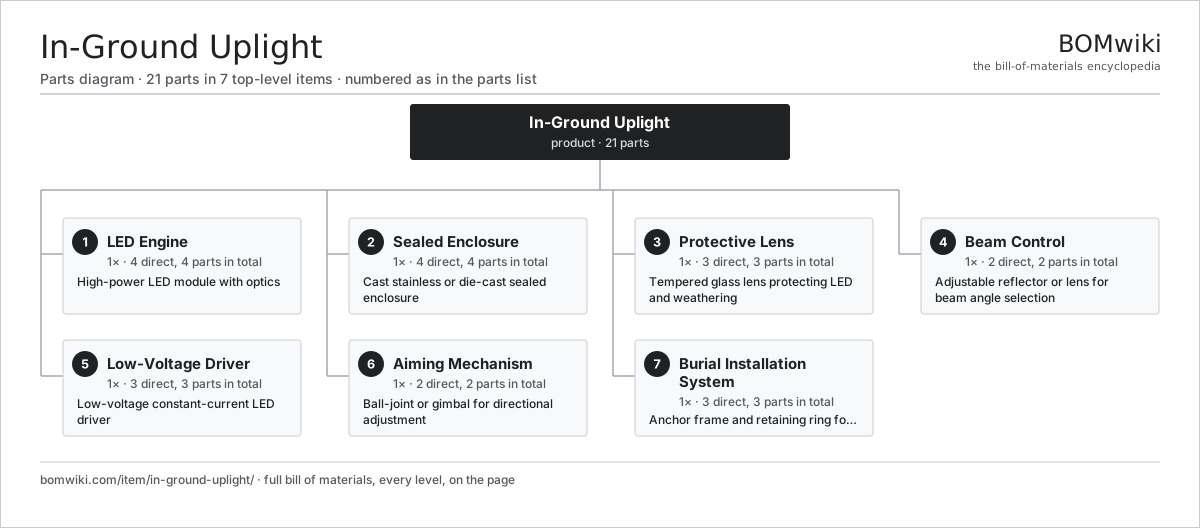
| # | Part | Qty | What it does |
|---|---|---|---|
| 1 | LED Engine 4 parts | 1× | High-power LED module with optics |
| 2 | Sealed Enclosure 4 parts | 1× | Cast stainless or die-cast sealed enclosure |
| 3 | Protective Lens 3 parts | 1× | Tempered glass lens protecting LED and weathering |
| 4 | Beam Control 2 parts | 1× | Adjustable reflector or lens for beam angle selection |
| 5 | Low-Voltage Driver 3 parts | 1× | Low-voltage constant-current LED driver |
| 6 | Aiming Mechanism 2 parts | 1× | Ball-joint or gimbal for directional adjustment |
| 7 | Burial Installation System 3 parts | 1× | Anchor frame and retaining ring for ground installation |
3D model
No 3D model yet. Have a CAD file of this? Add a 3D model. STL renders right on this page; STEP, FreeCAD, and OpenSCAD sources are welcome too (openly licensed, like all 3D models on BOMwiki).
Build & assembly graph
expand / collapse · shared sub-assemblies converge · links to related products · est. labourTap an assembly to expand/collapse · tap a part to open it · use “Open page” for any node · drag to pan, scroll to zoom.
Bill of materials for In-Ground Uplight
7 top-level lines · 28 rows shown · 21 parts total · indented to 3 levels| # | Item / sub-assembly | Part no. | Qty/assy | Ext. qty | Parts | Type |
|---|---|---|---|---|---|---|
| 1 | LED Engine 4 parts | in-ground-uplight-led-engine | 1× | 1 | 4 | assembly |
| 1.1 | LED Chip | in-ground-uplight-led-chip | 1× | 1 | · | part |
| 1.2 | MCPCB | in-ground-uplight-mcpcb | 1× | 1 | · | part |
| 1.3 | Primary Reflector | in-ground-uplight-primary-reflector | 1× | 1 | · | part |
| 1.4 | SMD Passive (R/C/L) | smd-passives | 1× | 1 | · | part |
| 2 | Sealed Enclosure 4 parts | in-ground-uplight-housing | 1× | 1 | 4 | assembly |
| 2.1 | Body Casting | in-ground-uplight-body-casting | 1× | 1 | · | part |
| 2.2 | Internal Heatsink | in-ground-uplight-internal-heatsink | 1× | 1 | · | part |
| 2.3 | O-Ring Set | oring-set | 1× | 1 | · | part |
| 2.4 | Access Plate | in-ground-uplight-top-plate | 1× | 1 | · | part |
| 3 | Protective Lens 3 parts | in-ground-uplight-lens | 1× | 1 | 3 | assembly |
| 3.1 | Glass Lens | in-ground-uplight-glass-lens | 1× | 1 | · | part |
| 3.2 | Lens Gasket | in-ground-uplight-lens-gasket | 1× | 1 | · | part |
| 3.3 | Lens Retainer | in-ground-uplight-lens-retainer | 1× | 1 | · | part |
| 4 | Beam Control 2 parts | in-ground-uplight-beam-control | 1× | 1 | 2 | assembly |
| 4.1 | Reflector Module | in-ground-uplight-reflector-module | 1× | 1 | · | part |
| 4.2 | Reflector Mount | in-ground-uplight-reflector-mount | 1× | 1 | · | part |
| 5 | Low-Voltage Driver 3 parts | in-ground-uplight-driver | 1× | 1 | 3 | assembly |
| 5.1 | Driver IC | in-ground-uplight-driver-ic | 1× | 1 | · | part |
| 5.2 | Driver Housing | in-ground-uplight-driver-housing | 1× | 1 | · | part |
| 5.3 | Surge Protection | in-ground-uplight-surge-protection | 1× | 1 | · | part |
| 6 | Aiming Mechanism 2 parts | in-ground-uplight-aiming-mechanism | 1× | 1 | 2 | assembly |
| 6.1 | Ball Joint | in-ground-uplight-ball-joint | 1× | 1 | · | part |
| 6.2 | Friction Collar | in-ground-uplight-friction-collar | 1× | 1 | · | part |
| 7 | Burial Installation System 3 parts | in-ground-uplight-burial-bracket | 1× | 1 | 3 | assembly |
| 7.1 | Ground Ring | in-ground-uplight-ground-ring | 1× | 1 | · | part |
| 7.2 | Retaining Collar | in-ground-uplight-retaining-collar | 1× | 1 | · | part |
| 7.3 | Fastener Set | fastener-set | 1× | 1 | · | part |
Something wrong in this list? Report a problem with this BOM.
Related products
same domain, ranked by shared parts Aviation Obstruction Light
192 parts · shares 1 with this page
Explosion-Proof Light Fixture
31 parts · shares 1 with this page
Aviation Obstruction Light
192 parts · shares 1 with this page
Explosion-Proof Light Fixture
31 parts · shares 1 with this page
 Heliport Beacon
39 parts · shares 1 with this page
Heliport Beacon
39 parts · shares 1 with this page
 LED Floodlight
134 parts · shares 1 with this page
LED Floodlight
134 parts · shares 1 with this page
 LED High Bay Light
153 parts · shares 1 with this page
LED High Bay Light
153 parts · shares 1 with this page
Sourcing: possible vendors
Browse the supplier directory → Prices, MOQ, and lead times are algorithmic estimates, not quotes, and not claims about these companies. Company mappings are curated by keyword; est. price band $3–$2k. How estimates work| Vendor | HQ | Specialty | MOQ | Lead time |
|---|---|---|---|---|
|
🇳🇱Signify
signify.com ↗
|
Eindhoven, NL | Lighting (Philips Hue) | 2,000 units | 6–10 wks |
| acuitybrands.com ↗ | Atlanta, US | Lighting & controls | 2,000 units | 6–10 wks |
|
🇦🇹Zumtobel
zumtobelgroup.com ↗
|
Dornbirn, AT | Lighting | 2,000 units | 6–10 wks |
| creelighting.com ↗ | Racine, US | LED lighting | 2,000 units | 6–10 wks |
|
🇮🇳Havells
havells.com ↗
|
Noida, IN | Electrical & lighting | 2,000 units | 6–10 wks |
1,673-word article