Inclined Elevator
ProductOverview
An inclined elevator, also called a funicular or incline car, is a rail-guided transportation system for persons or goods traveling along an inclined plane (typically 20–45 degrees) rather than vertically. A passenger cabin is suspended from a wire rope powered by an electric motor and a counterweight balance. The cabin's suspended floor platform auto-levels, keeping occupants horizontal despite the incline.
Inclined elevators are ubiquitous in hilly cities, mountain regions, and waterway sites where terrain or elevation changes make conventional vertical elevators impractical or uneconomical. Famous examples include the San Francisco cable cars, the Mérida cable car in Venezuela (once the world's highest), and the funiculars of Lyon, Switzerland, and Hong Kong. Modern inclined elevators serving waterways are common in shipping locks and canal systems, where vessels pass between elevation levels.
A typical system transports 8–20 passengers per cabin at speeds of 0.3–0.8 m/s, completing a full trip (loading, travel, unloading) in 1–5 minutes depending on distance. Energy efficiency is exceptional: the counterweight (typically 50–70% of the cabin and passenger load) descends as the cabin ascends, mechanically offsetting the load and reducing motor work to nearly zero under balanced conditions. A loaded ascending cabin and an empty descending cabin represent the only net energy consumption.
How it Works
Passengers queue at the lower station, enter the cabin, and sit or stand. An operator (or automatic sensor in modern systems) confirms the door is closed and presses the ascending button. The motor starts, and the drive pulley begins rotating, gripping the steel rope through friction.
As the pulley rotates, it pulls the rope. The rope is anchored at both ends: one end is tied to the ascending cabin carriage, and the other end is tied to the descending counterweight. The rope runs through fixed guide pulleys at the top and bottom of the incline. As the rope shortens on the cabin side, it lengthens on the counterweight side; the cabin rises while the counterweight descends in perfect synchronization.
The leveling platform inside the cabin is mechanically suspended on a pendulum or pivoted frame. As the cabin tilts upward along the incline (at 20–45 degrees), the floor platform's angle adjusts automatically, remaining approximately horizontal relative to gravity. Passengers experience smooth, level motion despite traveling on an incline.
The guide wheels mounted on the cabin carriage run along the inclined rail track, keeping the cabin centered and preventing lateral swinging. Rail friction and air resistance add minimal load; the counterweight provides the majority of mechanical balance.
As the cabin reaches the upper station, a mechanical limit switch (triggered by a cam on the cabin or rope) signals the motor to stop. The parking brake engages, holding the cabin stationary. Passengers exit, and the cabin is now ready to descend.
For descent, the process reverses: passengers (or cargo) board at the upper station, the door closes, and the descent button is pressed. The motor energizes in reverse (or the brake releases if the system is gravity-driven; most modern systems use motor control for smooth braking). The pulley rotates in the opposite direction, allowing the rope to slip through the grooves as the counterweight (now ascending) and the cabin (now descending) exchange roles.
The motor's gear reducer maintains constant speed during descent via electrical braking (the motor acts as a generator, converting kinetic energy into electrical resistance). This prevents uncontrolled free-fall and ensures smooth, constant-speed descent regardless of load.
Rope and Counterweight Design
The key to inclined elevator efficiency is the counterweight balance. For a cabin plus passengers totaling 5000 kg ascending a 30-degree incline, the weight component along the incline is 5000 × sin(30°) = 2500 kg. If the counterweight is sized at 2500 kg (50% of total cabin mass), the net load on the motor is zero during balanced operation (cabin ascending with passengers, counterweight descending empty).
In practice, counterweights are sized at 50–70% of the maximum cabin load. A 50% counterweight provides perfect balance when the cabin is half-full on ascent and half-empty on descent; a 70% counterweight favors energy recovery during loaded descent (when gravity assists). The wire rope is typically 12–16 mm diameter, 6×19 or 8×19 construction, rated for 5000–8000 kg safe working load, providing at least 2:1 safety factor over the maximum loaded cabin.
The rope passes over the drive pulley (the power transmission point) and over fixed guide pulleys at the top and bottom of the incline. These guide pulleys change the rope direction, allowing the cabin and counterweight to travel along separate but parallel paths.
Safety and Reliability
Inclined elevators incorporate multiple independent safety systems:
Mechanical Overspeed Governor: A centrifugal governor on the drive shaft detects excessive speed. If speed exceeds a preset threshold (e.g., 1.5× normal speed), the governor triggers a mechanical brake (the parking brake), stopping the cabin immediately.
Load-Holding Brake: The spring-applied parking brake, holding 2–3× the maximum load, keeps the cabin suspended indefinitely during power loss.
Limit Switches: Mechanical limit switches at both terminals stop the motor at the correct positions, preventing over-travel.
Emergency Brake Rope: A manual brake rope runs alongside the incline track. Any passenger can pull the rope, triggering an immediate emergency stop. The rope actuates the brake via a mechanical linkage.
Door Interlocks: The cabin door has a mechanical interlock; if the door opens during motion, a cam or lever cuts power to the motor and applies the brake.
Buffer Springs: Compression springs and hydraulic buffers at the upper and lower terminals cushion arrival, limiting deceleration to safe levels (typically 1–2 g).
Environmental Performance
Inclined elevators are exceptionally energy-efficient. A loaded cabin ascending and an empty cabin descending consume approximately 10–20 kWh per hour of continuous operation, assuming the counterweight is sized optimally. This is 30–50% lower than vertical car elevators of similar capacity.
For gravity-assisted descent (a loaded cabin descending and an empty counterweight ascending), some systems can actually generate electrical power. The motor operates as a generator, converting gravitational potential energy into electrical current that flows back to the grid or charges onboard batteries. This regenerative braking can recover 20–40% of the energy used for ascent, making inclined elevators the most efficient vertical transportation systems available.
Maintenance is minimal: rail inspection and lubrication every 6–12 months, rope inspection annually (visual for corrosion, calipers for wear), and brake service every 2–3 years. Most installations operate for 30–50 years without major overhaul.
Comparison with Vertical Elevators
Vertical car elevators and goods lifts use counterweights like inclined elevators but operate over purely vertical distances. Vertical systems typically require more robust guide rails and smoother rope systems to maintain level cabins. Inclined elevators accept that the cabin tilts along the incline and use only a simple suspension pivot for auto-leveling. This makes inclined elevators mechanically simpler and more durable.
For comparison, inclined elevators are common on waterways with ship locks, where a ship lift would be too expensive. Instead, inclines with small vessels or barges provide alternative routing with lower operating cost.
Inclined Elevator parts and their functions
8 top-level parts · 421 parts in total · full bill of materials below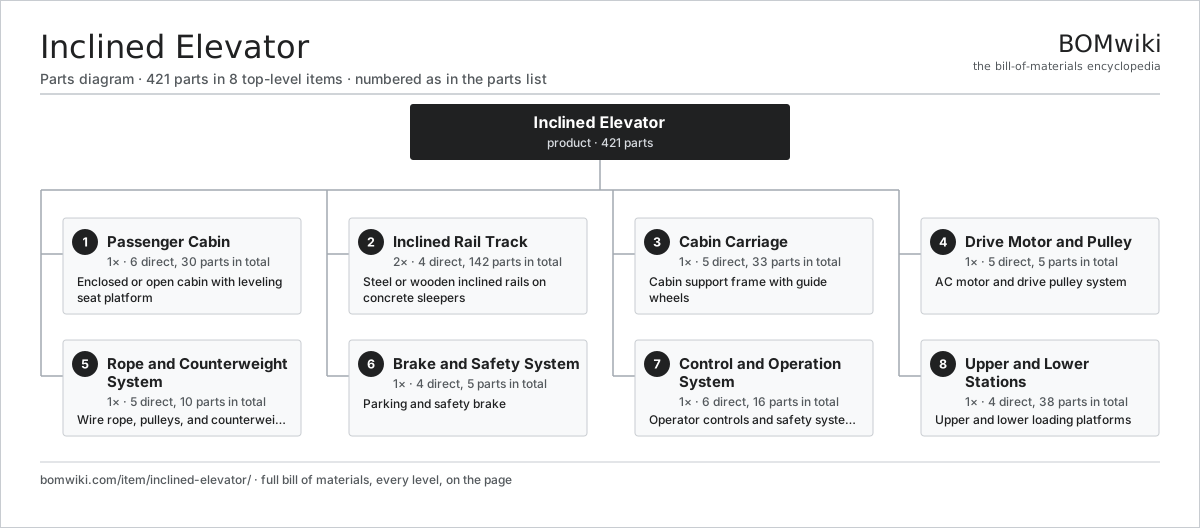
| # | Part | Qty | What it does |
|---|---|---|---|
| 1 | Passenger Cabin 6 parts | 1× | Enclosed or open cabin with leveling seat platform |
| 2 | Inclined Rail Track 4 parts | 2× | Steel or wooden inclined rails on concrete sleepers |
| 3 | Cabin Carriage 5 parts | 1× | Cabin support frame with guide wheels |
| 4 | Drive Motor and Pulley 5 parts | 1× | AC motor and drive pulley system |
| 5 | Rope and Counterweight System 5 parts | 1× | Wire rope, pulleys, and counterweight balance |
| 6 | Brake and Safety System 4 parts | 1× | Parking and safety brake |
| 7 | Control and Operation System 6 parts | 1× | Operator controls and safety systems |
| 8 | Upper and Lower Stations 4 parts | 1× | Upper and lower loading platforms |
3D model
No 3D model yet. Have a CAD file of this? Add a 3D model. STL renders right on this page; STEP, FreeCAD, and OpenSCAD sources are welcome too (openly licensed, like all 3D models on BOMwiki).
Build & assembly graph
expand / collapse · shared sub-assemblies converge · links to related products · est. labourTap an assembly to expand/collapse · tap a part to open it · use “Open page” for any node · drag to pan, scroll to zoom.
Bill of materials for Inclined Elevator
8 top-level lines · 47 rows shown · 421 parts total · indented to 3 levels| # | Item / sub-assembly | Part no. | Qty/assy | Ext. qty | Parts | Type |
|---|---|---|---|---|---|---|
| 1 | Passenger Cabin 6 parts | inclined-elevator-cabin | 1× | 1 | 30 | assembly |
| 1.1 | Cabin Frame | inclined-elevator-cabin-body | 1× | 1 | · | part |
| 1.2 | Leveling Platform | inclined-elevator-cabin-floor | 1× | 1 | · | part |
| 1.3 | Cabin Door | inclined-elevator-cabin-door | 1× | 1 | · | part |
| 1.4 | Seating | inclined-elevator-seat-assembly | 1× | 1 | · | part |
| 1.5 | Cable Attachment | inclined-elevator-cable-rope-lug | 2× | 2 | · | part |
| 1.6 | Fastener Set | fastener-set | 24× | 24 | · | part |
| 2 | Inclined Rail Track 4 parts | inclined-elevator-rail-track | 2× | 2 | 142 | assembly |
| 2.1 | Inclined Rail | inclined-elevator-rail-section | 2× | 4 | · | part |
| 2.2 | Concrete Sleeper | inclined-elevator-rail-sleeper | 20× | 40 | · | part |
| 2.3 | Rail Fish-Plate | inclined-elevator-rail-fastener | 40× | 80 | · | part |
| 2.4 | Fastener Set | fastener-set | 80× | 160 | · | part |
| 3 | Cabin Carriage 5 parts | inclined-elevator-carriage-frame | 1× | 1 | 33 | assembly |
| 3.1 | Carriage Frame | inclined-elevator-carriage-body | 1× | 1 | · | part |
| 3.2 | Guide Wheel | inclined-elevator-guide-wheel | 4× | 4 | · | part |
| 3.3 | Wheel Mounting Bracket | inclined-elevator-wheel-bracket | 4× | 4 | · | part |
| 3.4 | Ball Bearing | ball-bearing | 8× | 8 | · | part |
| 3.5 | Fastener Set | fastener-set | 16× | 16 | · | part |
| 4 | Drive Motor and Pulley 5 parts | inclined-elevator-drive-motor | 1× | 1 | 5 | assembly |
| 4.1 | AC Motor | inclined-elevator-electric-motor | 1× | 1 | · | part |
| 4.2 | Drive Pulley | inclined-elevator-pulley-drive | 1× | 1 | · | part |
| 4.3 | Gear Reducer | inclined-elevator-gearbox | 1× | 1 | · | part |
| 4.4 | Flexible Coupling | inclined-elevator-coupling | 1× | 1 | · | part |
| 4.5 | Motor Brake | inclined-elevator-motor-brake | 1× | 1 | · | part |
| 5 | Rope and Counterweight System 5 parts | inclined-elevator-rope-system | 1× | 1 | 10 | assembly |
| 5.1 | Main Wire Rope | inclined-elevator-main-rope | 2× | 2 | · | part |
| 5.2 | Guide Pulley | inclined-elevator-pulley-guide | 2× | 2 | · | part |
| 5.3 | Counterweight | inclined-elevator-counterweight-mass | 1× | 1 | · | part |
| 5.4 | Counterweight Frame | inclined-elevator-counterweight-frame | 1× | 1 | · | part |
| 5.5 | Cable Terminator | inclined-elevator-rope-terminator | 4× | 4 | · | part |
| 6 | Brake and Safety System 4 parts | inclined-elevator-brake-system | 1× | 1 | 5 | assembly |
| 6.1 | Parking Brake | inclined-elevator-spring-brake | 1× | 1 | · | part |
| 6.2 | Overspeed Governor | inclined-elevator-governor | 1× | 1 | · | part |
| 6.3 | Emergency Brake Rope | inclined-elevator-emergency-brake-rope | 1× | 1 | · | part |
| 6.4 | Buffer Spring | inclined-elevator-buffer-spring | 2× | 2 | · | part |
| 7 | Control and Operation System 6 parts | inclined-elevator-control-cabin | 1× | 1 | 16 | assembly |
| 7.1 | Control Panel | inclined-elevator-control-panel | 1× | 1 | · | part |
| 7.2 | Upper Limit Switch | inclined-elevator-limit-switch-top | 1× | 1 | · | part |
| 7.3 | Lower Limit Switch | inclined-elevator-limit-switch-bottom | 1× | 1 | · | part |
| 7.4 | Door Interlock | inclined-elevator-interlock-door | 1× | 1 | · | part |
| 7.5 | Relay | relay | 4× | 4 | · | part |
| 7.6 | Connector | connector | 8× | 8 | · | part |
| 8 | Upper and Lower Stations 4 parts | inclined-elevator-stations | 1× | 1 | 38 | assembly |
| 8.1 | Station Platform | inclined-elevator-station-platform | 2× | 2 | · | part |
| 8.2 | Station Gate | inclined-elevator-station-gate | 2× | 2 | · | part |
| 8.3 | Station Handrail | inclined-elevator-handrail | 2× | 2 | · | part |
| 8.4 | Fastener Set | fastener-set | 32× | 32 | · | part |
Something wrong in this list? Report a problem with this BOM.
Sourcing: possible vendors
Browse the supplier directory → Prices, MOQ, and lead times are algorithmic estimates, not quotes, and not claims about these companies. Company mappings are curated by keyword; est. price band $10k–$200k. How estimates work| Vendor | HQ | Specialty | MOQ | Lead time |
|---|---|---|---|---|
|
🇺🇸Otis
otis.com ↗
|
Farmington, US | Elevators & escalators | 20 units | 14–24 wks |
| schindler.com ↗ | Ebikon, CH | Elevators & escalators | 20 units | 14–24 wks |
|
🇫🇮KONE
kone.com ↗
|
Espoo, FI | Elevators & escalators | 20 units | 14–24 wks |
| tkelevator.com ↗ | Düsseldorf, DE | Elevators | 20 units | 14–24 wks |
| mitsubishielectric.com ↗ | Tokyo, JP | Elevators & electronics | 20 units | 14–24 wks |
1,337-word article