Industrial Strobe Beacon
ProductOverview
Industrial strobe beacons are high-intensity warning lights used in airports, seaports, emergency vehicles, broadcast transmission towers, and critical-infrastructure security systems. Unlike continuous LED or incandescent warning lights, strobes produce brief, intense flashes (1–10 Hz repetition rate) that command attention through rapid light-dark cycles, stimulating the human visual system far more effectively than steady light for capturing and holding attention.
The strobe lamp module contains either a xenon discharge tube or high-power LED array capable of producing peak intensities of 5,000–50,000 candelas per flash. The flasher circuit controls the timing, allowing field programmable flash rates from 1 Hz (slow warning) to 10 Hz (urgent alert). A regulated 24 VDC supply powers the entire assembly, making the beacon compatible with standard industrial control systems and uninterruptible power supply (UPS) architecture.
Xenon vs. LED strobes
Xenon strobes (traditional design):
- Higher peak intensity per watt (200–300 lumens per strobe at 50 mA discharge)
- Shorter flash duration (0.5–1 ms), creating sharper temporal contrast
- Xenon lamp replacement every 10,000–20,000 flashes (~1–3 years of continuous operation)
- Cost-effective for long-range visible applications (500+ meter standoff)
LED strobes (modern design):
- Lower peak intensity per unit power but superior reliability
- Longer operational life (50,000+ hours before noticeable dimming)
- No consumable lamp replacement; only the driver electronics age
- Cooler operation (less thermal stress on optics), reducing maintenance
High-reliability critical applications (airports, offshore platforms) increasingly use LED strobes to minimize maintenance burden, while legacy installations and cost-sensitive applications continue using xenon for superior luminous efficiency.
Xenon lamp operation
The xenon discharge tube is a gas-filled bulb with two main electrodes (cathode and anode) and a trigger electrode. Under normal conditions, xenon gas is non-conductive. When the flasher circuit needs to produce a strobe, the high-voltage supply generates a 5–10 kV negative pulse on the trigger electrode. This ionizes the xenon gas, creating a conductive plasma bridge between cathode and anode. Current flows for 1–2 milliseconds, producing a brilliant flash of bluish-white light as electrons excite xenon atoms.
The peak current during the discharge is typically 15–50 mA, drawing 50–200 joules of energy per flash from the filter capacitor bank. After the flash, the plasma cools and deionizes, returning the tube to its non-conductive state. The voltage regulator then recharges the capacitor bank over 100–200 ms, preparing for the next triggered flash.
The xenon tube's protective sleeve is quartz or borosilicate glass, thermally rated to handle the brief but intense heat from each flash. Over thousands of flashes, the electrodes slowly erode due to ion bombardment, gradually increasing the trigger voltage required to ionize the gas. After 10,000–20,000 flashes, the trigger voltage exceeds the supply capability, and the lamp fails. Users must replace the entire tube cartridge via the screw or bayonet socket.
Reflector and beam pattern
The polished aluminum or chrome reflector behind the xenon tube or LED concentrates the strobe's omnidirectional light output into a directed beam. Reflector geometry determines the beam pattern:
- Narrow beam (15°–30°): Deep parabolic reflector concentrating light into a tight spotlight, suitable for long-range visibility (500+ meters) or tower-top obstruction lights.
- Medium beam (40°–60°): Reflector producing a half-angle beam suitable for general warning at 100–300 meter ranges.
- Flood beam (90°+): Shallow reflector or diffuse lens spreading light across wide angles for close-range awareness.
Field customization is straightforward: swap the Reflector Bowl for an alternative geometry matching the target application, without removing the entire housing.
Flash synchronization and network integration
Large installations (airport runways, offshore platforms) require multiple strobes to flash in synchronized patterns, creating distinctive beacon signatures recognizable to operators. The control interface accepts either:
- Opto-isolated sync input: A 24 VDC digital pulse train triggers the strobe at the falling edge, allowing multiple beacons to respond to a single master timing signal.
- RS-485 network: Beacons listen to a command bus, allowing programmable flash patterns (e.g., "1 flash every 2 seconds," "double-flash," "morse code pattern").
- Manual control: A potentiometer or switch selects preset flash rates (1 Hz, 2 Hz, 5 Hz, 10 Hz).
Network-integrated beacons are especially valuable in dynamic situations: an air-traffic control tower can command all beacons on the airfield to switch between slow (2 Hz) daytime flash and fast (10 Hz) nighttime flash without physical intervention.
Thermal and electrical design
Xenon strobes generate significant transient current during each flash, and the bulk capacitor bank must supply this energy on-demand without sagging the 24 V rail. A 2200 µF capacitor charges from 0 to 24 V and then discharges 100–200 joules in 1–2 milliseconds, producing a di/dt (current slew rate) of 100+ A per millisecond.
The power supply must be sized adequately: a 24 VDC, 5 A supply (120 W) is typical for medium-power xenon strobes, ensuring that each flash triggers cleanly and the supply recharges the capacitor bank within the 100–200 ms interval before the next flash. Undersized supplies will cause the strobe to miss triggers or produce weak flashes.
The finned heatsink inside the housing dissipates waste heat from the flasher circuit. Xenon strobes are only 30–40% efficient (60–70% of input energy is lost as heat), so a 100 W strobe produces 60–70 W of continuous waste heat even though each individual flash lasts only 1 ms. This heat must escape passively through the housing walls or actively via an external heatsink.
Environmental and safety considerations
Xenon strobes emit brief, intense UV radiation during each flash, as excited xenon atoms emit both visible and UV photons. The polycarbonate or borosilicate dome blocks direct UV exposure, protecting users and degrading surrounding materials. However, UV leakage around the dome can still occur, and prolonged exposure near operating xenon strobes requires UV-rated eye protection.
LED strobes, emitting only visible light via phosphor conversion, pose no UV hazard and are inherently safer for proximity installations.
Photosensitivity and epilepsy: High-frequency strobes (>8 Hz) can trigger seizures in individuals with photosensitive epilepsy. Critical-infrastructure strobes are typically limited to 5 Hz or slower, with warnings posted in areas with continuous visible strobing.
Glare and vision disruption: Xenon strobe peak intensity (10,000–50,000 cd) can cause temporary blindness when viewed directly, especially at close range (< 10 meters). Mounting beacons outside direct eye-level ensures that incidental exposure (e.g., peripheral vision while driving) does not impair safety.
Applications and deployment patterns
Airport obstruction lighting: FAA regulations require aircraft-warning strobes on tall structures (towers, buildings >200 feet) visible for 10+ nautical miles. Xenon strobes flashing white or red at 40–60 flashes per minute are standard. Many airports are upgrading to LED strobes (10,000+ hour lifespan) to reduce maintenance costs.
Emergency vehicles: Police, fire, and ambulance vehicles use strobes in the 5–10 Hz range to alert other traffic. Vehicle strobes are often frequency-locked via magnetic or optical coupling, ensuring simultaneous flashing and maximum attention-capture.
Broadcast transmission towers: TV and radio towers require red obstruction strobes visible for 10+ km on overcast days. Multi-lamp installations (4–6 strobes per tower) create redundancy: if one lamp fails, the beacon remains operational.
Offshore platforms: Oil and gas platforms use strobes for air and sea navigation. Unique flash patterns (e.g., "iso-strobe" = single strobe every 10 seconds) identify individual platforms; the distinctive timing is learnable and recognizable to aircraft and vessel operators.
Security and perimeter: Strobes mounted on security fences or gate structures deter unauthorized entry by creating an obvious, attention-commanding presence at sensitive perimeters.
Regulatory standards
- FAA L-856 (airport lighting): Specifies strobe intensity, color (white/red), and flash rates for obstruction lighting.
- IALA-G1064 (aids to navigation): Maritime strobe standards, defining flash patterns for lighthouses and buoys.
- IEC 60598-2-23 (strobing lamps): General safety and photobiological safety for strobe luminaires.
- ANSI C57.109 (electrical safety of strobe power supplies).
Certification is typically vendor-specific: a Xenon strobe designed for FAA airports carries an FAA TSO (Technical Standard Order), while marine strobes require U.S. Coast Guard approval (USCG).
Maintenance and field service
Xenon strobes require lamp replacement every 1–3 years in continuous-duty installations (nighttime operation year-round). Technicians simply unscrew the lamp cartridge from the socket and install a new one, a 5-minute field operation. The rest of the beacon (flasher circuit, reflector, dome) is permanent and requires no service.
LED strobes, by contrast, have no consumable lamp: the only failure mode is the electronic driver, which may have a 10+ year lifespan. When the driver fails (rare), the entire beacon is typically replaced rather than repaired, as driver-level repair is not cost-effective.
Preventive maintenance includes:
- Annual inspection: Ensuring dome is clean and undamaged, checking that mounting bolts are tight, verifying that sync signals are being received correctly.
- Testing: Confirming strobe flashes at the correct rate and that backup power (UPS) can sustain the beacon during mains power loss.
- Thermal check: IR thermography to verify that the housing is not overheating (indicating internal arcing or excessive power draw).
Industrial Strobe Beacon parts and their functions
7 top-level parts · 28 parts in total · full bill of materials below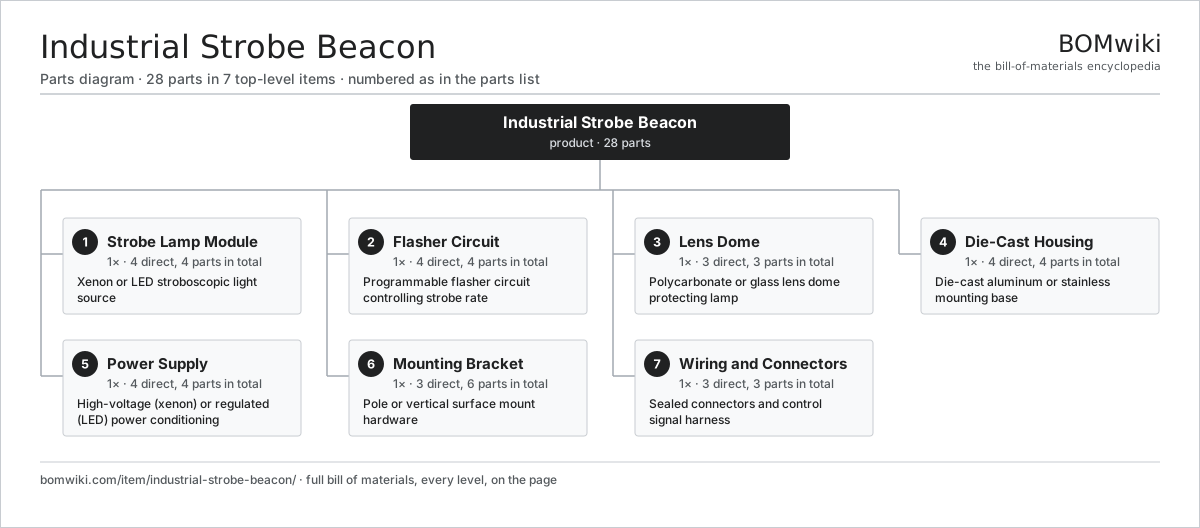
| # | Part | Qty | What it does |
|---|---|---|---|
| 1 | Strobe Lamp Module 4 parts | 1× | Xenon or LED stroboscopic light source |
| 2 | Flasher Circuit 4 parts | 1× | Programmable flasher circuit controlling strobe rate |
| 3 | Lens Dome 3 parts | 1× | Polycarbonate or glass lens dome protecting lamp |
| 4 | Die-Cast Housing 4 parts | 1× | Die-cast aluminum or stainless mounting base |
| 5 | Power Supply 4 parts | 1× | High-voltage (xenon) or regulated (LED) power conditioning |
| 6 | Mounting Bracket 3 parts | 1× | Pole or vertical surface mount hardware |
| 7 | Wiring and Connectors 3 parts | 1× | Sealed connectors and control signal harness |
3D model
No 3D model yet. Have a CAD file of this? Add a 3D model. STL renders right on this page; STEP, FreeCAD, and OpenSCAD sources are welcome too (openly licensed, like all 3D models on BOMwiki).
Build & assembly graph
expand / collapse · shared sub-assemblies converge · links to related products · est. labourTap an assembly to expand/collapse · tap a part to open it · use “Open page” for any node · drag to pan, scroll to zoom.
Bill of materials for Industrial Strobe Beacon
7 top-level lines · 32 rows shown · 28 parts total · indented to 3 levels| # | Item / sub-assembly | Part no. | Qty/assy | Ext. qty | Parts | Type |
|---|---|---|---|---|---|---|
| 1 | Strobe Lamp Module 4 parts | industrial-strobe-beacon-lamp-module | 1× | 1 | 4 | assembly |
| 1.1 | Xenon Flash Tube | industrial-strobe-beacon-xenon-tube | 1× | 1 | · | part |
| 1.2 | Lamp Base | industrial-strobe-beacon-lamp-base | 1× | 1 | · | part |
| 1.3 | Reflector Bowl | industrial-strobe-beacon-reflector-bowl | 1× | 1 | · | part |
| 1.4 | Protective Sleeve | industrial-strobe-beacon-lamp-protective-sleeve | 1× | 1 | · | part |
| 2 | Flasher Circuit 4 parts | industrial-strobe-beacon-flasher-circuit | 1× | 1 | 4 | assembly |
| 2.1 | Flasher MCU | industrial-strobe-beacon-flasher-mcu | 1× | 1 | · | part |
| 2.2 | High-Voltage Supply | industrial-strobe-beacon-high-voltage-supply | 1× | 1 | · | part |
| 2.3 | Trigger Transformer | industrial-strobe-beacon-trigger-transformer | 1× | 1 | · | part |
| 2.4 | Control Interface | industrial-strobe-beacon-control-interface | 1× | 1 | · | part |
| 3 | Lens Dome 3 parts | industrial-strobe-beacon-lens-dome | 1× | 1 | 3 | assembly |
| 3.1 | Dome Material | industrial-strobe-beacon-dome-material | 1× | 1 | · | part |
| 3.2 | Dome Gasket | industrial-strobe-beacon-dome-gasket | 1× | 1 | · | part |
| 3.3 | Retainer Ring | industrial-strobe-beacon-dome-retainer-ring | 1× | 1 | · | part |
| 4 | Die-Cast Housing 4 parts | industrial-strobe-beacon-housing | 1× | 1 | 4 | assembly |
| 4.1 | Base Casting | industrial-strobe-beacon-base-casting | 1× | 1 | · | part |
| 4.2 | Internal Bracket | industrial-strobe-beacon-internal-bracket | 1× | 1 | · | part |
| 4.3 | Finned Heatsink | industrial-strobe-beacon-finned-heatsink | 1× | 1 | · | part |
| 4.4 | Fastener Set | fastener-set | 1× | 1 | · | part |
| 5 | Power Supply 4 parts | industrial-strobe-beacon-power-supply | 1× | 1 | 4 | assembly |
| 5.1 | Input Transformer | industrial-strobe-beacon-input-transformer | 1× | 1 | · | part |
| 5.2 | Rectifier Filter | industrial-strobe-beacon-rectifier-filter | 1× | 1 | · | part |
| 5.3 | Voltage Regulator | industrial-strobe-beacon-voltage-regulator | 1× | 1 | · | part |
| 5.4 | Fuse Module | industrial-strobe-beacon-fuse-module | 1× | 1 | · | part |
| 6 | Mounting Bracket 3 parts | industrial-strobe-beacon-mounting-bracket | 1× | 1 | 6 | assembly |
| 6.1 | Pole Adapter | industrial-strobe-beacon-pole-adapter | 1× | 1 | · | part |
| 6.2 | Swivel Joint | industrial-strobe-beacon-swivel-joint | 1× | 1 | · | part |
| 6.3 | Mounting Screws | industrial-strobe-beacon-mounting-screws | 4× | 4 | · | part |
| 7 | Wiring and Connectors 3 parts | industrial-strobe-beacon-wiring | 1× | 1 | 3 | assembly |
| 7.1 | Power Connector | industrial-strobe-beacon-power-connector | 1× | 1 | · | part |
| 7.2 | Control Connector | industrial-strobe-beacon-control-connector | 1× | 1 | · | part |
| 7.3 | Strain Relief Boot | industrial-strobe-beacon-strain-relief-boot | 1× | 1 | · | part |
Something wrong in this list? Report a problem with this BOM.
Sourcing: possible vendors
Browse the supplier directory → Prices, MOQ, and lead times are algorithmic estimates, not quotes, and not claims about these companies. Company mappings are curated by keyword; est. price band $3–$2k. How estimates work| Vendor | HQ | Specialty | MOQ | Lead time |
|---|---|---|---|---|
|
🇳🇱Signify
signify.com ↗
|
Eindhoven, NL | Lighting (Philips Hue) | 2,000 units | 6–10 wks |
| acuitybrands.com ↗ | Atlanta, US | Lighting & controls | 2,000 units | 6–10 wks |
|
🇦🇹Zumtobel
zumtobelgroup.com ↗
|
Dornbirn, AT | Lighting | 2,000 units | 6–10 wks |
| creelighting.com ↗ | Racine, US | LED lighting | 2,000 units | 6–10 wks |
|
🇮🇳Havells
havells.com ↗
|
Noida, IN | Electrical & lighting | 2,000 units | 6–10 wks |
1,615-word article