Industrial Workbench
ProductOverview
An industrial workbench is a stationary assembly and repair table optimized for precision work with hand and power tools. The Frame Assembly is welded structural steel, I-beams for the front and back rails and C-channels for the sides, providing a rigid, non-flexing platform. The Work Surface Assembly is typically a 4–6 inch thick solid-core butcher block (hard maple, absorbs impact), a 1/2" welded steel plate (maximum rigidity, good for magnetic vise holding), or laminated hardwood with steel edge cap (good compromise). Two drawer stacks, one on each side, provide organized storage for fasteners, small tools, and materials. A riser cabinet rises at the rear, offering a back panel for pegboard-style tool hanging and upper shelves for frequently-accessed parts. An integrated power distribution unit feeds 120 V AC to multiple receptacles for corded tools and lighting. A quick-change vise bracket at one end completes the setup.
Industrial benches are found in tool crib rooms, assembly plants, automotive repair shops, electronics labs, and maker spaces, anywhere precision hand assembly or troubleshooting happens. The design maximizes surface area, tool accessibility, and ergonomics for standing work lasting several hours.
Structural frame and load
The Frame Assembly is the foundation. Front and back main rails (typically W6×15 I-beams or UPN 80 channels) span the full bench length and are welded to vertical corner posts (80 × 80 mm square tube). End side rails (150 × 75 mm C-channels) join the main rails at each end. Four diagonal braces, running from top-front to bottom-rear on each side, resist sway and torsion, critical because workbenches are often bumped or have eccentric loads (a technician pressing hard with a screwdriver on one corner).
The rated distributed load is typically 500–1000 kg, meaning the bench can safely support that mass spread across the entire 1.5–2.4 m length. Local point loads (e.g., a 50 kg vise clamped at one end) are handled separately, the vise-mount plate distributes the vise load directly to the main frame, bypassing the work surface. For structural verification, a typical 2.0 m × 0.75 m industrial bench with I-beam rails will not deflect more than 3 mm under a 500 kg distributed load, ensuring dimensional accuracy for precision assembly.
Work surface options
Three common work surface materials serve different needs:
Butcher block (solid wood, 4–6 inches thick): Impact-absorbing, quiet, and forgiving on hand tools. A dropped wrench on wood doesn't bounce like it does on steel. Wood is also warm to the touch, reducing hand fatigue in cold shops. Downside: must be sealed periodically to prevent water absorption, and is not suitable for sharp chemical spills. Cost is moderate (~$1000–$1500 for a 2 m × 0.75 m slab).
Steel plate (1/2" hot-rolled or cold-rolled, 10–15 mm thick): Rigid, won't dent or gouge, and allows magnetic hold-down devices (magnetic clamps, jigs). Excellent for precision metrology work where deflection must be <1 mm. Downside: steel is loud (metal on metal), cold to the touch, and reflects work light. Requires degreasing and rust-inhibitor spray. Cost is moderate (~$1200–$1800).
Laminate or plywood with steel edge: A compromise: a plywood core with laminate or veneer facing, bonded to a plywood or thin-steel sub-frame. Less expensive and lighter than solid butcher block, but not as durable. Used when budget is tight or when the bench is temporary or mobile.
The edge cap, typically a steel angle or hardwood edge, protects the top from chipping when items are set down or tools are knocked against the edge during use.
Drawer organization
The drawer stacks bolt to mounting ledges welded onto the frame sides. Each unit typically has 5–7 drawers, each rated for 50 kg (full-extension ball-bearing slides are critical, a sticky drawer is a safety hazard). Drawers are typically 500 mm wide (matching the workbench width), 150 mm tall, and 400 mm deep, with a 3 mm steel base to avoid deflection when loaded with heavy tools.
Technicians organize by category: fasteners (bolts, nuts, washers), cutting tools (drill bits, end mills, taps), gauges (calipers, micrometers), and consumables (solvents, rags). A hand-written or laminated label strip on each drawer front prevents searching.
Upper riser cabinet
The Riser Cabinet Assembly mounts on the back edge, rising 0.8–1.2 m above the work surface. It typically has three or four adjustable shelves, rated 100 kg each, and a back panel of welded steel sheet or pegboard. The pegboard variant allows hanging of frequently-used tools, screwdrivers, hammers, wrenches, on double-hook pegboard pegs, keeping them visible and within arm's reach. A rear leg bolted to the main frame's back corner supports the riser weight (typically 100–200 kg loaded).
The riser's back panel also contains a power distribution box, mounted at roughly 1.2 m height, with four duplex receptacles for plugging in corded tools. An optional overhead clip light or suspended fixture, 500–1000 W, provides shadow-free illumination of the work surface.
Electrical and power
The Power Distribution Unit is fed by a 12 AWG three-conductor cord (2–4 m long) plugged into a 120 V wall outlet. A 15 A inline breaker in the power box protects against simultaneous overload (e.g., a 15 A rotary grinder and a 10 A impact driver running together would exceed 15 A and trip the breaker, preventing a fire). The receptacles are standard NEMA 5-15, ungrounded or grounded (three-prong), depending on building code and the tools available in the shop.
Higher-end benches add 208 V three-phase access, supporting heavier machinery (a bench-top milling machine or press), but single-phase 120 V is typical for hand-tool workshops.
Vise mounting and quick-change
The Vise Mount Bracket is either a direct-bolt mounting plate (simple, permanent) or a T-slot or quick-change adapter allowing rapid removal and swap of accessories. A traditional bench vise bolts to the plate at one end of the worktop; a quick-change variant uses tapered or locking pins so the vise can be removed in seconds and replaced with a parallel clamp, angle plate, or mill-drill mounting block.
Vibration isolation and levelling
The Leg and Foot Assembly uses either threaded screw-jack legs or elastomer-isolator columns. Screw legs allow height adjustment (typically 0.85–1.0 m) for ergonomics. Elastomer isolators (rubber or spring elements) dampen vibration from powered tools (a rotary grinder or impact driver), protecting precision metrology instruments on adjacent tables and reducing noise in the workshop.
Levelling pads under each foot, anti-slip rubber or magnetic shims, allow the operator to fine-tune level using a bubble level. A rocking bench is not only uncomfortable but also introduces errors in precision assembly; a 10-minute levelling job at setup prevents hours of frustration.
Industrial Workbench parts and their functions
8 top-level parts · 105 parts in total · full bill of materials below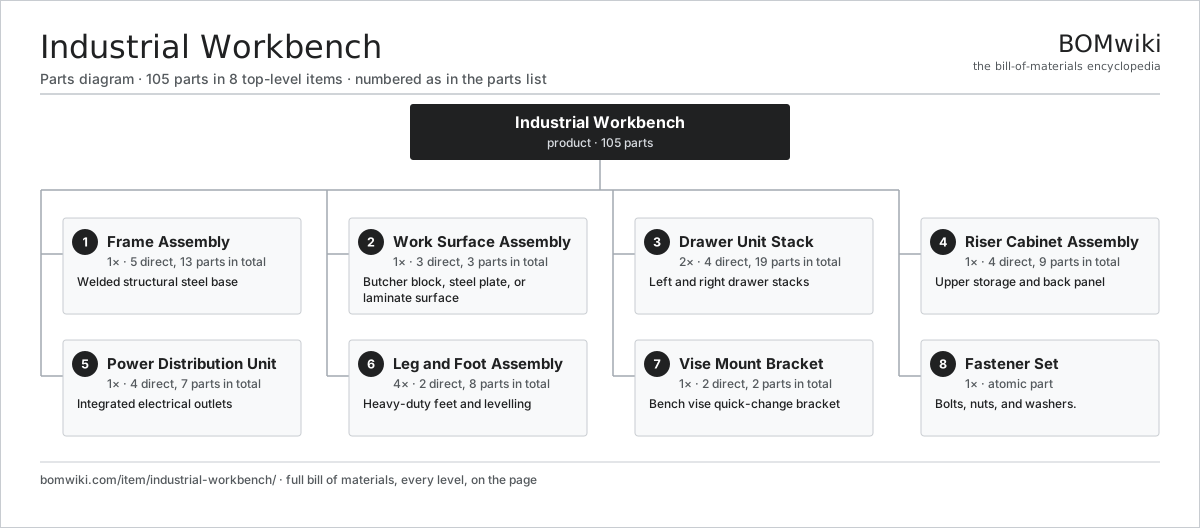
| # | Part | Qty | What it does |
|---|---|---|---|
| 1 | Frame Assembly 5 parts | 1× | Welded structural steel base |
| 2 | Work Surface Assembly 3 parts | 1× | Butcher block, steel plate, or laminate surface |
| 3 | Drawer Unit Stack 4 parts | 2× | Left and right drawer stacks |
| 4 | Riser Cabinet Assembly 4 parts | 1× | Upper storage and back panel |
| 5 | Power Distribution Unit 4 parts | 1× | Integrated electrical outlets |
| 6 | Leg and Foot Assembly 2 parts | 4× | Heavy-duty feet and levelling |
| 7 | Vise Mount Bracket 2 parts | 1× | Bench vise quick-change bracket |
| 8 | Fastener Set | 1× | Bolts, nuts, and washers. |
3D model
No 3D model yet. Have a CAD file of this? Add a 3D model. STL renders right on this page; STEP, FreeCAD, and OpenSCAD sources are welcome too (openly licensed, like all 3D models on BOMwiki).
Build & assembly graph
expand / collapse · shared sub-assemblies converge · links to related products · est. labourTap an assembly to expand/collapse · tap a part to open it · use “Open page” for any node · drag to pan, scroll to zoom.
Bill of materials for Industrial Workbench
8 top-level lines · 32 rows shown · 105 parts total · indented to 3 levels| # | Item / sub-assembly | Part no. | Qty/assy | Ext. qty | Parts | Type |
|---|---|---|---|---|---|---|
| 1 | Frame Assembly 5 parts | industrial-workbench-frame | 1× | 1 | 13 | assembly |
| 1.1 | Main Rail | industrial-workbench-main-rail | 2× | 2 | · | part |
| 1.2 | Side Rail | industrial-workbench-side-rail | 2× | 2 | · | part |
| 1.3 | Frame Post | industrial-workbench-frame-post | 4× | 4 | · | part |
| 1.4 | Diagonal Brace | industrial-workbench-diagonal-brace | 4× | 4 | · | part |
| 1.5 | Drawer Mount Ledge | industrial-workbench-mounting-ledge | 1× | 1 | · | part |
| 2 | Work Surface Assembly 3 parts | industrial-workbench-top | 1× | 1 | 3 | assembly |
| 2.1 | Top Slab | industrial-workbench-top-slab | 1× | 1 | · | part |
| 2.2 | Top Edge | industrial-workbench-top-edge | 1× | 1 | · | part |
| 2.3 | Top Backing | industrial-workbench-top-backing | 1× | 1 | · | part |
| 3 | Drawer Unit Stack 4 parts | industrial-workbench-drawer-unit | 2× | 2 | 19 | assembly |
| 3.1 | Drawer Frame | industrial-workbench-drawer-frame | 1× | 2 | · | part |
| 3.2 | Drawer Box | industrial-workbench-drawer-box | 6× | 12 | · | part |
| 3.3 | Drawer Slide | industrial-workbench-drawer-slide | 6× | 12 | · | part |
| 3.4 | Drawer Pull | industrial-workbench-drawer-pull | 6× | 12 | · | part |
| 4 | Riser Cabinet Assembly 4 parts | industrial-workbench-riser-cabinet | 1× | 1 | 9 | assembly |
| 4.1 | Riser Frame | industrial-workbench-riser-frame | 1× | 1 | · | part |
| 4.2 | Riser Shelf | industrial-workbench-riser-shelf | 3× | 3 | · | part |
| 4.3 | Back Panel | industrial-workbench-back-panel | 1× | 1 | · | part |
| 4.4 | Riser Leg | industrial-workbench-riser-leg | 4× | 4 | · | part |
| 5 | Power Distribution Unit 4 parts | industrial-workbench-power-strip | 1× | 1 | 7 | assembly |
| 5.1 | Power Cord | industrial-workbench-power-cable | 1× | 1 | · | part |
| 5.2 | Outlet Socket | industrial-workbench-outlet-socket | 4× | 4 | · | part |
| 5.3 | Circuit Breaker | industrial-workbench-circuit-breaker | 1× | 1 | · | part |
| 5.4 | Light Fixture | industrial-workbench-light-socket | 1× | 1 | · | part |
| 6 | Leg and Foot Assembly 2 parts | industrial-workbench-leg-set | 4× | 4 | 8 | assembly |
| 6.1 | Adjustable Leg | industrial-workbench-leg | 4× | 16 | · | part |
| 6.2 | Foot Pad | industrial-workbench-foot-pad | 4× | 16 | · | part |
| 7 | Vise Mount Bracket 2 parts | industrial-workbench-vise-mount | 1× | 1 | 2 | assembly |
| 7.1 | Vise Mount Plate | industrial-workbench-vise-plate | 1× | 1 | · | part |
| 7.2 | Quick Release Adapter | industrial-workbench-vise-quick-release | 1× | 1 | · | part |
| 8 | Fastener Set | fastener-set | 1× | 1 | · | part |
Something wrong in this list? Report a problem with this BOM.
Sourcing: possible vendors
Browse the supplier directory → Prices, MOQ, and lead times are algorithmic estimates, not quotes, and not claims about these companies. Company mappings are curated by keyword; est. price band $50–$3k. How estimates work| Vendor | HQ | Specialty | MOQ | Lead time |
|---|---|---|---|---|
| steelcase.com ↗ | Grand Rapids, US | Office furniture | 200 units | 6–12 wks |
| millerknoll.com ↗ | Zeeland, US | Furniture (Herman Miller) | 200 units | 6–12 wks |
|
🇺🇸Haworth
haworth.com ↗
|
Holland, US | Office furniture | 200 units | 6–12 wks |
|
🇺🇸HNI
hnicorp.com ↗
|
Muscatine, US | Furniture & hearth | 200 units | 6–12 wks |
| ikea.com ↗ | Älmhult, SE | Furniture manufacturing | 200 units | 6–12 wks |
1,270-word article