Integrating Sphere Photometer
ProductOverview
An integrating sphere photometer is a specialized light-measurement instrument that captures all light emitted or scattered by a sample, integrating it into a single total quantity. Unlike a point spectrometer that measures only the light incident at a small solid angle, an integrating sphere collects light from the full hemisphere of emission, making it ideal for measuring total luminous intensity (lumens), radiant power (watts), and spectral content of light sources and reflective materials. A perfect integrating sphere is a sphere coated internally with a perfectly diffuse white material. Light entering the sphere bounces repeatedly, creating a uniform intensity at any point on the interior surface, so the measurement is independent of the light distribution, all patterns are "averaged out."
The Integrating Sphere Cavity is the key element: a hollow cavity coated with Spectralon or PTFE, typically 150–300 mm in diameter, with diffuse reflectance >98%. The Port Assembly include a sample entrance port (where the light source is placed or sample is inserted) and a detector port (where the Spectrometer Detector Assembly measures the diffuse light). A Baffle Assembly inside blocks the direct light from the sample, forcing the detector to measure only light that has bounced at least once, eliminating errors from glint or directly transmitted light. The Spectrometer Detector Assembly is typically a fiber-coupled UV-VIS spectrometer, allowing both total spectral power and color metrics (CCT, CRI) to be extracted. The Lamp & Illumination or external light source is controlled by the Control & Readout Electronics, and software calculates luminous intensity and spectral properties using calibration data from the Calibration & Reference.
How it works
A light source is placed at the Sample Entrance Port. Light spreads in all directions, striking the sphere's diffuse interior coating. Each photon is scattered with high probability of remaining inside the sphere and bouncing again, creating a nearly uniform illumination on the sphere's interior, a Lambertian "sky." The Spectrometer Detector Assembly samples this uniform field, producing a signal proportional to the total light power inside the sphere.
The relationship between light power (Φ, watts) and the signal S (photocurrent or spectral counts) is:
S ∝ Φ · ρ^n
where ρ is the sphere's reflectance (typically 0.98) and n is a geometric factor (typically 2–3, depending on sphere size and port configuration). Calibration involves placing a reference light source of known power inside the sphere and recording the signal, then solving for the proportionality constant. Subsequent measurements of unknown sources use this calibration.
The Baffle Assembly prevents the detector from "seeing" the direct beam, which would introduce systematic error. Without it, a highly collimated source would produce an artificially high signal, while a diffuse source would appear dimmer.
For a spectrometer-coupled sphere, the Spectrometer Detector Assembly measures spectral intensity I(λ) dλ across 300–900 nm. Total luminous intensity (in lumens) is computed by integrating the spectral power weighted by the photopic luminosity function V(λ):
Φ_v = K_m ∫ I(λ) · V(λ) dλ
where K_m is the maximum photopic luminous efficacy (~683 lm/W).
Color properties (CCT, CRI) are derived from the tristimulus values (X, Y, Z) computed from the spectral distribution and standard observer color-matching functions.
The Calibration & Reference contains NIST-traceable reference lamps, whose spectral output and luminous flux are documented. Periodic recalibration ensures measurement traceability.
Applications
LED manufacturers use integrating sphere photometry to verify lumen output, color temperature, and color rendering index before shipment. Automotive lighting suppliers measure headlight and taillight luminous intensity. Display manufacturers characterize backlight brightness. Building lighting designers verify that light sources meet photometric specifications. In laboratory settings, researchers use them to characterize novel light sources (laser-driven plasma, bioluminescence, chemiluminescence). Standards bodies use them to calibrate reference sources. Museums use them to characterize art lighting and evaluate light damage risk. In medical and dental applications, researchers characterize the spectral output of curing lights and verify patient safety.
Integrating Sphere Photometer parts and their functions
8 top-level parts · 31 parts in total · full bill of materials below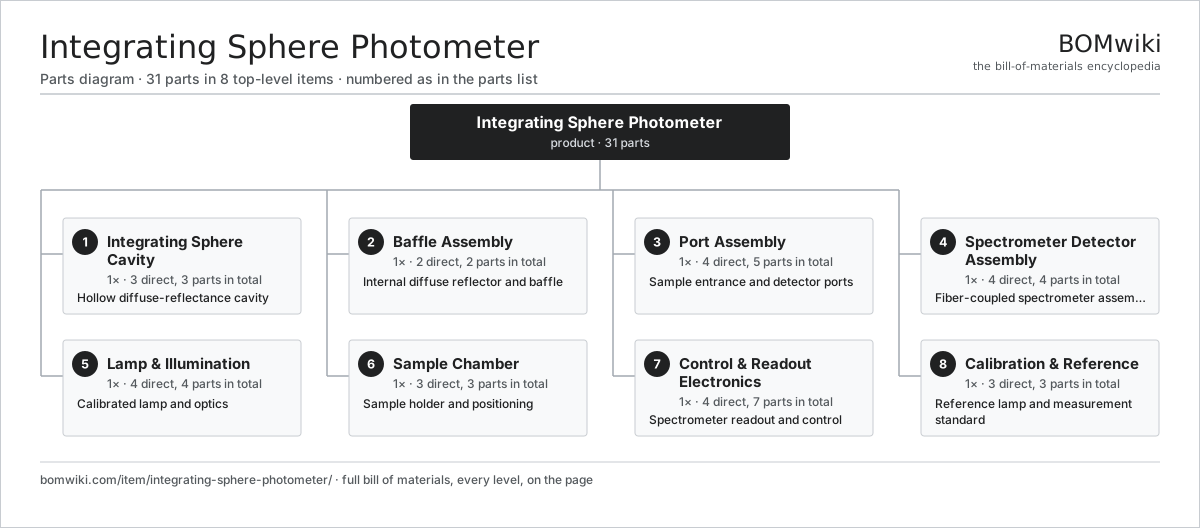
| # | Part | Qty | What it does |
|---|---|---|---|
| 1 | Integrating Sphere Cavity 3 parts | 1× | Hollow diffuse-reflectance cavity |
| 2 | Baffle Assembly 2 parts | 1× | Internal diffuse reflector and baffle |
| 3 | Port Assembly 4 parts | 1× | Sample entrance and detector ports |
| 4 | Spectrometer Detector Assembly 4 parts | 1× | Fiber-coupled spectrometer assembly |
| 5 | Lamp & Illumination 4 parts | 1× | Calibrated lamp and optics |
| 6 | Sample Chamber 3 parts | 1× | Sample holder and positioning |
| 7 | Control & Readout Electronics 4 parts | 1× | Spectrometer readout and control |
| 8 | Calibration & Reference 3 parts | 1× | Reference lamp and measurement standard |
3D model
No 3D model yet. Have a CAD file of this? Add a 3D model. STL renders right on this page; STEP, FreeCAD, and OpenSCAD sources are welcome too (openly licensed, like all 3D models on BOMwiki).
Build & assembly graph
expand / collapse · shared sub-assemblies converge · links to related products · est. labourTap an assembly to expand/collapse · tap a part to open it · use “Open page” for any node · drag to pan, scroll to zoom.
Bill of materials for Integrating Sphere Photometer
8 top-level lines · 35 rows shown · 31 parts total · indented to 3 levels| # | Item / sub-assembly | Part no. | Qty/assy | Ext. qty | Parts | Type |
|---|---|---|---|---|---|---|
| 1 | Integrating Sphere Cavity 3 parts | integrating-sphere-photometer-sphere | 1× | 1 | 3 | assembly |
| 1.1 | Sphere Shell | integrating-sphere-photometer-sphere-shell | 1× | 1 | · | part |
| 1.2 | Diffuse White Coating (Spectralon/PTFE) | integrating-sphere-photometer-coating | 1× | 1 | · | part |
| 1.3 | Mounting Ring | integrating-sphere-photometer-support-ring | 1× | 1 | · | part |
| 2 | Baffle Assembly 2 parts | integrating-sphere-photometer-baffle | 1× | 1 | 2 | assembly |
| 2.1 | Baffle Plate | integrating-sphere-photometer-baffle-plate | 1× | 1 | · | part |
| 2.2 | Black Absorber Patch | integrating-sphere-photometer-absorber-patch | 1× | 1 | · | part |
| 3 | Port Assembly 4 parts | integrating-sphere-photometer-ports | 1× | 1 | 5 | assembly |
| 3.1 | Sample Entrance Port | integrating-sphere-photometer-entrance-port | 1× | 1 | · | part |
| 3.2 | Detector Port | integrating-sphere-photometer-detector-port | 1× | 1 | · | part |
| 3.3 | Port Shutter | integrating-sphere-photometer-port-shutter | 2× | 2 | · | part |
| 3.4 | Collimating Optics | integrating-sphere-photometer-collimator | 1× | 1 | · | part |
| 4 | Spectrometer Detector Assembly 4 parts | integrating-sphere-photometer-detector | 1× | 1 | 4 | assembly |
| 4.1 | Optical Fiber / Coupler | integrating-sphere-photometer-detector-fiber | 1× | 1 | · | part |
| 4.2 | Spectrometer Grating & Lens | integrating-sphere-photometer-spectrometer-optics | 1× | 1 | · | part |
| 4.3 | CCD Detector Array | integrating-sphere-photometer-ccd-array | 1× | 1 | · | part |
| 4.4 | Spectrometer Housing | integrating-sphere-photometer-detector-body | 1× | 1 | · | part |
| 5 | Lamp & Illumination 4 parts | integrating-sphere-photometer-lamp-source | 1× | 1 | 4 | assembly |
| 5.1 | Calibrated Reference Lamp | integrating-sphere-photometer-lamp | 1× | 1 | · | part |
| 5.2 | Lamp Power Supply | integrating-sphere-photometer-lamp-power-supply | 1× | 1 | · | part |
| 5.3 | Condenser Lens | integrating-sphere-photometer-condenser | 1× | 1 | · | part |
| 5.4 | Lamp Heat Sink / Fan | integrating-sphere-photometer-lamp-cooling | 1× | 1 | · | part |
| 6 | Sample Chamber 3 parts | integrating-sphere-photometer-sample-chamber | 1× | 1 | 3 | assembly |
| 6.1 | Chamber Housing | integrating-sphere-photometer-chamber-body | 1× | 1 | · | part |
| 6.2 | Thermal Controller / Heater | integrating-sphere-photometer-temperature-control | 1× | 1 | · | part |
| 6.3 | Sample Mounting Fixture | integrating-sphere-photometer-sample-holder | 1× | 1 | · | part |
| 7 | Control & Readout Electronics 4 parts | integrating-sphere-photometer-electronics | 1× | 1 | 7 | assembly |
| 7.1 | Spectrometer Readout Card | integrating-sphere-photometer-spectrometer-electronics | 1× | 1 | · | part |
| 7.2 | Lamp Power Control Module | integrating-sphere-photometer-lamp-controller | 1× | 1 | · | part |
| 7.3 | Main Control PCB | integrating-sphere-photometer-main-control | 1× | 1 | · | part |
| 7.4 | Connector | connector | 4× | 4 | · | part |
| 8 | Calibration & Reference 3 parts | integrating-sphere-photometer-calibration-unit | 1× | 1 | 3 | assembly |
| 8.1 | Standard Reference Lamp | integrating-sphere-photometer-standard-lamp | 1× | 1 | · | part |
| 8.2 | Calibration Lamp Holder | integrating-sphere-photometer-calibration-holder | 1× | 1 | · | part |
| 8.3 | Calibration Certificate & Traceability | integrating-sphere-photometer-calibration-docs | 1× | 1 | · | part |
Something wrong in this list? Report a problem with this BOM.
Sourcing: possible vendors
Browse the supplier directory → Prices, MOQ, and lead times are algorithmic estimates, not quotes, and not claims about these companies. Company mappings are curated by keyword; est. price band $100–$8k. How estimates work| Vendor | HQ | Specialty | MOQ | Lead time |
|---|---|---|---|---|
|
🇯🇵Canon
canon.com ↗
|
Tokyo, JP | Imaging & optics | 500 units | 10–16 wks |
|
🇯🇵Nikon
nikon.com ↗
|
Tokyo, JP | Imaging & optics | 500 units | 10–16 wks |
|
🇩🇪ZEISS
zeiss.com ↗
|
Oberkochen, DE | Optics & optoelectronics | 500 units | 10–16 wks |
| leica-camera.com ↗ | Wetzlar, DE | Cameras & optics | 500 units | 10–16 wks |
| flir.com ↗ | Wilsonville, US | Thermal imaging | 500 units | 10–16 wks |
662-word article