Internal Welding Machine
ProductOverview
The internal pipe welder is a fully automated orbital welding head engineered to join two pipe sections by orbital fusion welding from inside the bore. The machine is used in critical applications, boiler tube assemblies, high-pressure process equipment, nuclear containment piping, and aerospace tubing, where a root-pass weld must penetrate fully without burn-through and without exterior slag, undercut, or porosity.
The machine consists of six major subsystems: the Orbital Welding Head Assembly (a motorized rotating carriage holding the welding torch), the Welding Power Source (inverter-based 200–500 amp DC source), the Welding Torch and Feeder (water-cooled electrode holder), the Backing Ring Applicator (magnetic or mechanical grip for copper backing ring), the Orbital Rotation Drive Motor (servo motor spinning the torch orbit), and the Control and Timing Electronics (PLC programmable logic controller managing the weld sequence).
Key design features: the Orbital Welding Head Assembly clamps onto the outer pipe surface, with the spindle expanding to grip the inner bore via a collet ring, achieving <0.001 inch runout; the Backing Ring Applicator positions a copper backing ring at the butt joint (root side) before the arc starts, preventing melt-through; and the Control and Timing Electronics executes a pre-programmed weld recipe (arc schedules for root, fill, cap passes) with real-time feedback from voltage and current sensors.
How It Works
Two pipe sections are aligned end-to-end with a gap (typically 0.050–0.125 inch) at the butt joint, held in a fixed pipe stand or external clamp. The operator inserts the internal-pipe-welder assembly from the end of one pipe, pushes it over the clamp onto the bore, and clamps the collet ring Collet Clamp Ring by hand or pneumatic toggle. The spindle is now concentric with the bore (within 0.001 inch TIR). The copper backing ring is slid over the inner diameter on the root side of the butt joint, positioned at the gap.
The operator activates the Control and Timing Electronics touchscreen, selecting the weld recipe for the current pipe size and material (e.g., "3-inch-schedule-40-carbon-steel"). The machine sequence begins:
Backing Ring Placement: The Backing Ring Applicator electromagnet engages, holding the backing ring centered and flush against the root side of the gap. The backup ring material (typically copper) will later be knocked out from inside the finished pipe or remains in place if not required to be removed.
Torch Initialization: The Electrode Feed Motor motor starts spooling wire (or consumable electrode) at a programmed rate (inches/minute). The Welding Power Source ramps the arc current to a pre-strike value (100–150 amps).
Arc Start: The torch tip is brought into proximity to the work (automated or manual pilot arc initiation). Once the arc ignites, the voltage feedback loop of the Control Electronics Board stabilizes the arc gap at a target voltage setpoint (20–24 volts, typical).
Orbital Rotation and Travel: The Orbital Rotation Drive Motor spins the Orbital Welding Head Assembly at the recipe speed (e.g., 2,400 rpm for a 3-inch pipe). As the torch orbits, it traces a circular path around the inside of the bore, fusing the two pipe edges with the molten weld pool. The arc current is programmed to rise in steps for the root pass (250 amps), middle fill passes (350 amps), and cap pass (400 amps), matching the gap geometry and wire feed speed.
Cooling and Thermal Management: The Torch Cooling System circulates water through the Torch Body (water jacket around the electrode), the Backing Ring Applicator magnet windings, and the Servo Motor stator. The Thermostatic Water Valve maintains outlet water at ~40°C, preventing torch overtemp and magnet coil overheat.
Pass Transitions: Upon completing a full orbit (3–5 seconds), the control unit automatically increments the wire feed rate and arc current, executing the next pass (fill-1, fill-2, cap). The operator may manually trigger the next pass via the touchscreen, or the machine auto-advances based on elapsed time or encoder revolution count.
Arc Stop and Backplate Release: When all passes are complete, the Welding Power Source ramps the current down and extinguishes the arc. The Backing Ring Applicator electromagnet de-energizes, releasing the backing ring. The torch is withdrawn, and the collet Collet Clamp Ring is released.
The result is a full-penetration root weld with no burn-through (thanks to the backing ring) and no surface slag (shielding gas keeps the arc zone clean).
Root, Fill, and Cap Passes
A typical internal orbital weld uses three program steps:
- Root Pass: 200–300 amps, slow travel speed, tight arc gap (20 volts), small bead width. Produces a narrow root bead fused to the backing ring, minimal spatter.
- Fill Passes: 350–400 amps, medium travel speed, larger bead width. Multiple orbits (2–4 passes typical) build up weld height and reinforce the joint.
- Cap Pass: 400–450 amps, final fast pass, wide bead, cosmetic appearance. Completes penetration and provides uniform surface profile.
The Control Microcontroller controls the arc schedule using pulse-mode arc (if equipped), oscillating arc current at 1–10 kHz to control heat input and bead shape. Modern supplies also offer ripple arc, a lower-frequency (~200 Hz) current modulation for better weld metal fluidity and reduced spatter.
Backing Ring and Burn-Through Prevention
The Backing Ring Applicator holds a consumable copper backing ring (sized per pipe wall thickness: 1/8 inch for thin wall, 1/4 inch for thick wall) at the root of the weld. Copper is chosen because:
- Thermal Conductivity: Copper conducts heat away from the root, preventing localized melting and burn-through.
- Non-Fusible: Copper does not melt until ~1,085°C; the weld pool (steel melts at ~1,500°C) reaches liquid state, but the copper backing ring remains solid, providing a mechanical stop.
- Chemical Inertness: Copper does not alloy with the weld metal at normal arc temperatures.
After the weld cools, the backing ring is knocked out from inside (using a punch and mallet) or left in place if specifications allow. For critical applications (boiler tubes), the backing ring must be removed to prevent galvanic corrosion.
Shielding Gas and Arc Environment
The Gas Nozzle Cup delivers shielding gas (argon, CO₂, or 75% Ar / 25% CO₂ mix) at 20–30 CFM, enveloping the arc in an inert atmosphere. This prevents oxygen and nitrogen from the air from oxidizing the molten steel, which would cause porosity and brittleness. Inside a confined pipe bore, the gas flow is naturally constrained and bounces off the pipe wall, ensuring complete coverage.
Field Inspection and Qualification
Finished welds are inspected per ASME B31.1 (Power Piping) or AWS D1.1 (Structural Steel Welding) standards:
- Visual: Surface ripple pattern, bead width, height, spatter count.
- Radiography (X-ray): Detects internal porosity, cracks, tungsten inclusions, lack of fusion.
- Hydrostatic Test: Pressurizes the completed pipe to 1.5× operating pressure, verifying structural integrity.
The Touchscreen Interface logs arc voltage and current waveforms for every weld, creating a digital record (heat signature) that can be reviewed post-weld to confirm the arc profile matched the specification recipe. Many machines include Ethernet connectivity to upload logs to a central quality database.
Maintenance and Service Life
The Welding Contact Tip wears with every welding session and is replaced after 500–1,000 feet of wire feed. The Spindle Mechanical Seal (face seal) is inspected annually for wear and replaced if internal spatter accumulates. The Torch Cooling System water should be drained and replaced every 6 months if not using inhibited coolant. The Planetary Gearbox oil level is checked monthly; the gearbox is replaced every 10,000+ weld cycles. The Welding Power Source inverter (IGBT) stage is warranted for 10 years; electrolytic capacitors typically require refresh around year 8.
Internal Welding Machine parts and their functions
8 top-level parts · 36 parts in total · full bill of materials below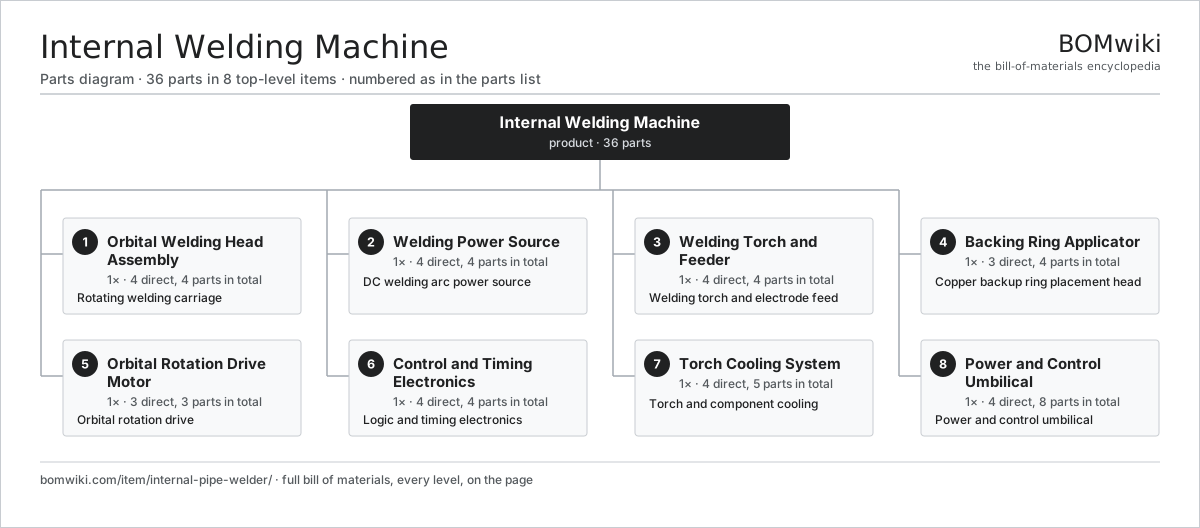
| # | Part | Qty | What it does |
|---|---|---|---|
| 1 | Orbital Welding Head Assembly 4 parts | 1× | Rotating welding carriage |
| 2 | Welding Power Source 4 parts | 1× | DC welding arc power source |
| 3 | Welding Torch and Feeder 4 parts | 1× | Welding torch and electrode feed |
| 4 | Backing Ring Applicator 3 parts | 1× | Copper backup ring placement head |
| 5 | Orbital Rotation Drive Motor 3 parts | 1× | Orbital rotation drive |
| 6 | Control and Timing Electronics 4 parts | 1× | Logic and timing electronics |
| 7 | Torch Cooling System 4 parts | 1× | Torch and component cooling |
| 8 | Power and Control Umbilical 4 parts | 1× | Power and control umbilical |
3D model
No 3D model yet. Have a CAD file of this? Add a 3D model. STL renders right on this page; STEP, FreeCAD, and OpenSCAD sources are welcome too (openly licensed, like all 3D models on BOMwiki).
Build & assembly graph
expand / collapse · shared sub-assemblies converge · links to related products · est. labourTap an assembly to expand/collapse · tap a part to open it · use “Open page” for any node · drag to pan, scroll to zoom.
Bill of materials for Internal Welding Machine
8 top-level lines · 38 rows shown · 36 parts total · indented to 3 levels| # | Item / sub-assembly | Part no. | Qty/assy | Ext. qty | Parts | Type |
|---|---|---|---|---|---|---|
| 1 | Orbital Welding Head Assembly 4 parts | internal-pipe-welder-orbital-head | 1× | 1 | 4 | assembly |
| 1.1 | Orbital Spindle | internal-pipe-welder-head-spindle | 1× | 1 | · | part |
| 1.2 | Spindle Bearing Pair | internal-pipe-welder-head-bearing-set | 1× | 1 | · | part |
| 1.3 | Spindle Mechanical Seal | internal-pipe-welder-head-seal-assembly | 1× | 1 | · | part |
| 1.4 | Collet Clamp Ring | internal-pipe-welder-head-clamp-ring | 1× | 1 | · | part |
| 2 | Welding Power Source 4 parts | internal-pipe-welder-power-supply | 1× | 1 | 4 | assembly |
| 2.1 | Welding Transformer | internal-pipe-welder-power-transformer | 1× | 1 | · | part |
| 2.2 | Inverter IGBT Module | internal-pipe-welder-power-rectifier | 1× | 1 | · | part |
| 2.3 | Control Electronics Board | internal-pipe-welder-power-control-board | 1× | 1 | · | part |
| 2.4 | Main Power Contactor | internal-pipe-welder-power-contactor | 1× | 1 | · | part |
| 3 | Welding Torch and Feeder 4 parts | internal-pipe-welder-torch-assembly | 1× | 1 | 4 | assembly |
| 3.1 | Torch Body | internal-pipe-welder-torch-body | 1× | 1 | · | part |
| 3.2 | Electrode Feed Motor | internal-pipe-welder-torch-electrode-feeder | 1× | 1 | · | part |
| 3.3 | Gas Nozzle Cup | internal-pipe-welder-torch-nozzle-cup | 1× | 1 | · | part |
| 3.4 | Welding Contact Tip | internal-pipe-welder-torch-contact-tip | 1× | 1 | · | part |
| 4 | Backing Ring Applicator 3 parts | internal-pipe-welder-backing-ring-applicator | 1× | 1 | 4 | assembly |
| 4.1 | Magnetic Backing Ring Holder | internal-pipe-welder-backing-ring-magnet | 1× | 1 | · | part |
| 4.2 | Spring Retraction Mechanism | internal-pipe-welder-backing-ring-spring | 1× | 1 | · | part |
| 4.3 | Backing Ring Jaw Chuck | internal-pipe-welder-backing-ring-jaw | 2× | 2 | · | part |
| 5 | Orbital Rotation Drive Motor 3 parts | internal-pipe-welder-drive-motor | 1× | 1 | 3 | assembly |
| 5.1 | Servo Motor | internal-pipe-welder-drive-servo-motor | 1× | 1 | · | part |
| 5.2 | Planetary Gearbox | internal-pipe-welder-drive-gearbox | 1× | 1 | · | part |
| 5.3 | Flexible Coupling | internal-pipe-welder-drive-coupling | 1× | 1 | · | part |
| 6 | Control and Timing Electronics 4 parts | internal-pipe-welder-control-unit | 1× | 1 | 4 | assembly |
| 6.1 | Control Microcontroller | internal-pipe-welder-plc-processor | 1× | 1 | · | part |
| 6.2 | Program and Data Storage | internal-pipe-welder-plc-memory | 1× | 1 | · | part |
| 6.3 | Touchscreen Interface | internal-pipe-welder-plc-display | 1× | 1 | · | part |
| 6.4 | Logic Power Supply Module | internal-pipe-welder-plc-power-supply | 1× | 1 | · | part |
| 7 | Torch Cooling System 4 parts | internal-pipe-welder-cooling-system | 1× | 1 | 5 | assembly |
| 7.1 | Cooling Water Pump | internal-pipe-welder-cooling-pump | 1× | 1 | · | part |
| 7.2 | Heat Radiator | internal-pipe-welder-cooling-radiator | 1× | 1 | · | part |
| 7.3 | Coolant Hose | internal-pipe-welder-cooling-hoses | 2× | 2 | · | part |
| 7.4 | Thermostatic Water Valve | internal-pipe-welder-cooling-thermostatic-valve | 1× | 1 | · | part |
| 8 | Power and Control Umbilical 4 parts | internal-pipe-welder-cable-bundle | 1× | 1 | 8 | assembly |
| 8.1 | Main Power Cable | internal-pipe-welder-cable-power | 1× | 1 | · | part |
| 8.2 | Signal and Control Cable | internal-pipe-welder-cable-signal | 1× | 1 | · | part |
| 8.3 | Integrated Coolant Hose | internal-pipe-welder-cable-water | 2× | 2 | · | part |
| 8.4 | Cable Entry Boot | internal-pipe-welder-cable-strain-relief | 4× | 4 | · | part |
Something wrong in this list? Report a problem with this BOM.
Sourcing: possible vendors
Browse the supplier directory → Prices, MOQ, and lead times are algorithmic estimates, not quotes, and not claims about these companies. Company mappings are curated by keyword; est. price band $10k–$50M. How estimates work| Vendor | HQ | Specialty | MOQ | Lead time |
|---|---|---|---|---|
|
🇺🇸SLB
slb.com ↗
|
Houston, US | Oilfield services & equipment | made to order | 24–48 wks |
| halliburton.com ↗ | Houston, US | Oilfield services | made to order | 24–48 wks |
| bakerhughes.com ↗ | Houston, US | Energy technology | made to order | 24–48 wks |
|
🇺🇸NOV
nov.com ↗
|
Houston, US | Drilling equipment | made to order | 24–48 wks |
| technipfmc.com ↗ | London, GB | Subsea & surface systems | made to order | 24–48 wks |
1,384-word article