Inversion Table
ProductOverview
An inversion table suspends a person upside down, or at any angle short of it, by clamping the ankles and rotating a padded bed about a horizontal pivot. It is used for spinal traction: hanging by the ankles applies a distracting force along the spine equal to a large fraction of body weight, which users employ for back-pain relief and stretching. The machine is entirely mechanical, no motor, no electronics. Rotation is controlled by the user's own arm position, and the maximum angle is capped by the Angle Control.
Balance-point rotation
The design problem is letting a person rotate their own body weight smoothly with almost no effort, in both directions. The solution is to place the rotation axis of the Pivot System almost exactly through the combined centre of mass of user plus bed. Two Pivot Shaft stubs on the bed ride in Ball Bearing pairs held by Pivot Bracket mounts at the top of the A-frame.
Getting the centre of mass onto the axis is what the height setting does. The user dials their height into the Height Column, locked by the Height Index Pin; this slides the Ankle Lock System further from or closer to the pivot so that taller and shorter users alike balance at the same axis. With the body balanced, raising the arms overhead shifts mass toward the head and the bed rotates backward; bringing the arms to the chest shifts mass back and the bed returns upright. The Balance Adjuster offsets the bed a hole or two relative to the axis to bias this behaviour, most users set a slight feet-heavy bias so the table self-returns to vertical when they relax.
Ankle restraint
Everything depends on the Ankle Lock System, the only thing holding the user at full inversion. Standing on the Footplate, the user's ankles sit against the rear Ankle Bar rollers; pulling the Clamp Lever ratchets the front Ankle Roller pair closed in indexed steps until snug. A spring-loaded Lock Pawl (returned by a Coil Spring) holds the ratchet closed and must be deliberately pulled to release, it cannot back-drive under load. The contoured rollers spread the clamp force over the instep and Achilles area; at full inversion the restraint carries the user's entire weight, so ASTM F3158 testing loads it well beyond the rated 135 kg.
Angle limiting
New users do not go straight to 90°. The Tether Strap is a webbing strap between frame and bed whose adjusted length stops rotation at a chosen angle; most tables mark settings for 20°, 40° and 60°. Some designs use an Angle Stop Pin in indexed holes instead, which gives positive stops that cannot creep. At 60° the axial traction force already reaches roughly 75-85% of body weight, which is why moderate angles deliver most of the decompression effect. For full inversion the strap is unclipped and rubber-faced Rotation Stop blocks catch the bed at 90°, where the user can hang free or do inverted crunches. The Angle Scale decal on the frame shows the current angle.
Frame and return
The Base Frame is a folding steel A-frame: Front Leg Pair and Rear Leg Pair pairs joined by a Fold Hinge, stiffened by Cross Brace tubes, and shod with Floor Pad feet so the frame does not walk across the floor as the bed swings. The frame geometry keeps the support feet outside the swept arc of the bed and user at every angle, tipping stability at full inversion is the governing load case.
Returning upright from 90° is the moment that needs mechanical help. Arm repositioning provides only a small righting moment when fully inverted, so the Handle Set gives the user two long Side Handle rails, reachable at any bed angle, to push against and start the bed swinging back; once past about 60° the feet-heavy balance bias takes over and the bed settles to vertical on its own. The Backrest Bed itself, a rigid Bed Board under a closed-cell Bed Pad, with a sliding Headrest, must stay stiff in both orientations, since at full inversion it hangs from the pivot shafts rather than resting on them.
Inversion Table parts and their functions
7 top-level parts · 42 parts in total · full bill of materials below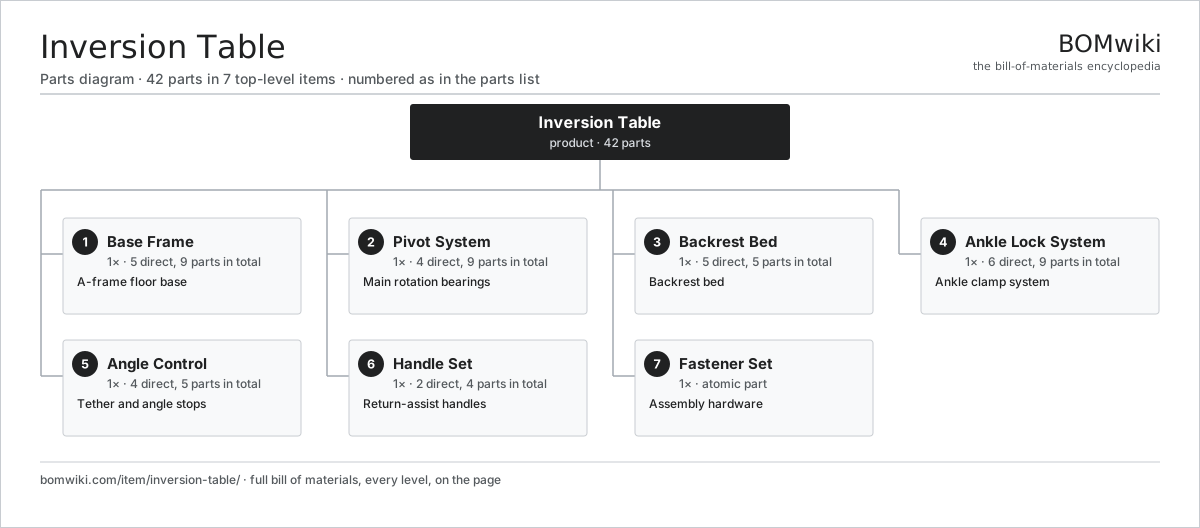
| # | Part | Qty | What it does |
|---|---|---|---|
| 1 | Base Frame 5 parts | 1× | A-frame floor base |
| 2 | Pivot System 4 parts | 1× | Main rotation bearings |
| 3 | Backrest Bed 5 parts | 1× | Backrest bed |
| 4 | Ankle Lock System 6 parts | 1× | Ankle clamp system |
| 5 | Angle Control 4 parts | 1× | Tether and angle stops |
| 6 | Handle Set 2 parts | 1× | Return-assist handles |
| 7 | Fastener Set | 1× | Assembly hardware |
3D model
No 3D model yet. Have a CAD file of this? Add a 3D model. STL renders right on this page; STEP, FreeCAD, and OpenSCAD sources are welcome too (openly licensed, like all 3D models on BOMwiki).
Build & assembly graph
expand / collapse · shared sub-assemblies converge · links to related products · est. labourTap an assembly to expand/collapse · tap a part to open it · use “Open page” for any node · drag to pan, scroll to zoom.
Bill of materials for Inversion Table
7 top-level lines · 33 rows shown · 42 parts total · indented to 3 levels| # | Item / sub-assembly | Part no. | Qty/assy | Ext. qty | Parts | Type |
|---|---|---|---|---|---|---|
| 1 | Base Frame 5 parts | inversion-table-base-frame | 1× | 1 | 9 | assembly |
| 1.1 | Front Leg Pair | inversion-table-front-leg | 1× | 1 | · | part |
| 1.2 | Rear Leg Pair | inversion-table-rear-leg | 1× | 1 | · | part |
| 1.3 | Cross Brace | inversion-table-cross-brace | 2× | 2 | · | part |
| 1.4 | Floor Pad | inversion-table-floor-pad | 4× | 4 | · | part |
| 1.5 | Fold Hinge | inversion-table-fold-hinge | 1× | 1 | · | part |
| 2 | Pivot System 4 parts | inversion-table-pivot-system | 1× | 1 | 9 | assembly |
| 2.1 | Pivot Shaft | inversion-table-pivot-shaft | 2× | 2 | · | part |
| 2.2 | Ball Bearing | ball-bearing | 4× | 4 | · | part |
| 2.3 | Pivot Bracket | inversion-table-pivot-bracket | 2× | 2 | · | part |
| 2.4 | Balance Adjuster | inversion-table-balance-adjuster | 1× | 1 | · | part |
| 3 | Backrest Bed 5 parts | inversion-table-bed | 1× | 1 | 5 | assembly |
| 3.1 | Bed Board | inversion-table-bed-board | 1× | 1 | · | part |
| 3.2 | Bed Pad | inversion-table-bed-pad | 1× | 1 | · | part |
| 3.3 | Headrest | inversion-table-headrest | 1× | 1 | · | part |
| 3.4 | Height Column | inversion-table-height-column | 1× | 1 | · | part |
| 3.5 | Height Index Pin | inversion-table-height-pin | 1× | 1 | · | part |
| 4 | Ankle Lock System 6 parts | inversion-table-ankle-lock | 1× | 1 | 9 | assembly |
| 4.1 | Ankle Bar | inversion-table-ankle-bar | 1× | 1 | · | part |
| 4.2 | Ankle Roller | inversion-table-ankle-roller | 4× | 4 | · | part |
| 4.3 | Clamp Lever | inversion-table-clamp-lever | 1× | 1 | · | part |
| 4.4 | Lock Pawl | inversion-table-lock-pawl | 1× | 1 | · | part |
| 4.5 | Footplate | inversion-table-footplate | 1× | 1 | · | part |
| 4.6 | Coil Spring | coil-spring | 1× | 1 | · | part |
| 5 | Angle Control 4 parts | inversion-table-angle-control | 1× | 1 | 5 | assembly |
| 5.1 | Tether Strap | inversion-table-tether-strap | 1× | 1 | · | part |
| 5.2 | Angle Stop Pin | inversion-table-angle-pin | 1× | 1 | · | part |
| 5.3 | Rotation Stop | inversion-table-rotation-stop | 2× | 2 | · | part |
| 5.4 | Angle Scale | inversion-table-angle-scale | 1× | 1 | · | part |
| 6 | Handle Set 2 parts | inversion-table-handle-set | 1× | 1 | 4 | assembly |
| 6.1 | Side Handle | inversion-table-side-handle | 2× | 2 | · | part |
| 6.2 | Handle Grip | inversion-table-handle-grip | 2× | 2 | · | part |
| 7 | Fastener Set | fastener-set | 1× | 1 | · | part |
Something wrong in this list? Report a problem with this BOM.
Related products
same domain, ranked by shared parts Adjustable Dumbbell
113 parts · shares 1 with this page
Adjustable Dumbbell
113 parts · shares 1 with this page
 Adjustable Kettlebell
47 parts · shares 1 with this page
Belt Squat Machine
49 parts · shares 1 with this page
Adjustable Kettlebell
47 parts · shares 1 with this page
Belt Squat Machine
49 parts · shares 1 with this page
 Climbing Auto-Belay
49 parts · shares 1 with this page
Hack Squat Machine
61 parts · shares 1 with this page
Climbing Auto-Belay
49 parts · shares 1 with this page
Hack Squat Machine
61 parts · shares 1 with this page
 Leg Press Machine
54 parts · shares 1 with this page
Leg Press Machine
54 parts · shares 1 with this page
Sourcing: possible vendors
Browse the supplier directory → Prices, MOQ, and lead times are algorithmic estimates, not quotes, and not claims about these companies. Company mappings are curated by keyword; est. price band $100–$10k. How estimates work| Vendor | HQ | Specialty | MOQ | Lead time |
|---|---|---|---|---|
| lifefitness.com ↗ | Rosemont, US | Fitness equipment | 200 units | 8–14 wks |
| technogym.com ↗ | Cesena, IT | Fitness equipment | 200 units | 8–14 wks |
|
🇺🇸Peloton
onepeloton.com ↗
|
New York, US | Connected fitness | 200 units | 8–14 wks |
| johnsonhealthtech.com ↗ | Taichung, TW | Fitness (Matrix) | 200 units | 8–14 wks |
|
🇺🇸Precor
precor.com ↗
|
Woodinville, US | Fitness equipment | 200 units | 8–14 wks |
756-word article