Climbing Ladder Ergometer
ProductOverview
A Jacobs Ladder climbing machine (often called a "rope climb simulator" or "climbing ladder ergometer") presents an endlessly-scrolling set of rungs that the user must climb to keep pace with. Unlike the Vertical Climber with its alternating foot drive or a stair-stepper with discrete steps, the Jacobs Ladder uses a continuous Continuous Belt and Pulleys that loops over pulleys. The user must keep pushing the rungs downward fast enough to avoid sliding backward; if the user falters, the belt keeps moving and gravity does the work of lowering them. The infinitely scalable resistance means a sprint athlete and a deconditioned person can use the same machine at their own pace, there is no "setting" to adjust, only the user's effort.
The innovation that makes this work is the closed-loop Motor Speed Controller: the Belt Speed Sensor measures belt speed, and the motor accelerates or decelerates to match the user's climbing pace within limits. If a user stops pushing hard, the belt slows; if they accelerate, the motor follows. The Magnetic Braking System adds resistance to the motor shaft so that at any belt speed, the user must work harder to maintain that speed than they would on a frictionless escalator.
Rung design and climbing mechanics
The Climbing Rung rungs are spaced 150–200 mm (6–8 inches) apart vertically, matching a typical stair tread. Each rung is an aluminum or molded-plastic stepping surface about 150–200 mm wide and 250–300 mm front-to-back, sized to accept a climbing shoe toe. The Rung Grip Insert grip surface is rubber or elastomer, essential for traction when sweaty.
Rungs are mounted to a Rung Carrier Plate belt, a continuous steel or fabric-reinforced rubber webbing that loops over the Upper Drive Pulley at the top of the machine and the Lower Return Pulley at the bottom. Spaced evenly along the belt, each rung is bolted or riveted via a Rung Mount Bracket. The user's footfall does not directly drive the machine; instead, the user climbs the stationary rungs as they appear, and the belt scrolls downward at whatever speed the AC Motor sets.
Proper form requires the user to push each rung downward with purpose, activating the glutes and hamstrings much like a rope climb or stair ascent. Most users find a rhythm of 60–90 steps per minute; elite athletes may exceed 120 steps per minute. The psychological difference from other machines is significant: there is no discrete "set" to complete, and the illusion of an infinite climb can be psychologically harder than a timer-based interval.
Motor and belt drive
The AC Motor is a 0.5–1.5 kW single-phase AC induction motor whose speed is controlled by a Motor Speed Controller (a variable-frequency drive). The motor shaft is fitted with a Drive Pulley, a grooved or toothed pulley that grips the Continuous Rung Belt and drives it upward.
The belt itself is a hybrid structure: a strong fabric or steel-cord backing (like a car timing belt) to which individual rungs are pre-mounted. Replacement is a field service task requiring belt removal and re-tensioning. The belt speed typically ranges from 0 to 2.5 m/s, which translates to about 0.5–6 steps per second, or 30–360 steps per minute, a range that covers casual walking to sprinting.
The Idler Pulley units maintain tension and center the belt as it loops. Ball Bearing blocks in the pulley housings support the load, and sealed bearings minimize maintenance needs.
Closed-loop speed control
The key to usability is the Belt Speed Sensor, typically a magnetic or optical encoder that reads the belt position. The Control Board samples this signal at ~10–100 Hz and computes belt speed. The motor controller then adjusts AC frequency sent to the motor to accelerate or decelerate the belt to match the user's climbing pace.
This creates a peculiar dynamic: the machine resists rapid acceleration and deceleration. If a user suddenly sprints hard, the motor will lag slightly, and the belt will slow relative to where the user's legs want to be. Conversely, if a user tries to rest on the rungs and catch breath, the belt will slow and the user will continue forward through the rungs momentarily before the motor fully decelerates. Most machines implement a "coast" limit: if the belt speed would drop below a minimum (e.g., 1 step per 2 seconds), the machine shuts down automatically to prevent the user from getting trapped climbing in place.
Magnetic braking and resistance
The Magnetic Braking System system is an eddy-current brake. A Brake Rotor Disc disc is fixed to the motor-driven pulley shaft. Around it, a set of Neodymium Magnet permanent magnets is mounted in a Brake Housing Assembly that can move radially in or out. As the rotor spins, changing magnetic flux induces electrical currents (eddy currents) in the rotor material, creating a retarding torque.
The closer the magnets sit to the rotor, the stronger the braking force; therefore, the harder the user must push the rungs to maintain a given belt speed. The Brake Position Actuator adjusts this gap either continuously or in fixed levels (e.g., 20 steps). Some commercial machines use a manual hand lever, while others use a motor-driven worm screw for electronic adjustment.
The beauty of this design is that the brake torque is nearly independent of belt speed: the load felt at 1 step per second is almost identical to the load at 3 steps per second for the same brake setting. This differs from fan resistance (where drag increases with speed) or friction brakes (where load can be speed-dependent), making the effort more predictable and suitable for interval training.
Handrails and user interface
Dual Handrail Assembly structures flank the machine. The Handrail Tube is a steel or aluminum tube, 25–32 mm diameter, running from near the bottom of the machine up to shoulder height or higher. Grips are foam or rubber sleeves for comfort and slip resistance.
The Electronics and Control Panel are housed in a control module, typically mounted at waist height on one side of the frame. The Display Panel shows time elapsed, estimated altitude climbed (calculated from step rate and standard riser height), approximate power output (in watts, derived from user weight, step rate, and magnetic brake level), and the current resistance setting if applicable.
User experience and metrics
A typical session might be 5–15 minutes. At low resistance, the effort is aerobic and sustainable for 30+ minutes. At high resistance, users often work in 30-second to 2-minute intervals; the maximal oxygen uptake (VO2max) demand can exceed that of a sprint on other equipment because the entire body weight is lifted continuously.
Calories burned are high, 100–200 kcal per 10 minutes depending on body weight and effort. The simplicity of the motion (continuous stepping) and the constant activation of large muscles (glutes, quads, calves, core) make this one of the most metabolically demanding gym machines per unit time.
Maintenance and durability
The Continuous Rung Belt is the primary consumable, lasting 2–5 years in commercial gyms with heavy use. Replacement requires removing the motor and idler pulleys, threading the new belt, and re-tensioning. The Ball Bearing blocks in the pulleys should be lubricated annually. The Neodymium Magnet materials are permanent and do not degrade, though the Brake Housing Assembly adjusting mechanism can accumulate grit over time.
The AC Motor and Power Supply are robust; failure is rare. The Control Board is sensitive to humidity in some commercial environments, so ensuring adequate ventilation around the electronics module extends service life.
Climbing Ladder Ergometer parts and their functions
8 top-level parts · 136 parts in total · full bill of materials below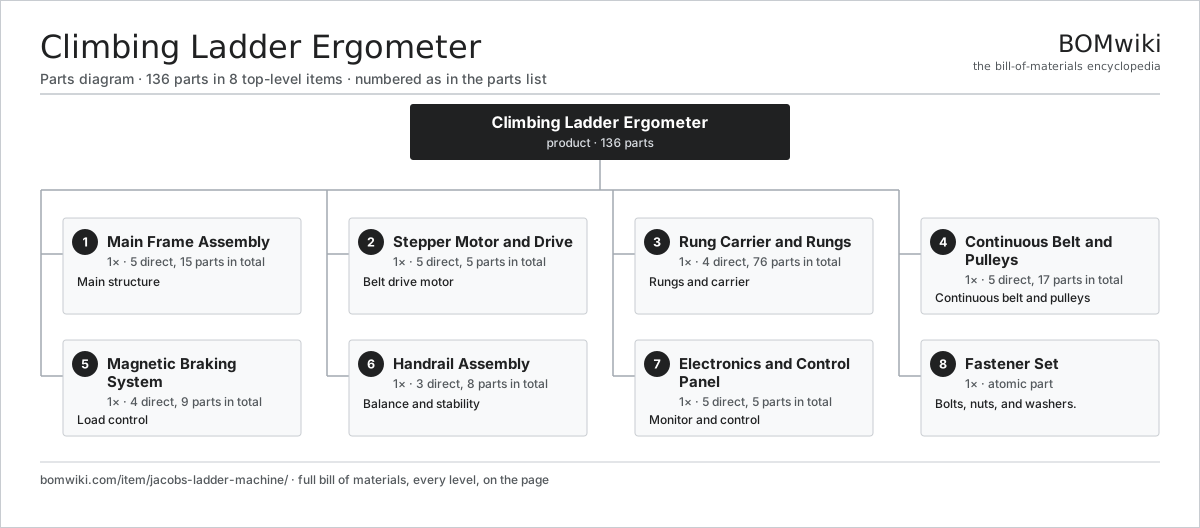
| # | Part | Qty | What it does |
|---|---|---|---|
| 1 | Main Frame Assembly 5 parts | 1× | Main structure |
| 2 | Stepper Motor and Drive 5 parts | 1× | Belt drive motor |
| 3 | Rung Carrier and Rungs 4 parts | 1× | Rungs and carrier |
| 4 | Continuous Belt and Pulleys 5 parts | 1× | Continuous belt and pulleys |
| 5 | Magnetic Braking System 4 parts | 1× | Load control |
| 6 | Handrail Assembly 3 parts | 1× | Balance and stability |
| 7 | Electronics and Control Panel 5 parts | 1× | Monitor and control |
| 8 | Fastener Set | 1× | Bolts, nuts, and washers. |
3D model
No 3D model yet. Have a CAD file of this? Add a 3D model. STL renders right on this page; STEP, FreeCAD, and OpenSCAD sources are welcome too (openly licensed, like all 3D models on BOMwiki).
Build & assembly graph
expand / collapse · shared sub-assemblies converge · links to related products · est. labourTap an assembly to expand/collapse · tap a part to open it · use “Open page” for any node · drag to pan, scroll to zoom.
Bill of materials for Climbing Ladder Ergometer
8 top-level lines · 39 rows shown · 136 parts total · indented to 3 levels| # | Item / sub-assembly | Part no. | Qty/assy | Ext. qty | Parts | Type |
|---|---|---|---|---|---|---|
| 1 | Main Frame Assembly 5 parts | jacobs-ladder-frame | 1× | 1 | 15 | assembly |
| 1.1 | Side Rail | jacobs-ladder-side-rail | 2× | 2 | · | part |
| 1.2 | Cross Tube | jacobs-ladder-cross-tube | 6× | 6 | · | part |
| 1.3 | Base Foot Block | jacobs-ladder-base-block | 2× | 2 | · | part |
| 1.4 | Motor Mount Plate | jacobs-ladder-motor-mount | 1× | 1 | · | part |
| 1.5 | Bearing Support Block | jacobs-ladder-bearing-block | 4× | 4 | · | part |
| 2 | Stepper Motor and Drive 5 parts | jacobs-ladder-drive-motor | 1× | 1 | 5 | assembly |
| 2.1 | AC Motor | jacobs-ladder-ac-motor | 1× | 1 | · | part |
| 2.2 | Motor Speed Controller | jacobs-ladder-motor-controller | 1× | 1 | · | part |
| 2.3 | Drive Pulley | jacobs-ladder-drive-pulley | 1× | 1 | · | part |
| 2.4 | Belt Speed Sensor | jacobs-ladder-speed-sensor | 1× | 1 | · | part |
| 2.5 | Power Supply | power-supply | 1× | 1 | · | part |
| 3 | Rung Carrier and Rungs 4 parts | jacobs-ladder-rung-assembly | 1× | 1 | 76 | assembly |
| 3.1 | Climbing Rung | jacobs-ladder-rung | 25× | 25 | · | part |
| 3.2 | Rung Carrier Plate | jacobs-ladder-rung-carrier | 1× | 1 | · | part |
| 3.3 | Rung Mount Bracket | jacobs-ladder-rung-bracket | 25× | 25 | · | part |
| 3.4 | Rung Grip Insert | jacobs-ladder-rung-insert | 25× | 25 | · | part |
| 4 | Continuous Belt and Pulleys 5 parts | jacobs-ladder-belt-system | 1× | 1 | 17 | assembly |
| 4.1 | Upper Drive Pulley | jacobs-ladder-upper-pulley | 1× | 1 | · | part |
| 4.2 | Lower Return Pulley | jacobs-ladder-lower-pulley | 1× | 1 | · | part |
| 4.3 | Idler Pulley | jacobs-ladder-idler-pulley | 2× | 2 | · | part |
| 4.4 | Continuous Rung Belt | jacobs-ladder-belt | 1× | 1 | · | part |
| 4.5 | Ball Bearing | ball-bearing | 12× | 12 | · | part |
| 5 | Magnetic Braking System 4 parts | jacobs-ladder-magnetic-brake | 1× | 1 | 9 | assembly |
| 5.1 | Brake Rotor Disc | jacobs-ladder-brake-rotor | 1× | 1 | · | part |
| 5.2 | Neodymium Magnet | neodymium-magnet | 6× | 6 | · | part |
| 5.3 | Brake Housing Assembly | jacobs-ladder-brake-housing | 1× | 1 | · | part |
| 5.4 | Brake Position Actuator | jacobs-ladder-brake-actuator | 1× | 1 | · | part |
| 6 | Handrail Assembly 3 parts | jacobs-ladder-handrail-assy | 1× | 1 | 8 | assembly |
| 6.1 | Handrail Tube | jacobs-ladder-handrail | 2× | 2 | · | part |
| 6.2 | Handrail Grip Sleeve | jacobs-ladder-handrail-grip | 2× | 2 | · | part |
| 6.3 | Handrail Bracket | jacobs-ladder-handrail-bracket | 4× | 4 | · | part |
| 7 | Electronics and Control Panel 5 parts | jacobs-ladder-electronics | 1× | 1 | 5 | assembly |
| 7.1 | Control Board | jacobs-ladder-control-pcb | 1× | 1 | · | part |
| 7.2 | Display Panel | jacobs-ladder-display-panel | 1× | 1 | · | part |
| 7.3 | Speed Encoder | jacobs-ladder-speed-encoder | 1× | 1 | · | part |
| 7.4 | Microcontroller | mcu | 1× | 1 | · | part |
| 7.5 | Power Supply | power-supply | 1× | 1 | · | part |
| 8 | Fastener Set | fastener-set | 1× | 1 | · | part |
Something wrong in this list? Report a problem with this BOM.
Related products
same domain, ranked by shared parts Anti-Gravity Treadmill
96 parts · shares 3 with this page
Anti-Gravity Treadmill
96 parts · shares 3 with this page
 Baseball Pitching Machine
144 parts · shares 3 with this page
Percussion Massage Gun
71 parts · shares 3 with this page
Vertical Climber
59 parts · shares 3 with this page
Pneumatic Resistance Machine
52 parts · shares 2 with this page
Baseball Pitching Machine
144 parts · shares 3 with this page
Percussion Massage Gun
71 parts · shares 3 with this page
Vertical Climber
59 parts · shares 3 with this page
Pneumatic Resistance Machine
52 parts · shares 2 with this page
 Rotating Climbing Wall
190 parts · shares 2 with this page
Rotating Climbing Wall
190 parts · shares 2 with this page
Sourcing: possible vendors
Browse the supplier directory → Prices, MOQ, and lead times are algorithmic estimates, not quotes, and not claims about these companies. Company mappings are curated by keyword; est. price band $100–$10k. How estimates work| Vendor | HQ | Specialty | MOQ | Lead time |
|---|---|---|---|---|
| lifefitness.com ↗ | Rosemont, US | Fitness equipment | 200 units | 8–14 wks |
| technogym.com ↗ | Cesena, IT | Fitness equipment | 200 units | 8–14 wks |
|
🇺🇸Peloton
onepeloton.com ↗
|
New York, US | Connected fitness | 200 units | 8–14 wks |
| johnsonhealthtech.com ↗ | Taichung, TW | Fitness (Matrix) | 200 units | 8–14 wks |
|
🇺🇸Precor
precor.com ↗
|
Woodinville, US | Fitness equipment | 200 units | 8–14 wks |
1,319-word article