Jet Bridge
ProductOverview
A jet bridge (passenger boarding bridge, or PBB) is a movable covered walkway connecting a terminal gate to an aircraft door, allowing passengers to board and disembark directly from the building rather than crossing the ramp. The machine is part logistics infrastructure and part precision mechanism, it must position its exit mouth within ±25 mm of the aircraft cabin sill while supporting crowds of moving passengers and maintaining environmental seal.
The design balances structural simplicity (no articulated arms or swivel joints, the tunnel itself pivots and extends) with the precision required to meet aircraft doors on wide-body jets, narrow-body turboprops, and regional commuter aircraft, whose sill heights range from 1.7 m (low-deck aircraft) to 4.2 m (upper deck of an A380).
Structure
The Telescoping Tunnel is the working path: two nested aluminum tubes sliding on Extension Roller guides, extended and retracted by twin Lift Cylinder rams driven from the Hydraulic System system. The outer tube carries non-slip Floor Section aluminum grating and paired Handrail Set grab bars; the inner tube slides inside on ball bearings, so the tunnel can grow from ~0 m (parked) to ~9 m in under a minute. Both the inner and outer surfaces are typically aluminum extrusion for light weight and corrosion resistance.
At the cabin end, a fabric Bellows Seal accordion compresses against the aircraft fuselage, maintaining cabin pressurization and weather sealing. The attachment point is a metal Air Bridge frame that swivels slightly to absorb the aircraft's fuselage curvature.
The Rotunda is the terminal-building end: a fixed platform mounted to the gate structure, housing the base of the Telescoping Tunnel and providing the boarding entry. A Rotunda Stairs or secondary access path allows queued passengers to move from the terminal level to the rotunda floor.
Positioning
The entire assembly sits on a Mobile Chassis that rolls on Guide Wheel casters and is propelled by the Drive Bogie, a powered wheel system that pushes or pulls the bridge across the apron under wireless or tethered control. The Drive Motor and Drive Transmission move the bridge at ~0.5 km/h, slow enough for operator to fine-tune position.
Once at the aircraft nose, Bumper Pad on the front of the chassis contact the fuselage and limit further advance. The Brake System then engages, holding the bridge stationary against the aircraft.
Height alignment is automated: four Lift Cylinder rams raise and lower the entire Lift Beam in a Lift Linkage parallelogram arrangement, keeping the tunnel mouth level as it rises. The operator inputs the desired height (or the system reads the sill from a sensor) and the Control Electronics hydraulic proportioning brings the mouth to within ±25 mm of the aircraft sill, critical for passengers in mobility devices and crew pushing luggage carts.
Control and safety
The Position Controller continuously monitors three dimensions: tunnel extension (via Position Sensor), vertical lift height, and the approach distance to the aircraft (via nose-contact pressure feedback). Interlocks prevent passengers from boarding until the tunnel is fully extended and the lift cylinders are locked. The Safety Relay cuts power to the proportional valves if any envelope limit is exceeded, and an Alarm Beacon strobes whenever the bridge is in motion to warn ground personnel on the apron.
The Operator Cabin operator uses a proportional joystick to command simultaneous extension and lift, with the controller ramping acceleration and deceleration smoothly so passengers on the bridge feel minimal motion. On the aircraft end, a secondary Cab Console interface allows the gate agent to fine-tune the final approach without radio communication delays.
Hydraulics and power
The Hydraulic Pump, fed by the electric or diesel Drive Motor, pressurizes the Hydraulic Tank at 100–210 bar. The Valve Manifold proportional valves meter independent flows to the extension cylinders, four lift cylinders, and the brake circuit. A Accumulator nitrogen-charged sphere stores energy to hold the tunnel vertical in case of pump failure, preventing a dangerous drop while passengers evacuate.
System duty cycle is nearly continuous: in a busy hub, a gate might dock and undock a jet bridge every 45 minutes for 18 hours a day. Heat dissipation and seal longevity dominate maintenance planning, proportional valves and cylinder seals are the wear items, requiring replacement at 2000–4000 operating hours.
Standards and integration
Jet bridges comply with EN 13331 (equipment for airport ground handling) and IATA AHM (Airport Handling Manual) design load cases. Older bridges are mechanical cable-driven or electromechanical; modern bridges are fully hydraulic for smoother operator feel and better fail-safe behavior. Newer designs add electric propulsion and digital networked control, allowing a single operator to pre-position multiple bridges from the gate agent's workstation.
Jet Bridge parts and their functions
8 top-level parts · 62 parts in total · full bill of materials below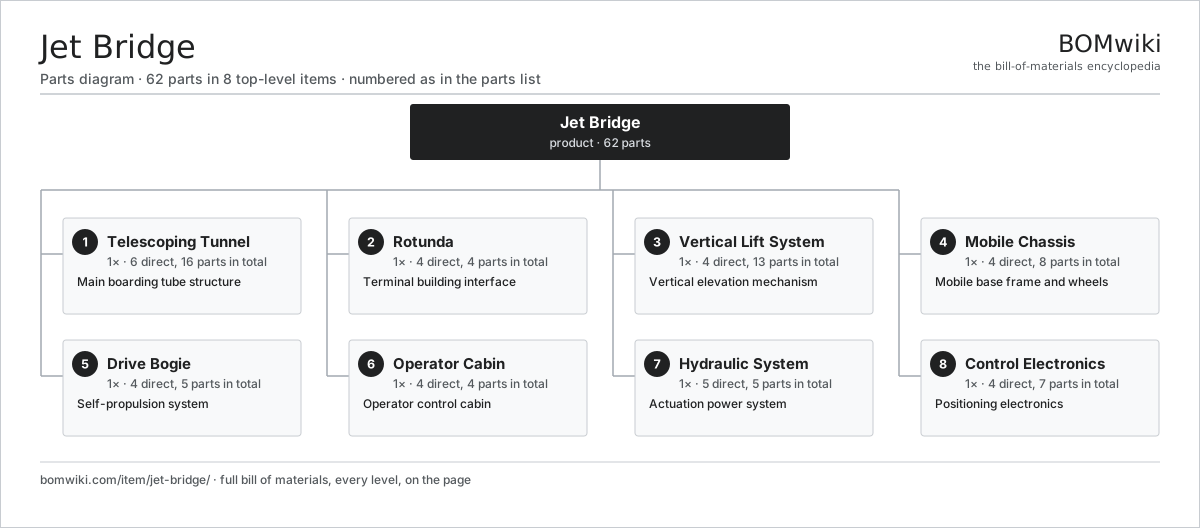
| # | Part | Qty | What it does |
|---|---|---|---|
| 1 | Telescoping Tunnel 6 parts | 1× | Main boarding tube structure |
| 2 | Rotunda 4 parts | 1× | Terminal building interface |
| 3 | Vertical Lift System 4 parts | 1× | Vertical elevation mechanism |
| 4 | Mobile Chassis 4 parts | 1× | Mobile base frame and wheels |
| 5 | Drive Bogie 4 parts | 1× | Self-propulsion system |
| 6 | Operator Cabin 4 parts | 1× | Operator control cabin |
| 7 | Hydraulic System 5 parts | 1× | Actuation power system |
| 8 | Control Electronics 4 parts | 1× | Positioning electronics |
3D model
No 3D model yet. Have a CAD file of this? Add a 3D model. STL renders right on this page; STEP, FreeCAD, and OpenSCAD sources are welcome too (openly licensed, like all 3D models on BOMwiki).
Build & assembly graph
expand / collapse · shared sub-assemblies converge · links to related products · est. labourTap an assembly to expand/collapse · tap a part to open it · use “Open page” for any node · drag to pan, scroll to zoom.
Bill of materials for Jet Bridge
8 top-level lines · 43 rows shown · 62 parts total · indented to 3 levels| # | Item / sub-assembly | Part no. | Qty/assy | Ext. qty | Parts | Type |
|---|---|---|---|---|---|---|
| 1 | Telescoping Tunnel 6 parts | jet-bridge-telescoping-tunnel | 1× | 1 | 16 | assembly |
| 1.1 | Outer Tube | jet-bridge-outer-tube | 1× | 1 | · | part |
| 1.2 | Inner Tube | jet-bridge-inner-tube | 1× | 1 | · | part |
| 1.3 | Floor Section | jet-bridge-floor-section | 3× | 3 | · | part |
| 1.4 | Handrail Set | jet-bridge-handrail-set | 2× | 2 | · | part |
| 1.5 | Extension Roller | jet-bridge-extension-roller | 8× | 8 | · | part |
| 1.6 | Bellows Seal | jet-bridge-bellows-seal | 1× | 1 | · | part |
| 2 | Rotunda 4 parts | jet-bridge-rotunda | 1× | 1 | 4 | assembly |
| 2.1 | Rotunda Frame | jet-bridge-rotunda-frame | 1× | 1 | · | part |
| 2.2 | Rotunda Floor | jet-bridge-rotunda-floor | 1× | 1 | · | part |
| 2.3 | Rotunda Stairs | jet-bridge-rotunda-stairs | 1× | 1 | · | part |
| 2.4 | Air Bridge | jet-bridge-air-bridge | 1× | 1 | · | part |
| 3 | Vertical Lift System 4 parts | jet-bridge-lift-system | 1× | 1 | 13 | assembly |
| 3.1 | Lift Cylinder | jet-bridge-lift-cylinder | 4× | 4 | · | part |
| 3.2 | Lift Beam | jet-bridge-lift-beam | 1× | 1 | · | part |
| 3.3 | Lift Linkage | jet-bridge-lift-linkage | 4× | 4 | · | part |
| 3.4 | Pressure Sensor | pressure-sensor | 4× | 4 | · | part |
| 4 | Mobile Chassis 4 parts | jet-bridge-chassis | 1× | 1 | 8 | assembly |
| 4.1 | Chassis Frame | jet-bridge-chassis-frame | 1× | 1 | · | part |
| 4.2 | Guide Wheel | jet-bridge-guide-wheel | 4× | 4 | · | part |
| 4.3 | Bumper Pad | jet-bridge-bumper-pads | 2× | 2 | · | part |
| 4.4 | Brake System | jet-bridge-brake-system | 1× | 1 | · | part |
| 5 | Drive Bogie 4 parts | jet-bridge-drive-bogie | 1× | 1 | 5 | assembly |
| 5.1 | Drive Motor | jet-bridge-drive-motor | 1× | 1 | · | part |
| 5.2 | Drive Transmission | jet-bridge-drive-transmission | 1× | 1 | · | part |
| 5.3 | Drive Wheel | jet-bridge-drive-wheels | 2× | 2 | · | part |
| 5.4 | Steering Control | jet-bridge-steering-control | 1× | 1 | · | part |
| 6 | Operator Cabin 4 parts | jet-bridge-cab | 1× | 1 | 4 | assembly |
| 6.1 | Cab Shelter | jet-bridge-cab-shelter | 1× | 1 | · | part |
| 6.2 | Cab Console | jet-bridge-cab-console | 1× | 1 | · | part |
| 6.3 | LCD Panel | lcd-panel | 1× | 1 | · | part |
| 6.4 | Cab Heater | jet-bridge-cab-heater | 1× | 1 | · | part |
| 7 | Hydraulic System 5 parts | jet-bridge-hydraulics | 1× | 1 | 5 | assembly |
| 7.1 | Hydraulic Pump | jet-bridge-hydraulic-pump | 1× | 1 | · | part |
| 7.2 | Hydraulic Tank | jet-bridge-hydraulic-tank | 1× | 1 | · | part |
| 7.3 | Valve Manifold | jet-bridge-valve-manifold | 1× | 1 | · | part |
| 7.4 | Accumulator | jet-bridge-accumulator | 1× | 1 | · | part |
| 7.5 | Wire Bundle | wire-bundle | 1× | 1 | · | part |
| 8 | Control Electronics 4 parts | jet-bridge-controls | 1× | 1 | 7 | assembly |
| 8.1 | Position Controller | jet-bridge-position-controller | 1× | 1 | · | part |
| 8.2 | Position Sensor | jet-bridge-position-sensor | 3× | 3 | · | part |
| 8.3 | Safety Relay | jet-bridge-safety-relay | 2× | 2 | · | part |
| 8.4 | Alarm Beacon | jet-bridge-alarm-beacon | 1× | 1 | · | part |
Something wrong in this list? Report a problem with this BOM.
Related products
same domain, ranked by shared parts


Sourcing: possible vendors
Browse the supplier directory → Prices, MOQ, and lead times are algorithmic estimates, not quotes, and not claims about these companies. Company mappings are curated by keyword; est. price band $30k–$1.5M. How estimates work| Vendor | HQ | Specialty | MOQ | Lead time |
|---|---|---|---|---|
| oshkoshaerotech.com ↗ | Orlando, US | Airport ground support | made to order | 16–30 wks |
| tld-group.com ↗ | Paris, FR | Ground support equipment | made to order | 16–30 wks |
| textrongse.txtsv.com ↗ | Augusta, US | Ground support equipment | made to order | 16–30 wks |
| vestergaardcompany.com ↗ | Skanderborg, DK | De-icers & GSE | made to order | 16–30 wks |
| mallaghangse.com ↗ | Dungannon, GB | Ground support equipment | made to order | 16–30 wks |
846-word article