Jib Crane
ProductOverview
A jib crane is a fixed crane consisting of a vertical pillar and a horizontal cantilevered arm that rotates (slews) about the pillar axis. A hoist trolley travels along the arm, so the hook covers an annular area, typically a 270° to 360° circle of 2 to 10 m radius. Jib cranes handle the short, repetitive lifts that would otherwise monopolise an overhead crane: loading machine tools, serving welding benches, tending presses. Capacities run from 125 kg ergonomic units to 10 t workshop columns, with 500 kg to 2 t the dominant class.
The machine divides into a structural set, Pillar (Mast), Jib Arm, Foundation Interface, and a mechanism set: the Slewing Unit, the Hoist Trolley, and the Electrification Kit that powers a hoist such as an electric chain hoist hung from the trolley.
Structure and load path
Every load on the hook produces two actions at the mast: a vertical force and an overturning moment equal to load times radius. A 1 t load at 4 m radius applies roughly 40 kN·m of moment, and it is this moment, not the vertical load, that sizes everything below the hook. The Boom Track Beam is a rolled IPE or W-shape whose bottom flange doubles as the trolley track; tip deflection is limited to about span/150 at rated load so the trolley does not run downhill. Free-standing designs carry the boom root on a welded Arm Connection Bracket; braced designs add a Tie Rod Brace from the mast top to mid-boom, which permits a lighter beam but obstructs hook approach near the mast.
The Mast Tube resists the moment in bending. At its foot, four or more Base Gusset Rib ribs spread the wall stress into the Base Flange Plate, and eight Foundation Anchor Bolt studs carry the moment as a push-pull couple into the concrete. The footing is large, commonly 1.5 to 3 m square and up to 1.2 m deep, because soil bearing, not steel strength, usually governs. Erection uses Levelling Nut Set sets to plumb the mast within 1:1000 before Non-Shrink Grout is rammed under the plate; an out-of-plumb mast makes the arm self-rotate toward the low side.
Slewing
The arm rotates on a Slewing Ring Bearing, a single-row, four-point-contact ball bearing with bolted rings, the same family of component used in excavator turntables. One bearing simultaneously reacts thrust (the vertical load), radial force, and the full tilting moment, which is why it replaced the older arrangement of separate top and bottom pivot bearings. Ring bolts are grade 10.9, torqued and re-checked annually, since bolt preload is what keeps the raceway geometry true.
Cranes up to about 2 t are slewed by hand: the operator simply pulls the load, and an adjustable Slew Friction Brake friction pad damps the motion so the arm does not coast. Larger or higher cranes use a Slew Drive Unit, a gearmotor whose Slew Pinion meshes with teeth cut into the slewing ring, turning the arm at 0.5–1 rpm. A Slew Limit Switch cuts the drive before the rubber Slew Buffer stops are struck. Standard cranes are limited to 270°–300° by the Rotation Limit Stop because the power cable rises through the mast and would wind up; full 360° endless slewing requires a slip-ring collector at the mast head.
Trolley and electrification
The Hoist Trolley is a four-wheel carrier whose flanged Wheel Assembly wheels run on the angled underside of the boom flange. Two Trolley Side Plate plates hang on a crossbar, the Hoist Suspension Bar, from which the hoist is suspended; Trolley Spacer Set washers adjust the plate gap to the flange width. Push trolleys suffice to about 2 t; beyond that a motorised trolley travels at 10–20 m/min.
Power reaches the moving hoist through the Electrification Kit kit: a galvanised Festoon C-Rail C-rail under the boom carries Festoon Cable Trolley cable carriers, each supporting a loop of Flat Festoon Cable. The festoon extends and gathers as the hoist travels. A lockable Mains Isolator Switch at the mast base provides maintenance isolation per EN 60204-32.
Variants
Wall-mounted (cantilever) jibs bolt to a building column and swing about 180°, saving floor space and foundation cost but requiring the column to take the moment. Articulating jibs use two hinged arm segments so the hook can reach around obstructions and inside machines. Foundationless models spread the moment over a wide bolted base on an existing 150–200 mm slab, trading radius and capacity (typically ≤1 t at ≤5 m) for installation cost. Stainless and food-grade versions are specified to EN 13001 with crane group classification matched to duty, while North American practice follows ASME B30.11 with a 15% impact allowance and span/150 deflection limit.
Jib Crane parts and their functions
7 top-level parts · 124 parts in total · full bill of materials below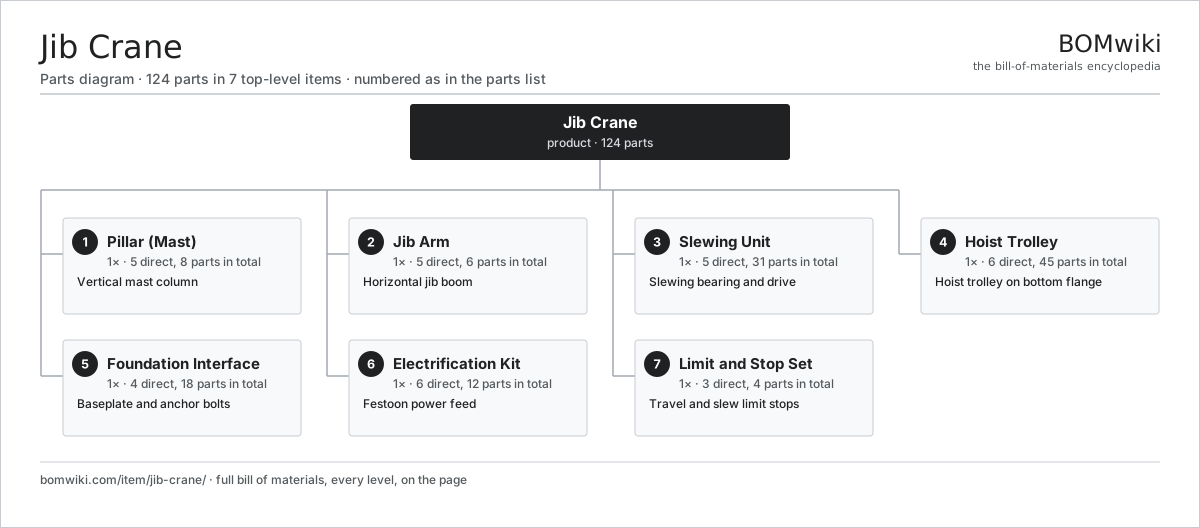
| # | Part | Qty | What it does |
|---|---|---|---|
| 1 | Pillar (Mast) 5 parts | 1× | Vertical mast column |
| 2 | Jib Arm 5 parts | 1× | Horizontal jib boom |
| 3 | Slewing Unit 5 parts | 1× | Slewing bearing and drive |
| 4 | Hoist Trolley 6 parts | 1× | Hoist trolley on bottom flange |
| 5 | Foundation Interface 4 parts | 1× | Baseplate and anchor bolts |
| 6 | Electrification Kit 6 parts | 1× | Festoon power feed |
| 7 | Limit and Stop Set 3 parts | 1× | Travel and slew limit stops |
3D model
No 3D model yet. Have a CAD file of this? Add a 3D model. STL renders right on this page; STEP, FreeCAD, and OpenSCAD sources are welcome too (openly licensed, like all 3D models on BOMwiki).
Build & assembly graph
expand / collapse · shared sub-assemblies converge · links to related products · est. labourTap an assembly to expand/collapse · tap a part to open it · use “Open page” for any node · drag to pan, scroll to zoom.
Bill of materials for Jib Crane
7 top-level lines · 50 rows shown · 124 parts total · indented to 3 levels| # | Item / sub-assembly | Part no. | Qty/assy | Ext. qty | Parts | Type |
|---|---|---|---|---|---|---|
| 1 | Pillar (Mast) 5 parts | jib-crane-pillar | 1× | 1 | 8 | assembly |
| 1.1 | Mast Tube | jib-crane-mast-tube | 1× | 1 | · | part |
| 1.2 | Base Flange Plate | jib-crane-base-flange | 1× | 1 | · | part |
| 1.3 | Head Flange | jib-crane-head-flange | 1× | 1 | · | part |
| 1.4 | Base Gusset Rib | jib-crane-gusset | 4× | 4 | · | part |
| 1.5 | Cable Access Cover | jib-crane-access-cover | 1× | 1 | · | part |
| 2 | Jib Arm 5 parts | jib-crane-arm | 1× | 1 | 6 | assembly |
| 2.1 | Boom Track Beam | jib-crane-boom-beam | 1× | 1 | · | part |
| 2.2 | Arm Connection Bracket | jib-crane-arm-bracket | 1× | 1 | · | part |
| 2.3 | Tie Rod Brace | jib-crane-tie-rod | 1× | 1 | · | part |
| 2.4 | Trolley End Stop | jib-crane-trolley-stop | 2× | 2 | · | part |
| 2.5 | Fastener Set | fastener-set | 1× | 1 | · | part |
| 3 | Slewing Unit 5 parts | jib-crane-slewing-unit | 1× | 1 | 31 | assembly |
| 3.1 | Slewing Ring Bearing | jib-crane-slewing-bearing | 1× | 1 | · | part |
| 3.2 | Slew Drive Unit 4 parts | jib-crane-slew-drive | 1× | 1 | 27 | assembly |
| 3.2.1 | Servo Motor 4 parts + deeper › | servo-motor | 1× | 1 | 24 | assembly |
| 3.2.2 | Helical Gear Pair | gear-pair | 1× | 1 | · | part |
| 3.2.3 | Slew Pinion | jib-crane-slew-pinion | 1× | 1 | · | part |
| 3.2.4 | Gearbox Housing | gearbox-housing | 1× | 1 | · | part |
| 3.3 | Slew Friction Brake | jib-crane-slew-brake | 1× | 1 | · | part |
| 3.4 | Rotation Limit Stop | jib-crane-rotation-stop | 1× | 1 | · | part |
| 3.5 | Fastener Set | fastener-set | 1× | 1 | · | part |
| 4 | Hoist Trolley 6 parts | jib-crane-trolley | 1× | 1 | 45 | assembly |
| 4.1 | Wheel Assembly 5 parts | wheel-assembly | 4× | 4 | 9 | assembly |
| 4.1.1 | Alloy Wheel | alloy-wheel | 1× | 4 | · | part |
| 4.1.2 | Tire | tire | 1× | 4 | · | part |
| 4.1.3 | TPMS Sensor | tpms-sensor | 1× | 4 | · | part |
| 4.1.4 | Lug Nut | lug-nut | 5× | 20 | · | part |
| 4.1.5 | Valve Stem | valve-stem | 1× | 4 | · | part |
| 4.2 | Trolley Side Plate | jib-crane-trolley-sideplate | 2× | 2 | · | part |
| 4.3 | Hoist Suspension Bar | jib-crane-hoist-lug | 1× | 1 | · | part |
| 4.4 | Trolley Spacer Set | jib-crane-trolley-spacer | 1× | 1 | · | part |
| 4.5 | Ball Bearing | ball-bearing | 4× | 4 | · | part |
| 4.6 | Fastener Set | fastener-set | 1× | 1 | · | part |
| 5 | Foundation Interface 4 parts | jib-crane-foundation | 1× | 1 | 18 | assembly |
| 5.1 | Foundation Anchor Bolt | jib-crane-anchor-bolt | 8× | 8 | · | part |
| 5.2 | Anchor Bolt Template | jib-crane-anchor-template | 1× | 1 | · | part |
| 5.3 | Levelling Nut Set | jib-crane-levelling-nut | 8× | 8 | · | part |
| 5.4 | Non-Shrink Grout | jib-crane-grout-pack | 1× | 1 | · | part |
| 6 | Electrification Kit 6 parts | jib-crane-electrification | 1× | 1 | 12 | assembly |
| 6.1 | Festoon C-Rail | jib-crane-festoon-track | 1× | 1 | · | part |
| 6.2 | Festoon Cable Trolley | jib-crane-festoon-trolley | 6× | 6 | · | part |
| 6.3 | Flat Festoon Cable | jib-crane-flat-cable | 1× | 1 | · | part |
| 6.4 | Mains Isolator Switch | jib-crane-isolator | 1× | 1 | · | part |
| 6.5 | Connector | connector | 2× | 2 | · | part |
| 6.6 | Wire Bundle | wire-bundle | 1× | 1 | · | part |
| 7 | Limit and Stop Set 3 parts | jib-crane-end-stops | 1× | 1 | 4 | assembly |
| 7.1 | Slew Buffer | jib-crane-slew-buffer | 2× | 2 | · | part |
| 7.2 | Slew Limit Switch | jib-crane-slew-limit-switch | 1× | 1 | · | part |
| 7.3 | Fastener Set | fastener-set | 1× | 1 | · | part |
Something wrong in this list? Report a problem with this BOM.
Related products
same domain, ranked by shared parts Forklift
4,153 parts · shares 7 with this page
Forklift
4,153 parts · shares 7 with this page
 Straddle Carrier
122 parts · shares 6 with this page
Straddle Carrier
122 parts · shares 6 with this page
 Telehandler
349 parts · shares 6 with this page
Telehandler
349 parts · shares 6 with this page
 Bag Dump Station
134 parts · shares 3 with this page
Bag Dump Station
134 parts · shares 3 with this page
 Bag Palletizer
951 parts · shares 3 with this page
Bag Palletizer
951 parts · shares 3 with this page
 Container Handler
552 parts · shares 3 with this page
Container Handler
552 parts · shares 3 with this page
Sourcing: possible vendors
Browse the supplier directory → Prices, MOQ, and lead times are algorithmic estimates, not quotes, and not claims about these companies. Company mappings are curated by keyword; est. price band $2k–$300k. How estimates work| Vendor | HQ | Specialty | MOQ | Lead time |
|---|---|---|---|---|
| toyota-industries.com ↗ | Kariya, JP | Forklifts & logistics | 20 units | 10–16 wks |
| kiongroup.com ↗ | Frankfurt, DE | Forklifts (Linde, STILL) | 20 units | 10–16 wks |
| jungheinrich.com ↗ | Hamburg, DE | Warehouse trucks | 20 units | 10–16 wks |
| crown.com ↗ | New Bremen, US | Forklifts | 20 units | 10–16 wks |
|
🇨🇳Hangcha
hcforklift.com ↗
|
Hangzhou, CN | Forklifts & material handling | 20 units | 10–16 wks |
846-word article