Jig Borer
ProductOverview
A jig borer is a precision vertical milling machine designed specifically for boring holes in jigs, fixtures, and master parts where absolute accuracy of hole location is critical, sometimes within 0.025 mm (±0.001"). Unlike a general-purpose drill press or milling machine, a jig borer has an ultra-rigid Precision Spindle Assembly with runout under 0.001" TIR, precision Coordinate Table with calibrated dials, and fine feed controls that allow positioning to a fraction of a millimeter. The entire machine is a collection of precision-made components: the Main Column is stress-relieved ductile iron, the Spindle Head with Z Positioning carries a lead-screw Z-Axis Dial for vertical positioning, and the X and Y table movements are controlled by hand-cranked Lead Screw with Dial micrometers. Jig borers are expensive and specialized, found mainly in toolrooms, aerospace shops, and manufacturing engineering departments where hole accuracy directly affects product quality.
Spindle and bearings
The Precision Spindle Assembly is the heart of the machine's accuracy. Its Spindle Shaft is ground to micron tolerances and runs in high-precision angular contact Ball Bearing pairs, often preloaded and running in oil. Runout (the radial deviation of the spindle centerline as it rotates) is measured at <0.001" TIR (total indicated runout) at the Spindle Collet, achievable only with small-diameter shafts (typically 25–35 mm) and precision spindles costing thousands of dollars. The spindle is driven by a 0.5–3 kW Drive Motor at 500–3000 rpm, often with variable speed via a Speed Control. Lower speeds (500–1000 rpm) are used for tough materials or larger drills; higher speeds (2000–3000 rpm) for finishing and small-diameter holes.
Coordinate table and positioning
The Coordinate Table is a ductile iron Table Casting that moves in X and Y directions on hardened and scraped precision ways. Unlike a typical milling machine table with rapid positioning, the jig borer uses hand-cranked jig-borer-ball-screw leads with calibrated Lead Screw with Dial dials. Each complete turn of the dial advances the table by a known distance (e.g., 1 mm per turn on a metric dial), and the dial face is subdivided into 100 divisions, each representing 0.01 mm. The table locks in place with a precision clamp, then the operator manually turns the X dial to the desired hole location (measured in mm or inches), verifies the reading, and locks the table. A X-Axis Micrometer and Y-Axis Micrometer repeat the process for Y. This manual but precise method, combined with careful layout and a sharp drill, delivers hole concentricity within ±0.05 mm in a well-maintained machine.
Head positioning and Z infeed
The Spindle Head with Z Positioning, which carries the Precision Spindle Assembly, moves vertically on hardened precision Vertical Guide Ways of the Main Column. A Z-Axis Lead Screw (typically 2 mm pitch on metric machines) with a Z-Axis Micrometer allows the operator to set the vertical distance from the spindle nose to the workpiece surface to within 0.01 mm. Once set and locked, the drill engages the part at a consistent depth. Some machines have power Z-feeds; others rely on manual hand-wheel drives. The Spindle Nose Block interfaces with the spindle, and the entire head assembly is supported by precision Ball Bearing slides that allow smooth, friction-free motion.
Frame and reference datum
The Main Column is precision ductile iron, typically stress-relieved to stabilize dimensions. The Column Casting is scraped and hardened on its Vertical Guide Ways (usually V-grooves and flat ways), achieving straightness and parallelism to a few micrometers. The Column Base sits on the shop floor, typically with Table T-Slot Clamps or precision magnetic mounting feet to isolate vibration. A warped or poorly installed foundation can degrade a jig borer's accuracy significantly.
Fine feed controls
The Fine Feed Controls subsystem is what makes a jig borer distinct. Unlike rapid handwheels on a mill, the X, Y, and Z axes have X-Axis Micrometer, Y, and Z dials marked in 0.01 mm (metric) or 0.001" (inch) increments. Some machines use vernier calipers for ultra-fine reading; others employ digital readouts on the dials for ease of use. The Zero Adjust Locks allow each dial to be re-zeroed after a hole is bored, simplifying the setup for the next hole: bore the first hole, zero the dial, position to the next hole location by the dial, drill, and repeat.
Drilling cycle
A toolmaker wants to bore four holes in a plate at exact spacings: 50.00 mm (X) and 25.00 mm (Y) from a reference corner. The plate is clamped to the Coordinate Table, and the first hole location (0.00, 0.00) is established by moving the table and spindle to touch a layout line or edge. The X and Y dials are zeroed. The spindle speed is set to 1500 rpm for the 5 mm drill (steel), and the drill is manually advanced downward by turning the Z dial hand-wheel. The drill breaks through, and the depth dial is zeroed. The next hole is 50 mm away in X; the operator cranks the X dial to 50.00, locks the table, and spins down the Z dial to engage the drill. Repeat for the remaining two holes at Y = 25.00 and Y = 50.00, each time advancing X back to 0.00. All four holes end up within ±0.05 mm of their intended locations, precision that would be difficult or impossible on a standard milling machine.
Applications
Jig borers are used to bore or ream holes in:
- Drill jigs: Master templates with precision-positioned bushings that guide drills.
- Fixtures: Custom clamping devices for production machines.
- Master gages: Reference parts against which production parts are checked.
- Aerospace components: High-tolerance assemblies where hole location affects stress distribution.
- Plastic mold inserts: Cooling holes and other features requiring precise alignment.
Because jig borers are slow and labor-intensive compared to CNC mills, their use has declined in high-volume production. However, for low-volume custom work and toolmaking, they remain invaluable.
Jig Borer parts and their functions
8 top-level parts · 47 parts in total · full bill of materials below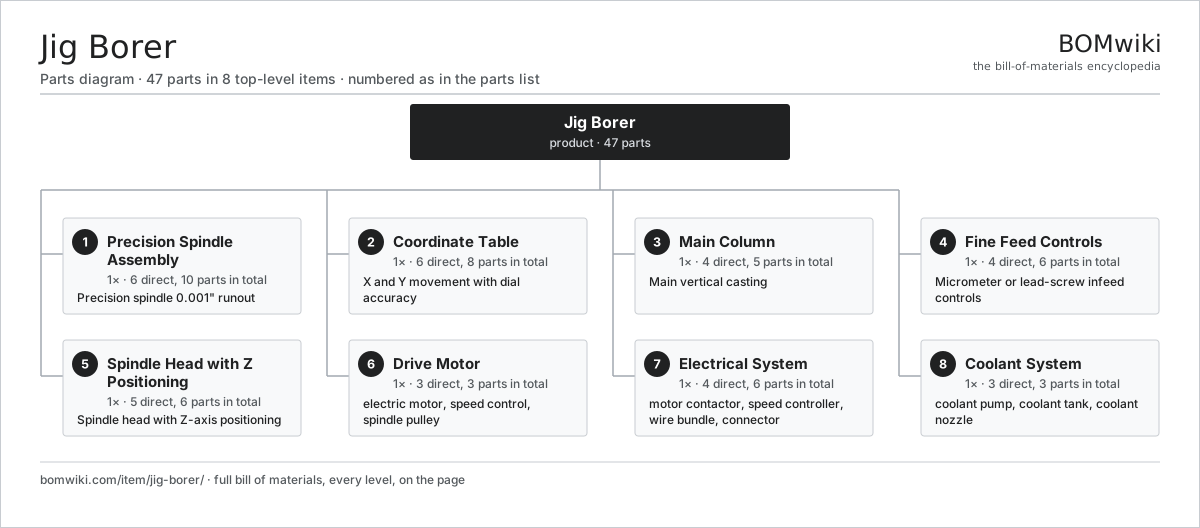
| # | Part | Qty | What it does |
|---|---|---|---|
| 1 | Precision Spindle Assembly 6 parts | 1× | Precision spindle 0.001" runout |
| 2 | Coordinate Table 6 parts | 1× | X and Y movement with dial accuracy |
| 3 | Main Column 4 parts | 1× | Main vertical casting |
| 4 | Fine Feed Controls 4 parts | 1× | Micrometer or lead-screw infeed controls |
| 5 | Spindle Head with Z Positioning 5 parts | 1× | Spindle head with Z-axis positioning |
| 6 | Drive Motor 3 parts | 1× | Low-speed, variable spindle motor with speed control. |
| 7 | Electrical System 4 parts | 1× | Motor starter and speed control electronics. |
| 8 | Coolant System 3 parts | 1× | Pump and nozzle delivering cutting fluid, often hand-oilcan style. |
3D model
No 3D model yet. Have a CAD file of this? Add a 3D model. STL renders right on this page; STEP, FreeCAD, and OpenSCAD sources are welcome too (openly licensed, like all 3D models on BOMwiki).
Build & assembly graph
expand / collapse · shared sub-assemblies converge · links to related products · est. labourTap an assembly to expand/collapse · tap a part to open it · use “Open page” for any node · drag to pan, scroll to zoom.
Bill of materials for Jig Borer
8 top-level lines · 43 rows shown · 47 parts total · indented to 3 levels| # | Item / sub-assembly | Part no. | Qty/assy | Ext. qty | Parts | Type |
|---|---|---|---|---|---|---|
| 1 | Precision Spindle Assembly 6 parts | jig-borer-spindle | 1× | 1 | 10 | assembly |
| 1.1 | Spindle Bearing Housing | jig-borer-spindle-housing | 1× | 1 | · | part |
| 1.2 | Ball Bearing | ball-bearing | 4× | 4 | · | part |
| 1.3 | Spindle Shaft | jig-borer-spindle-shaft | 1× | 1 | · | part |
| 1.4 | Spindle Collet | jig-borer-spindle-collet | 1× | 1 | · | part |
| 1.5 | Spindle Motor | jig-borer-spindle-motor | 1× | 1 | · | part |
| 1.6 | Oil Seal | oil-seal | 2× | 2 | · | part |
| 2 | Coordinate Table 6 parts | jig-borer-coordinate-table | 1× | 1 | 8 | assembly |
| 2.1 | Table Casting | jig-borer-table-casting | 1× | 1 | · | part |
| 2.2 | X-Axis Slide | jig-borer-x-slide | 1× | 1 | · | part |
| 2.3 | Y-Axis Slide | jig-borer-y-slide | 1× | 1 | · | part |
| 2.4 | Ball Screw | ball-screw | 2× | 2 | · | part |
| 2.5 | Lead Screw with Dial | jig-borer-lead-screw-dial | 2× | 2 | · | part |
| 2.6 | Table T-Slot Clamps | jig-borer-table-clamps | 1× | 1 | · | part |
| 3 | Main Column 4 parts | jig-borer-column | 1× | 1 | 5 | assembly |
| 3.1 | Column Casting | jig-borer-column-body | 1× | 1 | · | part |
| 3.2 | Column Base | jig-borer-column-base | 1× | 1 | · | part |
| 3.3 | Vertical Guide Ways | jig-borer-column-ways | 2× | 2 | · | part |
| 3.4 | Fastener Set | fastener-set | 1× | 1 | · | part |
| 4 | Fine Feed Controls 4 parts | jig-borer-fine-feeds | 1× | 1 | 6 | assembly |
| 4.1 | X-Axis Micrometer | jig-borer-x-micrometer-dial | 1× | 1 | · | part |
| 4.2 | Y-Axis Micrometer | jig-borer-y-micrometer-dial | 1× | 1 | · | part |
| 4.3 | Z-Axis Micrometer | jig-borer-z-micrometer-dial | 1× | 1 | · | part |
| 4.4 | Zero Adjust Locks | jig-borer-zero-adjust-mechanisms | 3× | 3 | · | part |
| 5 | Spindle Head with Z Positioning 5 parts | jig-borer-head | 1× | 1 | 6 | assembly |
| 5.1 | Head Housing | jig-borer-head-body | 1× | 1 | · | part |
| 5.2 | Z-Axis Lead Screw | jig-borer-z-lead-screw | 1× | 1 | · | part |
| 5.3 | Z-Axis Dial | jig-borer-z-dial | 1× | 1 | · | part |
| 5.4 | Spindle Nose Block | jig-borer-spindle-nose-block | 1× | 1 | · | part |
| 5.5 | Ball Bearing | ball-bearing | 2× | 2 | · | part |
| 6 | Drive Motor 3 parts | jig-borer-drive-motor | 1× | 1 | 3 | assembly |
| 6.1 | Electric Motor | jig-borer-drive-motor-body | 1× | 1 | · | part |
| 6.2 | Speed Control | jig-borer-speed-control-dial | 1× | 1 | · | part |
| 6.3 | Spindle Pulley | jig-borer-spindle-pulley | 1× | 1 | · | part |
| 7 | Electrical System 4 parts | jig-borer-electrical | 1× | 1 | 6 | assembly |
| 7.1 | Motor Contactor | jig-borer-motor-contactor | 1× | 1 | · | part |
| 7.2 | Speed Controller | jig-borer-vfd-or-rheostat | 1× | 1 | · | part |
| 7.3 | Wire Bundle | wire-bundle | 1× | 1 | · | part |
| 7.4 | Connector | connector | 3× | 3 | · | part |
| 8 | Coolant System 3 parts | jig-borer-coolant-system | 1× | 1 | 3 | assembly |
| 8.1 | Coolant Pump | jig-borer-coolant-pump | 1× | 1 | · | part |
| 8.2 | Coolant Tank | jig-borer-coolant-reservoir | 1× | 1 | · | part |
| 8.3 | Coolant Nozzle | jig-borer-coolant-nozzle | 1× | 1 | · | part |
Something wrong in this list? Report a problem with this BOM.
Related products
same domain, ranked by shared parts Bed-Type Milling Machine
151 parts · shares 1 with this page
Bed-Type Milling Machine
151 parts · shares 1 with this page
 Bevel Gear Generator
201 parts · shares 1 with this page
Camshaft Grinder
489 parts · shares 1 with this page
Centering and Facing Machine
1,419 parts · shares 1 with this page
Bevel Gear Generator
201 parts · shares 1 with this page
Camshaft Grinder
489 parts · shares 1 with this page
Centering and Facing Machine
1,419 parts · shares 1 with this page
 Centerless Grinder
129 parts · shares 1 with this page
Centerless Grinder
129 parts · shares 1 with this page
Sourcing: possible vendors
Browse the supplier directory → Prices, MOQ, and lead times are algorithmic estimates, not quotes, and not claims about these companies. Company mappings are curated by keyword; est. price band $10k–$1M. How estimates work| Vendor | HQ | Specialty | MOQ | Lead time |
|---|---|---|---|---|
|
🇩🇪DMG MORI
dmgmori.com ↗
|
Bielefeld, DE | Machine tools | 5 units | 12–20 wks |
|
🇯🇵Mazak
mazak.com ↗
|
Oguchi, JP | Machine tools | 5 units | 12–20 wks |
| haascnc.com ↗ | Oxnard, US | CNC machine tools | 5 units | 12–20 wks |
|
🇯🇵Okuma
okuma.com ↗
|
Niwa, JP | Machine tools | 5 units | 12–20 wks |
|
🇩🇪Trumpf
trumpf.com ↗
|
Ditzingen, DE | Laser & sheet-metal machines | 5 units | 12–20 wks |
1,064-word article