Jig Grinder
ProductOverview
A jig grinder finishes hardened holes to extraordinary tolerance, ±0.01 mm (±0.0004"), by grinding rather than boring. After a hole has been drilled, hardened, and left 0.1–0.2 mm oversize, a jig grinder removes that final layer under precise control, delivering a perfectly cylindrical hole with excellent surface finish and form. The High-Speed Grinding Spindle runs at 3000–10000 rpm with a tiny 1–3 mm diameter Grinding Wheel (1-3 mm), guided by a Planetary Motion Head that allows the wheel to orbit and traverse the hole wall. The Coordinate Table positions the part with the same precision as a jig borer. Jig grinders are found in tool-and-die shops, aerospace suppliers, and anywhere hardened components require extremely accurate holes, fuel injector bodies, hydraulic manifold blocks, precision pump housings.
Grinding spindle and wheel
The High-Speed Grinding Spindle is even more rigid than a jig borer spindle. Its Spindle Shaft is 15–20 mm diameter and runs in preloaded angular-contact Ball Bearing pairs in the Spindle Bearing Housing, achieving runout under 0.0005" TIR at the wheel. The Grinding Wheel (1-3 mm) is typically 1–3 mm in diameter, bonded with a vitrified or resinoid abrasive (usually aluminum oxide or CBN), and form-dressed (shaped to the hole profile) by the Wheel Dressing Unit. The spindle is driven by a Spindle VFD at constant speed; lower speeds (3000–5000 rpm) are used for roughing or hard materials, higher speeds (7000–10000 rpm) for finishing and fine form control.
Planetary motion mechanism
The Planetary Motion Head is the key feature that distinguishes a jig grinder. The grinding spindle doesn't simply move vertically; it orbits. A Planetary Rotation Arm rotates about the vertical centerline (driven by the Planetary Drive Motor), carrying the Spindle Nose Carriage and grinding wheel along a circular path. The orbit radius is adjustable via the Radial (X) Feed Screw and controlled by a Planetary Position Dial: starting with a 0.5 mm orbit, the wheel makes contact at a single point on the hole wall, grinding away 0.001–0.002" per revolution. As the wheel orbits, it traces the cylindrical surface, removing material uniformly. Simultaneously, the Vertical (Z) Feed Screw can advance the wheel vertically in small increments (0.01 mm typical), allowing the wheel to traverse the full depth of a deep hole without stopping. This combination of orbital motion (maintaining roundness) and axial feed (filling the hole depth) produces a finished hole that is round, straight, and accurately sized.
Coordinate table and positioning
The Coordinate Table, with its X-Axis Slide and Y-Axis Slide, is identical in function to a jig borer's table. The workpiece is positioned using hand-cranked X/Y Micrometer Dial dials with 0.01 mm graduations. The hole location is set, the spindle is lowered over the hole, and grinding begins. On a machine with fully automated controls, the table and planetary motions might be linked, allowing the machine to finish multiple holes in a programmed sequence.
Column and frame
The Main Column is precision ductile iron, stress-relieved and ground on its Vertical Precision Ways to a few micrometers of straightness. The entire machine is suspended on vibration-isolating mounts to prevent resonance that could degrade the finished hole form.
Wheel dressing and form control
The Wheel Dressing Unit employs a Diamond Dresser (single-point diamond, typically) to periodically remove the glazed outer layer of abrasive grains. Unlike a planer or shaper, the wheel is form-dressed: the diamond is positioned on a path that traces the desired hole profile (circular, for most applications; sometimes tapered or contoured). Each dressing cycle might take 10–30 seconds. The frequency depends on spindle speed and material hardness; a shop running steel at 5000 rpm might dress every 20–50 holes; one running aluminum at 8000 rpm every 100–200 holes. Keeping the wheel sharp and true is essential; a dull or out-of-round wheel produces poor surface finish and tapered holes.
Coolant and chip management
The Coolant System is critical. A Coolant Pump circulates a fine oil-in-water emulsion (typically 1–2 µm active viscosity) through a Coolant Nozzle directed at the grinding zone. The grinding action generates heat and very fine abrasive dust; coolant cools the part and flushes the dust toward the Chip Separator, which removes spent abrasive particles before the coolant recirculates. A Coolant Filter keeps the supply tank clean. Without adequate cooling, the workpiece heats up, expands, and the hole grows out of tolerance; fine abrasive dust remaining in the coolant will scratch the finished hole.
Typical finishing cycle
A hardened hydraulic manifold block arrives with four drilled holes, each left 0.15 mm oversize (e.g., a nominally 10 mm hole has been drilled to 10.15 mm and hardened at 58 HRC). The block is mounted on the Coordinate Table, the first hole positioned under the Planetary Motion Head, and the spindle is lowered to light engagement. The grinding wheel (3 mm diameter, form-dressed to a 10 mm circle) is set to orbit at 1 mm radius with a 0.005 mm/revolution feed. The Planetary Drive Motor starts the orbit; the wheel traces the hole wall, removing 0.002 mm per orbit. After roughly 100 orbits (10 seconds), the hole is finished: 10.0 mm ±0.01 mm, surface finish Ra 0.2 µm, perfectly round. The workpiece is indexed to the next hole, and the cycle repeats.
Advantages and limitations
Grinding tolerates the hardened state of the workpiece, making it ideal for heat-treated parts where boring would be difficult. The orbit mechanism ensures roundness independent of spindle runout (which is minimal anyway). The downside is speed: finishing a 10 mm hole takes roughly 20–30 seconds (compared to 2–3 seconds on a modern CNC mill with comparable spindle stability). Jig grinders are labor-intensive and typically used only when the tolerance or form requirement cannot be met any other way.
Jig Grinder parts and their functions
8 top-level parts · 49 parts in total · full bill of materials below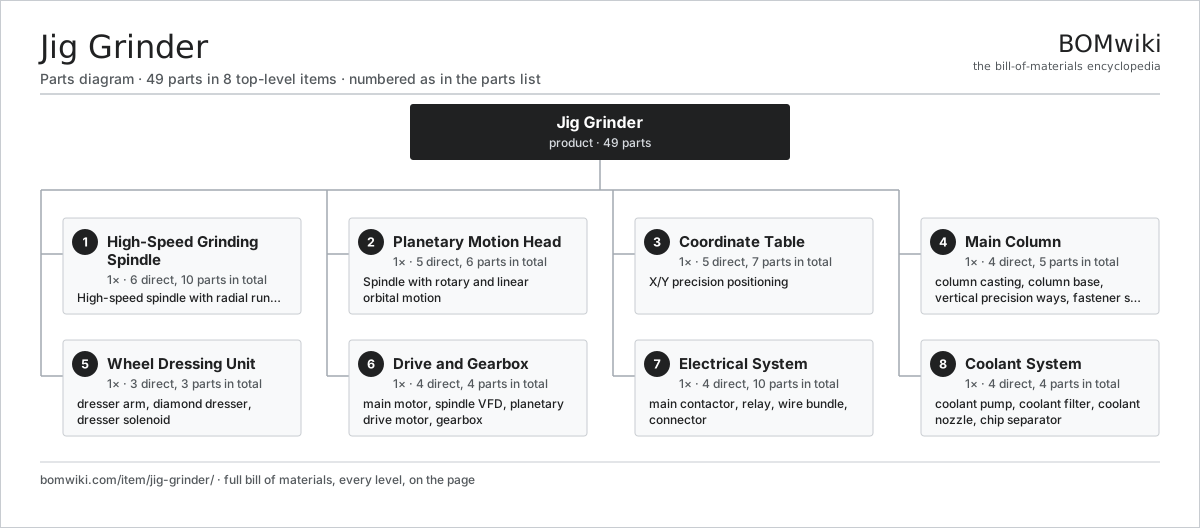
| # | Part | Qty | What it does |
|---|---|---|---|
| 1 | High-Speed Grinding Spindle 6 parts | 1× | High-speed spindle with radial runout <0.0005" |
| 2 | Planetary Motion Head 5 parts | 1× | Spindle with rotary and linear orbital motion |
| 3 | Coordinate Table 5 parts | 1× | X/Y precision positioning |
| 4 | Main Column 4 parts | 1× | Precision vertical casting serving as reference frame. |
| 5 | Wheel Dressing Unit 3 parts | 1× | Automatically trues the grinding wheel to maintain form accuracy. |
| 6 | Drive and Gearbox 4 parts | 1× | Motor and transmission providing spindle drive and planetary motion actuation. |
| 7 | Electrical System 4 parts | 1× | Motor control and safety interlocks. |
| 8 | Coolant System 4 parts | 1× | Delivers grinding coolant and removes fine abrasive dust. |
3D model
No 3D model yet. Have a CAD file of this? Add a 3D model. STL renders right on this page; STEP, FreeCAD, and OpenSCAD sources are welcome too (openly licensed, like all 3D models on BOMwiki).
Build & assembly graph
expand / collapse · shared sub-assemblies converge · links to related products · est. labourTap an assembly to expand/collapse · tap a part to open it · use “Open page” for any node · drag to pan, scroll to zoom.
Bill of materials for Jig Grinder
8 top-level lines · 43 rows shown · 49 parts total · indented to 3 levels| # | Item / sub-assembly | Part no. | Qty/assy | Ext. qty | Parts | Type |
|---|---|---|---|---|---|---|
| 1 | High-Speed Grinding Spindle 6 parts | jig-grinder-grinding-spindle | 1× | 1 | 10 | assembly |
| 1.1 | Spindle Bearing Housing | jig-grinder-spindle-bearing-housing | 1× | 1 | · | part |
| 1.2 | Ball Bearing | ball-bearing | 4× | 4 | · | part |
| 1.3 | Spindle Shaft | jig-grinder-spindle-shaft | 1× | 1 | · | part |
| 1.4 | Grinding Wheel (1-3 mm) | jig-grinder-grinding-wheel-small | 1× | 1 | · | part |
| 1.5 | Spindle Motor | jig-grinder-spindle-motor | 1× | 1 | · | part |
| 1.6 | Oil Seal | oil-seal | 2× | 2 | · | part |
| 2 | Planetary Motion Head 5 parts | jig-grinder-planetary-head | 1× | 1 | 6 | assembly |
| 2.1 | Planetary Rotation Arm | jig-grinder-planetary-arm | 1× | 1 | · | part |
| 2.2 | Spindle Nose Carriage | jig-grinder-spindle-nose-carriage | 1× | 1 | · | part |
| 2.3 | Radial (X) Feed Screw | jig-grinder-x-feed-screw-planetary | 1× | 1 | · | part |
| 2.4 | Vertical (Z) Feed Screw | jig-grinder-z-feed-screw-planetary | 1× | 1 | · | part |
| 2.5 | Planetary Position Dial | jig-grinder-planetary-indexing-dial | 2× | 2 | · | part |
| 3 | Coordinate Table 5 parts | jig-grinder-coordinate-table | 1× | 1 | 7 | assembly |
| 3.1 | Table Casting | jig-grinder-table-casting | 1× | 1 | · | part |
| 3.2 | X-Axis Slide | jig-grinder-x-slide | 1× | 1 | · | part |
| 3.3 | Y-Axis Slide | jig-grinder-y-slide | 1× | 1 | · | part |
| 3.4 | Ball Screw | ball-screw | 2× | 2 | · | part |
| 3.5 | X/Y Micrometer Dial | jig-grinder-lead-screw-dial | 2× | 2 | · | part |
| 4 | Main Column 4 parts | jig-grinder-column | 1× | 1 | 5 | assembly |
| 4.1 | Column Casting | jig-grinder-column-body | 1× | 1 | · | part |
| 4.2 | Column Base | jig-grinder-column-base | 1× | 1 | · | part |
| 4.3 | Vertical Precision Ways | jig-grinder-vertical-ways | 2× | 2 | · | part |
| 4.4 | Fastener Set | fastener-set | 1× | 1 | · | part |
| 5 | Wheel Dressing Unit 3 parts | jig-grinder-grinding-wheel-dresser | 1× | 1 | 3 | assembly |
| 5.1 | Dresser Arm | jig-grinder-dresser-arm | 1× | 1 | · | part |
| 5.2 | Diamond Dresser | jig-grinder-diamond-dresser-point | 1× | 1 | · | part |
| 5.3 | Dresser Solenoid | jig-grinder-dresser-solenoid | 1× | 1 | · | part |
| 6 | Drive and Gearbox 4 parts | jig-grinder-drive-system | 1× | 1 | 4 | assembly |
| 6.1 | Main Motor | jig-grinder-drive-motor | 1× | 1 | · | part |
| 6.2 | Spindle VFD | jig-grinder-spindle-vfd | 1× | 1 | · | part |
| 6.3 | Planetary Drive Motor | jig-grinder-planetary-motor | 1× | 1 | · | part |
| 6.4 | Gearbox | jig-grinder-gearbox | 1× | 1 | · | part |
| 7 | Electrical System 4 parts | jig-grinder-electrical | 1× | 1 | 10 | assembly |
| 7.1 | Main Contactor | jig-grinder-main-contactor | 1× | 1 | · | part |
| 7.2 | Relay | relay | 2× | 2 | · | part |
| 7.3 | Wire Bundle | wire-bundle | 1× | 1 | · | part |
| 7.4 | Connector | connector | 6× | 6 | · | part |
| 8 | Coolant System 4 parts | jig-grinder-coolant-system | 1× | 1 | 4 | assembly |
| 8.1 | Coolant Pump | jig-grinder-coolant-pump | 1× | 1 | · | part |
| 8.2 | Coolant Filter | jig-grinder-coolant-filter | 1× | 1 | · | part |
| 8.3 | Coolant Nozzle | jig-grinder-coolant-nozzle | 1× | 1 | · | part |
| 8.4 | Chip Separator | jig-grinder-chip-separator | 1× | 1 | · | part |
Something wrong in this list? Report a problem with this BOM.
Related products
same domain, ranked by shared parts Bed-Type Milling Machine
151 parts · shares 1 with this page
Bed-Type Milling Machine
151 parts · shares 1 with this page
 Bevel Gear Generator
201 parts · shares 1 with this page
Camshaft Grinder
489 parts · shares 1 with this page
Centering and Facing Machine
1,419 parts · shares 1 with this page
Bevel Gear Generator
201 parts · shares 1 with this page
Camshaft Grinder
489 parts · shares 1 with this page
Centering and Facing Machine
1,419 parts · shares 1 with this page
 Centerless Grinder
129 parts · shares 1 with this page
Centerless Grinder
129 parts · shares 1 with this page
Sourcing: possible vendors
Browse the supplier directory → Prices, MOQ, and lead times are algorithmic estimates, not quotes, and not claims about these companies. Company mappings are curated by keyword; est. price band $10k–$1M. How estimates work| Vendor | HQ | Specialty | MOQ | Lead time |
|---|---|---|---|---|
|
🇩🇪DMG MORI
dmgmori.com ↗
|
Bielefeld, DE | Machine tools | 5 units | 12–20 wks |
|
🇯🇵Mazak
mazak.com ↗
|
Oguchi, JP | Machine tools | 5 units | 12–20 wks |
| haascnc.com ↗ | Oxnard, US | CNC machine tools | 5 units | 12–20 wks |
|
🇯🇵Okuma
okuma.com ↗
|
Niwa, JP | Machine tools | 5 units | 12–20 wks |
|
🇩🇪Trumpf
trumpf.com ↗
|
Ditzingen, DE | Laser & sheet-metal machines | 5 units | 12–20 wks |
1,052-word article