Juice Bubbler Dispenser
ProductOverview
The juice bubbler dispenser is a refrigerated beverage station featuring a decorative cascading spray effect that keeps chilled juice visible and inviting to customers. Found in diners, fast-casual restaurants, bowling alleys, and arcade venues, the bubbler combines cold storage, circulation, and dispensing in one compact unit.
The machine's defining feature is the spray nozzle at the center of the bowl. A circulation pump draws juice from the bowl and forces it upward through the nozzle, where it emerges as a fountain. The cascading juice falls back into the bowl, creating visual movement and appealing presentation. This circulation also aerates and mixes the juice, ensuring uniform flavor.
The bowl is housed in an insulated, refrigerated cabinet maintaining 35–40°F. A hermetic compressor system similar to a small household refrigerator cools the juice continuously. Customers dispense via a gravity-fed tap at the base, or (in some models) a solenoid portion valve for portion-controlled service.
How It Works
The operator fills the bowl with freshly prepared juice (concentrate diluted with water, or pre-made bottled juice). The power switch is activated on the control panel. The compressor energizes, and the refrigeration thermostat begins cycling to bring the juice down from room temperature to 35–40°F. This initial cool-down typically takes 20–30 minutes.
Once the juice reaches temperature, the pump motor is switched on (often automatically linked to the power switch). The pump impeller draws juice from the bowl through the suction line, creates pressure, and forces the juice up through the discharge line to the spray nozzle.
At the nozzle, the pressurized juice emerges from 4–8 small holes, forming a multi-jet fountain. The juice cascades down the deflector, creating a sheet or curtain of liquid that falls back into the bowl. This spectacle is visible through transparent or translucent bowl walls, attracting customer attention.
As juice circulates, air is incorporated into the flow, creating visible bubbles and a lively appearance (hence the name "bubbler"). The constant recirculation keeps juice mixed and prevents settling of sediment or particles.
When a customer wants a drink, they open the tap valve at the dispensing faucet. Gravity pressure from the bowl height (18–24 inches above the tap) delivers juice. The customer fills their cup, closes the tap, and the dispensed volume can be metered by a solenoid valve if the machine includes portion control.
The refrigeration system cycles continuously as juice is dispensed and removed from the bowl. The thermostat senses temperature dropping as juice is withdrawn, and the compressor energizes to re-cool. As long as the ambient room temperature is below 75°F, the compressor can maintain 35–40°F inside the bowl.
Juice Selection and Preservation
Juice bubblers work with any chilled beverage: orange juice, grape juice, fruit punch, lemonade, or pre-made soft drink syrups diluted with carbonated or still water. Carbonated beverages require a slight design change, closed bowl and sealed lines, to prevent CO₂ loss; most traditional bubblers are designed for still juice.
Pulpy juices (with orange flesh particles or berry seeds) can clog the pump inlet strainer. Some installations include a coarse strainer in the bowl to trap large particles.
Fresh juice begins to oxidize and sour after 4–6 hours in the bubbler, even when refrigerated. Commercial operations typically drain and refill every 2–4 hours during service, more frequently in busy venues. The bowl drain at the base allows quick drainage.
Maintenance
Daily cleaning involves draining the bowl at shift end and rinsing with hot water. The spray nozzle is soaked to dissolve any sugar buildup from juice that crystallizes. The pump inlet strainer is inspected and cleaned of debris, a clogged strainer reduces pump output or causes cavitation noise.
Weekly, the pump discharge line is flushed with fresh water and mild vinegar (1:3 vinegar:water) to dissolve any sugar deposits inside the tubing. The refrigeration condenser coils (visible on the back of the cabinet) are vacuumed or blown clean of dust; a clogged condenser reduces cooling efficiency and causes the compressor to labor and overheat.
Monthly, the refrigeration thermostat is checked by verifying that the compressor cycles on when the bowl temperature rises above 40°F and off when it drops below 35°F. If the thermostat is stuck or malfunctioning, the compressor may run continuously or not at all, causing juice to warm up or the bowl to freeze.
The pump typically lasts 2–3 years under heavy continuous use. Bearings wear, causing noise and vibration; seal leakage allows juice to escape. Pump replacement is a field-serviceable operation.
The hermetic compressor is sealed and not serviceable by the operator. If the compressor fails (no cooling despite extended run time), the entire refrigeration system must be replaced by a technician. Lifespan is typically 5–10 years depending on ambient temperature and duty cycle.
Troubleshooting
If the spray pattern is weak or uneven, the spray nozzle is partially clogged with sugar or mineral deposits. Soak the nozzle in vinegar and hot water for 15–20 minutes, then use a fine wire or needle to clear the jets carefully.
If the pump makes noise (squealing, cavitation), the pump inlet strainer may be clogged, or the bowl level may be low. Check the bowl for adequate juice and clean the strainer.
If juice is not cold after 30 minutes of operation, the compressor may not be running. Verify the control panel power switch is on and listen for compressor hum. If there is no sound, the compressor may have failed or a circuit breaker may have tripped.
If juice leaks from the pump discharge line, a fitting or seal is cracked. Tighten fittings or replace tubing as needed.
Standards and Safety
Commercial juice bubblers comply with NSF/ANSI 4 (sanitation) and UL 197 (electrical safety). All juice-contact surfaces are stainless steel, aluminum, or food-grade plastic. The refrigeration system uses a sealed hermetic compressor; no technician should attempt to open or modify the sealed system, as refrigerant is hazardous.
The circulation pump is fully enclosed and guarded against accidental hand contact. The bowl outlet is positioned and sized to prevent siphoning if the bowl is connected to a drainage system improperly.
The electrical supply includes proper grounding. If the machine is located in a wet environment, ground-fault circuit protection is required.
Juice Bubbler Dispenser parts and their functions
8 top-level parts · 35 parts in total · full bill of materials below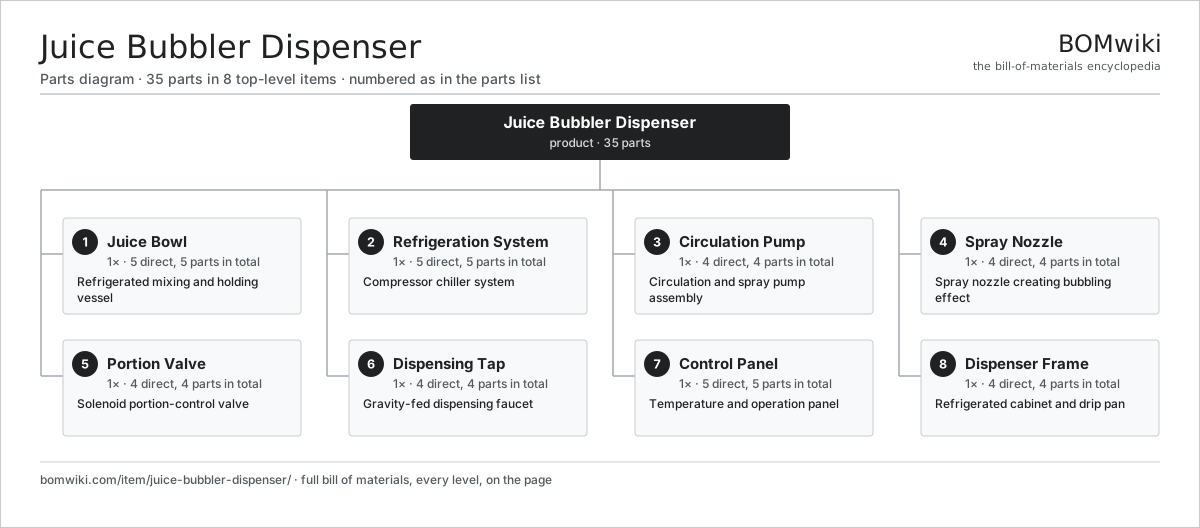
| # | Part | Qty | What it does |
|---|---|---|---|
| 1 | Juice Bowl 5 parts | 1× | Refrigerated mixing and holding vessel |
| 2 | Refrigeration System 5 parts | 1× | Compressor chiller system |
| 3 | Circulation Pump 4 parts | 1× | Circulation and spray pump assembly |
| 4 | Spray Nozzle 4 parts | 1× | Spray nozzle creating bubbling effect |
| 5 | Portion Valve 4 parts | 1× | Solenoid portion-control valve |
| 6 | Dispensing Tap 4 parts | 1× | Gravity-fed dispensing faucet |
| 7 | Control Panel 5 parts | 1× | Temperature and operation panel |
| 8 | Dispenser Frame 4 parts | 1× | Refrigerated cabinet and drip pan |
3D model
No 3D model yet. Have a CAD file of this? Add a 3D model. STL renders right on this page; STEP, FreeCAD, and OpenSCAD sources are welcome too (openly licensed, like all 3D models on BOMwiki).
Build & assembly graph
expand / collapse · shared sub-assemblies converge · links to related products · est. labourTap an assembly to expand/collapse · tap a part to open it · use “Open page” for any node · drag to pan, scroll to zoom.
Bill of materials for Juice Bubbler Dispenser
8 top-level lines · 43 rows shown · 35 parts total · indented to 3 levels| # | Item / sub-assembly | Part no. | Qty/assy | Ext. qty | Parts | Type |
|---|---|---|---|---|---|---|
| 1 | Juice Bowl 5 parts | juice-bubbler-dispenser-bowl | 1× | 1 | 5 | assembly |
| 1.1 | Bowl Tank | juice-bubbler-dispenser-bowl-tank | 1× | 1 | · | part |
| 1.2 | Cooling Jacket | juice-bubbler-dispenser-bowl-jacket | 1× | 1 | · | part |
| 1.3 | Bowl Lid | juice-bubbler-dispenser-bowl-lid | 1× | 1 | · | part |
| 1.4 | Bowl Outlet | juice-bubbler-dispenser-bowl-outlet | 1× | 1 | · | part |
| 1.5 | Bowl Thermometer | juice-bubbler-dispenser-bowl-thermometer | 1× | 1 | · | part |
| 2 | Refrigeration System 5 parts | juice-bubbler-dispenser-refrigeration | 1× | 1 | 5 | assembly |
| 2.1 | Compressor | juice-bubbler-dispenser-refrigeration-compressor | 1× | 1 | · | part |
| 2.2 | Condenser | juice-bubbler-dispenser-refrigeration-condenser | 1× | 1 | · | part |
| 2.3 | Evaporator | juice-bubbler-dispenser-refrigeration-evaporator | 1× | 1 | · | part |
| 2.4 | Refrigeration Thermostat | juice-bubbler-dispenser-refrigeration-thermostat | 1× | 1 | · | part |
| 2.5 | Condenser Fan | juice-bubbler-dispenser-refrigeration-fan | 1× | 1 | · | part |
| 3 | Circulation Pump 4 parts | juice-bubbler-dispenser-pump | 1× | 1 | 4 | assembly |
| 3.1 | Pump Motor | juice-bubbler-dispenser-pump-motor | 1× | 1 | · | part |
| 3.2 | Pump Head | juice-bubbler-dispenser-pump-head | 1× | 1 | · | part |
| 3.3 | Pump Inlet | juice-bubbler-dispenser-pump-inlet | 1× | 1 | · | part |
| 3.4 | Pump Discharge | juice-bubbler-dispenser-pump-discharge | 1× | 1 | · | part |
| 4 | Spray Nozzle 4 parts | juice-bubbler-dispenser-spray | 1× | 1 | 4 | assembly |
| 4.1 | Spray Head | juice-bubbler-dispenser-spray-nozzle | 1× | 1 | · | part |
| 4.2 | Nozzle Post | juice-bubbler-dispenser-spray-support | 1× | 1 | · | part |
| 4.3 | Nozzle Valve | juice-bubbler-dispenser-spray-valve | 1× | 1 | · | part |
| 4.4 | Spray Deflector | juice-bubbler-dispenser-spray-deflector | 1× | 1 | · | part |
| 5 | Portion Valve 4 parts | juice-bubbler-dispenser-valve | 1× | 1 | 4 | assembly |
| 5.1 | Valve Solenoid | juice-bubbler-dispenser-valve-solenoid | 1× | 1 | · | part |
| 5.2 | Valve Body | juice-bubbler-dispenser-valve-spool | 1× | 1 | · | part |
| 5.3 | Valve Spring | juice-bubbler-dispenser-valve-spring | 1× | 1 | · | part |
| 5.4 | Portion Timer | juice-bubbler-dispenser-valve-timer | 1× | 1 | · | part |
| 6 | Dispensing Tap 4 parts | juice-bubbler-dispenser-tap | 1× | 1 | 4 | assembly |
| 6.1 | Tap Valve | juice-bubbler-dispenser-tap-valve | 1× | 1 | · | part |
| 6.2 | Tap Spout | juice-bubbler-dispenser-tap-spout | 1× | 1 | · | part |
| 6.3 | Tap Bracket | juice-bubbler-dispenser-tap-bracket | 1× | 1 | · | part |
| 6.4 | Tap Drip Tray | juice-bubbler-dispenser-tap-drip-tray | 1× | 1 | · | part |
| 7 | Control Panel 5 parts | juice-bubbler-dispenser-controls | 1× | 1 | 5 | assembly |
| 7.1 | Control Faceplate | juice-bubbler-dispenser-controls-faceplate | 1× | 1 | · | part |
| 7.2 | Power Switch | juice-bubbler-dispenser-controls-power-switch | 1× | 1 | · | part |
| 7.3 | Temp Indicator | juice-bubbler-dispenser-controls-temp-light | 1× | 1 | · | part |
| 7.4 | Pump Switch | juice-bubbler-dispenser-controls-pump-switch | 1× | 1 | · | part |
| 7.5 | Portion Dial | juice-bubbler-dispenser-controls-portion-dial | 1× | 1 | · | part |
| 8 | Dispenser Frame 4 parts | juice-bubbler-dispenser-frame | 1× | 1 | 4 | assembly |
| 8.1 | Cabinet Body | juice-bubbler-dispenser-frame-body | 1× | 1 | · | part |
| 8.2 | Frame Base | juice-bubbler-dispenser-frame-base | 1× | 1 | · | part |
| 8.3 | Frame Drip Pan | juice-bubbler-dispenser-frame-drip-pan | 1× | 1 | · | part |
| 8.4 | Main Wiring | juice-bubbler-dispenser-frame-wiring | 1× | 1 | · | part |
Something wrong in this list? Report a problem with this BOM.
Sourcing: possible vendors
Browse the supplier directory → Prices, MOQ, and lead times are algorithmic estimates, not quotes, and not claims about these companies. Company mappings are curated by keyword; est. price band $1k–$500k. How estimates work| Vendor | HQ | Specialty | MOQ | Lead time |
|---|---|---|---|---|
| gea.com ↗ | Düsseldorf, DE | Process technology | 20 units | 12–20 wks |
| buhlergroup.com ↗ | Uzwil, CH | Food & materials processing | 20 units | 12–20 wks |
| tetrapak.com ↗ | Pully, CH | Food packaging & processing | 20 units | 12–20 wks |
| jbtc.com ↗ | Chicago, US | Food processing equipment | 20 units | 12–20 wks |
| alfalaval.com ↗ | Lund, SE | Heat transfer & separation | 20 units | 12–20 wks |
1,268-word article