Kaleidoscope
ProductOverview
A kaleidoscope is a toy or artistic viewing instrument consisting of a cylinder with internal mirrors and a rotating chamber of colored objects. When light passes through the objects and reflects within the Mirror System, the viewer sees through the Eyepiece Lens Assembly a highly symmetrical, repeating pattern. Rotating the Object Chamber continuously changes the pattern by rearranging the position of internal glass beads, sequins, or paper fragments, creating an ever-shifting mandala of light and color.
The physics is straightforward: a set of precisely angled plane mirrors creates multiple images of the same scene. Three mirrors at 60 degrees to each other produce six-fold symmetry; four mirrors at 45 degrees produce eight-fold symmetry. The Front Window at the object chamber's end admits ambient light or transmitted light, which illuminates the colorful objects within. The resulting reflections and refractions create the intricate, symmetric pattern.
How it works
The Barrel Body is a cylindrical tube typically 8–12 inches long and 2–3 inches in diameter. Inside, the Mirror System is mounted at the front, forming a triangular or square cross-section. The three mirrors of the Primary Mirror, Secondary Mirror, and Tertiary Mirror are angled at precise intervals (45°, 60°, or 72° depending on the desired symmetry) and meet at a central axis.
The Object Chamber, a frosted or translucent glass cylinder, is positioned immediately in front of the mirrors. Its Rear Chamber Cap mates with the mirror system, forming a sealed or semi-sealed viewing chamber. The Front Chamber Cap is a translucent, often frosted or diffusing surface that admits light. The Internal Objects, loose colored glass beads, sequins, or paper cutouts, fill the chamber volume.
Light enters through the Front Window, striking the colored objects and creating scattering and diffusion. This light bounces among the objects and reflects off the internal mirrors. Each mirror reflection creates a virtual image of the same colored objects. Because the mirrors meet at fixed angles (e.g., 60°), they generate multiple reflections at regular intervals around the circular view: with three 60° mirrors, six reflections are visible, creating a six-fold symmetric pattern.
The viewer peers through the Eyepiece Lens Assembly mounted at the rear of the barrel. A simple kaleidoscope uses a single Primary Eyepiece Lens, a converging lens with a focal length of 20–50 mm. The eyepiece magnifies the pattern (typically 4–8×) and projects a virtual image at a comfortable viewing distance (often infinity, allowing relaxed eye focus).
Rotation and Pattern Change
The Object Chamber can rotate freely relative to the mirror system via the Rotation Bearing Assembly, a low-friction bearing assembly at the junction between the chamber and barrel. As the user rotates the object chamber by hand, the colored objects tumble within, changing their spatial arrangement. The multiple mirror reflections capture this new arrangement, producing a completely different symmetric pattern. The symmetry itself remains constant (always six-fold or eight-fold, depending on the mirror count), but the aesthetic arrangement of colors and shapes shifts continuously.
Optical Principles
The key principle is multiple reflections creating virtual images. If three mirrors are arranged at 60° angles, each mirror reflects the scene once, but the reflections also bounce between mirrors, creating secondary reflections. This multiplying effect produces the visual symmetry.
A true image of the object is formed once, between the mirrors. Multiple virtual images are then reflected back to the viewer by the mirror surfaces. The number of virtual images is determined by the angle θ between adjacent mirrors:
Number of images = (360° / θ) − 1
For three 60° mirrors: (360 / 60) − 1 = 5 additional virtual images plus 1 real image = 6 total view sectors, creating six-fold symmetry.
Materials and Construction
Traditional kaleidoscopes use cardboard or wood barrels, which are lightweight and inexpensive. The mirror backing (Mirror Backing Frame) is typically aluminum or brass. The mirrors themselves are silvered glass or aluminized surfaces, optically flat and highly reflective (85–95% reflectivity).
The Object Chamber is made of frosted or translucent glass to scatter light evenly. The Internal Objects are usually colored glass beads or sequins, chosen for their optical properties: glass is transparent and colorful; sequins are reflective and add sparkle.
The Eyepiece Lens Assembly is a simple converging lens (focal length 20–50 mm, diameter 0.5–1 inch), ground and polished from optical glass or acrylic. No complex eyepiece is needed because the field of view is moderate (30–50°) and distortion is acceptable.
Lighting Conditions
Early kaleidoscopes relied entirely on ambient light, held up to a window or toward the sun. The user rotates the object chamber to vary the pattern while observing the resulting symmetry. Modern kaleidoscopes may include Light Diffuser Film plates or optional illumination to enhance brightness in indoor settings.
Historical Context
The kaleidoscope was invented by Scottish physicist Sir David Brewster in 1816 and was a near-instant sensation. Brewster patented the design, recognizing its appeal both as a scientific demonstration of optical principles and as a mesmerizing toy. Victorian-era kaleidoscopes were elaborate, with hand-painted glass objects, decorative brass fittings, and mahogany barrels. Mass production in the 20th century made simple, affordable cardboard versions ubiquitous.
Modern art installations and interactive exhibits employ large-scale kaleidoscopes or light-based symmetry displays. The mathematical elegance of the mirror arrangement has made the kaleidoscope an enduring symbol of symmetry and fractal-like patterns in popular culture.
Kaleidoscope parts and their functions
6 top-level parts · 30 parts in total · full bill of materials below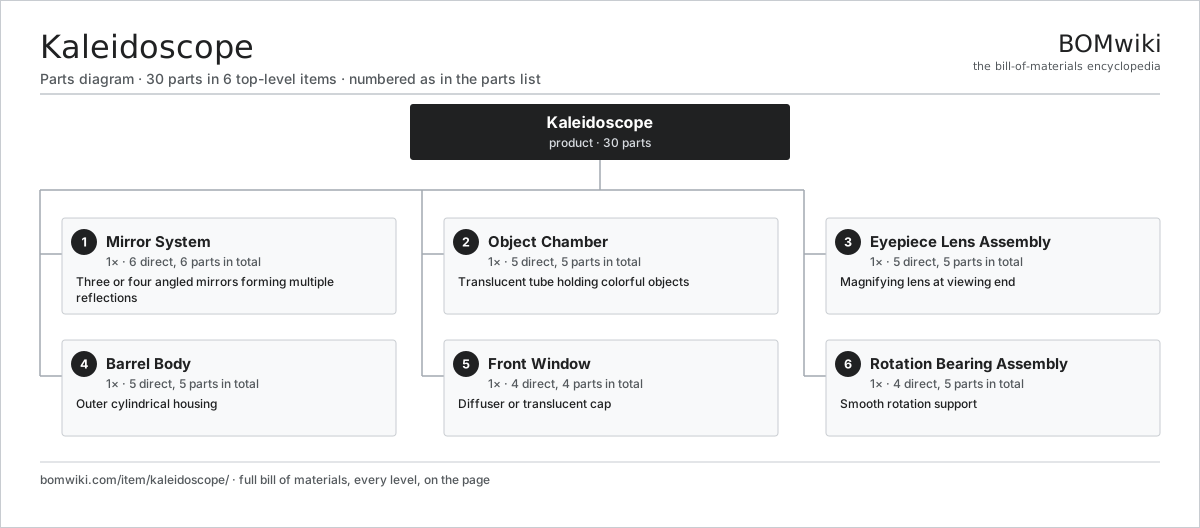
| # | Part | Qty | What it does |
|---|---|---|---|
| 1 | Mirror System 6 parts | 1× | Three or four angled mirrors forming multiple reflections |
| 2 | Object Chamber 5 parts | 1× | Translucent tube holding colorful objects |
| 3 | Eyepiece Lens Assembly 5 parts | 1× | Magnifying lens at viewing end |
| 4 | Barrel Body 5 parts | 1× | Outer cylindrical housing |
| 5 | Front Window 4 parts | 1× | Diffuser or translucent cap |
| 6 | Rotation Bearing Assembly 4 parts | 1× | Smooth rotation support |
3D model
No 3D model yet. Have a CAD file of this? Add a 3D model. STL renders right on this page; STEP, FreeCAD, and OpenSCAD sources are welcome too (openly licensed, like all 3D models on BOMwiki).
Build & assembly graph
expand / collapse · shared sub-assemblies converge · links to related products · est. labourTap an assembly to expand/collapse · tap a part to open it · use “Open page” for any node · drag to pan, scroll to zoom.
Bill of materials for Kaleidoscope
6 top-level lines · 35 rows shown · 30 parts total · indented to 3 levels| # | Item / sub-assembly | Part no. | Qty/assy | Ext. qty | Parts | Type |
|---|---|---|---|---|---|---|
| 1 | Mirror System 6 parts | kaleidoscope-mirror-system | 1× | 1 | 6 | assembly |
| 1.1 | Primary Mirror | kaleidoscope-mirror-primary | 1× | 1 | · | part |
| 1.2 | Secondary Mirror | kaleidoscope-mirror-secondary | 1× | 1 | · | part |
| 1.3 | Tertiary Mirror | kaleidoscope-mirror-tertiary | 1× | 1 | · | part |
| 1.4 | Mirror Backing Frame | kaleidoscope-mirror-backing | 1× | 1 | · | part |
| 1.5 | Mirror Spacing Wedge | kaleidoscope-mirror-spacing-wedge | 1× | 1 | · | part |
| 1.6 | Fastener Set | fastener-set | 1× | 1 | · | part |
| 2 | Object Chamber 5 parts | kaleidoscope-object-chamber | 1× | 1 | 5 | assembly |
| 2.1 | Object Chamber Tube | kaleidoscope-chamber-tube | 1× | 1 | · | part |
| 2.2 | Front Chamber Cap | kaleidoscope-chamber-endcap-front | 1× | 1 | · | part |
| 2.3 | Rear Chamber Cap | kaleidoscope-chamber-endcap-rear | 1× | 1 | · | part |
| 2.4 | Internal Objects | kaleidoscope-internal-objects | 1× | 1 | · | part |
| 2.5 | Chamber Seal | kaleidoscope-chamber-seal | 1× | 1 | · | part |
| 3 | Eyepiece Lens Assembly 5 parts | kaleidoscope-eyepiece-lens | 1× | 1 | 5 | assembly |
| 3.1 | Primary Eyepiece Lens | kaleidoscope-eyepiece-lens-primary | 1× | 1 | · | part |
| 3.2 | Secondary Field Lens | kaleidoscope-eyepiece-lens-secondary | 1× | 1 | · | part |
| 3.3 | Eyepiece Housing | kaleidoscope-eyepiece-housing | 1× | 1 | · | part |
| 3.4 | Eyepiece Stop Ring | kaleidoscope-eyepiece-stop-ring | 1× | 1 | · | part |
| 3.5 | Fastener Set | fastener-set | 1× | 1 | · | part |
| 4 | Barrel Body 5 parts | kaleidoscope-barrel-body | 1× | 1 | 5 | assembly |
| 4.1 | Barrel Tube | kaleidoscope-barrel-tube | 1× | 1 | · | part |
| 4.2 | Front Barrel Coupling | kaleidoscope-barrel-coupling-front | 1× | 1 | · | part |
| 4.3 | Rear Barrel Coupling | kaleidoscope-barrel-coupling-rear | 1× | 1 | · | part |
| 4.4 | Barrel Reinforcement Ring | kaleidoscope-barrel-strengthening-ring | 1× | 1 | · | part |
| 4.5 | Fastener Set | fastener-set | 1× | 1 | · | part |
| 5 | Front Window 4 parts | kaleidoscope-front-window | 1× | 1 | 4 | assembly |
| 5.1 | Window Glass Disk | kaleidoscope-window-glass | 1× | 1 | · | part |
| 5.2 | Window Mount Ring | kaleidoscope-window-mount-ring | 1× | 1 | · | part |
| 5.3 | Light Diffuser Film | kaleidoscope-window-light-diffuser | 1× | 1 | · | part |
| 5.4 | Fastener Set | fastener-set | 1× | 1 | · | part |
| 6 | Rotation Bearing Assembly 4 parts | kaleidoscope-rotation-bearing | 1× | 1 | 5 | assembly |
| 6.1 | Bearing Race | kaleidoscope-bearing-race | 1× | 1 | · | part |
| 6.2 | Bearing Cage | kaleidoscope-bearing-cage | 1× | 1 | · | part |
| 6.3 | Ball Bearing | ball-bearing | 2× | 2 | · | part |
| 6.4 | Bearing Lubricant | kaleidoscope-bearing-lubrication | 1× | 1 | · | part |
Something wrong in this list? Report a problem with this BOM.
Related products
same domain, ranked by shared parts Camera Gimbal Stabilizer
177 parts · shares 1 with this page
Camera Gimbal Stabilizer
177 parts · shares 1 with this page
 Camera Jib Crane
67 parts · shares 1 with this page
Camera Jib Crane
67 parts · shares 1 with this page
 Camera Motion Control Rig
210 parts · shares 1 with this page
Camera Motion Control Rig
210 parts · shares 1 with this page
 Computerized GoTo Telescope
320 parts · shares 1 with this page
Computerized GoTo Telescope
320 parts · shares 1 with this page
 Digital Cinema Camera
305 parts · shares 1 with this page
Digital Cinema Camera
305 parts · shares 1 with this page
Sourcing: possible vendors
Browse the supplier directory → Prices, MOQ, and lead times are algorithmic estimates, not quotes, and not claims about these companies. Company mappings are curated by keyword; est. price band $100–$8k. How estimates work| Vendor | HQ | Specialty | MOQ | Lead time |
|---|---|---|---|---|
|
🇯🇵Canon
canon.com ↗
|
Tokyo, JP | Imaging & optics | 500 units | 10–16 wks |
|
🇯🇵Nikon
nikon.com ↗
|
Tokyo, JP | Imaging & optics | 500 units | 10–16 wks |
|
🇩🇪ZEISS
zeiss.com ↗
|
Oberkochen, DE | Optics & optoelectronics | 500 units | 10–16 wks |
| leica-camera.com ↗ | Wetzlar, DE | Cameras & optics | 500 units | 10–16 wks |
| flir.com ↗ | Wilsonville, US | Thermal imaging | 500 units | 10–16 wks |
916-word article