Keg Racking Machine
ProductOverview
Keg racking machines are specialized filling equipment for craft breweries, beverage producers, and contract manufacturers who package products in stainless steel kegs (20–50 L euro-kegs or half-barrels). The machine automates the complete cycle: cleanliness verification, internal wash with hot caustic solution, counter-pressure filling under CO2, ball-lock valve installation, CO2 saturation, and final pressure testing, eliminating manual labor, reducing product oxidation, and ensuring consistent quality.
Industrial keg racking machines operate at 10–20 kegs per hour per head. Dual-head or carousel designs can achieve higher throughput. The machines are common in breweries, cideries, winemakers, and specialty beverage producers seeking professional keg management.
How it works
Keg Positioning and Cleanliness Check
Empty kegs arrive on an infeed conveyor and are lifted pneumatically into a center chuck that aligns them vertically with the fill head. An optical or ultrasonic sensor inspects the keg interior, detecting residue or particulates from prior use. Dirty kegs are automatically diverted to the wash queue; clean kegs advance to the fill station.
Internal Wash Cycle
The keg is internally sprayed with hot caustic solution (70–90 °C, typically 0.5–2% sodium hydroxide or phosphoric acid) for 90–180 seconds. A rotating or fixed spray nozzle inside the keg delivers high-impact spray to all internal surfaces. The caustic solution is circulated from a main tank via a pump and heater. After caustic circulation, the keg is rinsed with hot water (60–70 °C) for 30–45 seconds, eliminating chemical residue. Both caustic and rinse drain back to their respective tanks for reuse.
Counter-Pressure Filling
Once the keg is clean and dry, the fill head descends and engages the keg dip-tube (the long tube inside the keg reaching the bottom). The counter-pressure fill valve opens, metering product from a positive-displacement pump at 5–10 bar. Counter-pressure inside the keg headspace (achieved via nitrogen or CO2 pre-charge or maintained by the fill valve check mechanism) prevents product agitation and foam, critical for preserving carbonation in beer and cider. Fill volume is controlled by solenoid dwell time and verified via load cell or volumetric counting. Typical fill accuracy is ±1 L on a 50 L keg.
Ball-Lock Valve Installation
Once filling is complete, the fill head retracts and a pneumatic or servo-driven valve-threading spindle descends. A gripper holds the ball-lock valve (or lug-cap) and threads it onto the keg opening at controlled torque (typically 10–20 N·m). Torque feedback confirms proper seating and prevents over-tightening (which can crack the keg neck) or under-tightening (which causes leaks). A proximity sensor confirms the valve is fully seated.
CO2 Saturation and Pressure Equilibration
With the ball-lock valve installed, the PLC opens a solenoid proportioning valve supplying CO2 (from a dual-stage regulator) into the keg headspace. CO2 is injected at 0.5–3 bar for 10–30 seconds, depending on the product type and desired carbonation level. Beer (typically 2.5–2.8 volumes CO2) requires less aggressive injection than soda or cider. The PLC monitors final headspace pressure and shuts off CO2 when the setpoint (typically 2.0–2.5 bar) is reached.
Final Pressure Test
An electronic pressure gauge (0–5 bar transducer) measures the keg headspace pressure. If pressure is within tolerance (e.g., 2.0–2.5 bar ±0.2 bar), the keg passes and is discharged. If pressure is below range, the keg is re-pressurized; if above, excess CO2 is vented. Out-of-spec kegs are flagged to the operator for manual inspection (possible leaks in valve seals).
Discharge and Palletizing
Once pressure-tested, the keg is lowered onto the discharge conveyor and transferred to a palletizer or storage area. Empty keg return is either manual (kegs collected from bars/restaurants) or via a separate reverse-logistics loop.
Typical Keg Sizes and Configurations
Euro-Keg (Slim Keg)
Volume: 20–30 L. Height: ~670 mm. Common in Europe for beer and cider. Threading: M30×3.5 (metric). Typical fill rate: 15–20 kegs/hour per head.
Half-Barrel (Standard US)
Volume: 58.67 L (~15.5 gallons). Height: ~850 mm. Threading: 2-inch NPT (National Pipe Thread). Typical fill rate: 10–15 kegs/hour per head.
Sixth-Barrel (Slim)
Volume: 19.7 L (~5.2 gallons). Height: ~700 mm. Threading: 2-inch NPT. Common for craft breweries with limited distribution.
Caustic and Rinse Water Reuse
Modern keg-racking machines recover caustic and rinse water for multiple cycles, reducing chemical and water waste. A caustic tank (50–200 L) is heated once daily; caustic is recirculated through kegs throughout the shift and disposed of after 50–100 keg cycles (degradation of alkalinity over time). Rinse water is similarly recycled but replaced more frequently (every 20–30 kegs) to prevent microbial growth.
Counter-Pressure Fill Advantages
Counter-pressure filling prevents gas escape and product aeration, critical for beer and carbonated beverages. The fill valve design maintains 5–10 bar inside the keg during fill, so incoming product is pushed in rather than flowing under gravity. This protects product flavor and carbonation retention post-fill.
CO2 Saturation and Product Type
Beer: 2.5–2.8 volumes CO2 (0.5–1.5 bar injection). Cider: 3.5–4.5 volumes (1.5–2.5 bar injection). Mead or wine: 0.5–1.5 volumes (0.2–0.5 bar injection, nitrogen often preferred to preserve wine aromatics). The PLC can be programmed with multiple recipes per product type.
Ball-Lock Valve Seals and Maintenance
Ball-lock seals (typically nitrile rubber or EPDM) wear over 50–100 keg cycles and must be replaced. A worn seal causes pressure loss post-fill; final pressure test catches these before keg leaves the facility. Standard maintenance: replace seals quarterly or per failure rate.
Troubleshooting Pressure Loss
Common causes of keg pressure loss after filling: (1) ball-lock valve not fully threaded or unseated (torque feedback alarm), (2) worn seal or O-ring (visible weeping from valve), (3) dip-tube cracked inside keg (rare, visible during pre-fill inspection). All are detected during pressure test or during customer complaint handling.
Integration with Packaging Line
Keg racking machines are often standalone or paired with a palletizer for automatic stacking. Larger breweries may integrate dual-head or carousel designs for throughput of 30–50 kegs/hour. Downstream, kegs are stored at 2–4 °C until shipment.
Regulatory and Quality Compliance
Keg-filling operations are subject to food-safety and beverage-production regulations (FDA, local health codes). Key compliance points: (1) caustic wash temperatures and times per HACCP plans, (2) pressure-test verification (must document final pressure for each keg), (3) ball-lock valve torque logging (traceability of mechanical sealing), (4) product temperature control if relevant (e.g., pasteurized beer). Modern PLC systems automatically log all parameters to a database for compliance audits.
Keg Racking Machine parts and their functions
8 top-level parts · 30 parts in total · full bill of materials below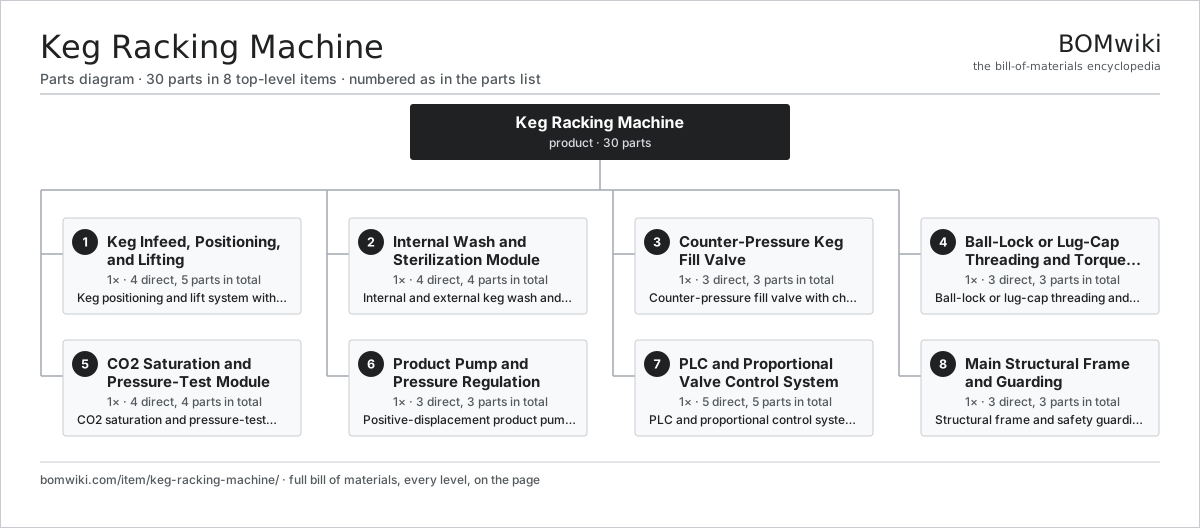
| # | Part | Qty | What it does |
|---|---|---|---|
| 1 | Keg Infeed, Positioning, and Lifting 4 parts | 1× | Keg positioning and lift system with cleanliness check |
| 2 | Internal Wash and Sterilization Module 4 parts | 1× | Internal and external keg wash and caustic sterilization |
| 3 | Counter-Pressure Keg Fill Valve 3 parts | 1× | Counter-pressure fill valve with check mechanism |
| 4 | Ball-Lock or Lug-Cap Threading and Torque Assembly 3 parts | 1× | Ball-lock or lug-cap threading and torque assembly |
| 5 | CO2 Saturation and Pressure-Test Module 4 parts | 1× | CO2 saturation and pressure-test module |
| 6 | Product Pump and Pressure Regulation 3 parts | 1× | Positive-displacement product pump and regulator |
| 7 | PLC and Proportional Valve Control System 5 parts | 1× | PLC and proportional control system |
| 8 | Main Structural Frame and Guarding 3 parts | 1× | Structural frame and safety guarding |
3D model
No 3D model yet. Have a CAD file of this? Add a 3D model. STL renders right on this page; STEP, FreeCAD, and OpenSCAD sources are welcome too (openly licensed, like all 3D models on BOMwiki).
Build & assembly graph
expand / collapse · shared sub-assemblies converge · links to related products · est. labourTap an assembly to expand/collapse · tap a part to open it · use “Open page” for any node · drag to pan, scroll to zoom.
Bill of materials for Keg Racking Machine
8 top-level lines · 39 rows shown · 30 parts total · indented to 3 levels| # | Item / sub-assembly | Part no. | Qty/assy | Ext. qty | Parts | Type |
|---|---|---|---|---|---|---|
| 1 | Keg Infeed, Positioning, and Lifting 4 parts | keg-racking-machine-keg-infeed | 1× | 1 | 5 | assembly |
| 1.1 | Keg Infeed Conveyor 1 parts | keg-racking-machine-infeed-conveyor | 1× | 1 | 1 | assembly |
| 1.1.1 | Infeed Conveyor Motor | keg-racking-machine-infeed-motor | 1× | 1 | · | part |
| 1.2 | Keg Cleanliness Optical Sensor | keg-racking-machine-cleanliness-sensor | 1× | 1 | · | part |
| 1.3 | Pneumatic Keg Lift Cylinder | keg-racking-machine-lift-cylinders | 2× | 2 | · | part |
| 1.4 | Keg Center Chuck or Guide | keg-racking-machine-keg-chuck | 1× | 1 | · | part |
| 2 | Internal Wash and Sterilization Module 4 parts | keg-racking-machine-wash-sterilize | 1× | 1 | 4 | assembly |
| 2.1 | Wash Circulation Pump 1 parts | keg-racking-machine-wash-pump | 1× | 1 | 1 | assembly |
| 2.1.1 | Wash Pump Motor | keg-racking-machine-wash-pump-motor | 1× | 1 | · | part |
| 2.2 | Internal Wash Spray Nozzles | keg-racking-machine-wash-nozzles | 1× | 1 | · | part |
| 2.3 | Caustic Tank Immersion Heater | keg-racking-machine-caustic-heater | 1× | 1 | · | part |
| 2.4 | Caustic Storage and Circulation Tank | keg-racking-machine-caustic-tank | 1× | 1 | · | part |
| 3 | Counter-Pressure Keg Fill Valve 3 parts | keg-racking-machine-fill-head | 1× | 1 | 3 | assembly |
| 3.1 | Precision Counter-Pressure Fill Valve | keg-racking-machine-fill-valve | 1× | 1 | · | part |
| 3.2 | Dip-Tube Presence Sensor | keg-racking-machine-dip-tube-sensor | 1× | 1 | · | part |
| 3.3 | Pressure Sensor | pressure-sensor | 1× | 1 | · | part |
| 4 | Ball-Lock or Lug-Cap Threading and Torque Assembly 3 parts | keg-racking-machine-valve-install | 1× | 1 | 3 | assembly |
| 4.1 | Valve Threading Servo Motor | keg-racking-machine-valve-spindle-motor | 1× | 1 | · | part |
| 4.2 | Valve Torque Transducer | keg-racking-machine-torque-sensor | 1× | 1 | · | part |
| 4.3 | Valve Gripper or Chuck | keg-racking-machine-valve-gripper | 1× | 1 | · | part |
| 5 | CO2 Saturation and Pressure-Test Module 4 parts | keg-racking-machine-gas-system | 1× | 1 | 4 | assembly |
| 5.1 | CO2 Pressure Regulator | keg-racking-machine-gas-regulator | 1× | 1 | · | part |
| 5.2 | CO2 Injection Solenoid Valve | keg-racking-machine-gas-solenoid | 1× | 1 | · | part |
| 5.3 | Electronic Pressure Test Gauge | keg-racking-machine-pressure-test-gauge | 1× | 1 | · | part |
| 5.4 | Overpressure Relief Valve | keg-racking-machine-gas-relief | 1× | 1 | · | part |
| 6 | Product Pump and Pressure Regulation 3 parts | keg-racking-machine-pump | 1× | 1 | 3 | assembly |
| 6.1 | Pump Drive Motor | keg-racking-machine-pump-motor | 1× | 1 | · | part |
| 6.2 | Positive-Displacement Pump Rotor | keg-racking-machine-pump-unit | 1× | 1 | · | part |
| 6.3 | Pump Pressure Relief Valve | keg-racking-machine-pump-relief | 1× | 1 | · | part |
| 7 | PLC and Proportional Valve Control System 5 parts | keg-racking-machine-servo-drives | 1× | 1 | 5 | assembly |
| 7.1 | Keg Racking Control PLC | keg-racking-machine-plc | 1× | 1 | · | part |
| 7.2 | Fill Metering Proportional Amplifier | keg-racking-machine-fill-amp | 1× | 1 | · | part |
| 7.3 | CO2 Proportional Amplifier | keg-racking-machine-gas-amp | 1× | 1 | · | part |
| 7.4 | Valve Stepper Amplifier | keg-racking-machine-valve-amp | 1× | 1 | · | part |
| 7.5 | Touch Digitizer | touch-digitizer | 1× | 1 | · | part |
| 8 | Main Structural Frame and Guarding 3 parts | keg-racking-machine-frame | 1× | 1 | 3 | assembly |
| 8.1 | Structural Steel Frame | keg-racking-machine-frame-struct | 1× | 1 | · | part |
| 8.2 | Electrical Control Enclosure | keg-racking-machine-enclosure | 1× | 1 | · | part |
| 8.3 | Safety Guard Assembly | keg-racking-machine-guard | 1× | 1 | · | part |
Something wrong in this list? Report a problem with this BOM.
Related products
same domain, ranked by shared parts Carbonation System
29 parts · shares 2 with this page
Carbonation System
29 parts · shares 2 with this page
 Chocolate Enrober
470 parts · shares 2 with this page
Confectionery Depositor
699 parts · shares 2 with this page
Chocolate Enrober
470 parts · shares 2 with this page
Confectionery Depositor
699 parts · shares 2 with this page
 Drum Drying Machine
634 parts · shares 2 with this page
Drum Drying Machine
634 parts · shares 2 with this page
 Fluid Bed Dryer
550 parts · shares 2 with this page
Fluid Bed Dryer
550 parts · shares 2 with this page
Sourcing: possible vendors
Browse the supplier directory → Prices, MOQ, and lead times are algorithmic estimates, not quotes, and not claims about these companies. Company mappings are curated by keyword; est. price band $1k–$500k. How estimates work| Vendor | HQ | Specialty | MOQ | Lead time |
|---|---|---|---|---|
| gea.com ↗ | Düsseldorf, DE | Process technology | 20 units | 12–20 wks |
| buhlergroup.com ↗ | Uzwil, CH | Food & materials processing | 20 units | 12–20 wks |
| tetrapak.com ↗ | Pully, CH | Food packaging & processing | 20 units | 12–20 wks |
| jbtc.com ↗ | Chicago, US | Food processing equipment | 20 units | 12–20 wks |
| alfalaval.com ↗ | Lund, SE | Heat transfer & separation | 20 units | 12–20 wks |
1,145-word article