Key Cutting Machine
ProductOverview
A key cutting machine (key duplicator) copies the bitting of an existing key onto a blank. The mechanical principle is a pantograph collapsed to zero ratio: an original key and an uncut blank are clamped side by side in two vises on a common Clamp Carriage, a hardened Tracer Stylus is held at exactly the same position relative to the original as the rotating Cutter Wheel is to the blank, and as the operator moves the carriage so the stylus rides the original's peaks and valleys, the cutter mills the identical profile into the blank. Whatever the stylus does, the cutter does, one key-width away.
Hardware stores and locksmiths run these machines on cylinder house keys and edge-cut automotive keys; a duplicate takes 20–40 seconds. Accuracy matters because pin-tumbler locks tolerate only about ±0.1 mm of depth error before pins fail to reach the shear line, so the machine must hold roughly half that.
How it works
Both keys are clamped in Four-Way Key Vise jaws, four-sided rotatable vises whose faces grip standard bow-stop blanks, narrow blades, and cruciform sections. Clamping identically is the first accuracy requirement: the Shoulder/Tip Gauge flips down so the operator registers both keys by their shoulders (or by the tip, for shoulderless automotive blanks) before tightening the Vise Clamp Handle screws. A key seated 0.3 mm off in the vise produces a duplicate with every cut 0.3 mm out of position.
The operator then swings the carriage on its Carriage Pivot Shaft until the blank meets the spinning cutter and the stylus rests on the original, and slides the carriage axially along its travel. A Coil Spring preloads the stylus contact so the original, not the operator's wrist, controls depth. The Tracer Guide Arm holds the stylus rigidly at the vise spacing; any flex here translates directly into cut error, which is why the arm and the Cast Machine Base are castings rather than fabrications.
The cutter is a hardened HSS milling disc whose tooth form matches the stylus profile, spun at about 1,400 rpm through a Drive Belt from the Drive Motor. The Step Pulley Pair give a slower 700 rpm step for steel blanks, which would burn cutter teeth at brass speeds. After the pass the operator touches the new key to the Deburring Brush Wheel on the same spindle to strip the burr, an unbrushed key feels sharp and can hang in the lock.
Calibration
Duplicators drift: cutter regrinds change its diameter, vise jaws wear, and the stylus tip rounds. The Calibration System procedure restores zero. Ground Calibration Alignment Bars are clamped in both vises and the Depth Micrometer Adjuster, a micrometer screw graduated around 0.01 mm, is turned until cutter and stylus just touch their bars simultaneously; that zeroes depth. The Spacing Adjustment Screw zeroes the lateral axis so cuts land at the right stations along the blade. A factory Reference Test Key of known bitting verifies the result, and Adjustment Lock Screws freeze the settings. A machine cutting consistently shallow is the classic symptom of a worn cutter that calibration can absorb until the next regrind.
Variants
The traced duplicator described here covers edge-cut keys. Related machines extend the idea: tubular-key machines rotate the blank under a single-point cutter; laser-track (sidewinder) machines for high-security automotive keys mill a wandering groove into the blade face with an end mill under two-axis control; and electronic code machines drop the tracer entirely, the operator enters a lock code or decodes the original with a built-in gauge, and stepper-driven axes position the blank against the cutter to factory depth-and-space tables. Code machines cut a key without an original, which is how locksmiths originate keys for a lock from its stamped code.
Construction notes
Everything hangs off rigidity. Spindle runout is held low by paired Ball Bearing races and the flanged Cutter Retaining Nut clamping the cutter square to the Spindle Shaft. The Safety Eye Shield and Chip Tray manage the spray of brass swarf, the LED Work Lamp lights the contact point, and the Power Switch includes no-volt release so the cutter cannot restart unattended after a power interruption. Total machine weight of 12–25 kg is mostly the base casting, deliberately so.
Key Cutting Machine parts and their functions
7 top-level parts · 63 parts in total · full bill of materials below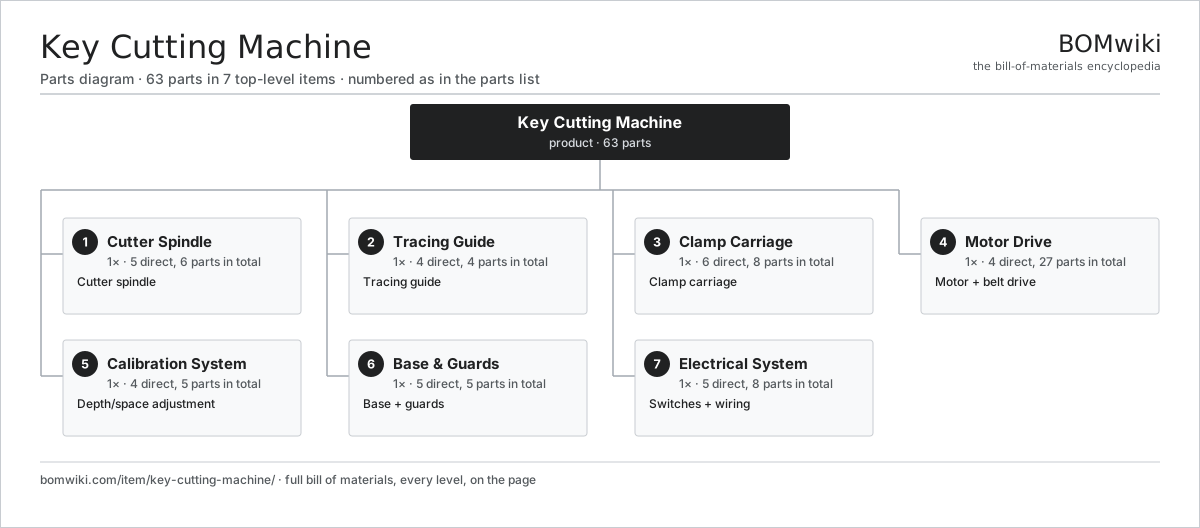
| # | Part | Qty | What it does |
|---|---|---|---|
| 1 | Cutter Spindle 5 parts | 1× | Cutter spindle |
| 2 | Tracing Guide 4 parts | 1× | Tracing guide |
| 3 | Clamp Carriage 6 parts | 1× | Clamp carriage |
| 4 | Motor Drive 4 parts | 1× | Motor + belt drive |
| 5 | Calibration System 4 parts | 1× | Depth/space adjustment |
| 6 | Base & Guards 5 parts | 1× | Base + guards |
| 7 | Electrical System 5 parts | 1× | Switches + wiring |
3D model
No 3D model yet. Have a CAD file of this? Add a 3D model. STL renders right on this page; STEP, FreeCAD, and OpenSCAD sources are welcome too (openly licensed, like all 3D models on BOMwiki).
Build & assembly graph
expand / collapse · shared sub-assemblies converge · links to related products · est. labourTap an assembly to expand/collapse · tap a part to open it · use “Open page” for any node · drag to pan, scroll to zoom.
Bill of materials for Key Cutting Machine
7 top-level lines · 44 rows shown · 63 parts total · indented to 3 levels| # | Item / sub-assembly | Part no. | Qty/assy | Ext. qty | Parts | Type |
|---|---|---|---|---|---|---|
| 1 | Cutter Spindle 5 parts | key-cutting-machine-spindle | 1× | 1 | 6 | assembly |
| 1.1 | Cutter Wheel | key-cutting-machine-cutter-wheel | 1× | 1 | · | part |
| 1.2 | Spindle Shaft | key-cutting-machine-spindle-shaft | 1× | 1 | · | part |
| 1.3 | Ball Bearing | ball-bearing | 2× | 2 | · | part |
| 1.4 | Cutter Retaining Nut | key-cutting-machine-spindle-nut | 1× | 1 | · | part |
| 1.5 | Deburring Brush Wheel | key-cutting-machine-brush-wheel | 1× | 1 | · | part |
| 2 | Tracing Guide 4 parts | key-cutting-machine-tracer | 1× | 1 | 4 | assembly |
| 2.1 | Tracer Stylus | key-cutting-machine-stylus | 1× | 1 | · | part |
| 2.2 | Tracer Guide Arm | key-cutting-machine-tracer-arm | 1× | 1 | · | part |
| 2.3 | Depth Micrometer Adjuster | key-cutting-machine-depth-adjuster | 1× | 1 | · | part |
| 2.4 | Coil Spring | coil-spring | 1× | 1 | · | part |
| 3 | Clamp Carriage 6 parts | key-cutting-machine-carriage | 1× | 1 | 8 | assembly |
| 3.1 | Four-Way Key Vise | key-cutting-machine-vise | 2× | 2 | · | part |
| 3.2 | Carriage Casting | key-cutting-machine-carriage-body | 1× | 1 | · | part |
| 3.3 | Carriage Pivot Shaft | key-cutting-machine-pivot-shaft | 1× | 1 | · | part |
| 3.4 | Vise Clamp Handle | key-cutting-machine-vise-handle | 2× | 2 | · | part |
| 3.5 | Shoulder/Tip Gauge | key-cutting-machine-shoulder-gauge | 1× | 1 | · | part |
| 3.6 | Coil Spring | coil-spring | 1× | 1 | · | part |
| 4 | Motor Drive 4 parts | key-cutting-machine-drive | 1× | 1 | 27 | assembly |
| 4.1 | Drive Motor 4 parts | key-cutting-machine-motor | 1× | 1 | 24 | assembly |
| 4.1.1 | Stator Assembly 3 parts + deeper › | stator-assembly | 1× | 1 | 3 | assembly |
| 4.1.2 | Rotor Assembly 4 parts + deeper › | rotor-assembly | 1× | 1 | 19 | assembly |
| 4.1.3 | Copper Winding | copper-winding | 1× | 1 | · | part |
| 4.1.4 | Motor Housing | motor-housing | 1× | 1 | · | part |
| 4.2 | Drive Belt | drive-belt | 1× | 1 | · | part |
| 4.3 | Step Pulley Pair | key-cutting-machine-pulleys | 1× | 1 | · | part |
| 4.4 | Belt Tensioner | key-cutting-machine-belt-tensioner | 1× | 1 | · | part |
| 5 | Calibration System 4 parts | key-cutting-machine-calibration | 1× | 1 | 5 | assembly |
| 5.1 | Calibration Alignment Bars | key-cutting-machine-alignment-bars | 2× | 2 | · | part |
| 5.2 | Spacing Adjustment Screw | key-cutting-machine-spacing-screw | 1× | 1 | · | part |
| 5.3 | Reference Test Key | key-cutting-machine-test-key | 1× | 1 | · | part |
| 5.4 | Adjustment Lock Screws | key-cutting-machine-lock-screws | 1× | 1 | · | part |
| 6 | Base & Guards 5 parts | key-cutting-machine-base | 1× | 1 | 5 | assembly |
| 6.1 | Cast Machine Base | key-cutting-machine-cast-base | 1× | 1 | · | part |
| 6.2 | Chip Tray | key-cutting-machine-chip-tray | 1× | 1 | · | part |
| 6.3 | Safety Eye Shield | key-cutting-machine-safety-shield | 1× | 1 | · | part |
| 6.4 | Sheet Metal Panel | sheet-panel | 1× | 1 | · | part |
| 6.5 | Fastener Set | fastener-set | 1× | 1 | · | part |
| 7 | Electrical System 5 parts | key-cutting-machine-electrical | 1× | 1 | 8 | assembly |
| 7.1 | Power Switch | key-cutting-machine-switch | 1× | 1 | · | part |
| 7.2 | LED Work Lamp | key-cutting-machine-work-lamp | 1× | 1 | · | part |
| 7.3 | Thermal Fuse | thermal-fuse | 1× | 1 | · | part |
| 7.4 | Wire Bundle | wire-bundle | 1× | 1 | · | part |
| 7.5 | Connector | connector | 4× | 4 | · | part |
Something wrong in this list? Report a problem with this BOM.
Related products
same domain, ranked by shared parts Money Counting Machine
102 parts · shares 11 with this page
Pouch Laminator
57 parts · shares 11 with this page
Electronic Safe
243 parts · shares 11 with this page
Money Counting Machine
102 parts · shares 11 with this page
Pouch Laminator
57 parts · shares 11 with this page
Electronic Safe
243 parts · shares 11 with this page
 Guillotine Paper Cutter
261 parts · shares 11 with this page
Guillotine Paper Cutter
261 parts · shares 11 with this page
 Pneumatic Tube Station
201 parts · shares 11 with this page
Pneumatic Tube Station
201 parts · shares 11 with this page
Sourcing: possible vendors
Browse the supplier directory → Prices, MOQ, and lead times are algorithmic estimates, not quotes, and not claims about these companies. Company mappings are curated by keyword; est. price band $50–$15k. How estimates work| Vendor | HQ | Specialty | MOQ | Lead time |
|---|---|---|---|---|
|
🇯🇵Canon
canon.com ↗
|
Tokyo, JP | Imaging & optics | 500 units | 8–12 wks |
|
🇯🇵Ricoh
ricoh.com ↗
|
Tokyo, JP | Office imaging | 500 units | 8–12 wks |
|
🇺🇸Xerox
xerox.com ↗
|
Norwalk, US | Printers & copiers | 500 units | 8–12 wks |
|
🇯🇵Epson
epson.com ↗
|
Suwa, JP | Printers & projectors | 500 units | 8–12 wks |
|
🇯🇵Brother
brother.com ↗
|
Nagoya, JP | Printers & sewing | 500 units | 8–12 wks |
774-word article