Kids Balance Bike
ProductOverview
A balance bike is a bicycle with the drivetrain deleted: no pedals, no cranks, no chain, no freewheel. A child of around two sits on a low saddle, walks the bike forward, and progresses to running and then gliding with both feet up. The design isolates the two genuinely hard skills of cycling, balancing and steering, from pedaling, which is easy by comparison. Children who learn this way typically skip training wheels entirely and transfer to a pedal bike between ages three and five, often in a single afternoon.
The idea is old: Karl von Drais's 1817 Laufmaschine, the ancestor of all bicycles, was a straddle-and-stride machine for adults. The modern children's version appeared commercially in the late 1990s and displaced training wheels because the physics is better. Training wheels prevent the lean that steering a bicycle requires; a balance bike demands it from the first push.
How it works
Everything is sized around the child planting both feet flat. The Frame drops its Main Frame tube low between the wheels for a standover near 300 mm, and the whole machine weighs 2–4.5 kg, a meaningful fraction of a toddler's body weight, which is why the lightest aluminum frames matter more here than anywhere else in cycling. The Saddle and Post sets the working position: the Saddle starts as low as 280 mm and the Seatpost extends 100–150 mm under a tool-free Seat Clamp, covering about two years of leg growth. Correct height leaves the knees slightly bent so the child can push with the whole foot.
Steering is deliberately slowed down. The Fork is raked for generous trail, so the front wheel self-centers at walking speed, and the Headset usually adds a Steering Limiter, an elastomer ring between steerer and frame that resists rotation past roughly 45–60° each side. The limiter prevents the jackknife (bar snapping sideways, child pitching over the front) while remaining soft enough to give way in a real fall instead of levering the frame.
The Wheelset splits the market in two. EVA foam Tire wheels never puncture, weigh around 200 g each, and need zero maintenance; pneumatic tires at about 2 bar roll better on gravel and grass and cushion impacts, at the cost of valves and possible flats. Either way the Hub is trivial, bolt axle, two sealed bearings, no freewheel, with Axle Nut Covers snapped over the nuts because toy-safety standards (EN 71, ASTM F963) forbid exposed protrusions at child head height.
Cockpit and glide stage
The Cockpit scales every dimension to the rider. The Handlebar is about 400 mm wide with the grip section drawn down to 19–22 mm diameter, since a toddler's hand cannot close around an adult 32 mm bar. The Safety Grips have enlarged mushroom ends serving two functions: a mechanical stop so sweaty hands cannot slide off, and a compliant bumper between bar end and child (or floor) in falls. A Bar Pad covers the stem clamp for the face-first stops that punctuate learning.
The Footrest marks the skill milestone the bike exists for. Once the child can run and lift both feet, the Footrest Plate above the rear wheel, narrow enough to never clip a striding heel, surfaced with Grip Tape, gives the feet a home during glides. A child gliding ten metres with feet up is balancing a bicycle; adding pedals at that point is a formality.
Brakes and standards
Most balance bikes for the youngest riders have no brake: shoes on the ground stop a 6 km/h glide reliably, and children under three lack the hand strength and coordination for a lever. Models aimed at 3–5 year olds often add a rear band or V-brake with a short-reach lever, teaching braking before the pedal bike. Regulatory classification matters to the design: as toys, balance bikes fall under EN 71 (Europe) and ASTM F963 (US), which drive the Frame Protectors, covered hardware, and grip-end requirements; some larger models are instead certified as bicycles under EN 14765. Wooden (birch-ply) frames remain a notable niche, heavier than aluminum but fully recyclable and with frame compliance that suits indoor floors.
Kids Balance Bike parts and their functions
8 top-level parts · 40 parts in total · full bill of materials below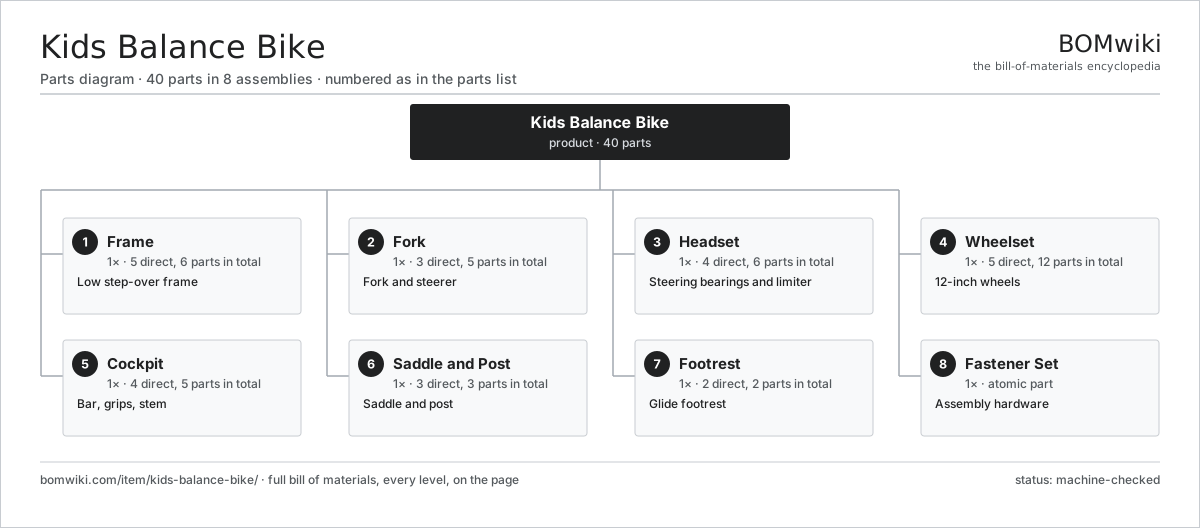
| # | Part | Qty | What it does |
|---|---|---|---|
| 1 | Frame 5 parts | 1× | Low step-over frame |
| 2 | Fork 3 parts | 1× | Fork and steerer |
| 3 | Headset 4 parts | 1× | Steering bearings and limiter |
| 4 | Wheelset 5 parts | 1× | 12-inch wheels |
| 5 | Cockpit 4 parts | 1× | Bar, grips, stem |
| 6 | Saddle and Post 3 parts | 1× | Saddle and post |
| 7 | Footrest 2 parts | 1× | Glide footrest |
| 8 | Fastener Set | 1× | Assembly hardware |
3D model
No 3D model yet. Have a CAD file of this? Add a 3D model — STL renders right on this page; STEP, FreeCAD, and OpenSCAD sources are welcome too (openly licensed, like all 3D models on BOMwiki).
Build & assembly graph
expand / collapse · shared sub-assemblies converge · links to related products · est. labourTap an assembly to expand/collapse · tap a part to open it · use “Open page” for any node · drag to pan, scroll to zoom.
Bill of materials for Kids Balance Bike
8 top-level lines · 34 rows shown · 40 parts total · indented to 3 levels| # | Item / sub-assembly | Part no. | Qty/assy | Ext. qty | Parts | Type |
|---|---|---|---|---|---|---|
| 1 | Frame 5 parts | kbb-frame | 1× | 1 | 6 | assembly |
| 1.1 | Main Frame | kbb-main-frame | 1× | 1 | · | part |
| 1.2 | Head Tube | kbb-head-tube | 1× | 1 | · | part |
| 1.3 | Seat Tube | kbb-seat-tube-insert | 1× | 1 | · | part |
| 1.4 | Rear Dropouts | kbb-rear-dropouts | 2× | 2 | · | part |
| 1.5 | Frame Protectors | kbb-frame-protectors | 1× | 1 | · | part |
| 2 | Fork 3 parts | kbb-fork | 1× | 1 | 5 | assembly |
| 2.1 | Fork Unit | kbb-fork-unit | 1× | 1 | · | part |
| 2.2 | Front Dropouts | kbb-front-dropouts | 2× | 2 | · | part |
| 2.3 | Axle Nut Covers | kbb-axle-covers | 2× | 2 | · | part |
| 3 | Headset 4 parts | kbb-headset | 1× | 1 | 6 | assembly |
| 3.1 | Bearing Cups | kbb-bearing-cups | 2× | 2 | · | part |
| 3.2 | Ball Bearing | ball-bearing | 2× | 2 | · | part |
| 3.3 | Steering Limiter | kbb-steering-limiter | 1× | 1 | · | part |
| 3.4 | Top Cap | kbb-top-cap | 1× | 1 | · | part |
| 4 | Wheelset 5 parts | kbb-wheelset | 1× | 1 | 12 | assembly |
| 4.1 | Rim | kbb-rim | 2× | 2 | · | part |
| 4.2 | Hub | kbb-hub | 2× | 2 | · | part |
| 4.3 | Spokes | kbb-spokes | 2× | 2 | · | part |
| 4.4 | Tire | kbb-tire | 2× | 2 | · | part |
| 4.5 | Ball Bearing | ball-bearing | 4× | 4 | · | part |
| 5 | Cockpit 4 parts | kbb-cockpit | 1× | 1 | 5 | assembly |
| 5.1 | Handlebar | kbb-handlebar | 1× | 1 | · | part |
| 5.2 | Stem | kbb-stem | 1× | 1 | · | part |
| 5.3 | Safety Grips | kbb-grips | 2× | 2 | · | part |
| 5.4 | Bar Pad | kbb-bar-pad | 1× | 1 | · | part |
| 6 | Saddle and Post 3 parts | kbb-saddle-group | 1× | 1 | 3 | assembly |
| 6.1 | Saddle | kbb-saddle | 1× | 1 | · | part |
| 6.2 | Seatpost | kbb-seatpost | 1× | 1 | · | part |
| 6.3 | Seat Clamp | kbb-seat-clamp | 1× | 1 | · | part |
| 7 | Footrest 2 parts | kbb-footrest | 1× | 1 | 2 | assembly |
| 7.1 | Footrest Plate | kbb-footrest-plate | 1× | 1 | · | part |
| 7.2 | Grip Tape | kbb-grip-tape | 1× | 1 | · | part |
| 8 | Fastener Set | fastener-set | 1× | 1 | · | part |
Sourcing: possible vendors
Prices, MOQ, and lead times are algorithmic estimates, not quotes, and not claims about these companies. Company mappings are curated by keyword; est. price band $200–$12k. How estimates work| Vendor | HQ | Specialty | MOQ | Lead time |
|---|---|---|---|---|
|
🇹🇼Giant
giant-bicycles.com ↗
|
Taichung, TW | Bicycles | 500 units | 6–12 wks |
|
🇺🇸Trek
trekbikes.com ↗
|
Waterloo, US | Bicycles | 500 units | 6–12 wks |
| specialized.com ↗ | Morgan Hill, US | Bicycles | 500 units | 6–12 wks |
|
🇹🇼Merida
merida-bikes.com ↗
|
Yuanlin, TW | Bicycles | 500 units | 6–12 wks |
| cannondale.com ↗ | Wilton, US | Bicycles | 500 units | 6–12 wks |
721-word article