Lab Water Purification System
ProductOverview
A laboratory water purification system produces ultrapure water (Type I per ASTM D1193) by cascading tap water through multiple stages: pre-filtration, reverse osmosis, ion exchange deionization, ultraviolet sterilization, and final 0.22 µm polishing. The resulting water has resistivity of 18.2 MΩ·cm (corresponding to <2 ppb dissolved ions), <1 CFU/100 mL bacteria, and <2 ppb organic carbon. This grade of water is essential for:
- Analytical chemistry: HPLC, ICP-MS, and atomic absorption spectroscopy require ultrapure water to avoid interference and instrumentation fouling.
- Cell and molecular biology: Enzyme assays, PCR, and cell culture are disrupted by trace metal ions, organic contaminants, or endotoxins.
- Pharmaceutical QA: USP and EP standards mandate Type I water for HPLC mobile phase and reagent dissolution.
Modern lab purification systems combine mechanical, thermal, and chemical stages in a compact tabletop unit, replacing older labor-intensive techniques (distillation, deionization cartridge rotation).
Stage-by-Stage Operation
Stage 1: Pre-Filtration (5 µm + Activated Carbon) Tap water enters a sediment cartridge (5 µm polypropylene, removes rust, sand, particulates >5 µm), followed by activated carbon block (removes chlorine, benzene, and taste/odor compounds via adsorption). This extends the lifespan of the downstream RO membrane by preventing mechanical fouling and chlorine damage (chlorine oxidizes polyamide RO membranes, destroying them). Pre-filter cartridges are replaced every 6–12 months depending on tap water quality.
Stage 2: Reverse Osmosis (RO) Tap water (minus sediment/chlorine) is pressurized by a pump to 60–80 psi (4–5.5 bar) and forced against a semi-permeable membrane with 0.0001 µm pores. Water molecules pass through (osmosis); dissolved salts, heavy metals, microorganisms, and most organic compounds are rejected. RO achieves 95–99% rejection of dissolved solids, producing two streams:
- Permeate (pure water, 10–20% of input): Conductivity ~50–100 µS/cm (~0.5–1 MΩ·cm resistivity at this stage).
- Reject (concentrated brine, 80–90% of input): Drained to sink or waste.
RO membranes have 2–5 year lifespan (replacement cost ~$50–200); lifespan depends on tap water TDS, sediment load, and pH.
Stage 3: Deionization (Ion Exchange) RO permeate still contains ~0.5–1 MΩ·cm resistivity (dissolved mineral ions). Mixed-bed ion-exchange resin (equal parts cation and anion resin beads) removes remaining ions by exchanging them for H⁺ and OH⁻:
- Na⁺ + (H⁺-resin) → H⁺ + (Na⁺-resin)
- Cl⁻ + (OH⁻-resin) → OH⁻ + (Cl⁻-resin)
This stage is critical because it directly achieves the 18.2 MΩ·cm target. After ~10–20 L throughput (depending on tap water hardness), the resin becomes saturated and must be replaced (cost ~$30–60). Color-change indicator beads shift from blue (fresh) to pink (saturated), signaling replacement.
Stage 4: Ultraviolet (UV) Sterilization Water flows through a quartz chamber containing a 254 nm UV-C lamp. UV light damages microbial DNA (thymine dimer formation), killing bacteria, viruses, and fungi. This stage also oxidizes residual organic carbon:
- UV + organic compound → CO₂ + H₂O
UV lamps degrade after 8,000–10,000 hours and must be replaced annually (cost ~$50–100). Older UV lamps transmit <70% of nominal intensity, requiring replacement.
Stage 5: Final 0.22 µm Polishing A 0.22 µm membrane cartridge removes bacteria, endotoxins, and particles as a final safeguard before dispensing. This is the only absolute barrier to bacterial contamination from the storage tank or atmosphere. Cartridges are rated for 500–1000 mL before saturation (replacement cost ~$30–50).
Storage & Monitoring Purified water is stored in a sealed tank (5–20 L HDPE or borosilicate glass) with a 0.22 µm vent filter preventing airborne contamination as water fills. A resistivity meter continuously monitors output quality; if resistivity drops below 17 MΩ·cm (threshold adjustable), an alarm alerts the operator to replace a cartridge.
Water Quality Specification (ASTM D1193)
Type I (ultrapure) water is defined by:
- Resistivity: ≥18.2 MΩ·cm @ 25 °C
- Conductivity: ≤0.055 µS/cm
- Silica (SiO₂): <2 ppb
- Bacteria: <1 CFU/100 mL
- Organic carbon (TOC): <2 ppb
- Particulates: <0.2 µm (ISO 8601 Class 100)
A typical lab purification system meets or exceeds all these specs at the outlet. However, quality degrades during storage (organic growth, airborne dust) unless the tank is sealed and vent-filtered.
Practical Considerations
Production rate: Modern systems produce 1–3 L/min after initial pressurization (first few liters are slower as the system stabilizes). This allows refilling a 10 mL burette in seconds, supporting high-throughput labs.
Operating cost: RO reject water (80–90% of input) is wasted. Using 10 L/day of purified water requires ~50–100 L/day input. At typical municipal water rates ($5–10/1000 gallons), this costs ~$20–30/month in water and sewer charges. Cartridge replacement adds ~$100–200/year. Total operating cost is roughly $200–400/year per system.
Temperature effects: Resistivity is temperature-compensated (the meter displays MΩ·cm @ 25 °C even if water is warmer), but ion-exchange resin efficiency drops at higher temperature. Hot water (>40 °C) should not be purified because resin releases absorbed ions.
Uptime and maintenance: Most failures are cartridge saturation (easy replacement) or UV lamp aging (also replaceable). RO membrane fouling is rare if pre-filters are changed regularly. Tank contamination (algae, bacterial bloom) is prevented by the 0.22 µm vent filter; if biofilm appears, drain the tank, rinse with 70% ethanol, refill, and run at least 50 L through the system to flush out residues.
Applications & Sensitivity
- HPLC: Ultrapure water eliminates baseline disturbance and drift; essential for gradient HPLC and UV detection below 200 nm.
- ICP-MS: Metal concentrations <100 ppb (blood lead, cadmium) require <1 ppb background from water; lab purification is mandatory.
- PCR: DNA polymerase is inhibited by Mg²⁺ and other metal ions; ultrapure water prevents PCR failure.
- Cell culture: Serum-free media depend on precise osmolality and ion balance; trace metals cause cell stress.
- TOC analysis: Environmental and pharmaceutical samples must be diluted in TOC-free water (<2 ppb) to measure analyte organic carbon without background noise.
Troubleshooting
| Symptom | Likely Cause | Action |
|---|---|---|
| Resistivity drops suddenly | Ion-exchange resin saturated | Replace cartridge; check color indicator |
| Low production rate | Pre-filter or RO membrane clogged | Replace pre-filter; if persists, replace RO cartridge |
| Bacteria count >1 CFU/100 mL | UV lamp degraded or storage tank contaminated | Replace UV lamp; if biofilm in tank, drain and flush with ethanol |
| Water taste/odor | Residual chlorine | Pre-filter carbon bed exhausted; replace |
| Alarm on resistivity meter | Conductivity probe fouled or deionizer saturated | Clean probe with ultrapure water; if persists, replace DI cartridge |
Safety Notes
- RO reject water is saline: High conductivity reject water is corrosive if allowed to accumulate; drain to sink promptly.
- UV lamp safety: Do not look directly at lamp; UV exposure causes cataracts. System enclosure shields lamp; do not open UV chamber during operation.
- Cartridge disposal: Spent ion-exchange resin contains absorbed metals; check local regulations for hazardous waste disposal (some cartridges are landfill-safe).
Lab Water Purification System parts and their functions
8 top-level parts · 25 parts in total · full bill of materials below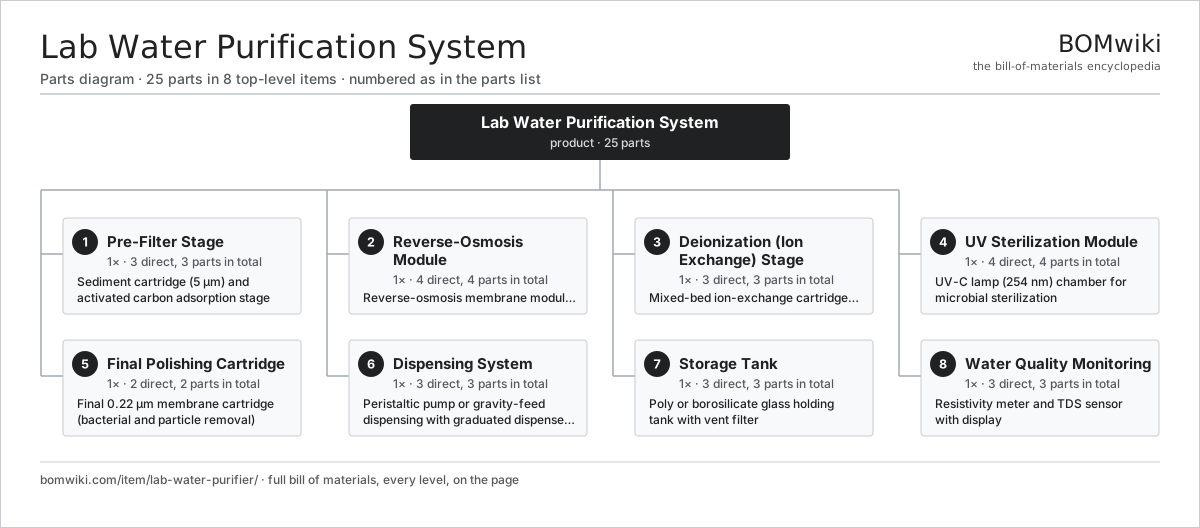
| # | Part | Qty | What it does |
|---|---|---|---|
| 1 | Pre-Filter Stage 3 parts | 1× | Sediment cartridge (5 µm) and activated carbon adsorption stage |
| 2 | Reverse-Osmosis Module 4 parts | 1× | Reverse-osmosis membrane module with high-pressure pump |
| 3 | Deionization (Ion Exchange) Stage 3 parts | 1× | Mixed-bed ion-exchange cartridge (deionization stage) |
| 4 | UV Sterilization Module 4 parts | 1× | UV-C lamp (254 nm) chamber for microbial sterilization |
| 5 | Final Polishing Cartridge 2 parts | 1× | Final 0.22 µm membrane cartridge (bacterial and particle removal) |
| 6 | Dispensing System 3 parts | 1× | Peristaltic pump or gravity-feed dispensing with graduated dispenser gun |
| 7 | Storage Tank 3 parts | 1× | Poly or borosilicate glass holding tank with vent filter |
| 8 | Water Quality Monitoring 3 parts | 1× | Resistivity meter and TDS sensor with display |
3D model
No 3D model yet. Have a CAD file of this? Add a 3D model. STL renders right on this page; STEP, FreeCAD, and OpenSCAD sources are welcome too (openly licensed, like all 3D models on BOMwiki).
Build & assembly graph
expand / collapse · shared sub-assemblies converge · links to related products · est. labourTap an assembly to expand/collapse · tap a part to open it · use “Open page” for any node · drag to pan, scroll to zoom.
Bill of materials for Lab Water Purification System
8 top-level lines · 33 rows shown · 25 parts total · indented to 3 levels| # | Item / sub-assembly | Part no. | Qty/assy | Ext. qty | Parts | Type |
|---|---|---|---|---|---|---|
| 1 | Pre-Filter Stage 3 parts | lab-water-purifier-prefilter | 1× | 1 | 3 | assembly |
| 1.1 | Sediment Filter Cartridge | lab-water-purifier-sediment-cartridge | 1× | 1 | · | part |
| 1.2 | Activated Carbon Cartridge | lab-water-purifier-carbon-cartridge | 1× | 1 | · | part |
| 1.3 | Filter Housing | lab-water-purifier-cartridge-housing | 1× | 1 | · | part |
| 2 | Reverse-Osmosis Module 4 parts | lab-water-purifier-ro-stage | 1× | 1 | 4 | assembly |
| 2.1 | RO Pump | lab-water-purifier-ro-pump | 1× | 1 | · | part |
| 2.2 | RO Membrane Cartridge | lab-water-purifier-ro-membrane | 1× | 1 | · | part |
| 2.3 | RO Membrane Housing | lab-water-purifier-ro-housing | 1× | 1 | · | part |
| 2.4 | RO Shut-off Valve | lab-water-purifier-ro-valve | 1× | 1 | · | part |
| 3 | Deionization (Ion Exchange) Stage 3 parts | lab-water-purifier-ion-exchange | 1× | 1 | 3 | assembly |
| 3.1 | Mixed-Bed Resin Cartridge | lab-water-purifier-mixed-resin-cartridge | 1× | 1 | · | part |
| 3.2 | Deionization Housing | lab-water-purifier-resin-housing | 1× | 1 | · | part |
| 3.3 | Resin Saturation Indicator | lab-water-purifier-resin-indicator | 1× | 1 | · | part |
| 4 | UV Sterilization Module 4 parts | lab-water-purifier-uv-lamp | 1× | 1 | 4 | assembly |
| 4.1 | UV-C Lamp | lab-water-purifier-uv-tube | 1× | 1 | · | part |
| 4.2 | UV Ballast | lab-water-purifier-uv-ballast | 1× | 1 | · | part |
| 4.3 | UV Chamber | lab-water-purifier-uv-chamber | 1× | 1 | · | part |
| 4.4 | UV Intensity Sensor (Optional) | lab-water-purifier-uv-sensor | 1× | 1 | · | part |
| 5 | Final Polishing Cartridge 2 parts | lab-water-purifier-polishing-cartridge | 1× | 1 | 2 | assembly |
| 5.1 | Polishing Membrane Cartridge | lab-water-purifier-polishing-membrane | 1× | 1 | · | part |
| 5.2 | Polishing Housing | lab-water-purifier-polishing-housing | 1× | 1 | · | part |
| 6 | Dispensing System 3 parts | lab-water-purifier-dispensing-system | 1× | 1 | 3 | assembly |
| 6.1 | Dispensing Pump (Optional) | lab-water-purifier-dispenser-pump | 1× | 1 | · | part |
| 6.2 | Dispenser Nozzle | lab-water-purifier-dispenser-nozzle | 1× | 1 | · | part |
| 6.3 | Dispensing Tubing | lab-water-purifier-flex-tubing | 1× | 1 | · | part |
| 7 | Storage Tank 3 parts | lab-water-purifier-storage-tank | 1× | 1 | 3 | assembly |
| 7.1 | Tank Vessel | lab-water-purifier-tank-vessel | 1× | 1 | · | part |
| 7.2 | Vent Filter | lab-water-purifier-tank-vent-filter | 1× | 1 | · | part |
| 7.3 | Tank Drain Valve | lab-water-purifier-tank-drain-valve | 1× | 1 | · | part |
| 8 | Water Quality Monitoring 3 parts | lab-water-purifier-monitoring | 1× | 1 | 3 | assembly |
| 8.1 | Resistivity Cell | lab-water-purifier-resistivity-sensor | 1× | 1 | · | part |
| 8.2 | TDS Sensor | lab-water-purifier-tds-sensor | 1× | 1 | · | part |
| 8.3 | Quality Display & Alarm | lab-water-purifier-display-unit | 1× | 1 | · | part |
Something wrong in this list? Report a problem with this BOM.
Used in 1 assembly
Sourcing: possible vendors
Browse the supplier directory → Prices, MOQ, and lead times are algorithmic estimates, not quotes, and not claims about these companies. Company mappings are curated by keyword; est. price band $1k–$500k. How estimates work| Vendor | HQ | Specialty | MOQ | Lead time |
|---|---|---|---|---|
| thermofisher.com ↗ | Waltham, US | Lab instruments | 100 units | 10–18 wks |
|
🇺🇸Agilent
agilent.com ↗
|
Santa Clara, US | Analytical instruments | 100 units | 10–18 wks |
|
🇺🇸Bruker
bruker.com ↗
|
Billerica, US | Scientific instruments | 100 units | 10–18 wks |
|
🇯🇵Shimadzu
shimadzu.com ↗
|
Kyoto, JP | Analytical instruments | 100 units | 10–18 wks |
|
🇺🇸Waters
waters.com ↗
|
Milford, US | Chromatography & MS | 100 units | 10–18 wks |
1,148-word article