Laboratory Bench
ProductOverview
A laboratory bench is a specialized work counter designed for chemical handling and scientific experiments, featuring a chemical-resistant Worktop Assembly and integrated utility delivery. The Worktop Assembly is typically cast epoxy or phenolic resin (25–30 mm thick), chosen for resistance to organic solvents, dilute acids, alkalis, and heat up to 150–200°C. The resin surface is slightly sloped with an integrated basin for rinsing glassware and a raised perimeter lip to contain small spills. Below the counter, the Base Cabinet Assembly provides secure storage for reagents, glassware, and equipment, with keyed locks on doors for hazardous chemical containment. At one end or the rear, a utility tower delivers compressed gas (nitrogen, compressed air, vacuum), hot/cold water, 120 V AC power, and drain service via integrated utility lines. The Base Frame Assembly is welded structural steel, and the reagent shelves above provide secondary storage for frequently-accessed bottles and reference materials.
Laboratory benches are purpose-built for chemistry, microbiology, and materials-testing environments, where standard office furniture would corrode or absorb spills. The design maximizes accessibility (reach radius ~0.75 m from the worker's position) and minimizes chemical inventory scattered on the work surface, a key safety practice.
Worktop and chemical resistance
The Worktop Assembly is the critical interface. Epoxy-resin slabs, typically cast on a plywood sub-frame, are chemically inert and can tolerate exposure to ethanol, acetone, toluene, dilute HCl, and dilute NaOH without degradation. Phenolic resin is slightly more rigid and tolerates higher heat (up to 200°C direct contact) but is more brittle. Both are non-porous, liquid cannot penetrate and harbor bacteria or mold, a requirement in microbiological labs.
The Resin Slab surface is slightly matte to reduce glare (polished surfaces create reflections that distort color-sensitive assays) and is molded with a ~5 degree slope toward the drip edge, channeling spills downward. The integral sink is a molded resin basin, 300 × 300 mm typical, recessed into the top and fitted with a strainer basket to catch debris. A drain line routes water into a waste container or the building sanitary line; in chemical labs, the waste drain may feed a secondary treatment system to neutralize acid or alkali before disposal.
Minor scratches and stains are inherent to lab work; they do not compromise functionality and are considered part of the bench's character. Deep gouges (from a Bunsen burner or sharp pipette) can be sealed with epoxy filler, and periodic surface stripping and re-coating (every 3–5 years in heavy-use labs) restores the original appearance.
Storage and cabinetry
The Base Cabinet Assembly beneath the worktop is enclosed for two reasons: to prevent spill escape (a contained spill is easier to clean) and to provide secure, organized storage. The hinged or sliding doors open to reveal shelves and drawers for beakers, flasks, tubing, and small instruments. A keyed lock on the top door secures the entire cabinet, essential when storing flammable or toxic reagents in a teaching lab where student access must be restricted.
Shelves are typically adjustable on 2-inch centers, allowing a technician to accommodate containers of varying height. Each shelf is rated 50 kg, and labs often load them heavily with stock reagents: 1 L bottles of methanol, acetone, and saline; volumetric flasks; and beaker sets. The side panels are plywood with a resin or laminate facing, preventing absorption of spilled liquids; a drain hole at the very bottom of the cabinet directs any accumulated liquid to a tray or floor.
Utilities and service tower
The Service Utility Tower is the infrastructure hub. A vertical aluminum or steel post (40–50 mm, 1.5–1.8 m tall) mounts at one end of the bench, with slotted channels running its length. The Gas Manifold is the first component: a brass or stainless-steel block with 4–6 color-coded ports (blue for nitrogen, red for air, yellow for vacuum, etc.), each with a needle-valve regulator. Each gas line from the manifold is a 6 mm copper or stainless tube terminating in a quick-disconnect fitting, allowing a student to plug in a rubber hose to their apparatus.
The Water Tap is a dual-handle ceramic cartridge fixture (hot on the left, cold on the right, as per ISO 6162) mounted on the tower at roughly 1.2 m height. The hot and cold supply lines (typically 1/2" PVC or copper) run through the internal conduit of the tower from the building supply; temperature is pre-mixed at a remote valve or thermostatic cartridge. The tap aerator reduces splashing and conserves water.
Power comes from two GFCI-protected receptacles on the tower, typically mounted at 1.0 m height. These are fed from a dedicated 20 A circuit in the building panel, wired through 3/4" EMT conduit to isolate the lab bench electrically. GFCI protection is mandatory in wet environments; it trips instantly if ground leakage is detected (e.g., if someone spills water on a hot-plate and touches both simultaneously).
The drain line from the sink runs down through the tower post and connects to a floor drain or waste container. In organic chemistry labs, the drain may feed a solvent recovery still or a neutralizing basin before final disposal.
Accessibility and ergonomics
The Leg and Foot Assembly is designed for precision work. Threaded or vibration-isolating feet set the counter height between 80 and 95 cm, accommodating technicians of varying heights. A microscope user, for instance, might prefer 85 cm (eye level at 1.2 m) whereas a standing cell-culture technician might prefer 90 cm (easier on the lower back during repetitive pipetting). Fine-levelling pads under each foot allow exact zeroing, a rocking bench causes reagent spills and introduces error into volumetric assays.
The 1.5 m length and 0.75 m depth are configured for a single technician's reach radius: ~0.75 m extends from the front edge to the back wall, covering the workstation and allowing easy access to the reagent shelves above. Multiple technicians can share a bench end-to-end (a 3 m island would seat three with overlapping access), but solvent vapors and heat can make crowding uncomfortable.
Ventilation and fume extraction
Most laboratory benches are paired with a fume hood or sash, a transparent enclosure with downward-facing exhaust that removes volatile organic vapors. However, the bench itself is often designed to work without a hood for lower-risk procedures (rinsing, mild exothermic reactions, glassware preparation). The resin surface does not absorb fumes, and the sink water provides cooling for exothermic reactions when needed (e.g., adding sulfuric acid to water with careful temperature monitoring).
High-volatility experiments (distillations, reflux with ether) require a hood; the tower is designed to fit within or adjacent to a hood opening without obstruction.
Maintenance and longevity
The epoxy or phenolic Resin Slab lasts 15–25 years with proper care: avoid placing hot items directly on the surface (use insulated mats), and wipe spills immediately to prevent staining. The steel frame is powder-coated and should be inspected monthly for rust; any rust spots are sanded and re-coated. The gas, water, and drain lines are the most likely to fail: copper tubing can corrode or pinhole (especially if slightly acidic water is present), and rubber drain lines can crack. These are typically replaced every 10 years as preventive maintenance.
The cabinet doors and shelves are the most frequently replaced components. Heavy loading, thermal cycling from hot water, and chemical splash eventually warp the plywood or degrade adhesives. Shelves can be replaced individually; a warped door is replaced in an afternoon.
Laboratory Bench parts and their functions
8 top-level parts · 79 parts in total · full bill of materials below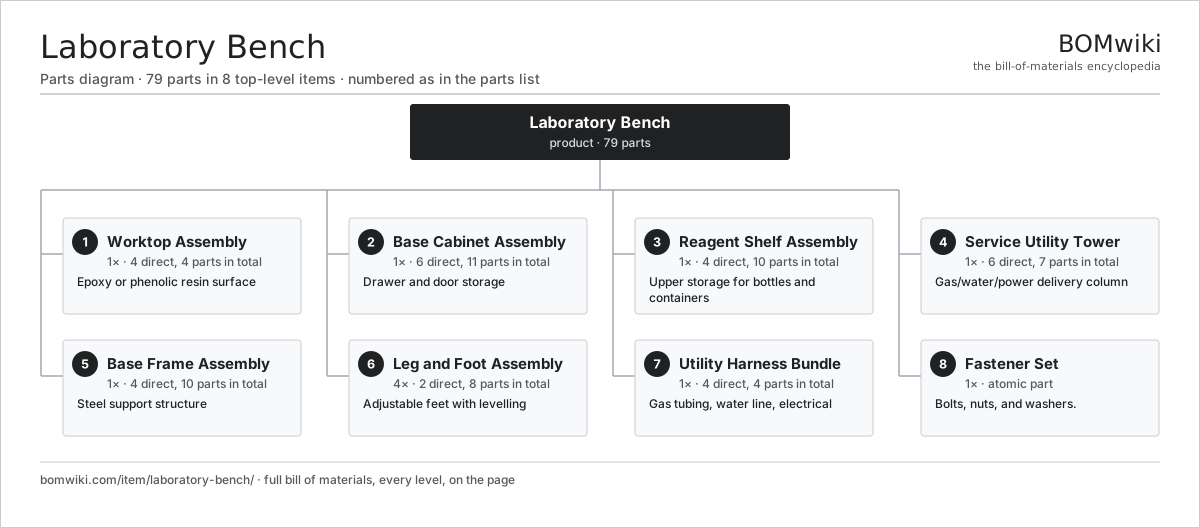
| # | Part | Qty | What it does |
|---|---|---|---|
| 1 | Worktop Assembly 4 parts | 1× | Epoxy or phenolic resin surface |
| 2 | Base Cabinet Assembly 6 parts | 1× | Drawer and door storage |
| 3 | Reagent Shelf Assembly 4 parts | 1× | Upper storage for bottles and containers |
| 4 | Service Utility Tower 6 parts | 1× | Gas/water/power delivery column |
| 5 | Base Frame Assembly 4 parts | 1× | Steel support structure |
| 6 | Leg and Foot Assembly 2 parts | 4× | Adjustable feet with levelling |
| 7 | Utility Harness Bundle 4 parts | 1× | Gas tubing, water line, electrical |
| 8 | Fastener Set | 1× | Bolts, nuts, and washers. |
3D model
No 3D model yet. Have a CAD file of this? Add a 3D model. STL renders right on this page; STEP, FreeCAD, and OpenSCAD sources are welcome too (openly licensed, like all 3D models on BOMwiki).
Build & assembly graph
expand / collapse · shared sub-assemblies converge · links to related products · est. labourTap an assembly to expand/collapse · tap a part to open it · use “Open page” for any node · drag to pan, scroll to zoom.
Bill of materials for Laboratory Bench
8 top-level lines · 38 rows shown · 79 parts total · indented to 3 levels| # | Item / sub-assembly | Part no. | Qty/assy | Ext. qty | Parts | Type |
|---|---|---|---|---|---|---|
| 1 | Worktop Assembly 4 parts | laboratory-bench-worktop | 1× | 1 | 4 | assembly |
| 1.1 | Resin Slab | laboratory-bench-resin-slab | 1× | 1 | · | part |
| 1.2 | Edge Profile | laboratory-bench-edge-profile | 1× | 1 | · | part |
| 1.3 | Sink Insert | laboratory-bench-sink-insert | 1× | 1 | · | part |
| 1.4 | Mounting Frame | laboratory-bench-mounting-frame | 1× | 1 | · | part |
| 2 | Base Cabinet Assembly 6 parts | laboratory-bench-base-cabinet | 1× | 1 | 11 | assembly |
| 2.1 | Cabinet Frame | laboratory-bench-cabinet-frame | 1× | 1 | · | part |
| 2.2 | Cabinet Side Panel | laboratory-bench-cabinet-side-panel | 2× | 2 | · | part |
| 2.3 | Cabinet Door | laboratory-bench-cabinet-door | 2× | 2 | · | part |
| 2.4 | Cabinet Shelf | laboratory-bench-cabinet-shelf | 3× | 3 | · | part |
| 2.5 | Cabinet Drawer | laboratory-bench-cabinet-drawer | 2× | 2 | · | part |
| 2.6 | Storage Lock | laboratory-bench-cabinet-lock | 1× | 1 | · | part |
| 3 | Reagent Shelf Assembly 4 parts | laboratory-bench-reagent-shelf | 1× | 1 | 10 | assembly |
| 3.1 | Shelf Post | laboratory-bench-shelf-post | 2× | 2 | · | part |
| 3.2 | Shelf Bracket | laboratory-bench-shelf-bracket | 4× | 4 | · | part |
| 3.3 | Shelf Panel | laboratory-bench-shelf-panel | 3× | 3 | · | part |
| 3.4 | Label Strip | laboratory-bench-shelf-label-strip | 1× | 1 | · | part |
| 4 | Service Utility Tower 6 parts | laboratory-bench-service-tower | 1× | 1 | 7 | assembly |
| 4.1 | Tower Post | laboratory-bench-tower-post | 1× | 1 | · | part |
| 4.2 | Gas Manifold | laboratory-bench-gas-manifold | 1× | 1 | · | part |
| 4.3 | Water Tap | laboratory-bench-water-tap | 1× | 1 | · | part |
| 4.4 | Tower Power Outlet | laboratory-bench-power-outlet | 2× | 2 | · | part |
| 4.5 | Tower Conduit | laboratory-bench-tower-conduit | 1× | 1 | · | part |
| 4.6 | Drain Line | laboratory-bench-drain-tube | 1× | 1 | · | part |
| 5 | Base Frame Assembly 4 parts | laboratory-bench-frame | 1× | 1 | 10 | assembly |
| 5.1 | Frame Rail | laboratory-bench-frame-rail | 2× | 2 | · | part |
| 5.2 | Frame Cross Member | laboratory-bench-frame-cross-member | 2× | 2 | · | part |
| 5.3 | Frame Brace | laboratory-bench-frame-brace | 2× | 2 | · | part |
| 5.4 | Foot Attachment Point | laboratory-bench-frame-foot-attachment | 4× | 4 | · | part |
| 6 | Leg and Foot Assembly 2 parts | laboratory-bench-leg-assembly | 4× | 4 | 8 | assembly |
| 6.1 | Adjustable Leg | laboratory-bench-leg | 4× | 16 | · | part |
| 6.2 | Levelling Pad | laboratory-bench-levelling-pad | 4× | 16 | · | part |
| 7 | Utility Harness Bundle 4 parts | laboratory-bench-utility-harness | 1× | 1 | 4 | assembly |
| 7.1 | Gas Supply Line | laboratory-bench-gas-supply-line | 1× | 1 | · | part |
| 7.2 | Water Supply Line | laboratory-bench-water-supply-line | 1× | 1 | · | part |
| 7.3 | Electrical Conduit | laboratory-bench-electrical-conduit | 1× | 1 | · | part |
| 7.4 | Drain Waste Line | laboratory-bench-drain-waste-line | 1× | 1 | · | part |
| 8 | Fastener Set | fastener-set | 1× | 1 | · | part |
Something wrong in this list? Report a problem with this BOM.
Used in 1 assembly
Sourcing: possible vendors
Browse the supplier directory → Prices, MOQ, and lead times are algorithmic estimates, not quotes, and not claims about these companies. Company mappings are curated by keyword; est. price band $50–$3k. How estimates work| Vendor | HQ | Specialty | MOQ | Lead time |
|---|---|---|---|---|
| steelcase.com ↗ | Grand Rapids, US | Office furniture | 200 units | 6–12 wks |
| millerknoll.com ↗ | Zeeland, US | Furniture (Herman Miller) | 200 units | 6–12 wks |
|
🇺🇸Haworth
haworth.com ↗
|
Holland, US | Office furniture | 200 units | 6–12 wks |
|
🇺🇸HNI
hnicorp.com ↗
|
Muscatine, US | Furniture & hearth | 200 units | 6–12 wks |
| ikea.com ↗ | Älmhult, SE | Furniture manufacturing | 200 units | 6–12 wks |
1,409-word article