Ladder Hoist
ProductOverview
The ladder hoist (or construction hoist) is a motorized vertical lift system for transporting workers and materials between floors on building facades. It is a standard feature on every multi-story building construction project worldwide, providing safe, efficient access for workers and a means to move heavy materials (concrete, steel, equipment) without relying on main cranes.
A typical hoist consists of a steel mast (vertical rail system) bolted to the building facade, a motorized carriage that runs on the mast, a suspended cage or platform carrying the load, and a control system enabling safe up/down operation with multiple safety interlocks. The system is simple, reliable, and cost-effective: rental costs are typically USD 200–400 per day in developed markets, with each hoist capable of moving 20–40 persons per hour between floors.
Mast & Rail System
The Vertical Rail Guide System forms the vertical guide structure. It comprises Vertical Guide Rails, typically two parallel steel channel or H-beam sections spaced 1.5–2.5 m apart (center-to-center), bolted to the building facade at 1.0–2.0 m intervals. The rails serve two purposes:
- Load path: The rails transmit all suspended loads (platform, cargo, personnel) down to the building structure through the bolted connections.
- Guidance: The rails guide the Motorized Platform Carriage vertically with minimal lateral deflection, ensuring smooth, level operation.
Rail spacing is a design choice: wider spacing (2.0–2.5 m) reduces rope sag and deflection but requires deeper rail sections and heavier fastening hardware. Narrower spacing (1.5–1.8 m) is typical for medium-height hoists and smaller platforms.
Each rail section is 1.0–3.0 m long and bolted to the next section above with splice plates and high-strength bolts (M16–M20, torqued to 150–200 Nm). The mast grows upward as construction progresses: a typical three-story building (10 m high) requires four to five rail sections stacked vertically. A 20-story building may use a single permanent mast of 60+ m height, left standing for the entire project.
Motorized Carriage & Drive System
The Motorized Platform Carriage is the active component, driven up and down the mast by Electric Drive Motor & Reduction. The carriage travels on Rail Roller Wheels, typically four roller wheels (two per rail face), each 75–150 mm diameter, rolling in flanged channels cast or bolted to the rail.
The carriage frame is a deep steel beam (I-section or box section, 300–500 mm deep) spanning between the two rails. Attached to the carriage are:
Drive Sprocket & Chain: A steel sprocket engaged with a steel roller chain driven by the motor gearbox. The sprocket meshes with the chain to lift or lower the load chain, which then drives the suspension cables.
Holding Brake System: A holding brake rated for 1.5–2.0× the maximum suspended load. The brake is spring-applied (engaged by spring when power is off) and solenoid-released (disengaged by electric solenoid during operation). This fail-safe design ensures the load is held even if electrical power fails.
The motor AC Electric Motor is typically a three-phase AC induction motor (10–30 kW), mounted on the carriage or at the mast head. Power is derived from the site electrical supply, usually requiring a dedicated service panel and emergency disconnect switch. The Gearbox Reducer provides speed reduction (typically 5:1 to 10:1) and torque multiplication, allowing the motor to lift the full rated load at 0.5–1.5 m/second.
The Motor Speed Controller, typically a variable-frequency drive (VFD), allows the operator to smoothly vary speed from zero to maximum. This is essential for safety: the operator can slowly lower the platform as it approaches a landing, reducing shock loads.
Suspension System & Load Path
The Load-Bearing & Drive Cables carries the suspended load. The system typically uses two independent Suspension Ropes, steel wire ropes, 12–16 mm diameter, rated for 100–200 kN breaking strength each. Each rope is anchored at the mast head (via Cable End Fittings) and routed downward to attach to the Platform & Safety Cage. The ropes pass over pulleys and are engaged by the Drive Sprocket & Chain via a load chain: as the sprocket rotates, the chain pulls the ropes, raising the platform.
The use of two separate ropes (or four, for redundancy) provides fail-safe operation: if one rope fails, the other(s) continue to support the load. The system is designed so no single-point failure can drop the platform. Design factors (load / breaking strength) are typically 5:1 or higher, meaning the ropes can withstand five times the maximum expected load before breaking.
Cable protection is critical for longevity: Cable Protection Sheaths, plastic or rubber sleeves, cover the cable lengths along the mast, protecting from UV degradation and physical damage. Cables are inspected monthly for signs of wear (fraying, broken strands, rust, kinks) and replaced if damage is detected. Typical cable service life is 5–10 years with proper maintenance.
Platform Cage & Load Carrying
The Platform & Safety Cage is the passenger/cargo compartment. It typically consists of:
Platform Floor Deck: A steel grating or plywood deck, typically 1.0–1.5 m × 1.0–1.5 m (0.75–2.25 m² area), rated for 1.5–2.0 kN/m² distributed load. Load capacity is typically 500–2000 kg total (5–20 persons at 100 kg average, plus 200–400 kg of cargo).
Safety Cage Frame: Welded steel tube structure, 1200–1500 mm high, surrounding the platform on all four sides. The cage provides fall protection and containment of cargo.
Access Gate & Interlocks: A hinged or sliding gate (0.9–1.2 m wide) allows workers and materials to enter/exit the platform. The gate is interlocked: the hoist cannot move while the gate is open, and the gate cannot be opened while the platform is in motion.
Load Attachment Points: Eyebolts or tie-down rings, typically 4–6 per platform, allow workers to secure bundles and loose items during transit, preventing cargo shift.
Control & Safety Systems
Operation is via Operation & Control Panel, either a hand-held pendant or fixed panel. The operator presses up/down buttons to move the platform. The Motor Speed Controller modulates motor speed based on button pressure, allowing smooth acceleration and deceleration.
Critical safety interlocks are managed by Safety Relay & Interlocks, a programmable controller:
- Gate interlock: The platform cannot move if the gate is open. An electro-magnetic lock or solenoid holds the gate closed during motion.
- Limit switches: Top & Bottom Limit Switches at the top and bottom of travel automatically cut motor power and apply the brake when the platform reaches maximum elevation or descends fully. This prevents over-travel and collision.
- Load monitoring: A Load Monitoring Cell measures platform weight. If the load exceeds the rated capacity (typically 500–2000 kg), the controller sounds an alarm and prevents upward motion, forcing the operator to remove excess load.
- Anti-drop device: The Anti-Drop Safety Device is a mechanical or hydraulic clutch that engages the suspension rope if tension suddenly drops (indicating a broken rope). This device holds the load even if both primary suspension ropes fail, providing a critical safety margin.
- Emergency descent: If power fails, Emergency Descent Valve allows the operator or rescue personnel to manually lower the platform using a hand valve or crank mechanism.
Building Attachment & Wind Resistance
The hoist must be rigidly anchored to the building to resist bending and sway. Mast Support & Building Attachment includes:
Facade Mounting Brackets: Steel angles or channels bolted to the building frame at 1.0–2.0 m vertical spacing. Building bolts must be high-strength (M16–M20, grade 8.8 or higher), torqued to 150–300 Nm.
Mast Top Assembly: The top of the mast extends 5–7 m above the highest operating level, housing cable pulleys and anchors. This height is necessary to provide mechanical advantage and rope wrap around pulleys.
Guy Wire Bracing: Steel wire guy ropes, typically two to four per mast, anchored at 45° angles from the mast head to the roof or upper structure. Guy cables resist lateral wind loads and prevent the mast from swaying or twisting.
Wind load design is critical: a tall hoist on a windy site can experience lateral loads of 10–30 kN (equivalent to the weight of 2–5 tonnes pushing sideways). Inadequate guy-cable tensioning can allow the mast to deflect 0.5–1.0 m horizontally, causing the platform to swing and workers to feel unsafe.
Typical Operating Cycle
A ladder hoist cycle unfolds as follows:
Load boarding (10–30 sec): Workers and cargo are placed on the platform. Material is secured with tie-down straps if needed. The gate is closed, triggering the interlock.
Upward transit (varies): The operator presses the up button. The motor engages, accelerating the platform smoothly at 0.5–1.5 m/second. For a 10-story building (30 m), ascent takes 20–60 seconds depending on speed and acceleration profile.
Landing (5 sec): As the platform approaches the target floor, the operator eases off the up button, allowing deceleration. The platform comes to rest precisely at floor level, where the gate interlock unlocks.
Unloading (10–30 sec): Workers and cargo exit the platform.
Descent (20–60 sec): The operator presses down, and the platform descends to the lower floor for the next load.
A single hoist can cycle continuously, moving 20–40 persons per hour between floors (or 2–5 tonnes of cargo per hour, depending on cycle time and load capacity).
Common Configurations
- Single-stage hoists: 5–10 m height, typical for small buildings or renovation work.
- Multi-stage hoists: Separate hoists at different floor levels, staggered vertically, providing redundancy and increased throughput.
- Permanent hoists: Installed in buildings with long construction timelines or permanent facilities, left in place beyond the construction phase.
- Car-ramp hoists: Wider platforms designed to transport vehicles or heavy machinery, with 5–10 tonne capacity.
Ladder hoists are indispensable infrastructure on modern construction sites, with tens of thousands of units deployed globally at any given time, moving millions of persons and hundreds of millions of kilograms of cargo daily.
Ladder Hoist parts and their functions
8 top-level parts · 30 parts in total · full bill of materials below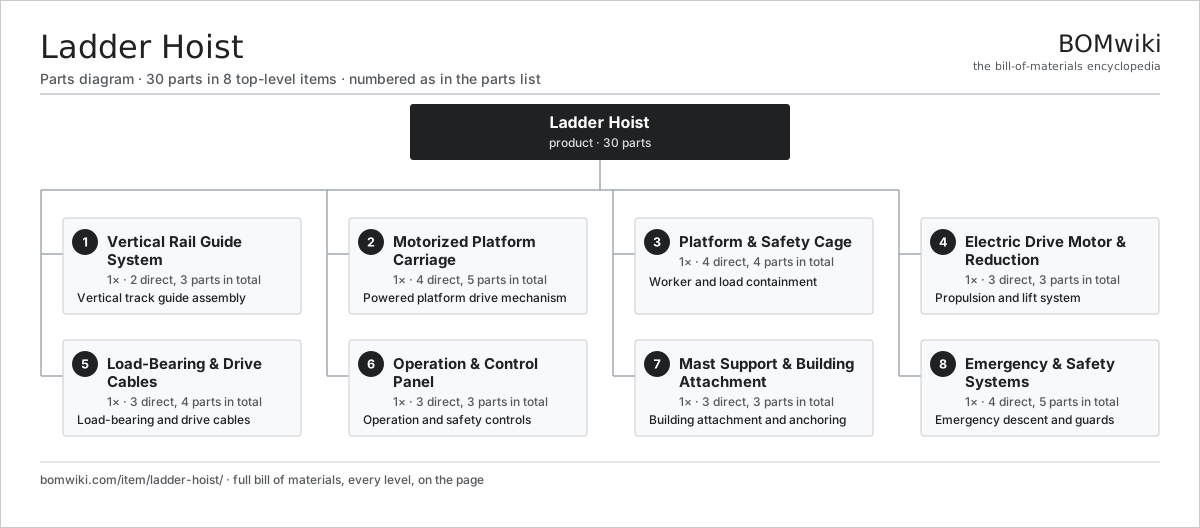
| # | Part | Qty | What it does |
|---|---|---|---|
| 1 | Vertical Rail Guide System 2 parts | 1× | Vertical track guide assembly |
| 2 | Motorized Platform Carriage 4 parts | 1× | Powered platform drive mechanism |
| 3 | Platform & Safety Cage 4 parts | 1× | Worker and load containment |
| 4 | Electric Drive Motor & Reduction 3 parts | 1× | Propulsion and lift system |
| 5 | Load-Bearing & Drive Cables 3 parts | 1× | Load-bearing and drive cables |
| 6 | Operation & Control Panel 3 parts | 1× | Operation and safety controls |
| 7 | Mast Support & Building Attachment 3 parts | 1× | Building attachment and anchoring |
| 8 | Emergency & Safety Systems 4 parts | 1× | Emergency descent and guards |
3D model
No 3D model yet. Have a CAD file of this? Add a 3D model. STL renders right on this page; STEP, FreeCAD, and OpenSCAD sources are welcome too (openly licensed, like all 3D models on BOMwiki).
Build & assembly graph
expand / collapse · shared sub-assemblies converge · links to related products · est. labourTap an assembly to expand/collapse · tap a part to open it · use “Open page” for any node · drag to pan, scroll to zoom.
Bill of materials for Ladder Hoist
8 top-level lines · 34 rows shown · 30 parts total · indented to 3 levels| # | Item / sub-assembly | Part no. | Qty/assy | Ext. qty | Parts | Type |
|---|---|---|---|---|---|---|
| 1 | Vertical Rail Guide System 2 parts | ladder-hoist-rail-system | 1× | 1 | 3 | assembly |
| 1.1 | Vertical Guide Rails | ladder-hoist-rails | 2× | 2 | · | part |
| 1.2 | Rail Spacing & Connectors | ladder-hoist-rail-connectors | 1× | 1 | · | part |
| 2 | Motorized Platform Carriage 4 parts | ladder-hoist-motorized-carriage | 1× | 1 | 5 | assembly |
| 2.1 | Carriage Structural Frame | ladder-hoist-carriage-frame | 1× | 1 | · | part |
| 2.2 | Rail Roller Wheels | ladder-hoist-rail-rollers | 2× | 2 | · | part |
| 2.3 | Drive Sprocket & Chain | ladder-hoist-drive-sprocket | 1× | 1 | · | part |
| 2.4 | Holding Brake System | ladder-hoist-brake-assembly | 1× | 1 | · | part |
| 3 | Platform & Safety Cage 4 parts | ladder-hoist-platform-cage | 1× | 1 | 4 | assembly |
| 3.1 | Platform Floor Deck | ladder-hoist-platform-floor | 1× | 1 | · | part |
| 3.2 | Safety Cage Frame | ladder-hoist-cage-frame | 1× | 1 | · | part |
| 3.3 | Access Gate & Interlocks | ladder-hoist-access-gate | 1× | 1 | · | part |
| 3.4 | Load Attachment Points | ladder-hoist-load-hooks | 1× | 1 | · | part |
| 4 | Electric Drive Motor & Reduction 3 parts | ladder-hoist-drive-motor | 1× | 1 | 3 | assembly |
| 4.1 | AC Electric Motor | ladder-hoist-ac-motor | 1× | 1 | · | part |
| 4.2 | Gearbox Reducer | ladder-hoist-gearbox-reducer | 1× | 1 | · | part |
| 4.3 | Motor Speed Controller | ladder-hoist-motor-controller | 1× | 1 | · | part |
| 5 | Load-Bearing & Drive Cables 3 parts | ladder-hoist-cable-rope | 1× | 1 | 4 | assembly |
| 5.1 | Suspension Ropes | ladder-hoist-suspension-cables | 2× | 2 | · | part |
| 5.2 | Cable End Fittings | ladder-hoist-cable-terminations | 1× | 1 | · | part |
| 5.3 | Cable Protection Sheaths | ladder-hoist-cable-guards | 1× | 1 | · | part |
| 6 | Operation & Control Panel 3 parts | ladder-hoist-control-system | 1× | 1 | 3 | assembly |
| 6.1 | Control Pendant | ladder-hoist-control-pendant | 1× | 1 | · | part |
| 6.2 | Safety Relay & Interlocks | ladder-hoist-safety-relay | 1× | 1 | · | part |
| 6.3 | Emergency Descent Valve | ladder-hoist-emergency-descent | 1× | 1 | · | part |
| 7 | Mast Support & Building Attachment 3 parts | ladder-hoist-support-structure | 1× | 1 | 3 | assembly |
| 7.1 | Mast Top Assembly | ladder-hoist-mast-head | 1× | 1 | · | part |
| 7.2 | Facade Mounting Brackets | ladder-hoist-facade-brackets | 1× | 1 | · | part |
| 7.3 | Guy Wire Bracing | ladder-hoist-guy-cables | 1× | 1 | · | part |
| 8 | Emergency & Safety Systems 4 parts | ladder-hoist-safety-devices | 1× | 1 | 5 | assembly |
| 8.1 | Top & Bottom Limit Switches | ladder-hoist-limit-switches | 2× | 2 | · | part |
| 8.2 | Anti-Drop Safety Device | ladder-hoist-anti-drop-device | 1× | 1 | · | part |
| 8.3 | Load Monitoring Cell | ladder-hoist-load-cell-limiter | 1× | 1 | · | part |
| 8.4 | Interlocked Gate Lock | ladder-hoist-emergency-gate-lock | 1× | 1 | · | part |
Something wrong in this list? Report a problem with this BOM.
Sourcing: possible vendors
Browse the supplier directory → Prices, MOQ, and lead times are algorithmic estimates, not quotes, and not claims about these companies. Company mappings are curated by keyword; est. price band $15k–$2M. How estimates work| Vendor | HQ | Specialty | MOQ | Lead time |
|---|---|---|---|---|
| caterpillar.com ↗ | Irving, US | Construction & mining equipment | made to order | 16–28 wks |
|
🇯🇵Komatsu
komatsu.com ↗
|
Tokyo, JP | Construction & mining equipment | made to order | 16–28 wks |
|
🇸🇪Volvo CE
volvoce.com ↗
|
Gothenburg, SE | Construction equipment | made to order | 16–28 wks |
|
🇨🇭Liebherr
liebherr.com ↗
|
Bulle, CH | Cranes & heavy equipment | made to order | 16–28 wks |
|
🇨🇳XCMG
xcmg.com ↗
|
Xuzhou, CN | Construction machinery | made to order | 16–28 wks |
1,740-word article