Large-Format View Camera
ProductAlso known as: view camera
Overview
A large-format view camera is the oldest camera architecture still in production: two standards on a rail, a bellows between them, a lens on the front and film on the back. What keeps it alive is not the big negative alone but geometry. Because the lens and film planes can each be tilted, swung, shifted, and raised independently, the photographer controls perspective and the plane of sharp focus in ways no fixed-body camera can. Architecture, product, and landscape photographers still reach for it, and the 4×5 inch sheet delivers roughly 13 times the area of a 35 mm frame.
The camera is a kit of subassemblies on the Monorail and Tripod Block: the Front Standard carrying the Lens and Shutter Unit, the Rear Standard carrying the Ground-Glass Back, and the Bellows sealing the space between them. There is no mirror, no rangefinder, no electronics; the photographer composes directly on ground glass.
Movements
Rise, fall, and shift translate a standard without rotating it. Front rise is the classic architectural move: point the camera level at a building, raise the lens with the Rise/Fall Slide, and the top of the building comes into frame while vertical lines stay parallel, the correction that, on a small camera, would require tilting the whole body and accepting converging verticals. This only works because the lens projects an image circle much larger than the film; a 150 mm plasmat covering 210 mm leaves about 45 mm of usable displacement around the 153 mm film diagonal.
Tilt and swing rotate a plane. Tilting the lens forward with the Tilt Axis applies the Scheimpflug principle: when the lens plane, film plane, and subject plane intersect along a common line, the whole subject plane is in focus. A landscape photographer tilts the lens a few degrees forward and holds flowers at one metre and mountains at infinity sharp simultaneously, at an aperture that depth of field alone could never manage. Rear movements on the Rear Tilt Axis and Rear Swing Base do the same focus job but also change the rendered shape of the subject, since they re-project the image geometry, product photographers use rear swings to stretch or square up an object.
Composing and focusing
The image on the Ground Glass is upside down and laterally reversed, dim at working apertures, so the photographer focuses under the Focusing Hood or a dark cloth with the lens wide open, usually with a loupe against the glass. A Fresnel Brightening Screen behind the screen redirects oblique corner rays toward the eye. Coarse focus slides a whole standard along the Monorail Tube; fine focus is the geared Focus Drive. The clipped corners of the screen double as a vignetting check, looking through them at the aperture confirms the lens still covers the film after movements.
Making an exposure
The sequence is deliberate. Compose and focus; stop the Leaf Shutter down to working aperture, typically f/22–f/45; close and cock the shutter. Slide a Sheet Film Holder under the Back Tension Springs, the spring back lifts the ground glass and seats the film exactly where the glass surface was, both machined to the ANSI depth standard of 4.8 mm for 4×5 holders. Pull the Dark Slide, fire with the Cable Release, reinsert the slide black-side-out to mark the sheet exposed. Each holder carries two sheets; a field day might be twenty exposures, each metered and composed individually.
Because each sheet develops individually, large format pairs naturally with the Zone System: exposure and development tailored per negative (N+1, N−1 development) to fit each scene's contrast to the film, per-frame processing that roll film cannot offer.
Lenses and the bellows
Large-format lenses are self-contained units: front and rear Lens Cell Pair threaded into a Copal-pattern shutter, clamped through a flat Lens Board by a Shutter Retaining Ring. Changing lenses means swapping boards into the Lens Board Clip retainers. Focal lengths run from 65–90 mm wide-angles to 300 mm and beyond; wide lenses compress the standards so close together that the pleated Pleated Bellows Body becomes stiff, which is why a loose Bag Bellows substitutes for wide work, while long lenses and macro need the Extension Rail.
Why it persists
A 4×5 negative scanned or contact-printed resolves detail comparable to very-high-resolution digital capture, but the deeper reason the design survives is that the camera is a direct mechanical statement of imaging geometry. Digital technical cameras for architectural work copy it exactly, the same standards, the same movements, with a medium-format digital back replacing the Sheet Film Holder on the same Graflok Slider interface, on bodies whose lineage runs straight back through this design.
Large-Format View Camera parts and their functions
8 top-level parts · 55 parts in total · full bill of materials below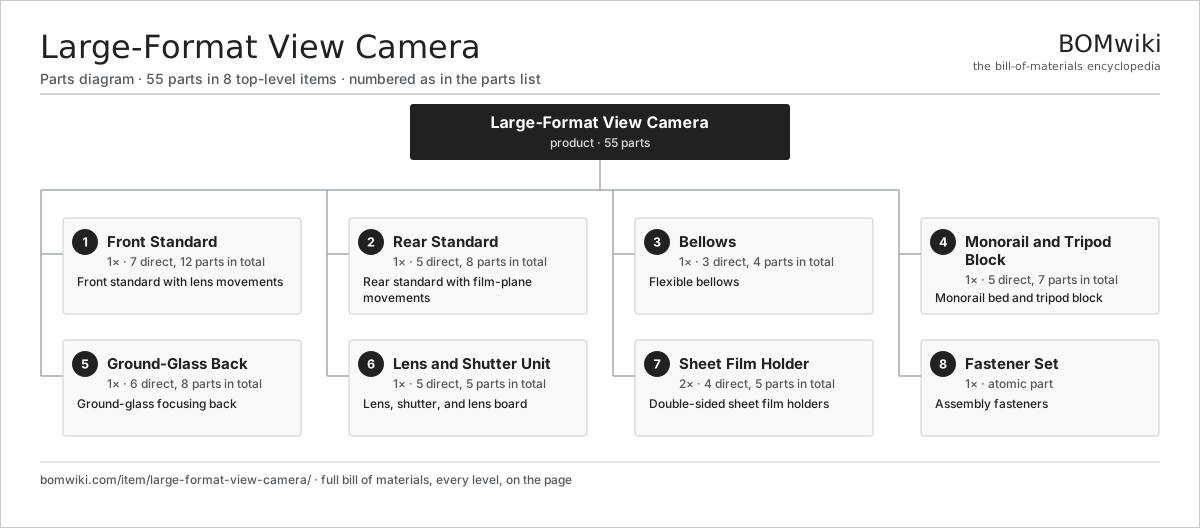
| # | Part | Qty | What it does |
|---|---|---|---|
| 1 | Front Standard 7 parts | 1× | Front standard with lens movements |
| 2 | Rear Standard 5 parts | 1× | Rear standard with film-plane movements |
| 3 | Bellows 3 parts | 1× | Flexible bellows |
| 4 | Monorail and Tripod Block 5 parts | 1× | Monorail bed and tripod block |
| 5 | Ground-Glass Back 6 parts | 1× | Ground-glass focusing back |
| 6 | Lens and Shutter Unit 5 parts | 1× | Lens, shutter, and lens board |
| 7 | Sheet Film Holder 4 parts | 2× | Double-sided sheet film holders |
| 8 | Fastener Set | 1× | Assembly fasteners |
3D model
No 3D model yet. Have a CAD file of this? Add a 3D model. STL renders right on this page; STEP, FreeCAD, and OpenSCAD sources are welcome too (openly licensed, like all 3D models on BOMwiki).
Build & assembly graph
expand / collapse · shared sub-assemblies converge · links to related products · est. labourTap an assembly to expand/collapse · tap a part to open it · use “Open page” for any node · drag to pan, scroll to zoom.
Bill of materials for Large-Format View Camera
8 top-level lines · 43 rows shown · 55 parts total · indented to 3 levels| # | Item / sub-assembly | Part no. | Qty/assy | Ext. qty | Parts | Type |
|---|---|---|---|---|---|---|
| 1 | Front Standard 7 parts | large-format-view-camera-front-standard | 1× | 1 | 12 | assembly |
| 1.1 | Front U-Frame | large-format-view-camera-front-frame | 1× | 1 | · | part |
| 1.2 | Tilt Axis | large-format-view-camera-tilt-axis | 1× | 1 | · | part |
| 1.3 | Swing Base | large-format-view-camera-swing-base | 1× | 1 | · | part |
| 1.4 | Rise/Fall Slide | large-format-view-camera-rise-slide | 1× | 1 | · | part |
| 1.5 | Shift Slide | large-format-view-camera-shift-slide | 1× | 1 | · | part |
| 1.6 | Movement Lock Knob | large-format-view-camera-lock-knob | 5× | 5 | · | part |
| 1.7 | Lens Board Clip | large-format-view-camera-board-clip | 2× | 2 | · | part |
| 2 | Rear Standard 5 parts | large-format-view-camera-rear-standard | 1× | 1 | 8 | assembly |
| 2.1 | Rear Frame | large-format-view-camera-rear-frame | 1× | 1 | · | part |
| 2.2 | Rear Tilt Axis | large-format-view-camera-rear-tilt | 1× | 1 | · | part |
| 2.3 | Rear Swing Base | large-format-view-camera-rear-swing | 1× | 1 | · | part |
| 2.4 | Focus Drive | large-format-view-camera-focus-drive | 1× | 1 | · | part |
| 2.5 | Movement Lock Knob | large-format-view-camera-lock-knob | 4× | 4 | · | part |
| 3 | Bellows 3 parts | large-format-view-camera-bellows | 1× | 1 | 4 | assembly |
| 3.1 | Pleated Bellows Body | large-format-view-camera-bellows-body | 1× | 1 | · | part |
| 3.2 | Bellows Mounting Frame | large-format-view-camera-bellows-frame | 2× | 2 | · | part |
| 3.3 | Bag Bellows | large-format-view-camera-bag-bellows | 1× | 1 | · | part |
| 4 | Monorail and Tripod Block 5 parts | large-format-view-camera-rail | 1× | 1 | 7 | assembly |
| 4.1 | Monorail Tube | large-format-view-camera-rail-tube | 1× | 1 | · | part |
| 4.2 | Carrier Clamp | large-format-view-camera-rail-clamp | 2× | 2 | · | part |
| 4.3 | Tripod Block | large-format-view-camera-tripod-block | 1× | 1 | · | part |
| 4.4 | Rail End Cap | large-format-view-camera-rail-end-cap | 2× | 2 | · | part |
| 4.5 | Extension Rail | large-format-view-camera-extension-rail | 1× | 1 | · | part |
| 5 | Ground-Glass Back 6 parts | large-format-view-camera-gg-back | 1× | 1 | 8 | assembly |
| 5.1 | Ground Glass | large-format-view-camera-ground-glass | 1× | 1 | · | part |
| 5.2 | Fresnel Brightening Screen | large-format-view-camera-fresnel | 1× | 1 | · | part |
| 5.3 | Back Tension Springs | large-format-view-camera-back-springs | 2× | 2 | · | part |
| 5.4 | Rotating Back Frame | large-format-view-camera-back-frame | 1× | 1 | · | part |
| 5.5 | Focusing Hood | large-format-view-camera-hood | 1× | 1 | · | part |
| 5.6 | Graflok Slider | large-format-view-camera-graflok-slider | 2× | 2 | · | part |
| 6 | Lens and Shutter Unit 5 parts | large-format-view-camera-lens-unit | 1× | 1 | 5 | assembly |
| 6.1 | Lens Cell Pair | large-format-view-camera-lens-cells | 1× | 1 | · | part |
| 6.2 | Leaf Shutter | large-format-view-camera-leaf-shutter | 1× | 1 | · | part |
| 6.3 | Lens Board | large-format-view-camera-lensboard | 1× | 1 | · | part |
| 6.4 | Cable Release | large-format-view-camera-cable-release | 1× | 1 | · | part |
| 6.5 | Shutter Retaining Ring | large-format-view-camera-retaining-ring | 1× | 1 | · | part |
| 7 | Sheet Film Holder 4 parts | large-format-view-camera-film-holder | 2× | 2 | 5 | assembly |
| 7.1 | Holder Body | large-format-view-camera-holder-body | 1× | 2 | · | part |
| 7.2 | Dark Slide | large-format-view-camera-dark-slide | 2× | 4 | · | part |
| 7.3 | Loading Flap | large-format-view-camera-holder-flap | 1× | 2 | · | part |
| 7.4 | Centre Septum | large-format-view-camera-film-septum | 1× | 2 | · | part |
| 8 | Fastener Set | fastener-set | 1× | 1 | · | part |
Something wrong in this list? Report a problem with this BOM.
Sourcing: possible vendors
Browse the supplier directory → Prices, MOQ, and lead times are algorithmic estimates, not quotes, and not claims about these companies. Company mappings are curated by keyword; est. price band $100–$8k. How estimates work| Vendor | HQ | Specialty | MOQ | Lead time |
|---|---|---|---|---|
|
🇯🇵Canon
canon.com ↗
|
Tokyo, JP | Imaging & optics | 500 units | 10–16 wks |
|
🇯🇵Nikon
nikon.com ↗
|
Tokyo, JP | Imaging & optics | 500 units | 10–16 wks |
|
🇩🇪ZEISS
zeiss.com ↗
|
Oberkochen, DE | Optics & optoelectronics | 500 units | 10–16 wks |
| leica-camera.com ↗ | Wetzlar, DE | Cameras & optics | 500 units | 10–16 wks |
| flir.com ↗ | Wilsonville, US | Thermal imaging | 500 units | 10–16 wks |
891-word article