Laser Marking Machine
ProductOverview
A laser marking machine uses a focused beam of infrared light to permanently mark, engrave, or etch part surfaces at high speed and with fine resolution. A Fiber Laser Source generates 20–100 W at 1064 nm (invisible infrared, requiring protective enclosure), and a Galvanometric Scan Head with precision galvanometers steers the beam across the workpiece in patterns defined by CAD or barcode data. The F-Theta Lens Assembly focuses the beam to a sharp spot (0.05–0.5 mm diameter), delivering enough power density to vaporize surface material or initiate color-change reactions in marking compounds. Marking speeds are extremely fast, 1000–8000 mm/sec, allowing simple text and barcodes to be marked in seconds. Fiber lasers are ideal for metals (steel, aluminum, anodized titanium, stainless) and superior to older CO2 lasers for these applications because 1064 nm is efficiently absorbed by metal surfaces, whereas CO2 (10.6 µm) is poorly absorbed and better suited to plastics and wood.
Fiber laser source
The Fiber Laser Source is fundamentally different from a lamp-pumped or diode-pumped laser. A Fiber Oscillator Module, a dedicated seed laser module, generates a weak (10 W) 1064 nm beam. This seed is launched into an Fiber Amplifier, a length of ytterbium (Yb) doped fiber that is pumped by high-power diodes at 976 nm. The diode light excites ytterbium ions in the fiber; when the seed photon passes through, it stimulates emission, amplifying it to the desired power (20–100 W) with high efficiency (50–70%, far better than older lamp-pumped solid-state lasers). The Laser Power Supply (400–800 W input) provides power to the diodes and seed laser. Heat is removed by a Laser Cooling Unit (water or air cooled, dissipating 200–500 W). The output is coupled into a Fiber Coupler, typically a single-mode fiber that delivers the beam to the galvo head.
Galvanometric scan head
The Galvanometric Scan Head is where speed and precision meet. Two X Galvo Motor and Y motors (galvanometers, precision torque motors) are mounted orthogonally, each driving a X-Axis Galvo Mirror and Y-Axis Galvo Mirror. The motors are high-bandwidth devices (8000 rad/sec is typical), able to accelerate and decelerate the mirrors in milliseconds. As the two mirrors pivot, they steer the laser beam across the work surface. A Beam Combiner ensures the X and Y scan paths are aligned so the beam traces a clean grid pattern. The Galvo Amplifier, a precision servo amplifier, receives command signals from the Control System (typically 0–10 VDC analog or digital pulses) and outputs high-current signals to the galvo motors. Scanning speed of 1000–8000 mm/sec is achievable; faster speeds require lower laser power or defocus slightly, reducing mark darkness.
Focusing optics
The F-Theta Lens Assembly is specialized. A simple lens would require refocusing as the beam scans across the work field because the optical path length changes. An F-Theta lens (a group of elements corrected for this aberration) maintains constant focal length and spot size across the entire marking area. Typical focal lengths are 100–300 mm, determining the field size: a 100 mm lens covers roughly a 70 × 70 mm area, while a 300 mm lens covers 200 × 200 mm. The lens is mounted in a Lens Mounting and can be manually or motorized focused via a Focus Adjustment. The Window Assembly, often made of ZnSe or fused silica, protects the optics from spatter and marks. Focus adjustment is critical: a 1064 nm laser focused at the wrong distance produces a much larger spot and weaker marking power.
Beam spot and marking mechanism
The laser vaporizes surface material via ablation, the intense focused beam heats the workpiece above its boiling point, and a layer of material explodes away. The process is so fast and localized that surrounding material is unaffected. On metal, a clean, dark mark forms; on anodized aluminum, the anodized layer is stripped, revealing shiny bare metal beneath. On stainless steel, oxidation (discoloration) occurs, darkening the mark. Some applications apply a laser-marking-machine-marking-compound (a paint or oil-based ink that changes color when heated) before marking, allowing marks on unprepared surfaces. Mark width is typically 0.05–0.5 mm; depth (for engraving) ranges from surface darkening (~0.001 mm) to deep etching (1–5 mm, requiring multiple passes and lower speed).
Work table and positioning
The Work Table and Positioning is a simple platform where the part is placed. Manual machines have a static table; the operator jogs a part under the beam and marks it, then repositions manually for the next mark. Automated machines include an XY Automation Stage, a motorized XY table driven by stepper motors, allowing the controller to index parts or multiple mark locations automatically. The table height is adjusted via the Z-Axis Head Mount, which positions the Galvanometric Scan Head for proper focus.
Control and programming
The Control System is an industrial PC or embedded system running marking software. The software:
- Imports designs: CAD files, fonts, barcodes, QR codes, or logos.
- Sets parameters: Power (%), speed (mm/sec), frequency (kHz).
- Defines scan pattern: Converts the design into XY coordinates and laser on/off timing.
- Commands galvos: Sends voltage commands to the Galvo Amplifier, steering the beam in real-time.
- Monitors completion: Tracks marking progress and triggers alarms if power drops or beam is blocked.
Modern software supports variable laser power, allowing shading and grayscale images to be marked by modulating beam intensity. Some systems integrate XY Automation Stage positioning, enabling automated multi-part runs with no operator intervention.
Safety and enclosure
Fiber laser light at 1064 nm is invisible but extremely dangerous, direct eye exposure causes irreversible retinal damage. The Safety Enclosure & Fume Extraction is a Class 4 laser safety housing (per ANSI Z136.1) with:
- Protective window: The Protective Window (polycarbonate or special optical glass) blocks 1064 nm while allowing visible light through.
- Safety interlock: If the enclosure door opens, the Safety Interlock kill the laser immediately.
- Emergency stop: A Emergency Stop Button button on the operator panel.
- Fume extraction: Marking produces aerosols and smoke; a Fume Blower with a Fume Filter removes them.
Typical marking cycle
A batch of 500 stainless steel nameplates (50 × 30 mm) arrives with a CAD file specifying the company logo, part number, and date code. Each plate is loaded into the Work Table and Positioning. The operator selects the program from the software library and presses Start. The Galvanometric Scan Head rapidly traces the logo at 3000 mm/sec, marks the text at 2000 mm/sec, all within 15 seconds. The part is removed, the next is loaded, and the cycle repeats, 200 parts per hour easily. The marks are permanent, waterproof, and require no secondary finishing.
Material and speed considerations
Different materials require different settings:
- Steel: 20–50% power, 3000–5000 mm/sec, 100 kHz frequency → dark, crisp marks.
- Aluminum: 30–60% power, 4000–6000 mm/sec → shiny or oxidized marks depending on anodize.
- Anodized aluminum: 15–30% power, 2000–4000 mm/sec → strips anodize, reveals shiny metal.
- Titanium (aerospace): 40–80% power, 1000–2000 mm/sec (slow for traceability) → high-contrast marks.
- Plastics (limited): Some acrylics and polyimides can be marked; PVC and PET are difficult or impossible.
Because 1064 nm is absorbed well by metals, fiber lasers are the standard for industrial marking. CO2 lasers (10.6 µm), better for wood and acrylic, are less common in metal shops. Nd:YAG (older technology) has been largely superseded by fiber for cost and efficiency reasons.
Laser Marking Machine parts and their functions
8 top-level parts · 45 parts in total · full bill of materials below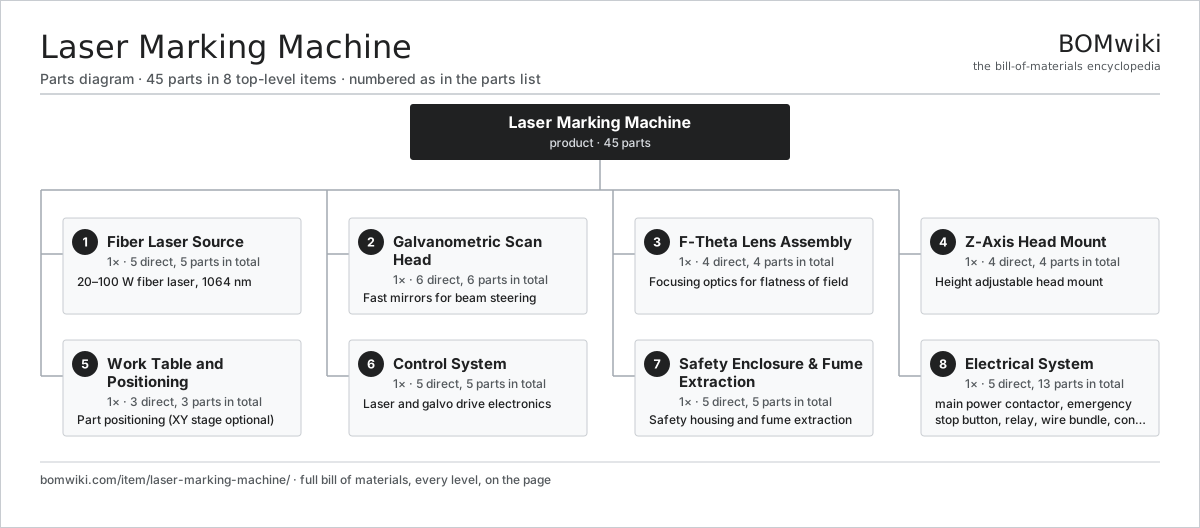
| # | Part | Qty | What it does |
|---|---|---|---|
| 1 | Fiber Laser Source 5 parts | 1× | 20–100 W fiber laser, 1064 nm |
| 2 | Galvanometric Scan Head 6 parts | 1× | Fast mirrors for beam steering |
| 3 | F-Theta Lens Assembly 4 parts | 1× | Focusing optics for flatness of field |
| 4 | Z-Axis Head Mount 4 parts | 1× | Height adjustable head mount |
| 5 | Work Table and Positioning 3 parts | 1× | Part positioning (XY stage optional) |
| 6 | Control System 5 parts | 1× | Laser and galvo drive electronics |
| 7 | Safety Enclosure & Fume Extraction 5 parts | 1× | Safety housing and fume extraction |
| 8 | Electrical System 5 parts | 1× | High-voltage laser power supply, galvo drives, and control power. |
3D model
No 3D model yet. Have a CAD file of this? Add a 3D model. STL renders right on this page; STEP, FreeCAD, and OpenSCAD sources are welcome too (openly licensed, like all 3D models on BOMwiki).
Build & assembly graph
expand / collapse · shared sub-assemblies converge · links to related products · est. labourTap an assembly to expand/collapse · tap a part to open it · use “Open page” for any node · drag to pan, scroll to zoom.
Bill of materials for Laser Marking Machine
8 top-level lines · 45 rows shown · 45 parts total · indented to 3 levels| # | Item / sub-assembly | Part no. | Qty/assy | Ext. qty | Parts | Type |
|---|---|---|---|---|---|---|
| 1 | Fiber Laser Source 5 parts | laser-marking-machine-fiber-laser-source | 1× | 1 | 5 | assembly |
| 1.1 | Fiber Oscillator Module | laser-marking-machine-fiber-oscillator | 1× | 1 | · | part |
| 1.2 | Fiber Amplifier | laser-marking-machine-fiber-amplifier | 1× | 1 | · | part |
| 1.3 | Laser Power Supply | laser-marking-machine-laser-power-supply | 1× | 1 | · | part |
| 1.4 | Laser Cooling Unit | laser-marking-machine-cooling-system | 1× | 1 | · | part |
| 1.5 | Fiber Coupler | laser-marking-machine-optical-coupling | 1× | 1 | · | part |
| 2 | Galvanometric Scan Head 6 parts | laser-marking-machine-galvo-head | 1× | 1 | 6 | assembly |
| 2.1 | X-Axis Galvo Mirror | laser-marking-machine-x-galvo-mirror | 1× | 1 | · | part |
| 2.2 | Y-Axis Galvo Mirror | laser-marking-machine-y-galvo-mirror | 1× | 1 | · | part |
| 2.3 | X Galvo Motor | laser-marking-machine-galvo-motor-x | 1× | 1 | · | part |
| 2.4 | Y Galvo Motor | laser-marking-machine-galvo-motor-y | 1× | 1 | · | part |
| 2.5 | Galvo Amplifier | laser-marking-machine-galvo-driver | 1× | 1 | · | part |
| 2.6 | Beam Combiner | laser-marking-machine-beam-combiner | 1× | 1 | · | part |
| 3 | F-Theta Lens Assembly 4 parts | laser-marking-machine-f-theta-lens | 1× | 1 | 4 | assembly |
| 3.1 | F-Theta Lens | laser-marking-machine-f-theta-lens-element | 1× | 1 | · | part |
| 3.2 | Lens Mounting | laser-marking-machine-lens-mount | 1× | 1 | · | part |
| 3.3 | Focus Adjustment | laser-marking-machine-focusing-actuator | 1× | 1 | · | part |
| 3.4 | Window Assembly | laser-marking-machine-beam-window | 1× | 1 | · | part |
| 4 | Z-Axis Head Mount 4 parts | laser-marking-machine-z-axis-column | 1× | 1 | 4 | assembly |
| 4.1 | Z Column | laser-marking-machine-z-column-body | 1× | 1 | · | part |
| 4.2 | Z-Axis Lead Screw | laser-marking-machine-z-lead-screw | 1× | 1 | · | part |
| 4.3 | Z Bearing Block | laser-marking-machine-z-bearing-block | 1× | 1 | · | part |
| 4.4 | Fastener Set | fastener-set | 1× | 1 | · | part |
| 5 | Work Table and Positioning 3 parts | laser-marking-machine-work-table | 1× | 1 | 3 | assembly |
| 5.1 | Work Table | laser-marking-machine-table-casting | 1× | 1 | · | part |
| 5.2 | XY Automation Stage | laser-marking-machine-xy-stage-optional | 1× | 1 | · | part |
| 5.3 | Part Fixtures | laser-marking-machine-part-clamps | 1× | 1 | · | part |
| 6 | Control System 5 parts | laser-marking-machine-controller | 1× | 1 | 5 | assembly |
| 6.1 | Main Controller Board | laser-marking-machine-main-controller-board | 1× | 1 | · | part |
| 6.2 | Laser Power Module | laser-marking-machine-laser-power-controller | 1× | 1 | · | part |
| 6.3 | Galvo Interface Board | laser-marking-machine-galvo-interface | 1× | 1 | · | part |
| 6.4 | Operator Panel | laser-marking-machine-display-panel | 1× | 1 | · | part |
| 6.5 | Power Supply | power-supply | 1× | 1 | · | part |
| 7 | Safety Enclosure & Fume Extraction 5 parts | laser-marking-machine-enclosure | 1× | 1 | 5 | assembly |
| 7.1 | Enclosure Frame | laser-marking-machine-enclosure-frame | 1× | 1 | · | part |
| 7.2 | Protective Window | laser-marking-machine-polycarbonate-window | 1× | 1 | · | part |
| 7.3 | Fume Blower | laser-marking-machine-extraction-blower | 1× | 1 | · | part |
| 7.4 | Fume Filter | laser-marking-machine-fume-filter | 1× | 1 | · | part |
| 7.5 | Safety Interlock | laser-marking-machine-safety-interlocks | 1× | 1 | · | part |
| 8 | Electrical System 5 parts | laser-marking-machine-electrical | 1× | 1 | 13 | assembly |
| 8.1 | Main Power Contactor | laser-marking-machine-main-contactor | 1× | 1 | · | part |
| 8.2 | Emergency Stop Button | laser-marking-machine-emergency-stop | 1× | 1 | · | part |
| 8.3 | Relay | relay | 2× | 2 | · | part |
| 8.4 | Wire Bundle | wire-bundle | 1× | 1 | · | part |
| 8.5 | Connector | connector | 8× | 8 | · | part |
Something wrong in this list? Report a problem with this BOM.
Sourcing: possible vendors
Browse the supplier directory → Prices, MOQ, and lead times are algorithmic estimates, not quotes, and not claims about these companies. Company mappings are curated by keyword; est. price band $10k–$1M. How estimates work| Vendor | HQ | Specialty | MOQ | Lead time |
|---|---|---|---|---|
|
🇩🇪DMG MORI
dmgmori.com ↗
|
Bielefeld, DE | Machine tools | 5 units | 12–20 wks |
|
🇯🇵Mazak
mazak.com ↗
|
Oguchi, JP | Machine tools | 5 units | 12–20 wks |
| haascnc.com ↗ | Oxnard, US | CNC machine tools | 5 units | 12–20 wks |
|
🇯🇵Okuma
okuma.com ↗
|
Niwa, JP | Machine tools | 5 units | 12–20 wks |
|
🇩🇪Trumpf
trumpf.com ↗
|
Ditzingen, DE | Laser & sheet-metal machines | 5 units | 12–20 wks |
1,349-word article