Laser Screed
ProductOverview
A laser screed is a self-propelled concrete finishing machine that produces precision-graded slab surfaces over large areas. It combines a moving screed board with an automatic height-adjustment system controlled by a laser transmitter reference plane. The operator rides the machine, monitoring a console display; the Laser Receiver and Controls system continuously compares the screed's actual height to the laser target, commanding proportional hydraulic cylinders to maintain grade within ±5 mm.
Laser screeds dominate industrial concrete floors, airport pavements, and highway slabs where large areas (often 10,000+ m²) must achieve tight flatness tolerances. Machine costs €120,000–180,000; operator wages and diesel fuel consume €40–60/m² of finished concrete. On a 50,000 m² warehouse floor, a laser screed completes the finishing pass in 15–20 days, whereas manual troweling teams would require 40–60 days, making the investment cost-effective on projects larger than 5,000 m².
The Telescoping Boom is the heart of the machine. It telescopes and tilts under proportional hydraulic control, lifting and positioning the Screed Head Assembly across the freshly placed concrete. The screed beam is rigid aluminum, typically 3.0–3.6 m wide, the target width is maximized to reduce passes over the same concrete, minimizing overlap and energy waste.
Laser guidance is continuous: a rotating laser transmitter (rotated by the contractor, placed on the slab datum) sweeps its beam across the work. The Laser Receiver Head head rotates to intercept the beam; when the beam crosses the receiver optics, the receiver reports the angle deviation (positive or negative). The proportional Leveling System system then commands the left and right leveling cylinders to adjust the screed tilt, bringing the receiver back into alignment. This feedback loop runs at 10 Hz, achieving stable ±5 mm height control even on uneven subgrades or over soft clay.
How it works
The operator mounts the console and starts the Engine and Fuel System. The Hydraulic Pump comes online, pressurizing the system to 210 bar. A contractor beforehand places a laser transmitter on a tripod, set at a reference elevation 50–100 mm above the final floor datum. The transmitter rotates slowly, sweeping a horizontal light plane across the entire slab area.
The operator engages forward, and the machine crawls forward at 0.5–1.5 m/min. The Receiver Module locks onto the laser beam. When the beam sweeps the receiver, the receiver angles change continuously. As the screed advances toward rising ground, the angle increases; the proportional Proportional Amplifier detects this and commands the right-side Right Leveling Cylinder to extend, dropping that side of the screed and maintaining the beam perpendicular to the receiver optics. Simultaneously, the left side may retract if the grade slopes. Within 0.5 seconds, the screed is back in alignment, and concrete flows across the Screed Beam.
The Vibrator Unit beneath the screed beam vibrates at 80–100 Hz, consolidating concrete and reducing bleed. The shoes at the leading edge guide the concrete and prevent washout. As the machine travels, concrete is struck level with the top of the screed; the trailing edge of the beam smooths the surface.
Multiple passes are sometimes required if the concrete slump is high (200+ mm). A first pass "roughly screeds," and a second pass 10 minutes later fine-tunes the surface. The concrete must be firm enough to support the machine wheels without sinking (typically 2–3 hours after placement for 200 mm slump concrete).
Slope control is automatic. If the slab design calls for a 1 % slope (e.g., 10 mm fall per meter), the contractor sets the laser transmitter tilted to that angle. The receiver then tracks a tilted plane, and the leveling cylinders maintain the screed parallel to that plane. Modern machines can program slopes up to 20 % directly via the Control Display console.
The Drive Chassis uses rubber tracks to distribute the 20-tonne load over a 2 m² footprint. Tracks leave minimal ruts in fresh concrete (typically < 5 mm), much less than wheel machines. Track speed is proportionally controlled by the operator via a joystick; fine-speed adjustments are made at 0.5 m/min for precision work.
Precision and tolerances
Flatness tolerance F150 (standard warehouse floor) requires surface variation ≤ 1 mm over 3 m when tested with a straightedge. A well-tuned laser screed can achieve this. Repeatability depends on:
Laser setup: The transmitter must rotate about its vertical axis only. A tilted or drifting transmitter corrupts all height measurements. Tripod setup typically takes 30 min and is checked with a level before concrete is placed.
Receiver calibration: The receiver must be perpendicular to the screed beam. After boom extension or major adjustments, the receiver angle offset must be re-zeroed. This is done by rolling the machine under a fixed reference rod (plumb line) and adjusting potentiometers on the Receiver Module.
Subgrade: Soft or compressible subgrades cause the slab to settle beneath the machine. On poor soils, a laser screed may score 10 mm during a single pass, then another 10 mm when crossed by a paver the next day. Proper substrate preparation (compacted base, drainage) is essential.
Concrete mix: High slump or bleed water disrupts consolidation. Many operators prefer a 100–150 mm slump (rather than 200 mm) for laser screed finishing. Slump beyond 200 mm causes the screed to sink and "walk" laterally.
Maintenance
The Telescoping Boom telescoping mechanism requires regular lubrication. Grease nipples on the boom sliding sections should be serviced weekly; the bronze bushings are prone to seizing if neglected. A seized boom section can be freed with an acetylene torch and a soft-blow hammer, taking 4–6 hours. Prevention is preferable to cure.
The screed beam shoes wear at 0.5–2 mm per 1000 m² screeded, depending on concrete stiffness and subgrade texture. Replacement shoes cost €200–300 per pair and are unbolted and replaced in 30 minutes. Worn shoes (asymmetric wear) cause the screed to drift sideways; this is a leading cause of wavy floors.
The Vibrator Unit is driven by a flexible coupling; if concrete is very stiff, the coupling can shear. Replacement takes 2 hours. Electric vibrator bearings and eccentric masses must be inspected annually; imbalance develops if fasteners loosen, and this causes dangerous machine vibration.
The hydraulic system must be bled of air after major hose replacements. Entrained air causes spongy response and loss of precision. Bleeding is performed by running the machine at low throttle, cycling each control slowly, and allowing air bubbles to escape through the return tank vent for 30 minutes.
Track replacement is expensive but inevitable. A rubber track lasts 500–1000 operating hours (8000–15000 m²) depending on subgrade and aggregate sharpness. A replacement track costs €4,000–6,000 per side and requires a one-day specialist swap.
Design variations and special applications
Spread machines (6–8 m screed width) are used on very flat, unobstructed slabs. They are heavier (25–30 tonnes) and slower (0.3–0.8 m/min) but finish in one pass.
Slope laser screeds are outfitted with tilting laser receivers for 10–20 % grades, used on parking structures and ramps.
Dowel bar insertion screeds include a sideways feed hopper and pusher ram, placing dowels into freshly screeded concrete before it sets. This is common on highway pavements and reduces post-placement labor.
Vibratory ride-on screeds (no laser) are simpler and cheaper (€50,000–80,000) but require an experienced operator to maintain grade by eye. They are used on small slabs or where accuracy requirements are relaxed (±10 mm).
Standards and operation
Laser screeds fall under machinery directive 2006/42/EC in Europe. Operators require OSHA certification or equivalent (8–16 hours training) covering equipment operation, concrete handling, and emergency shutdown. Most rental companies provide 4–6 hours of operator training with machine delivery. A competent operator can achieve F150 tolerances on properly prepared concrete within 10–20 hours of experience.
Laser Screed parts and their functions
7 top-level parts · 33 parts in total · full bill of materials below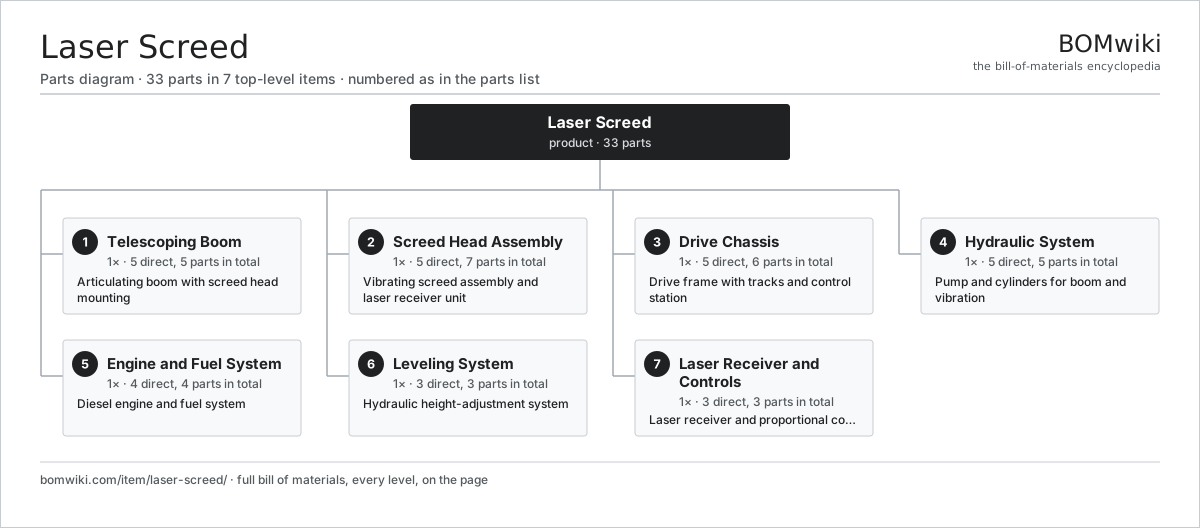
| # | Part | Qty | What it does |
|---|---|---|---|
| 1 | Telescoping Boom 5 parts | 1× | Articulating boom with screed head mounting |
| 2 | Screed Head Assembly 5 parts | 1× | Vibrating screed assembly and laser receiver unit |
| 3 | Drive Chassis 5 parts | 1× | Drive frame with tracks and control station |
| 4 | Hydraulic System 5 parts | 1× | Pump and cylinders for boom and vibration |
| 5 | Engine and Fuel System 4 parts | 1× | Diesel engine and fuel system |
| 6 | Leveling System 3 parts | 1× | Hydraulic height-adjustment system |
| 7 | Laser Receiver and Controls 3 parts | 1× | Laser receiver and proportional controls |
3D model
No 3D model yet. Have a CAD file of this? Add a 3D model. STL renders right on this page; STEP, FreeCAD, and OpenSCAD sources are welcome too (openly licensed, like all 3D models on BOMwiki).
Build & assembly graph
expand / collapse · shared sub-assemblies converge · links to related products · est. labourTap an assembly to expand/collapse · tap a part to open it · use “Open page” for any node · drag to pan, scroll to zoom.
Bill of materials for Laser Screed
7 top-level lines · 37 rows shown · 33 parts total · indented to 3 levels| # | Item / sub-assembly | Part no. | Qty/assy | Ext. qty | Parts | Type |
|---|---|---|---|---|---|---|
| 1 | Telescoping Boom 5 parts | laser-screed-boom | 1× | 1 | 5 | assembly |
| 1.1 | Boom Inner Section | laser-screed-boom-inner | 1× | 1 | · | part |
| 1.2 | Boom Middle Section | laser-screed-boom-middle | 1× | 1 | · | part |
| 1.3 | Boom Outer Section | laser-screed-boom-outer | 1× | 1 | · | part |
| 1.4 | Lift Cylinder | laser-screed-boom-cylinder-lift | 1× | 1 | · | part |
| 1.5 | Extend Cylinder | laser-screed-boom-cylinder-extend | 1× | 1 | · | part |
| 2 | Screed Head Assembly 5 parts | laser-screed-head | 1× | 1 | 7 | assembly |
| 2.1 | Screed Beam | laser-screed-head-beam | 1× | 1 | · | part |
| 2.2 | Vibrator Unit | laser-screed-vibratory-unit | 1× | 1 | · | part |
| 2.3 | Laser Receiver Head | laser-screed-receiver | 1× | 1 | · | part |
| 2.4 | Shoe Assembly | laser-screed-shoe-assembly | 2× | 2 | · | part |
| 2.5 | Level Sensor | laser-screed-level-sensor | 2× | 2 | · | part |
| 3 | Drive Chassis 5 parts | laser-screed-chassis | 1× | 1 | 6 | assembly |
| 3.1 | Main Frame | laser-screed-frame | 1× | 1 | · | part |
| 3.2 | Left Track | laser-screed-track-left | 1× | 1 | · | part |
| 3.3 | Right Track | laser-screed-track-right | 1× | 1 | · | part |
| 3.4 | Operator Platform | laser-screed-platform | 1× | 1 | · | part |
| 3.5 | Track Drive Motor | laser-screed-drive-motor | 2× | 2 | · | part |
| 4 | Hydraulic System 5 parts | laser-screed-hydraulics | 1× | 1 | 5 | assembly |
| 4.1 | Hydraulic Pump | laser-screed-pump | 1× | 1 | · | part |
| 4.2 | Proportional Valve Block | laser-screed-proportional-valve | 1× | 1 | · | part |
| 4.3 | Return Filter | laser-screed-pressure-filter | 1× | 1 | · | part |
| 4.4 | Hose Assembly | laser-screed-hose-set | 1× | 1 | · | part |
| 4.5 | Pressure Sensor | pressure-sensor | 1× | 1 | · | part |
| 5 | Engine and Fuel System 4 parts | laser-screed-engine | 1× | 1 | 4 | assembly |
| 5.1 | Engine | laser-screed-engine-block | 1× | 1 | · | part |
| 5.2 | Fuel Tank | laser-screed-fuel-tank | 1× | 1 | · | part |
| 5.3 | Radiator | laser-screed-radiator | 1× | 1 | · | part |
| 5.4 | Alternator | laser-screed-alternator | 1× | 1 | · | part |
| 6 | Leveling System 3 parts | laser-screed-leveling | 1× | 1 | 3 | assembly |
| 6.1 | Left Leveling Cylinder | laser-screed-leveling-cylinder-left | 1× | 1 | · | part |
| 6.2 | Right Leveling Cylinder | laser-screed-leveling-cylinder-right | 1× | 1 | · | part |
| 6.3 | Grade Control Valve | laser-screed-grade-control-valve | 1× | 1 | · | part |
| 7 | Laser Receiver and Controls 3 parts | laser-screed-electronics | 1× | 1 | 3 | assembly |
| 7.1 | Receiver Module | laser-screed-receiver-module | 1× | 1 | · | part |
| 7.2 | Proportional Amplifier | laser-screed-amplifier | 1× | 1 | · | part |
| 7.3 | Control Display | laser-screed-display | 1× | 1 | · | part |
Something wrong in this list? Report a problem with this BOM.
Related products
same domain, ranked by shared parts All-Terrain Mobile Crane
594 parts · shares 1 with this page
All-Terrain Mobile Crane
594 parts · shares 1 with this page
 Articulated Dump Truck
128 parts · shares 1 with this page
Articulated Dump Truck
128 parts · shares 1 with this page
 Articulated Haul Truck
128 parts · shares 1 with this page
Articulated Haul Truck
128 parts · shares 1 with this page
 Articulating Boom Lift
120 parts · shares 1 with this page
Articulating Boom Lift
120 parts · shares 1 with this page
 Asphalt Batch Plant
160 parts · shares 1 with this page
Asphalt Batch Plant
160 parts · shares 1 with this page
 Asphalt Distributor Truck
113 parts · shares 1 with this page
Asphalt Distributor Truck
113 parts · shares 1 with this page
Sourcing: possible vendors
Browse the supplier directory → Prices, MOQ, and lead times are algorithmic estimates, not quotes, and not claims about these companies. Company mappings are curated by keyword; est. price band $15k–$2M. How estimates work| Vendor | HQ | Specialty | MOQ | Lead time |
|---|---|---|---|---|
| caterpillar.com ↗ | Irving, US | Construction & mining equipment | made to order | 16–28 wks |
|
🇯🇵Komatsu
komatsu.com ↗
|
Tokyo, JP | Construction & mining equipment | made to order | 16–28 wks |
|
🇸🇪Volvo CE
volvoce.com ↗
|
Gothenburg, SE | Construction equipment | made to order | 16–28 wks |
|
🇨🇭Liebherr
liebherr.com ↗
|
Bulle, CH | Cranes & heavy equipment | made to order | 16–28 wks |
|
🇨🇳XCMG
xcmg.com ↗
|
Xuzhou, CN | Construction machinery | made to order | 16–28 wks |
1,362-word article