Lauter Tun
ProductOverview
A lauter tun is a specialized vessel designed for the lautering stage of brewing: the separation of clear wort from spent grain after mashing. Unlike a modern mash filter that uses pressure, a lauter tun relies on gravity drainage through a False Bottom Assembly. The tun consists of a Vessel Body with an insulated Cover and Lid, a Rake Mechanism for gentle grain agitation, a False Bottom Assembly and Runoff Manifold for drainage, and a Support Legs frame that elevates it above the kettle for gravity-fed transfer.
How it works
After the mash rest is complete, the entire mash (wet grain and liquid) is transferred from the mash tun into the lauter tun. The False Bottom Assembly consists of a Perforated Plate (perforated with 1–2 mm holes) supported by a Support Grid. As the mash settles, the heavier grain particles form a dense bed on top of the false bottom, while wort (the liquid) begins to drain downward through the perforations.
The Runoff Manifold, a horizontal stainless pipe with precision-cut slots along its underside, collects the wort from beneath the grain bed. The slots are oriented downward so that only wort can enter, while any grain particles settling onto the manifold are left behind. The wort then flows out through the Manifold Outlet and gravitates into the kettle below.
During the first minutes of runoff, the wort is typically turbid (cloudy) because fine grain dust has migrated into the liquid. To clarify, brewers perform a recirculation: the first runnings are pumped back onto the top of the grain bed via a separate arm from the kettle. This passes the cloudy wort through the grain bed a second time, using the grain itself as a filter. Once the runoff becomes clear (typically after 10–30 minutes), the brewer stops recirculation and allows a "full set", continuous gravity flow into the kettle.
The Rake Mechanism is essential to preventing stuck sparges. As the grain bed compacts under its own weight and the flow of water through the bed creates a differential pressure, fine particles can wedge into the pores of the Perforated Plate, completely clogging flow. The Rake Blades, rotating very slowly (1–10 RPM, driven by the Rake Motor), gently stir and loosen the grain bed, breaking up compacted channels and maintaining permeability. This is absolutely critical: a stuck lauter tun can result in hours of idle time and wasted grain.
The Cover and Lid is highly insulated (50–100 mm of foam or mineral wool) to maintain temperature throughout the lauter cycle, which can last 60–90 minutes. The Thermometer Pocket allows continuous temperature monitoring. If the grain bed cools significantly, enzymatic conversion slows or stops, reducing sugar recovery.
Once all the wort has been lautered (all the sugar extracted), the spent grain remains in the tun. The Spent Grain Removal port is opened, and the grain is either manually scooped out (via the Grain Scoop) or allowed to gravity-drain into a collection chute via the Grain Valve. The grain is typically used as animal feed and is still warm when discharged, making the recovery window tight.
The Support Legs frame elevates the entire tun to a height (typically 0.8–1.2 meters) that allows the Runoff Manifold outlet to sit well above the Kettle Vessel below, ensuring that wort flows downward by gravity alone, with no pump required. This gravity-driven architecture is both elegant and robust: no moving parts in the transfer path, and no risk of foaming from aggressive pumping.
Key design considerations
- False bottom design: The perforated plate must provide structural support (it bears the weight of 100+ kg of wet grain) while maintaining free drainage. Slot design on the manifold prevents grain from entering the discharge.
- Rake speed: Too fast, and the rake damages the grain bed and encourages mud-like settling; too slow, and compaction still occurs. 1–5 RPM is typical.
- Manifold placement: The manifold must sit low enough to clear trapped pockets of air, yet high enough above the vessel bottom to allow accumulated trub to settle safely.
- Temperature control: Insulation is critical. A 10°C drop over 90 minutes can reduce extract recovery by 5–10%.
- Grain outlet design: The outlet must be positioned to allow rapid grain discharge; grain left in the tun too long will sour and spoil the next batch's flavor.
Advantages and limitations
- Advantages: Simple, no moving parts in the product path, excellent water efficiency (minimal waste). Widely understood by brewers; historical tradition supports methodology.
- Limitations: Slower than pressure filters (60–90 min vs. 20–30 min). Risk of stuck sparges if grain is too finely crushed or if the rake fails. Temperature loss over long cycles.
Lauter Tun parts and their functions
7 top-level parts · 52 parts in total · full bill of materials below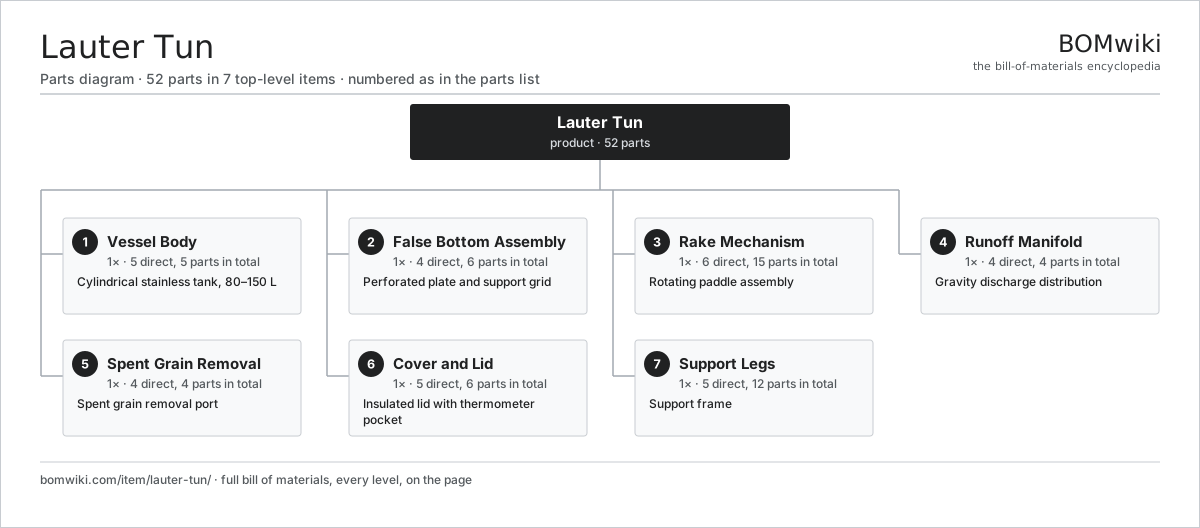
| # | Part | Qty | What it does |
|---|---|---|---|
| 1 | Vessel Body 5 parts | 1× | Cylindrical stainless tank, 80–150 L |
| 2 | False Bottom Assembly 4 parts | 1× | Perforated plate and support grid |
| 3 | Rake Mechanism 6 parts | 1× | Rotating paddle assembly |
| 4 | Runoff Manifold 4 parts | 1× | Gravity discharge distribution |
| 5 | Spent Grain Removal 4 parts | 1× | Spent grain removal port |
| 6 | Cover and Lid 5 parts | 1× | Insulated lid with thermometer pocket |
| 7 | Support Legs 5 parts | 1× | Support frame |
3D model
No 3D model yet. Have a CAD file of this? Add a 3D model. STL renders right on this page; STEP, FreeCAD, and OpenSCAD sources are welcome too (openly licensed, like all 3D models on BOMwiki).
Build & assembly graph
expand / collapse · shared sub-assemblies converge · links to related products · est. labourTap an assembly to expand/collapse · tap a part to open it · use “Open page” for any node · drag to pan, scroll to zoom.
Bill of materials for Lauter Tun
7 top-level lines · 40 rows shown · 52 parts total · indented to 3 levels| # | Item / sub-assembly | Part no. | Qty/assy | Ext. qty | Parts | Type |
|---|---|---|---|---|---|---|
| 1 | Vessel Body 5 parts | lauter-tun-vessel | 1× | 1 | 5 | assembly |
| 1.1 | Side Wall | lauter-tun-wall | 1× | 1 | · | part |
| 1.2 | Top Ring | lauter-tun-top-ring | 1× | 1 | · | part |
| 1.3 | Bottom Cone | lauter-tun-bottom-cone | 1× | 1 | · | part |
| 1.4 | Volume | lauter-tun-volume | 1× | 1 | · | part |
| 1.5 | Weld Seam | lauter-tun-weld | 1× | 1 | · | part |
| 2 | False Bottom Assembly 4 parts | lauter-tun-false-bottom | 1× | 1 | 6 | assembly |
| 2.1 | Perforated Plate | lauter-tun-perforated-plate | 1× | 1 | · | part |
| 2.2 | Support Grid | lauter-tun-support-grid | 1× | 1 | · | part |
| 2.3 | Grid Leg | lauter-tun-grid-legs | 3× | 3 | · | part |
| 2.4 | Center Pillar | lauter-tun-center-support | 1× | 1 | · | part |
| 3 | Rake Mechanism 6 parts | lauter-tun-rake-mechanism | 1× | 1 | 15 | assembly |
| 3.1 | Rake Motor | lauter-tun-rake-motor | 1× | 1 | · | part |
| 3.2 | Rake Shaft | lauter-tun-rake-shaft | 1× | 1 | · | part |
| 3.3 | Rake Arm | lauter-tun-rake-arm | 2× | 2 | · | part |
| 3.4 | Rake Blade | lauter-tun-rake-blade | 8× | 8 | · | part |
| 3.5 | Rake Bearing | lauter-tun-rake-bearing | 2× | 2 | · | part |
| 3.6 | Gear Reduction | lauter-tun-rake-gear-reduction | 1× | 1 | · | part |
| 4 | Runoff Manifold 4 parts | lauter-tun-runoff-manifold | 1× | 1 | 4 | assembly |
| 4.1 | Manifold Pipe | lauter-tun-manifold-pipe | 1× | 1 | · | part |
| 4.2 | Manifold Slots | lauter-tun-manifold-slots | 1× | 1 | · | part |
| 4.3 | Manifold Outlet | lauter-tun-manifold-outlet | 1× | 1 | · | part |
| 4.4 | Manifold Bracket | lauter-tun-manifold-bracket | 1× | 1 | · | part |
| 5 | Spent Grain Removal 4 parts | lauter-tun-grain-outlet | 1× | 1 | 4 | assembly |
| 5.1 | Grain Port | lauter-tun-grain-port | 1× | 1 | · | part |
| 5.2 | Grain Chute | lauter-tun-grain-chute | 1× | 1 | · | part |
| 5.3 | Grain Valve | lauter-tun-grain-valve | 1× | 1 | · | part |
| 5.4 | Grain Scoop | lauter-tun-grain-scoop | 1× | 1 | · | part |
| 6 | Cover and Lid 5 parts | lauter-tun-cover | 1× | 1 | 6 | assembly |
| 6.1 | Cover Frame | lauter-tun-cover-frame | 1× | 1 | · | part |
| 6.2 | Cover Insulation | lauter-tun-cover-insulation | 1× | 1 | · | part |
| 6.3 | Cover Face | lauter-tun-cover-face | 1× | 1 | · | part |
| 6.4 | Cover Handle | lauter-tun-cover-handle | 2× | 2 | · | part |
| 6.5 | Thermometer Pocket | lauter-tun-thermometer-pocket | 1× | 1 | · | part |
| 7 | Support Legs 5 parts | lauter-tun-legs | 1× | 1 | 12 | assembly |
| 7.1 | Leg Frame | lauter-tun-leg-frame | 1× | 1 | · | part |
| 7.2 | Leg Column | lauter-tun-leg-column | 4× | 4 | · | part |
| 7.3 | Cross Brace | lauter-tun-leg-cross-brace | 2× | 2 | · | part |
| 7.4 | Leg Foot | lauter-tun-leg-foot | 4× | 4 | · | part |
| 7.5 | Leg Height | lauter-tun-leg-height | 1× | 1 | · | part |
Something wrong in this list? Report a problem with this BOM.
Sourcing: possible vendors
Browse the supplier directory → Prices, MOQ, and lead times are algorithmic estimates, not quotes, and not claims about these companies. Company mappings are curated by keyword; est. price band $1k–$500k. How estimates work| Vendor | HQ | Specialty | MOQ | Lead time |
|---|---|---|---|---|
| gea.com ↗ | Düsseldorf, DE | Process technology | 20 units | 12–20 wks |
| buhlergroup.com ↗ | Uzwil, CH | Food & materials processing | 20 units | 12–20 wks |
| tetrapak.com ↗ | Pully, CH | Food packaging & processing | 20 units | 12–20 wks |
| jbtc.com ↗ | Chicago, US | Food processing equipment | 20 units | 12–20 wks |
| alfalaval.com ↗ | Lund, SE | Heat transfer & separation | 20 units | 12–20 wks |
825-word article