Lavatory Service Truck
ProductOverview
A lavatory service truck (also called lav cart or sanitation truck) maintains aircraft toilet and hand-washing facilities by collecting waste (fecal material, wastewater, paper) and replenishing potable water supplies. This unglamorous but mission-critical service occurs on every commercial flight turnaround.
Commercial aircraft carry 40–500 passengers; each generates approximately 1–2 liters of lavatory waste per 2–5 hour flight. Aircraft lavatories (typically 2–4 units on narrow-body, 6–8 on widebody) cannot dump waste in flight (regulatory prohibition, airspace contamination). Instead, waste is stored in sealed tanks beneath aircraft, collected on ground, and pumped into municipal sanitary systems at airports.
The lav cart uses vacuum technology (negative pressure) to extract waste from aircraft lavatory holding tanks via a single suction hose; fresh water is supplied separately via a pressurized water hose. Modern service takes 5–10 minutes per aircraft, supporting 12–20 aircraft per 8-hour shift.
Waste Collection System
The Waste Collection Tank (1500–3000 L) creates negative pressure via Vacuum Pump System (rotary vane pump, 50–100 L/min). When the waste hose is connected to an aircraft lavatory waste inlet, atmospheric pressure (on the aircraft side) overcomes the vacuum (truck side), pushing waste into the truck tank.
Vacuum principle:
- Atmospheric pressure ≈ 1 bar (14.7 psi).
- Truck tank vacuum ≈ 0.5 bar (7.5 psi absolute pressure).
- Pressure difference: 0.5 bar (7.5 psi) pushing waste downhill.
- Typical waste flow rate: 200–300 L/minute (emptying a 300 L aircraft tank in 1–2 minutes).
Waste tank design:
- Sealed stainless steel or epoxy-lined steel vessel (prevents corrosion, sanitization compliance).
- Waste Filter (80–100 micron mesh) traps solids, preventing pump clogging.
- Level Gauge (optical or float-type) signals when tank is 90% full (must empty, preventing overflow/overflow into cabin).
Post-collection:
- At airport, truck backs to sanitary sewage outlet (fixed ground connection), operator opens Isolation Valve, and waste drains by gravity into airport sanitary system (or is pumped via secondary pump if outlet is higher than truck tank).
Fresh Water Supply System
Aircraft lavatories require potable (drinking-quality) water for hand-washing and toilet flushing. The Fresh Water Tank (400–800 L, food-grade stainless steel) stores water meeting:
- EPA Safe Drinking Water Act standards (bacteria, chemicals, turbidity).
- IATA SCP guidelines (coliform testing, chlorine residual 0.2–0.5 ppm).
The Fresh Water Pump (centrifugal, 10–30 L/min at 1–2 bar) pressurizes water through hoses to aircraft inlet. At 2 bar (20 psi) pressure, water fills aircraft tanks (holding 300–600 L typical) in 15–30 minutes.
Water quality management:
- Daily: Test chlorine residual (should be 0.2–0.5 ppm free chlorine, ensuring bacteria suppression during storage and hose transit).
- Weekly: Bacterial culture test, turbidity measurement.
- Monthly: Full potability test (pH, hardness, iron, taste).
- Failure: Empty tank, sanitize, refill from certified water tender truck.
Many airports supply water to lav carts from central hydrant system (similar to fuel hydrant); trucks dock at hydrant station, pump fresh water into tanks (cost-effective, reduces truck turnarounds).
Hose Management & Quick-Disconnects
The Hose & Quick-Disconnect Cabinet stores:
- Waste hose: 3" ID vacuum hose, 50–100 m total, stored on motorized reel (manual reel on budget models).
- Water hose: 1" ID food-grade rubber, 50 m, separate compartment.
Quick-disconnect couplings (Quick Coupler, ISO 1219 flat-face design) enable rapid mating/demating without spillage:
- Operator unreels waste hose, walks to aircraft, connects to aircraft waste inlet.
- Operator returns to truck, activates vacuum pump via cab switch.
- Waste drains into truck (2–5 minutes for typical 300 L aircraft tank).
- Operator disconnects waste hose (residual backflow prevented by one-way check valve).
- Repeats process with water hose (15–30 minutes refill time).
Hose maintenance:
- Vacuum hose: Rated 0.5 bar vacuum + 0.5 bar positive pressure (handles aircraft cabin pressurization reversal during descent, preventing hose collapse).
- Water hose: FDA food-grade rating (NSF 61), internal diameter 1" = 25 mm = sufficient flow at 2 bar without excessive pressure drop over 50 m.
Electrical Control & Automation
The Control Console (cab-mounted panel) provides operator controls:
- Pump start/stop: Energizes Solenoid Valve (24 V solenoid) to open vacuum or water circuits.
- Valve selectors: Multi-position switch routing vacuum to waste or atmosphere (vent), isolating tank pressure.
- Gauges: Analog or digital displays of waste tank level, water tank level, pump pressure.
Modern systems use PLC (programmable logic controller) automating service cycles:
- Auto-vacuum: Operator presses "Service A/C" button, PLC sequences vacuum on → timer runs 2 minutes → pump off → operator disconnects.
- Water refill: Operator presses "Water Fill", PLC enables water pump → timer counts gallons → auto-shutoff at 600 L.
Safety interlocks prevent errors:
- Cannot activate vacuum if waste tank is already 90% full (prevents spillage).
- Cannot activate water pump if fresh tank is empty (prevents damage).
Operational Cycle & Turnaround
Typical narrow-body (Boeing 737) service (10 minutes):
Approach & position (1 min): Drive lav truck near aircraft, parallel park 5 m away, apply parking brake.
Waste collection (3 min):
- Operator unreels 30–40 m of waste hose, walks to aircraft waste service panel.
- Connects hose quick-disconnect to aircraft inlet (satisfying click indicates sealing).
- Returns to truck, starts vacuum pump via cab switch.
- Pump runs 2–3 minutes (estimated tank emptying time).
- Pump stops (auto-shutoff or manual).
- Operator walks back, disconnects hose (one-way check valve traps waste in hose), rolls up.
Water refill (5 min):
- Operator unreels water hose (10–15 m length), connects to aircraft potable water inlet.
- Returns to truck, starts water pump via cab switch.
- Pump pressure displayed on gauge (should reach 2 bar quickly).
- Operator estimates refill time (e.g., 30 L aircraft tank ÷ 20 L/min = 1.5 minutes).
- Pump stops (auto-shutoff or manual).
- Operator disconnects water hose, rolls up.
Depart (1 min): Stow hoses, drive away to next aircraft.
Widebody (A380) service (20–25 minutes, multiple lav trucks):
- A380 has 14 lavatories, waste tanks on fuselage exterior (difficult access).
- Typically 2–3 lav trucks service simultaneously (forward, aft, upper deck).
- Total waste collected: 600–800 L per flight.
- Water refilled: 1000–1200 L per flight.
Maintenance & Hygiene Protocols
Daily cleaning (end of shift):
- Operator fills waste tank 1/3 with bleach solution (100 ppm), circulates pump for 10 minutes.
- Drains bleach, refills with fresh water, circulates 5 minutes (rinse).
- Empties tank, air-dries overnight.
Water tank hygiene (weekly):
- Drain remaining water.
- Fill with 200 ppm bleach solution, let sit 2 hours, drain.
- Refill with fresh water, circulate pump 5 minutes (rinse).
Hose inspection (monthly):
- Visual check for cracking, pinhole leaks, surface contamination.
- Pressure test (apply 3 bar, hold 5 minutes, no visible leaks).
- Replace hoses showing wear (typical lifespan 2–3 years).
Environmental & Health Compliance
Lav carts handle biologically hazardous waste (fecal material harbors viruses, bacteria, parasites). Operators must:
- Wear gloves, aprons, boots (PPE).
- Wash hands after service.
- Never touch face/mouth while working.
- Report splashes/spills to health authority (possible flight delay if contamination risk).
Airports maintain centralized lav truck maintenance facilities with:
- Wash bay: Automated high-pressure washing (200+ bar, 80 °C water) sanitizing exteriors.
- Vacuum system maintenance: Pump inspection, seal replacement, filter cleaning.
- Water sanitation room: Tank filling from certified potable water only, testing equipment.
| Component | Service Interval | Cost |
|---|---|---|
| Vacuum Pump Seal | 2000 h | $1000–1500 |
| Water Pump Seal | 2000 h | $600–900 |
| Hose Replacement | 2 years | $1500–2500 |
| Tank Inspection | Annual | $300–500 (pressure test) |
| Major Overhaul | 8000 h / 10 years | $25,000–40,000 |
Lifespan: Lav trucks operate 12–15 years (6000–10,000 service hours) before scrapping. Biological corrosion (bacteria, acids in waste) and rubber/seal degradation accelerate wear vs. other ground equipment. Frequent wash-downs maintain external longevity but expedite electrical system fatigue.
Lavatory Service Truck parts and their functions
8 top-level parts · 73 parts in total · full bill of materials below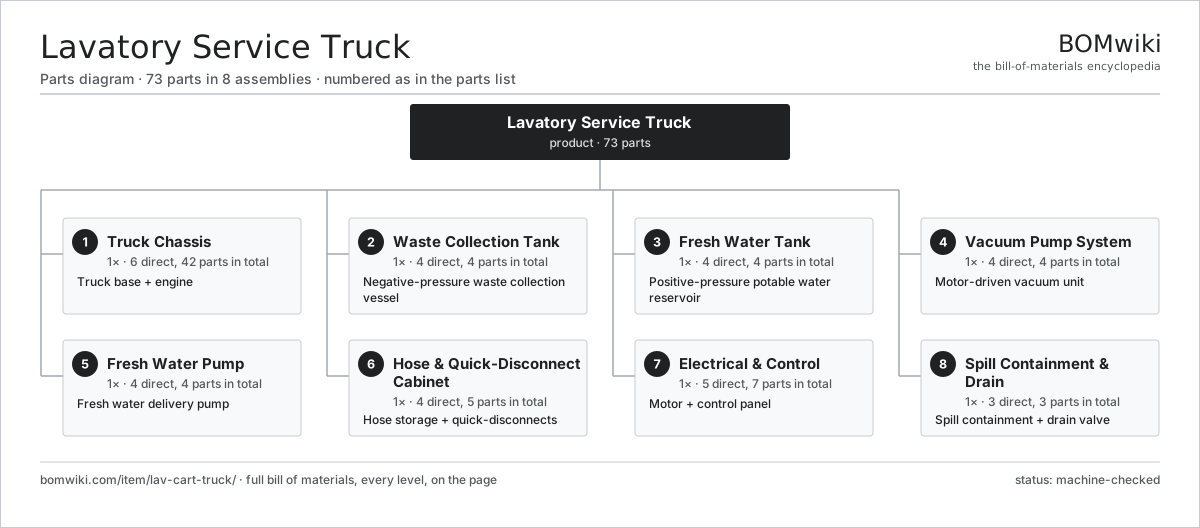
| # | Part | Qty | What it does |
|---|---|---|---|
| 1 | Truck Chassis 6 parts | 1× | Truck base + engine |
| 2 | Waste Collection Tank 4 parts | 1× | Negative-pressure waste collection vessel |
| 3 | Fresh Water Tank 4 parts | 1× | Positive-pressure potable water reservoir |
| 4 | Vacuum Pump System 4 parts | 1× | Motor-driven vacuum unit |
| 5 | Fresh Water Pump 4 parts | 1× | Fresh water delivery pump |
| 6 | Hose & Quick-Disconnect Cabinet 4 parts | 1× | Hose storage + quick-disconnects |
| 7 | Electrical & Control 5 parts | 1× | Motor + control panel |
| 8 | Spill Containment & Drain 3 parts | 1× | Spill containment + drain valve |
3D model
No 3D model yet. Have a CAD file of this? Add a 3D model — STL renders right on this page; STEP, FreeCAD, and OpenSCAD sources are welcome too (openly licensed, like all 3D models on BOMwiki).
Build & assembly graph
expand / collapse · shared sub-assemblies converge · links to related products · est. labourTap an assembly to expand/collapse · tap a part to open it · use “Open page” for any node · drag to pan, scroll to zoom.
Bill of materials for Lavatory Service Truck
8 top-level lines · 47 rows shown · 73 parts total · indented to 3 levels| # | Item / sub-assembly | Part no. | Qty/assy | Ext. qty | Parts | Type |
|---|---|---|---|---|---|---|
| 1 | Truck Chassis 6 parts | lav-cart-truck-chassis | 1× | 1 | 42 | assembly |
| 1.1 | Frame | lav-cart-truck-frame | 1× | 1 | · | part |
| 1.2 | Engine | lav-cart-truck-engine | 1× | 1 | · | part |
| 1.3 | Pump Drive | lav-cart-truck-pump-motor | 1× | 1 | · | part |
| 1.4 | Axles | lav-cart-truck-axles | 2× | 2 | · | part |
| 1.5 | Wheel Assembly 5 parts | wheel-assembly | 4× | 4 | 9 | assembly |
| 1.5.1 | Alloy Wheel | alloy-wheel | 1× | 4 | · | part |
| 1.5.2 | Tire | tire | 1× | 4 | · | part |
| 1.5.3 | TPMS Sensor | tpms-sensor | 1× | 4 | · | part |
| 1.5.4 | Lug Nut | lug-nut | 5× | 20 | · | part |
| 1.5.5 | Valve Stem | valve-stem | 1× | 4 | · | part |
| 1.6 | Suspension | lav-cart-truck-suspension | 1× | 1 | · | part |
| 2 | Waste Collection Tank 4 parts | lav-cart-truck-waste-tank | 1× | 1 | 4 | assembly |
| 2.1 | Waste Tank | lav-cart-truck-waste-tank-vessel | 1× | 1 | · | part |
| 2.2 | Waste Filter | lav-cart-truck-waste-filter | 1× | 1 | · | part |
| 2.3 | Level Gauge | lav-cart-truck-tank-gauge | 1× | 1 | · | part |
| 2.4 | Drain Valve | lav-cart-truck-tank-drain | 1× | 1 | · | part |
| 3 | Fresh Water Tank 4 parts | lav-cart-truck-freshwater-tank | 1× | 1 | 4 | assembly |
| 3.1 | Water Tank | lav-cart-truck-water-tank-vessel | 1× | 1 | · | part |
| 3.2 | Water Level | lav-cart-truck-water-level-indicator | 1× | 1 | · | part |
| 3.3 | Water Filter | lav-cart-truck-water-filter | 1× | 1 | · | part |
| 3.4 | Relief Valve | lav-cart-truck-water-pressure-relief | 1× | 1 | · | part |
| 4 | Vacuum Pump System 4 parts | lav-cart-truck-vacuum-pump | 1× | 1 | 4 | assembly |
| 4.1 | Pump Motor | lav-cart-truck-vacuum-pump-motor | 1× | 1 | · | part |
| 4.2 | Vacuum Pump | lav-cart-truck-vacuum-pump-unit | 1× | 1 | · | part |
| 4.3 | Vacuum Valve | lav-cart-truck-vacuum-valve | 1× | 1 | · | part |
| 4.4 | Control Manifold | lav-cart-truck-vacuum-manifold | 1× | 1 | · | part |
| 5 | Fresh Water Pump 4 parts | lav-cart-truck-pressure-pump | 1× | 1 | 4 | assembly |
| 5.1 | Water Pump Motor | lav-cart-truck-water-pump-motor | 1× | 1 | · | part |
| 5.2 | Water Pump | lav-cart-truck-water-pump-unit | 1× | 1 | · | part |
| 5.3 | Check Valve | lav-cart-truck-water-pump-check | 1× | 1 | · | part |
| 5.4 | Inlet Strainer | lav-cart-truck-water-filter-pump | 1× | 1 | · | part |
| 6 | Hose & Quick-Disconnect Cabinet 4 parts | lav-cart-truck-hose-cabinet | 1× | 1 | 5 | assembly |
| 6.1 | Waste Hose | lav-cart-truck-waste-hose | 1× | 1 | · | part |
| 6.2 | Water Hose | lav-cart-truck-water-hose | 1× | 1 | · | part |
| 6.3 | Quick Coupler | lav-cart-truck-quick-disconnect | 2× | 2 | · | part |
| 6.4 | Hose Cabinet | lav-cart-truck-cabinet | 1× | 1 | · | part |
| 7 | Electrical & Control 5 parts | lav-cart-truck-electrical-system | 1× | 1 | 7 | assembly |
| 7.1 | Battery | lav-cart-truck-battery | 2× | 2 | · | part |
| 7.2 | Alternator | lav-cart-truck-alternator | 1× | 1 | · | part |
| 7.3 | Solenoid Valve | lav-cart-truck-solenoid-valves | 2× | 2 | · | part |
| 7.4 | Motor Starter | lav-cart-truck-motor-starter | 1× | 1 | · | part |
| 7.5 | Control Console | lav-cart-truck-control-console | 1× | 1 | · | part |
| 8 | Spill Containment & Drain 3 parts | lav-cart-truck-drain-system | 1× | 1 | 3 | assembly |
| 8.1 | Drip Pan | lav-cart-truck-drip-pan | 1× | 1 | · | part |
| 8.2 | Isolation Valve | lav-cart-truck-isolation-valve | 1× | 1 | · | part |
| 8.3 | Sanitary Connection | lav-cart-truck-sanitary-station-outlet | 1× | 1 | · | part |
Sourcing: possible vendors
Prices, MOQ, and lead times are algorithmic estimates, not quotes, and not claims about these companies. Company mappings are curated by keyword; est. price band $30k–$1.5M. How estimates work| Vendor | HQ | Specialty | MOQ | Lead time |
|---|---|---|---|---|
| oshkoshaerotech.com ↗ | Orlando, US | Airport ground support | made to order | 16–30 wks |
| tld-group.com ↗ | Paris, FR | Ground support equipment | made to order | 16–30 wks |
| textrongse.txtsv.com ↗ | Augusta, US | Ground support equipment | made to order | 16–30 wks |
| vestergaardcompany.com ↗ | Skanderborg, DK | De-icers & GSE | made to order | 16–30 wks |
| mallaghangse.com ↗ | Dungannon, GB | Ground support equipment | made to order | 16–30 wks |
1,318-word article