Leather Embossing Press
ProductOverview
Leather embossing imprints decorative or functional textures onto shoe leather surfaces. A trademark logo on the vamp, a crocodile-skin texture on a loafer upper, or a subtle grain pattern on a dress shoe, all are produced by embossing presses. The process combines heat, pressure, and precisely engineered die geometry to transfer a pattern onto leather with permanent dimensional change.
Embossing is distinct from printing (ink-based, no dimensional change) and from surface dyeing (color change, minimal texture). A pressed emboss creates both visual and tactile texture, adding perceived luxury and brand identity.
Embossing Die Design and Materials
The embossing die assembly consists of a matched pair: a male die (with raised pattern) and a female die (with recessed cavity). When leather is heated and pressed between the dies, the leather is displaced into the female cavity, conforming to the raised pattern of the male die.
Die Geometry Considerations
- Pattern depth: Typically 0.5–2 mm, depending on desired visual prominence. Deeper patterns (2+ mm) create stronger visual impact but require more pressure and longer dwell time.
- Pattern complexity: Simple geometric (dots, lines) vs. complex realistic (animal skin, wood grain, architectural detail). Complex patterns require higher precision die machining and tighter pressure control.
- Draft angle: Dies are typically machined with a 1–3° taper (draft) to facilitate leather release after pressing; without draft, the leather can stick and tear as the die retracts.
- Edge radius: Sharp edges on the die pattern can cut or abrade leather; typical edge radius is 0.2–0.5 mm to compress leather fiber without tearing.
Die Material and Hardness
Embossing dies are typically hardened steel (60–62 HRC), which provides:
- Durability: One set of dies can emboss 500,000+ footwear components before visible wear; a busy factory might replace dies every 3–5 years.
- Dimensional stability: Hardened steel resists creep under sustained pressure, maintaining pattern sharpness over product runs.
- Cost: A custom die set for a new shoe style costs $3000–15,000 depending on complexity and surface area.
Heat and Pressure Effects on Leather
Leather is a complex biopolymer material (collagen fibers in a gelatin-like matrix). When heated and pressurized, leather undergoes temporary and permanent changes:
Temporary (Reversible) Changes
- Moisture movement: Heat drives water out of the leather matrix, reducing moisture content from ~12% to ~5%. This is reversible; re-wetting restores moisture.
- Fiber relaxation: Collagen fibers that normally maintain stress relax when heated, allowing easier repositioning.
Permanent (Irreversible) Changes
- Fiber orientation: When pressed, collagen fibers align perpendicular to the pressure axis, creating directional texture.
- Hydrogen bonding reformation: As leather cools under pressure, new hydrogen bonds form between collagen fibers and gelatin matrix, locking in the new shape. This is permanent for practical timescales (years of shoe wear).
- Moisture re-absorption: After release, leather gradually re-absorbs moisture from air (7–12% typical humidity), but the fiber alignment persists because the collagen structure has been mechanically rearranged.
Optimal Embossing Parameters
Embossing quality depends on balancing these effects:
- Temperature: 60–80 °C is optimal for footwear leather. Below 50 °C, leather is too stiff and embossing requires excessive pressure (~300 bar), risking leather damage. Above 90 °C, gelatin matrix begins to denature, causing fuzzing or surface cracking.
- Pressure: 100–200 bar is typical. Higher pressure (200+ bar) produces sharper details but increases tearing risk; lower pressure (50–100 bar) reduces risk but produces softer, less defined pattern.
- Dwell time: 5–20 seconds allows fiber realignment and partial re-cooling while under pressure. Shorter dwell (<5 sec) results in incomplete pattern transfer; longer dwell (>20 sec) increases cycle time without additional benefit.
Pressure Control and Feedback
The hydraulic system uses a proportional relief valve to limit peak pressure. A pressure transducer monitors actual clamping force; if pressure spikes above setpoint (indicating leather has fully compressed and can accept no more force), the system reduces pump displacement or vents flow to prevent die damage.
Different leather types require different pressure:
- Full-grain leather (3–4 mm thick): 150–200 bar, longer dwell (15–20 sec) for deep pattern penetration.
- Split leather (1–2 mm): 100–150 bar, shorter dwell (8–12 sec) to avoid over-compression.
- Chrome-tanned suede: 80–120 bar (soft, prone to crushing).
Operators maintain a recipe table at the machine listing pressure, temperature, and dwell time for each leather type and pattern used.
Embossing Quality and Pattern Fidelity
A well-executed emboss has:
- Sharp definition: Pattern edges are clean and distinct, not blurred or fuzzy.
- Full cavity fill: The raised male pattern has fully contacted all recesses in the female cavity, creating uniform depth.
- No bruising: Leather surface surrounding the pattern shows no discoloration or crushing (which indicates over-pressure or insufficient temp).
- Uniform density: Pattern appears evenly pressed across the entire die area, not lighter or darker in spots (which suggests uneven pressure or temperature distribution).
Common defects:
- Fuzzy edges: Indicates over-pressure or temperature too high, causing gelatin matrix to expand and degrade fibers.
- Incomplete fill: Low pressure, low temperature, or short dwell; pattern outline is visible but details not fully impressed.
- Bruising: Over-pressure or uneven platen contact; leather is damaged around pattern.
- Sticking: Leather adheres to die, tearing as press opens (indicates inadequate draft angle or sticky residue on die surface).
Post-Emboss Processing
After embossing, leather is typically allowed to cool before removal from the press. Rapid cooling (10–20 seconds) under pressure ensures fiber lock-in. Once removed, shoes are aged at room temperature for 24 hours, allowing residual heat to dissipate and moisture equilibration to fully complete. Only after this resting period are shoes sent for sole attachment or final inspection.
Some factories apply a light conditioning oil or finish after embossing to restore surface moisture and enhance the visual depth of the pattern, though this is optional.
Leather Embossing Press parts and their functions
7 top-level parts · 34 parts in total · full bill of materials below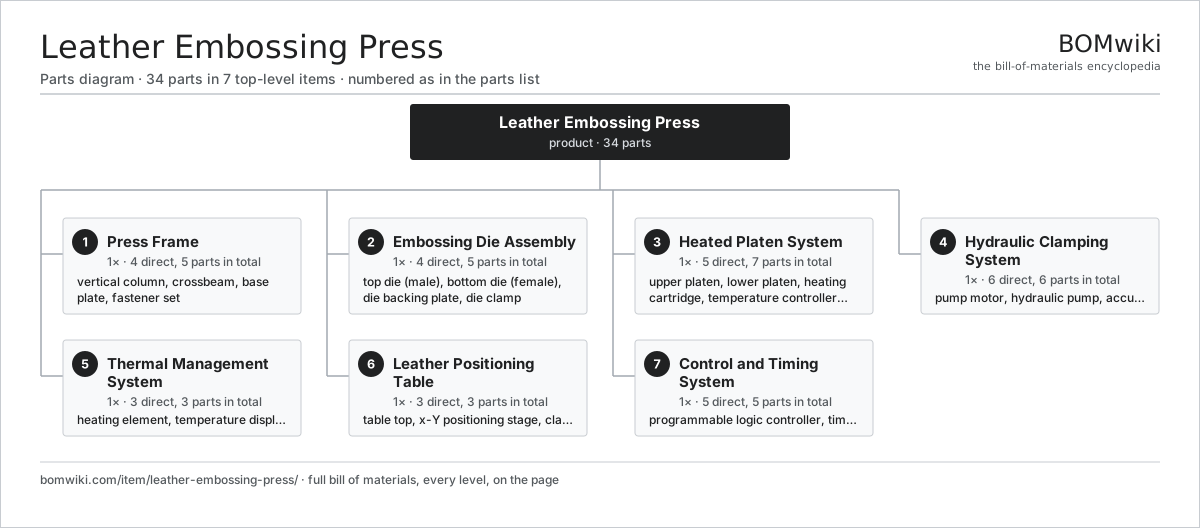
| # | Part | Qty | What it does |
|---|---|---|---|
| 1 | Press Frame 4 parts | 1× | Rigid steel C-frame or H-frame structure supporting press head and base platens. |
| 2 | Embossing Die Assembly 4 parts | 1× | Interchangeable die plates (male and female matched pair) imprinting pattern onto leather. |
| 3 | Heated Platen System 5 parts | 1× | Upper and lower heating plates maintaining optimal embossing temperature (60–80 °C). |
| 4 | Hydraulic Clamping System 6 parts | 1× | Hydraulic pump and cylinders delivering controlled embossing pressure to press head. |
| 5 | Thermal Management System 3 parts | 1× | Heating elements, thermostats, and optional cooling to maintain consistent embossing temperature. |
| 6 | Leather Positioning Table 3 parts | 1× | Adjustable table for positioning leather precisely under embossing dies. |
| 7 | Control and Timing System 5 parts | 1× | PLC-based automation controlling heating, pressure ramp, dwell, and release sequence. |
3D model
No 3D model yet. Have a CAD file of this? Add a 3D model. STL renders right on this page; STEP, FreeCAD, and OpenSCAD sources are welcome too (openly licensed, like all 3D models on BOMwiki).
Build & assembly graph
expand / collapse · shared sub-assemblies converge · links to related products · est. labourTap an assembly to expand/collapse · tap a part to open it · use “Open page” for any node · drag to pan, scroll to zoom.
Bill of materials for Leather Embossing Press
7 top-level lines · 37 rows shown · 34 parts total · indented to 3 levels| # | Item / sub-assembly | Part no. | Qty/assy | Ext. qty | Parts | Type |
|---|---|---|---|---|---|---|
| 1 | Press Frame 4 parts | leather-embossing-press-frame | 1× | 1 | 5 | assembly |
| 1.1 | Vertical Column | leather-embossing-press-column | 2× | 2 | · | part |
| 1.2 | Crossbeam | leather-embossing-press-crossbeam | 1× | 1 | · | part |
| 1.3 | Base Plate | leather-embossing-press-base | 1× | 1 | · | part |
| 1.4 | Fastener Set | fastener-set | 1× | 1 | · | part |
| 2 | Embossing Die Assembly 4 parts | leather-embossing-press-die-holder | 1× | 1 | 5 | assembly |
| 2.1 | Top Die (Male) | leather-embossing-press-top-die | 1× | 1 | · | part |
| 2.2 | Bottom Die (Female) | leather-embossing-press-bottom-die | 1× | 1 | · | part |
| 2.3 | Die Backing Plate | leather-embossing-press-die-backing-plate | 2× | 2 | · | part |
| 2.4 | Die Clamp | leather-embossing-press-die-clamp | 1× | 1 | · | part |
| 3 | Heated Platen System 5 parts | leather-embossing-press-heated-platens | 1× | 1 | 7 | assembly |
| 3.1 | Upper Platen | leather-embossing-press-upper-platen | 1× | 1 | · | part |
| 3.2 | Lower Platen | leather-embossing-press-lower-platen | 1× | 1 | · | part |
| 3.3 | Heating Cartridge | leather-embossing-press-heater-cartridge | 2× | 2 | · | part |
| 3.4 | Temperature Controller | leather-embossing-press-thermostatic-controller | 1× | 1 | · | part |
| 3.5 | Temperature Sensor | leather-embossing-press-temperature-sensor | 2× | 2 | · | part |
| 4 | Hydraulic Clamping System 6 parts | leather-embossing-press-hydraulic-system | 1× | 1 | 6 | assembly |
| 4.1 | Pump Motor | leather-embossing-press-pump-motor | 1× | 1 | · | part |
| 4.2 | Hydraulic Pump | leather-embossing-press-hydraulic-pump | 1× | 1 | · | part |
| 4.3 | Accumulator | leather-embossing-press-pressure-accumulator | 1× | 1 | · | part |
| 4.4 | Pressure Relief Valve | leather-embossing-press-pressure-relief | 1× | 1 | · | part |
| 4.5 | Solenoid Valve | leather-embossing-press-solenoid-valve | 1× | 1 | · | part |
| 4.6 | Hydraulic Hose Bundle | leather-embossing-press-hose-assembly | 1× | 1 | · | part |
| 5 | Thermal Management System 3 parts | leather-embossing-press-temperature-control | 1× | 1 | 3 | assembly |
| 5.1 | Heating Element | leather-embossing-press-heating-element | 1× | 1 | · | part |
| 5.2 | Temperature Display | leather-embossing-press-temperature-display | 1× | 1 | · | part |
| 5.3 | Coolant Pump | leather-embossing-press-coolant-pump | 1× | 1 | · | part |
| 6 | Leather Positioning Table 3 parts | leather-embossing-press-feed-table | 1× | 1 | 3 | assembly |
| 6.1 | Table Top | leather-embossing-press-table-top | 1× | 1 | · | part |
| 6.2 | X-Y Positioning Stage | leather-embossing-press-x-y-adjustment | 1× | 1 | · | part |
| 6.3 | Clamping System | leather-embossing-press-clamp-system | 1× | 1 | · | part |
| 7 | Control and Timing System 5 parts | leather-embossing-press-control-system | 1× | 1 | 5 | assembly |
| 7.1 | Programmable Logic Controller | leather-embossing-press-plc | 1× | 1 | · | part |
| 7.2 | Timer Module | leather-embossing-press-timer-module | 1× | 1 | · | part |
| 7.3 | Pressure Gauge | leather-embossing-press-pressure-gauge | 1× | 1 | · | part |
| 7.4 | HMI Touchscreen | leather-embossing-press-hmi-panel | 1× | 1 | · | part |
| 7.5 | Power Supply | power-supply | 1× | 1 | · | part |
Something wrong in this list? Report a problem with this BOM.
Sourcing: possible vendors
Browse the supplier directory → Prices, MOQ, and lead times are algorithmic estimates, not quotes, and not claims about these companies. Company mappings are curated by keyword; est. price band $10k–$1M. How estimates work| Vendor | HQ | Specialty | MOQ | Lead time |
|---|---|---|---|---|
|
🇨🇭Rieter
rieter.com ↗
|
Winterthur, CH | Spinning machinery | 10 units | 14–24 wks |
| truetzschler.com ↗ | Mönchengladbach, DE | Textile machinery | 10 units | 14–24 wks |
|
🇧🇪Picanol
picanol.be ↗
|
Ypres, BE | Weaving machines | 10 units | 14–24 wks |
| karlmayer.com ↗ | Obertshausen, DE | Warp knitting machines | 10 units | 14–24 wks |
|
🇨🇭Saurer
saurer.com ↗
|
Arbon, CH | Spinning & embroidery | 10 units | 14–24 wks |
980-word article