Leather Splitting Machine
ProductOverview
Leather splitting is a critical preprocessing step in footwear and leather goods manufacturing. Raw hides and skins arrive from tanneries at highly variable thickness (3–15 mm, depending on animal species and tanning process), but shoe uppers demand consistent thickness (1–2 mm for shoe vamps, 0.5–1 mm for lining). The leather splitting machine automates this thickness reduction using a powered band knife that shears hide into uniform ply.
Splitting increases usable leather yield per hide: a hide that arrives at 10 mm can be processed into 5–10 thinner plies, each suitable for different shoe components (vamp, side, heel counter, lining). This economic advantage drives widespread adoption in high-volume factories.
Band Knife Splitting Mechanism
The band knife assembly is the mechanical heart of the splitting machine. The band knife is a continuous steel blade running around two pulleys at 600–1500 m/min surface speed. Unlike a straight blade (which concentrates stress at one point), the band design distributes wear across the entire cutting edge, allowing longer intervals between resharpening.
Blade Geometry and Material
- Width: 50–100 mm, typically matching the cutting area width.
- Thickness: 1.5–2 mm hardened spring steel, allowing flex without buckling.
- Edge angle: 20–30° included angle, honed to a razor-fine edge.
- Backing: Continuous band wrapped around drive and tension pulleys; tension typically 200–400 N per mm of blade width, maintaining flatness and cutting efficiency.
As the feed roller advances leather under the blade, the blade shears the hide fibers rather than crushing or grinding (which would leave a rough, fluffy surface). A properly honed band knife produces a mirror-smooth split face.
Feed System Pressure and Speed Interaction
The feed rollers advance leather at 5–20 m/min, controlled by a variable-speed drive motor. Pressure between the feed rollers is 100–500 N/cm², adjustable to prevent slippage without crushing the leather.
The interaction between blade speed and feed speed determines cutting quality:
- High blade speed (1200 m/min) + slow feed (5 m/min): Produces smooth, clean split; knife makes many passes per unit thickness, minimizing fiber tearing.
- Low blade speed (600 m/min) + fast feed (20 m/min): Rougher split; fewer blade passes lead to fiber pull-out and a fuzzy surface.
Operators typically run at moderate speeds (900–1000 m/min blade, 10–15 m/min feed) for a balance of quality and production rate.
Thickness Control via Feedback Loop
The thickness gauge is a closed-loop feedback system. An inductive or laser distance sensor mounted downstream of the blade measures the exiting leather thickness in real-time. If thickness deviates beyond the setpoint (e.g., target 1.5 mm ±0.05 mm), the control system adjusts feed roller pressure or blade height to compensate.
Typical feedback response time: 1–2 seconds (the time leather takes to travel from blade to sensor and back to feed adjustment). This allows the machine to maintain tight tolerances even as hide thickness varies naturally (a single hide can be 8 mm on the shoulder and 12 mm on the belly).
Blade Maintenance: Stropping and Resharpening
A band knife runs for 8–16 hours of cutting time before edge dulling becomes noticeable (fuzzy split edges, increased tearing). Rather than stopping the machine for professional resharpening every shift, many splitting machines include an on-board stropping station.
The stropper is a rotating wheel or belt coated with fine abrasive compound (chromium oxide or diamond particles in a binder), rotating at low speed (50–100 rpm). The operator manually strops the knife edge against the wheel for 20–30 seconds, which hones away microscopic dulling and restores edge sharpness. Stropping extends run time between professional resharpening from 8 hours to 20–30 hours.
Once stropping can no longer restore sharpness, the blade requires professional resharpening (sent to a specialist or replaced entirely), typically every 50–100 operating hours depending on hide toughness and target finish quality.
Split Characteristics: Grain Side vs. Flesh Side
A typical hide consists of three distinct layers:
- Grain layer (epidermis + upper dermis): Fibrous, tight grain pattern, naturally durable.
- Corium (middle dermis): Softer, more fibrous; this is what's typically split away.
- Flesh side (lower dermis + subcutaneous): Loose, fluffy fibers; rarely used whole in footwear.
A band knife split yields:
- Top split (grain-side): Thin ply with grain pattern visible, suitable for shoe uppers; 0.5–1.5 mm.
- Bottom split (flesh-side): Fuzzy fiber bundle, 0.5–3 mm, used for insoles or internal components where durability is lower priority.
A hide that arrives at 10 mm might be split into:
- One 0.8 mm grain-side ply (vamp material)
- Two 1.5 mm middle plies (side/heel components)
- One 2.0 mm flesh-side ply (insole backing)
- Remaining 1.5 mm waste (drummed scrap for gelatin/glue manufacture)
This five-ply breakdown maximizes material yield and creates high-utilization.
Process Variability and Quality Control
Splitting quality depends on three process variables:
Hide moisture content: Dry hides (5–8% moisture) are brittle and split roughly; over-moist hides (12–15%) compress rather than shear. Optimal moisture is 10–12%, requiring climate-controlled storage (50–60% RH).
Blade edge condition: A dull blade leaves visible fiber tearing (called "fuzz" in industry); operators can typically distinguish good splits by feel (smooth vs. rough) before microscopic inspection.
Hide surface contamination: Dirt, salt, or sand embedded in hide surface will catch the blade and cause uneven pressure, resulting in thickness variation. Hide trimming and light wire-brushing are preprocessing steps.
Quality inspection is manual: a technician measures thickness at 5–10 points across the split (target ±0.05 mm tolerance) using a digital micrometer. The surface is also visually inspected for fiber pulling (which indicates dull blade or excessive feed pressure). Rejected splits are re-processed or sent to waste.
Typical factory acceptance rate: 85–95% of splits meet thickness tolerance on first pass; remaining splits are remade or used for lower-grade products.
Operator Safety and Machine Guarding
The rotating band knife is a serious pinch and laceration hazard. Industrial standards require:
- Full enclosure around knife area, leaving only a controlled leather feed opening.
- Emergency stop buttons mounted on both sides of machine within arm's reach.
- Interlock switches preventing machine operation if guards are open.
- Audible warning (buzzer or horn) before blade starts.
Operators wear close-fitted clothing (no loose sleeves) and keep hands clear of the feed area. Many factories mandate foot-operated start buttons, keeping hands free for leather positioning and pile removal.
Leather Splitting Machine parts and their functions
7 top-level parts · 34 parts in total · full bill of materials below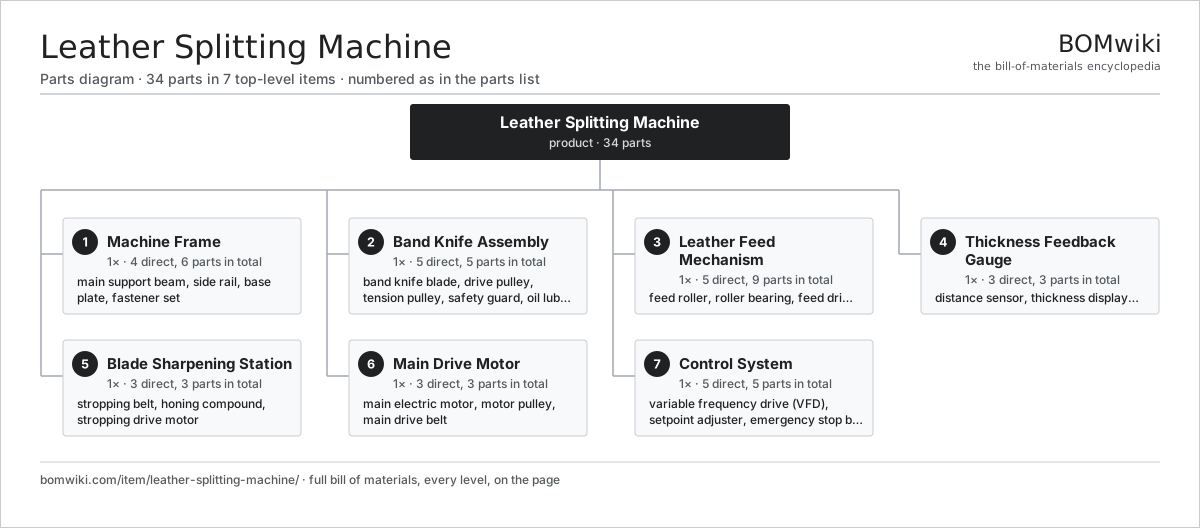
| # | Part | Qty | What it does |
|---|---|---|---|
| 1 | Machine Frame 4 parts | 1× | Welded steel structure supporting cutting head and feed mechanism. |
| 2 | Band Knife Assembly 5 parts | 1× | Rotating band knife shearing leather to target thickness, with drive pulleys and tension mechanism. |
| 3 | Leather Feed Mechanism 5 parts | 1× | Powered rollers advancing leather under knife at controlled speed and pressure. |
| 4 | Thickness Feedback Gauge 3 parts | 1× | Optical or mechanical sensor measuring leather thickness in real-time and signaling operator of deviations. |
| 5 | Blade Sharpening Station 3 parts | 1× | Manual or automatic stropping system maintaining band knife edge between resharpening intervals. |
| 6 | Main Drive Motor 3 parts | 1× | Electric motor powering band knife through belt or direct coupling. |
| 7 | Control System 5 parts | 1× | Operator interface with speed control, emergency stop, and thickness setpoint adjustment. |
3D model
No 3D model yet. Have a CAD file of this? Add a 3D model. STL renders right on this page; STEP, FreeCAD, and OpenSCAD sources are welcome too (openly licensed, like all 3D models on BOMwiki).
Build & assembly graph
expand / collapse · shared sub-assemblies converge · links to related products · est. labourTap an assembly to expand/collapse · tap a part to open it · use “Open page” for any node · drag to pan, scroll to zoom.
Bill of materials for Leather Splitting Machine
7 top-level lines · 35 rows shown · 34 parts total · indented to 3 levels| # | Item / sub-assembly | Part no. | Qty/assy | Ext. qty | Parts | Type |
|---|---|---|---|---|---|---|
| 1 | Machine Frame 4 parts | leather-splitting-machine-frame | 1× | 1 | 6 | assembly |
| 1.1 | Main Support Beam | leather-splitting-machine-main-beam | 2× | 2 | · | part |
| 1.2 | Side Rail | leather-splitting-machine-side-rails | 2× | 2 | · | part |
| 1.3 | Base Plate | leather-splitting-machine-base-plate | 1× | 1 | · | part |
| 1.4 | Fastener Set | fastener-set | 1× | 1 | · | part |
| 2 | Band Knife Assembly 5 parts | leather-splitting-machine-knife-assembly | 1× | 1 | 5 | assembly |
| 2.1 | Band Knife Blade | leather-splitting-machine-band-knife | 1× | 1 | · | part |
| 2.2 | Drive Pulley | leather-splitting-machine-drive-pulley | 1× | 1 | · | part |
| 2.3 | Tension Pulley | leather-splitting-machine-tension-pulley | 1× | 1 | · | part |
| 2.4 | Safety Guard | leather-splitting-machine-knife-guard | 1× | 1 | · | part |
| 2.5 | Oil Lubrication Pump | leather-splitting-machine-oil-pump | 1× | 1 | · | part |
| 3 | Leather Feed Mechanism 5 parts | leather-splitting-machine-feed-system | 1× | 1 | 9 | assembly |
| 3.1 | Feed Roller | leather-splitting-machine-feed-roller | 2× | 2 | · | part |
| 3.2 | Roller Bearing | leather-splitting-machine-roller-bearing | 4× | 4 | · | part |
| 3.3 | Feed Drive Motor | leather-splitting-machine-feed-motor | 1× | 1 | · | part |
| 3.4 | Feed Drive Belt | leather-splitting-machine-feed-belt | 1× | 1 | · | part |
| 3.5 | Pressure Adjuster | leather-splitting-machine-roller-pressure-adjust | 1× | 1 | · | part |
| 4 | Thickness Feedback Gauge 3 parts | leather-splitting-machine-thickness-gauge | 1× | 1 | 3 | assembly |
| 4.1 | Distance Sensor | leather-splitting-machine-gauge-sensor | 1× | 1 | · | part |
| 4.2 | Thickness Display | leather-splitting-machine-gauge-display | 1× | 1 | · | part |
| 4.3 | Alarm Relay | leather-splitting-machine-alarm-relay | 1× | 1 | · | part |
| 5 | Blade Sharpening Station 3 parts | leather-splitting-machine-blade-sharpener | 1× | 1 | 3 | assembly |
| 5.1 | Stropping Belt | leather-splitting-machine-stropping-belt | 1× | 1 | · | part |
| 5.2 | Honing Compound | leather-splitting-machine-honing-compound | 1× | 1 | · | part |
| 5.3 | Stropping Drive Motor | leather-splitting-machine-stropping-motor | 1× | 1 | · | part |
| 6 | Main Drive Motor 3 parts | leather-splitting-machine-motor-drive | 1× | 1 | 3 | assembly |
| 6.1 | Main Electric Motor | leather-splitting-machine-main-motor | 1× | 1 | · | part |
| 6.2 | Motor Pulley | leather-splitting-machine-motor-pulley | 1× | 1 | · | part |
| 6.3 | Main Drive Belt | leather-splitting-machine-drive-belt | 1× | 1 | · | part |
| 7 | Control System 5 parts | leather-splitting-machine-control-panel | 1× | 1 | 5 | assembly |
| 7.1 | Variable Frequency Drive (VFD) | leather-splitting-machine-vfd-drive | 1× | 1 | · | part |
| 7.2 | Setpoint Adjuster | leather-splitting-machine-thickness-setpoint | 1× | 1 | · | part |
| 7.3 | Emergency Stop Button | leather-splitting-machine-estop-button | 1× | 1 | · | part |
| 7.4 | Control Relay | leather-splitting-machine-control-relay | 1× | 1 | · | part |
| 7.5 | Power Supply | power-supply | 1× | 1 | · | part |
Something wrong in this list? Report a problem with this BOM.
Sourcing: possible vendors
Browse the supplier directory → Prices, MOQ, and lead times are algorithmic estimates, not quotes, and not claims about these companies. Company mappings are curated by keyword; est. price band $10k–$1M. How estimates work| Vendor | HQ | Specialty | MOQ | Lead time |
|---|---|---|---|---|
|
🇨🇭Rieter
rieter.com ↗
|
Winterthur, CH | Spinning machinery | 10 units | 14–24 wks |
| truetzschler.com ↗ | Mönchengladbach, DE | Textile machinery | 10 units | 14–24 wks |
|
🇧🇪Picanol
picanol.be ↗
|
Ypres, BE | Weaving machines | 10 units | 14–24 wks |
| karlmayer.com ↗ | Obertshausen, DE | Warp knitting machines | 10 units | 14–24 wks |
|
🇨🇭Saurer
saurer.com ↗
|
Arbon, CH | Spinning & embroidery | 10 units | 14–24 wks |
1,141-word article