Lens Blocker
ProductOverview
The lens blocker is a precision machine used in ophthalmic labs to temporarily attach (block) a lens to a reusable alloy or polymer block, enabling subsequent grinding and polishing operations. The block provides a mechanical handle that fits into grinding machines (generators, finishers) while keeping the delicate lens center safe from direct machine contact.
Blocking is essential in optics manufacturing: a loose or misaligned block risks lens fracture or dimensional errors in the finished lens. Modern automated blockers use heated adhesives, vision-guided alignment, and rapid cooling to achieve high precision (±0.5 mm centering) and fast throughput (45–90 seconds per lens including cooling and unblocking).
How it works
Adhesive Selection and Application
Two adhesive types are common:
Hot-melt adhesive: Heated to 60–80 °C, then dispensed as a thin bead around the lens-block interface. The hot adhesive fills micro-voids in the lens and block surfaces, creating strong mechanical bond once cooled. Unblocking is straightforward: brief thermal heating softens the adhesive, allowing block separation.
UV-cure or light-cure adhesive: Applied at room temperature, then cured by ultraviolet light. Enables faster unblocking (seconds with UV exposure vs. 5–20 minutes for hot-melt cooling) but requires more operator training and specialized equipment.
The Adhesive Dispensing System comprises a heated Adhesive Reservoir (1–2 L capacity, maintained at 60–80 °C), a Adhesive Pump (metering 0.5–2 ml per stroke), and a Dispenser Nozzle (heated needle, 0.5 mm orifice). The pump is triggered when the lens reaches the block; adhesive is deposited as a ring around the lens edge.
Lens-Block Centering
Precise centering requires vision feedback. The Alignment and Centering Optics integrates a Telecentric Objective Lens (maintaining 1:1 magnification across the working distance) and Ring Light (co-axial illumination). The Alignment Camera captures a top-down image of the lens and block; edge-detection software (running on the Image Processor) identifies the lens and block center coordinates.
The Motorized Centering Stage motorized stage then adjusts lens position via X-Axis Motor, Y-Axis Motor, and Z-Axis Motor (stepper motors with encoder feedback) until lens and block centroids are aligned within ±0.5 mm. The operator confirms alignment on the display, then presses a button to proceed.
Contact and Pressure Management
Once centered, the Pressure Control System system engages. A Contact Pressure Cylinder (pneumatic double-acting) applies downward force on the lens; the Pressure Regulator (proportional valve, 0–3 bar) limits contact pressure to prevent lens deformation. Typical contact pressure is 0.5–1 bar, enough to ensure good adhesive contact but not so high as to crush delicate materials like polycarbonate.
The Pressure Feedback Sensor provides feedback to the control system; if pressure drops suddenly during curing (indicating lens slip), the system alerts the operator.
Heating and Cooling
The Heated Platen (heated aluminum plate, 40–80 °C) accelerates adhesive flow and wetting. Hot-melt adhesive reaches full strength in 10–30 seconds at 60 °C; the lens-block assembly is then moved to the Chiller / Cooling System.
The chiller is a temperature-controlled water bath (5–15 °C) that rapidly cools the adhesive to room temperature, setting it within 5–20 minutes depending on block thickness. Cold temperature reduces adhesive viscosity and stiffness, enabling cleaner separation during unblocking.
Unblocking
Once the adhesive has cured in the chiller, the lens-block assembly is placed in the unblocking station. A Thermal Adhesive Release (heating element) briefly warms the adhesive interface to 40–60 °C, softening the adhesive. A Block Pusher Plate (pneumatic plate) then advances, pushing the block away from the lens. The Collet Release Solenoid pneumatic solenoid releases the lens collet, ejecting the lens.
Unblocking typically takes 1–2 minutes per lens; with practice, operators achieve non-destructive separation in >95% of cases.
Block Reusability and Economics
Blocking blocks are precious assets. Aluminum blocks (Aluminum Blocking Block) are reusable 20–50 times before surface wear requires refinishing. Brass blocks are durable but heavier and more expensive; polymer blocks are disposable but less durable (10–50 reuses).
A typical optical lab maintains 100–200 blocks in inventory, organized by size and material. Between uses, blocks are cleaned (adhesive residue removed with solvent) and stored. Refinishing involves light sanding or lapping to restore a clean surface; a block-refinishing jig enables fast batch renewal.
Manufacturing Workflow Integration
Blocking: Lens blank → blocker → blocked lens (with reference number etched on block).
Generation/Finishing: Blocked lens → lens generator or finisher → ground lens with block still attached.
Unblocking: Ground lens removed from block; block cleaned and stored for reuse.
Polishing and Coating: Unblocked lens → polisher → AR coater → final lens.
This workflow ensures that the valuable precision lens manufacturing (generation) is done with a stable mechanical reference (the block), improving dimensional repeatability.
Material Compatibility
Aluminum blocks: Ideal for glass and hard plastics (polycarbonate). Hot-melt adhesive bonds well to aluminum's oxidized surface. Reusable up to 50 times.
Brass blocks: Preferred for soft plastics (CR-39, nylon) requiring minimal mechanical stress. Adhesive wetting on brass is excellent. Heavy (100–200 grams per block) but extremely durable (50+ reuses).
Polymer blocks (nylon, acetal): Lightweight and ideal for delicate materials. However, adhesive may leach into polymers if over-heated; maximum platen temperature is 50–60 °C for polymer blocks. Reusable 10–30 times before surface degradation.
Precision and Tolerance Stack
The cumulative precision of blocking determines final lens tolerances:
- Blocking centering: ±0.5 mm
- Lens runout on block: ±0.1 mm (if block balance is good)
- Generator spindle runout: ±0.002 mm (TIR)
The blocking error (±0.5 mm) dominates. For high-precision lenses (optical instruments, lasers), a secondary centering step (re-blocking onto a precision spindle) reduces effective runout to ±0.1 mm.
Adhesive Chemistry and Adhesion Failure
Hot-melt adhesive is ethylene-vinyl-acetate (EVA) or polyamide, formulated to wet both glass and plastic surfaces. Adhesion strength is typically 5–10 MPa, strong enough to survive grinding forces (which are distributed over the block area) but weak enough to release with gentle thermal heating.
Adhesion failures occur if:
- Poor surface cleanliness: Dust or oil on block or lens reduces wetting; clean surfaces with isopropyl alcohol before blocking.
- Temperature instability: Adhesive must be maintained at setpoint (±2 °C); overheating causes charring and reduces strength.
- Over-cooling: Rapid quench (plunging hot block into cold water) can cause adhesive fracture; gradual cooling (in room-temperature water) is preferred.
- Insufficient contact pressure: Pressure too low results in thin adhesive films that fail during grinding.
Advantages over Mechanical Chucking
Adhesive blocking has key advantages over mechanical chucking (clamping the lens directly in a spindle):
- Damage-free: No clamp marks or stress concentration.
- Precision: Centering to ±0.5 mm is routine.
- Block reusability: Single blocks service dozens of lenses, reducing material waste.
- Manufacturing simplicity: Adhesive application is fast and reproducible.
The main disadvantage is the unblocking step, which adds time and risk of lens damage if performed carelessly.
Modern Automation Trends
Advanced blockers now integrate:
- Full vision automation: Lens-block alignment without operator intervention.
- Robotic load/unload: Automated part presentation and removal.
- Adhesive recirculation: Waste reduction through closed-loop pumping.
- Block tracking: RFID or barcode labeling on blocks enabling traceability and automated inventory.
These systems increase throughput to 100–200 lenses per hour while maintaining ±0.25 mm centering precision.
Lens Blocker parts and their functions
8 top-level parts · 41 parts in total · full bill of materials below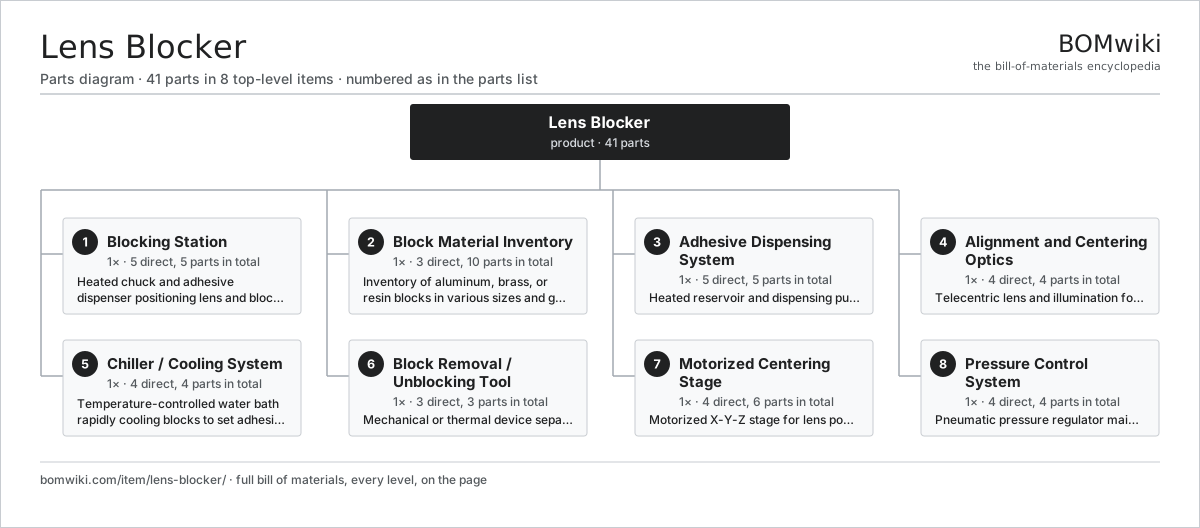
| # | Part | Qty | What it does |
|---|---|---|---|
| 1 | Blocking Station 5 parts | 1× | Heated chuck and adhesive dispenser positioning lens and block with alignment optics |
| 2 | Block Material Inventory 3 parts | 1× | Inventory of aluminum, brass, or resin blocks in various sizes and geometries |
| 3 | Adhesive Dispensing System 5 parts | 1× | Heated reservoir and dispensing pump delivering hot-melt or UV-cure adhesive |
| 4 | Alignment and Centering Optics 4 parts | 1× | Telecentric lens and illumination for precise lens-to-block centering |
| 5 | Chiller / Cooling System 4 parts | 1× | Temperature-controlled water bath rapidly cooling blocks to set adhesive |
| 6 | Block Removal / Unblocking Tool 3 parts | 1× | Mechanical or thermal device separating cooled block from lens for unblocking |
| 7 | Motorized Centering Stage 4 parts | 1× | Motorized X-Y-Z stage for lens positioning (±0.5 mm accuracy) |
| 8 | Pressure Control System 4 parts | 1× | Pneumatic pressure regulator maintaining consistent contact force |
3D model
No 3D model yet. Have a CAD file of this? Add a 3D model. STL renders right on this page; STEP, FreeCAD, and OpenSCAD sources are welcome too (openly licensed, like all 3D models on BOMwiki).
Build & assembly graph
expand / collapse · shared sub-assemblies converge · links to related products · est. labourTap an assembly to expand/collapse · tap a part to open it · use “Open page” for any node · drag to pan, scroll to zoom.
Bill of materials for Lens Blocker
8 top-level lines · 40 rows shown · 41 parts total · indented to 3 levels| # | Item / sub-assembly | Part no. | Qty/assy | Ext. qty | Parts | Type |
|---|---|---|---|---|---|---|
| 1 | Blocking Station 5 parts | lens-blocker-blocking-station | 1× | 1 | 5 | assembly |
| 1.1 | Heated Platen | lens-blocker-base-platen | 1× | 1 | · | part |
| 1.2 | Platen Heater | lens-blocker-platen-heater | 1× | 1 | · | part |
| 1.3 | Platen Thermometer | lens-blocker-platen-thermometer | 1× | 1 | · | part |
| 1.4 | Lens Holder Arm | lens-blocker-lens-holder-arm | 1× | 1 | · | part |
| 1.5 | Proximity Sensor | lens-blocker-proximity-sensor | 1× | 1 | · | part |
| 2 | Block Material Inventory 3 parts | lens-blocker-alloy-block-supply | 1× | 1 | 10 | assembly |
| 2.1 | Aluminum Blocking Block | lens-blocker-aluminum-block | 5× | 5 | · | part |
| 2.2 | Brass Blocking Block | lens-blocker-brass-block | 2× | 2 | · | part |
| 2.3 | Polymer Blocking Block | lens-blocker-polymer-block | 3× | 3 | · | part |
| 3 | Adhesive Dispensing System 5 parts | lens-blocker-adhesive-system | 1× | 1 | 5 | assembly |
| 3.1 | Adhesive Reservoir | lens-blocker-adhesive-tank | 1× | 1 | · | part |
| 3.2 | Adhesive Pump | lens-blocker-adhesive-pump | 1× | 1 | · | part |
| 3.3 | Dispenser Nozzle | lens-blocker-adhesive-dispenser-nozzle | 1× | 1 | · | part |
| 3.4 | Adhesive Supply Line | lens-blocker-adhesive-supply-line | 1× | 1 | · | part |
| 3.5 | Adhesive Thermostat | lens-blocker-adhesive-thermostat | 1× | 1 | · | part |
| 4 | Alignment and Centering Optics 4 parts | lens-blocker-alignment-optics | 1× | 1 | 4 | assembly |
| 4.1 | Telecentric Objective Lens | lens-blocker-telecentric-lens | 1× | 1 | · | part |
| 4.2 | Alignment Camera | lens-blocker-alignment-camera | 1× | 1 | · | part |
| 4.3 | Ring Light | lens-blocker-ring-light | 1× | 1 | · | part |
| 4.4 | Image Processor | lens-blocker-image-processor | 1× | 1 | · | part |
| 5 | Chiller / Cooling System 4 parts | lens-blocker-chiller-system | 1× | 1 | 4 | assembly |
| 5.1 | Cooling Tank | lens-blocker-chiller-tank | 1× | 1 | · | part |
| 5.2 | Refrigeration Unit | lens-blocker-chiller-unit | 1× | 1 | · | part |
| 5.3 | Chiller Pump | lens-blocker-chiller-pump | 1× | 1 | · | part |
| 5.4 | Chiller Controller | lens-blocker-chiller-thermostat | 1× | 1 | · | part |
| 6 | Block Removal / Unblocking Tool 3 parts | lens-blocker-block-removal-tool | 1× | 1 | 3 | assembly |
| 6.1 | Thermal Adhesive Release | lens-blocker-thermal-driver | 1× | 1 | · | part |
| 6.2 | Block Pusher Plate | lens-blocker-mechanical-pusher | 1× | 1 | · | part |
| 6.3 | Collet Release Solenoid | lens-blocker-collet-release | 1× | 1 | · | part |
| 7 | Motorized Centering Stage 4 parts | lens-blocker-centering-chuck | 1× | 1 | 6 | assembly |
| 7.1 | X-Axis Motor | lens-blocker-x-motor | 1× | 1 | · | part |
| 7.2 | Y-Axis Motor | lens-blocker-y-motor | 1× | 1 | · | part |
| 7.3 | Z-Axis Motor | lens-blocker-z-motor | 1× | 1 | · | part |
| 7.4 | Position Feedback Encoder | lens-blocker-position-encoder | 3× | 3 | · | part |
| 8 | Pressure Control System 4 parts | lens-blocker-pressure-control | 1× | 1 | 4 | assembly |
| 8.1 | Pressure Regulator | lens-blocker-pressure-regulator | 1× | 1 | · | part |
| 8.2 | Pressure Gauge | lens-blocker-pressure-gauge | 1× | 1 | · | part |
| 8.3 | Contact Pressure Cylinder | lens-blocker-air-cylinder | 1× | 1 | · | part |
| 8.4 | Pressure Feedback Sensor | lens-blocker-pressure-sensor | 1× | 1 | · | part |
Something wrong in this list? Report a problem with this BOM.
Sourcing: possible vendors
Browse the supplier directory → Prices, MOQ, and lead times are algorithmic estimates, not quotes, and not claims about these companies. Company mappings are curated by keyword; est. price band $100–$8k. How estimates work| Vendor | HQ | Specialty | MOQ | Lead time |
|---|---|---|---|---|
|
🇯🇵Canon
canon.com ↗
|
Tokyo, JP | Imaging & optics | 500 units | 10–16 wks |
|
🇯🇵Nikon
nikon.com ↗
|
Tokyo, JP | Imaging & optics | 500 units | 10–16 wks |
|
🇩🇪ZEISS
zeiss.com ↗
|
Oberkochen, DE | Optics & optoelectronics | 500 units | 10–16 wks |
| leica-camera.com ↗ | Wetzlar, DE | Cameras & optics | 500 units | 10–16 wks |
| flir.com ↗ | Wilsonville, US | Thermal imaging | 500 units | 10–16 wks |
1,250-word article