Lens Surfacing Generator
ProductOverview
The lens-surfacing generator is the heart of precision optics manufacturing, using computer-controlled grinding and polishing to shape individual lenses to exacting surface-form specifications. Unlike the edger (which shapes lens edges to frame geometry), the generator fabricates the refractive surfaces, the base curve and front surface, that determine optical power and aberration correction. Generators are deployed in optical labs, eyewear manufacturers, and custom lens fabricators serving high-end eyewear, industrial optics, and research applications.
A modern generator achieves 0.05–0.1 µm surface-form accuracy (peak-to-valley departure from an ideal sphere or asphere) and 0.05–0.2 µm surface roughness (Ra), meeting ISO 13666 and custom prescription tolerances. The machine integrates a high-speed rotating cutting tool, a servo-driven lens-block chuck with multi-axis tilt, and inline optical metrology that measures the surface in real time.
How it works
Tool and Spindle Management
The Cutting Spindle Assembly houses a high-speed cutting tool, typically a diamond-impregnated lap or carbide burr, rotating at 5,000–30,000 rpm depending on lens material (glass or plastic) and surface finish target. The spindle receives cutting-fluid mist from Mist Atomizer Nozzle arrays, which atomize coolant into a fine aerosol rather than flooding the workpiece (minimizing optical-surface contamination and thermal shock). A Automatic Tool Changer carousel holds up to 12 different tools, automatically indexing and changing them via a pneumatic gripper.
Lens Block Positioning
The lens blank is typically cemented into an aluminum or brass lens block, which mounts into the Lens Block Assembly. This assembly combines two critical rotations: the A-axis (workpiece rotation at 10–100 rpm for meridional grinding) and the C-axis (tilt at ±5 to ±15 degrees for aspheric surface generation). Modern generators also add XYZ linear stages for tool positioning, allowing the spindle to traverse in 3D space and execute complex surface-form families (bicentric, bifocal, progressive, and custom aspheres).
Real-Time Metrology and Closed-Loop Control
As grinding progresses, the Inline Measurement Station continuously measures the lens surface using white-light interferometry or focus-variation microscopy. Every 5–10 seconds, the Optical Profilometer captures a 3D profile, comparing measured form against the target CAM-generated surface model. If form departure exceeds tolerance, the CNC controller automatically adjusts spindle position or feedrate to converge onto the specification. This closed-loop feedback ensures repeatable high-precision results across thermal drift, tool wear, and material variation.
Swarf and Contamination Control
The Swarf Management System is critical for optical surfaces. Lens-grinding generates very fine silicate or plastic dust that, if allowed to settle on the workpiece, degrades surface finish and can embed in the lens surface. The system uses low-flow misting rather than flood cooling, a Swarf Catch Basin basin beneath the workpiece, and aggressive Coolant Filtration Unit filtration maintaining cleanliness better than ISO 18/16/13. Some generators use a secondary air-knife to blow away residual swarf before the final precision polish pass.
Machine Structure and Damping
The Machine Bed and Base is a monolithic cast-iron or precision-ground granite bed, 300–500 kg, providing the thermal mass and stiffness needed for 0.1 µm form tolerance. Vibration Isolators elastomeric mounts decouple spindle vibration from the precision-measuring optics, which are mounted on the same base. The spindle itself is enclosed in a Thermal Insulation Jacket insulation jacket, preventing infrared radiation from the high-speed motor from causing thermal drift in the CNC axes.
Optical Surface Generation Workflows
Spherical Lenses (Simple Base Curves)
For standard single-vision prescription lenses, the CAM system computes a tool path that sweeps the diamond cutting tool across the rotating lens block in a series of meridional traces. The lens rotates continuously (A-axis ~50 rpm) while the spindle feeds radially inward on the Y-axis at controlled speed. Tool engagement is depth-limited to ~0.01 mm per pass, requiring 20–40 successive passes to remove 1–2 mm of material. Once rough-ground, the machine automatically swaps to a finer tool, reduces spindle speed, and executes a finish pass.
Aspheric Surfaces (C-Axis Tilting)
Progressive bifocals and custom aspheres demand spatially varying surface curvature. The generator tilts the lens block on the C-axis while grinding, so the cutting tool attacks the surface at different rake angles across its diameter. This technique, called "aspheric grinding," allows a single radial-feed motion to generate a continuous surface with variable curvature matching the prescription map. The inline Optical Profilometer continuously validates form accuracy, particularly in the progressive corridor where surface curvature transitions from distance to near zones.
Polishing and Finishing
After grinding to approximate form, a second tool (polishing lap) executes a slower speed (1,000–5,000 rpm) and light pressure pass, removing grinding marks and achieving final surface roughness targets (0.05–0.2 µm Ra). Polishing may run at lower spindle speed and higher workpiece rotation (A-axis ~100 rpm) to randomize tool marks. The metrology station makes a final capture, validating form, roughness, and absence of scratches or contamination.
Control System and Programming
The Control Cabinet houses an industrial CNC controller running ISO G-code. A CAM system (like Zeiss OPTICAD or custom proprietary software) converts a lens prescription and surface-geometry specification into machine-readable tool paths, accounting for tool geometry, spindle deflection, and machine kinematic limitations. The Operator PC operator interface allows technicians to load jobs, monitor real-time spindle load and coolant temperature, and review metrology data. Advanced systems log complete traceability, tool wear, spindle hours, ambient humidity, enabling predictive maintenance.
Manufacturing Ecosystem
Lens generators are used primarily in high-volume prescription eyewear labs (producing 100–500+ lens pairs daily), industrial optics shops (manufacturing custom lenses for cameras, microscopes, and laser systems), and research institutions. A typical eyewear lab operates 1–3 generators in parallel, with one machine dedicated to base curves and another to progressive surfaces. Lead time for a custom aspheric prescription lens is typically 1–3 days from order to final QC.
Standards like ISO 13666 (ophthalmic lenses) and military specs (MIL-PRF-13830, MIL-PRF-51307) define acceptable surface-form error, scratches and digs, and coating durability. Custom industrial optics often target even tighter tolerances: ±0.01 µm form error for precision laser optics, or ±0.05 µm for high-end astronomical telescopes.
Precision Limits and Considerations
The 0.05–0.1 µm form accuracy of a modern generator is limited by spindle runout, thermal expansion of the machine structure, and coolant film thickness variations. To achieve these tolerances consistently, machines must stabilize thermally for 30–60 minutes before precision grinding, and environmental conditions (shop temperature within ±2 °C, humidity 30–60%) must be controlled. Diamond cutting tools are typically trued (dressed) daily using a precision dressing tool, and high-speed spindle bearings require regular maintenance to prevent runout growth beyond 2 µm TIR.
Lens Surfacing Generator parts and their functions
8 top-level parts · 48 parts in total · full bill of materials below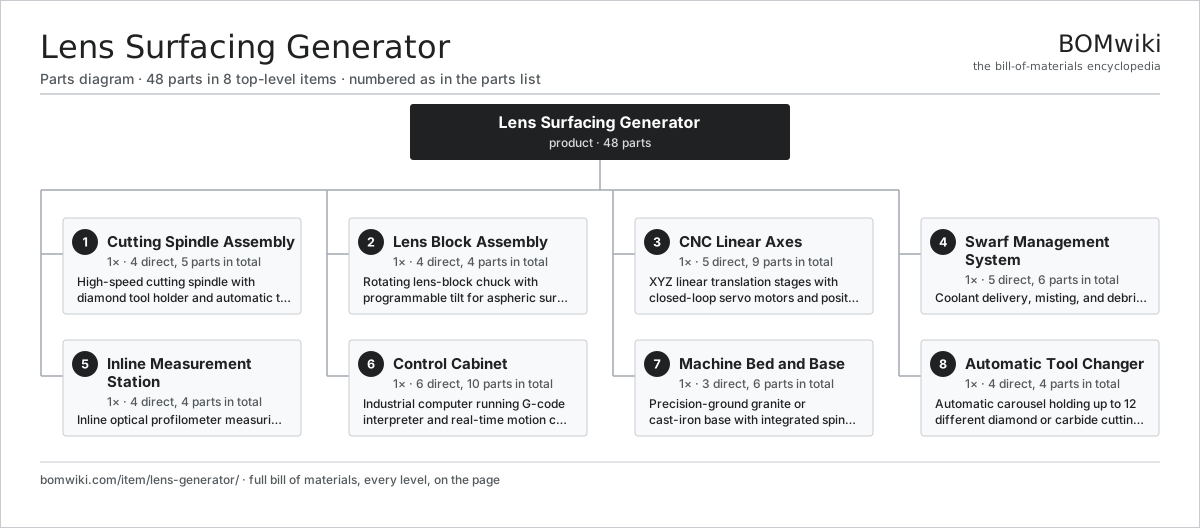
| # | Part | Qty | What it does |
|---|---|---|---|
| 1 | Cutting Spindle Assembly 4 parts | 1× | High-speed cutting spindle with diamond tool holder and automatic tool changer |
| 2 | Lens Block Assembly 4 parts | 1× | Rotating lens-block chuck with programmable tilt for aspheric surface generation |
| 3 | CNC Linear Axes 5 parts | 1× | XYZ linear translation stages with closed-loop servo motors and position feedback |
| 4 | Swarf Management System 5 parts | 1× | Coolant delivery, misting, and debris collection system for ultra-precision grinding |
| 5 | Inline Measurement Station 4 parts | 1× | Inline optical profilometer measuring surface form to 0.1 µm accuracy |
| 6 | Control Cabinet 6 parts | 1× | Industrial computer running G-code interpreter and real-time motion control |
| 7 | Machine Bed and Base 3 parts | 1× | Precision-ground granite or cast-iron base with integrated spindle and probe mounts |
| 8 | Automatic Tool Changer 4 parts | 1× | Automatic carousel holding up to 12 different diamond or carbide cutting tools |
3D model
No 3D model yet. Have a CAD file of this? Add a 3D model. STL renders right on this page; STEP, FreeCAD, and OpenSCAD sources are welcome too (openly licensed, like all 3D models on BOMwiki).
Build & assembly graph
expand / collapse · shared sub-assemblies converge · links to related products · est. labourTap an assembly to expand/collapse · tap a part to open it · use “Open page” for any node · drag to pan, scroll to zoom.
Bill of materials for Lens Surfacing Generator
8 top-level lines · 43 rows shown · 48 parts total · indented to 3 levels| # | Item / sub-assembly | Part no. | Qty/assy | Ext. qty | Parts | Type |
|---|---|---|---|---|---|---|
| 1 | Cutting Spindle Assembly 4 parts | lens-generator-spindle-assembly | 1× | 1 | 5 | assembly |
| 1.1 | Spindle Motor | lens-generator-spindle-motor | 1× | 1 | · | part |
| 1.2 | Spindle Bearings | lens-generator-spindle-bearings | 2× | 2 | · | part |
| 1.3 | Tool Holder | lens-generator-tool-holder | 1× | 1 | · | part |
| 1.4 | Spindle Cooling System | lens-generator-spindle-cooling | 1× | 1 | · | part |
| 2 | Lens Block Assembly 4 parts | lens-generator-workpiece-axis | 1× | 1 | 4 | assembly |
| 2.1 | Workpiece Rotation Motor | lens-generator-workpiece-motor | 1× | 1 | · | part |
| 2.2 | Tilt Axis Motor | lens-generator-tilt-motor | 1× | 1 | · | part |
| 2.3 | Workpiece Chuck | lens-generator-workpiece-chuck | 1× | 1 | · | part |
| 2.4 | Block Clamping System | lens-generator-block-clamping | 1× | 1 | · | part |
| 3 | CNC Linear Axes 5 parts | lens-generator-cnc-axes | 1× | 1 | 9 | assembly |
| 3.1 | X-Axis Stage | lens-generator-x-axis | 1× | 1 | · | part |
| 3.2 | Y-Axis Stage | lens-generator-y-axis | 1× | 1 | · | part |
| 3.3 | Z-Axis Stage | lens-generator-z-axis | 1× | 1 | · | part |
| 3.4 | Servo Amplifiers | lens-generator-servo-drivers | 3× | 3 | · | part |
| 3.5 | Encoder | encoder | 3× | 3 | · | part |
| 4 | Swarf Management System 5 parts | lens-generator-swarf-system | 1× | 1 | 6 | assembly |
| 4.1 | Coolant Pump | lens-generator-coolant-pump | 1× | 1 | · | part |
| 4.2 | Mist Atomizer Nozzle | lens-generator-mist-nozzle | 2× | 2 | · | part |
| 4.3 | Swarf Catch Basin | lens-generator-swarf-catch | 1× | 1 | · | part |
| 4.4 | Coolant Filtration Unit | lens-generator-coolant-filter | 1× | 1 | · | part |
| 4.5 | Pressure Sensor | pressure-sensor | 1× | 1 | · | part |
| 5 | Inline Measurement Station 4 parts | lens-generator-metrology-station | 1× | 1 | 4 | assembly |
| 5.1 | Optical Profilometer | lens-generator-profilometer | 1× | 1 | · | part |
| 5.2 | Focus-Variation Microscope | lens-generator-focus-variation | 1× | 1 | · | part |
| 5.3 | Measurement Optics | lens-generator-measurement-optics | 1× | 1 | · | part |
| 5.4 | Measurement PC | lens-generator-measurement-controller | 1× | 1 | · | part |
| 6 | Control Cabinet 6 parts | lens-generator-control-cabinet | 1× | 1 | 10 | assembly |
| 6.1 | CNC Motion Controller | lens-generator-cnc-controller | 1× | 1 | · | part |
| 6.2 | Machine PLC | lens-generator-plc | 1× | 1 | · | part |
| 6.3 | Spindle VFD | lens-generator-spindle-vfd | 1× | 1 | · | part |
| 6.4 | Operator PC | lens-generator-control-pc | 1× | 1 | · | part |
| 6.5 | Power Supply | power-supply | 2× | 2 | · | part |
| 6.6 | Connector | connector | 4× | 4 | · | part |
| 7 | Machine Bed and Base 3 parts | lens-generator-optical-bench | 1× | 1 | 6 | assembly |
| 7.1 | Monolithic Bed | lens-generator-base-structure | 1× | 1 | · | part |
| 7.2 | Vibration Isolators | lens-generator-vibration-isolators | 4× | 4 | · | part |
| 7.3 | Thermal Insulation Jacket | lens-generator-thermal-barrier | 1× | 1 | · | part |
| 8 | Automatic Tool Changer 4 parts | lens-generator-tool-changer | 1× | 1 | 4 | assembly |
| 8.1 | Carousel Motor | lens-generator-carousel-motor | 1× | 1 | · | part |
| 8.2 | Tool Gripper Actuator | lens-generator-gripper-actuator | 1× | 1 | · | part |
| 8.3 | Tool Carousel Frame | lens-generator-tool-carousel-frame | 1× | 1 | · | part |
| 8.4 | Connector | connector | 1× | 1 | · | part |
Something wrong in this list? Report a problem with this BOM.
Related products
same domain, ranked by shared parts Laser Tracker
142 parts · shares 3 with this page
Laser Tracker
142 parts · shares 3 with this page
 Patternless Lens Edger
57 parts · shares 3 with this page
Patternless Lens Edger
57 parts · shares 3 with this page
 Photo Minilab
454 parts · shares 2 with this page
Photo Minilab
454 parts · shares 2 with this page
 Cable Camera System
138 parts · shares 1 with this page
Cable Camera System
138 parts · shares 1 with this page
 Lens Polisher
38 parts · shares 1 with this page
Lens Polisher
38 parts · shares 1 with this page
 Rangefinder Binoculars
257 parts · shares 1 with this page
Rangefinder Binoculars
257 parts · shares 1 with this page
Sourcing: possible vendors
Browse the supplier directory → Prices, MOQ, and lead times are algorithmic estimates, not quotes, and not claims about these companies. Company mappings are curated by keyword; est. price band $100–$8k. How estimates work| Vendor | HQ | Specialty | MOQ | Lead time |
|---|---|---|---|---|
|
🇯🇵Canon
canon.com ↗
|
Tokyo, JP | Imaging & optics | 500 units | 10–16 wks |
|
🇯🇵Nikon
nikon.com ↗
|
Tokyo, JP | Imaging & optics | 500 units | 10–16 wks |
|
🇩🇪ZEISS
zeiss.com ↗
|
Oberkochen, DE | Optics & optoelectronics | 500 units | 10–16 wks |
| leica-camera.com ↗ | Wetzlar, DE | Cameras & optics | 500 units | 10–16 wks |
| flir.com ↗ | Wilsonville, US | Thermal imaging | 500 units | 10–16 wks |
1,162-word article