Lens Groover
ProductOverview
The lens groover is a specialized precision machine used to cut grooves or channels into ophthalmic lens edges, enabling mechanical lens attachment to frame fronts or securing specialty lens inserts. Grooved lenses are common in high-end eyewear (rimless or semi-rimless designs), sports eyewear, and industrial protective optics where the groove provides mechanical lock rather than adhesive bonding.
Grooving demands tight tolerances: groove depth must be consistent (±0.05 mm) and edges must be clean to prevent stress concentrations that would cause lens fracture under frame assembly pressure. Modern automated groovers achieve these tolerances using precision spindles, servo-driven positioning stages, and real-time depth monitoring.
How it works
Spindle and Cutting Wheel
The Spindle Assembly rotates a carbide or diamond-edged Grooving Wheel at 5,000–25,000 rpm depending on lens material (glass requires lower speeds; plastic allows higher speeds). The wheel diameter is typically 20–50 mm with a cutting width of 0.5–3 mm and a custom edge profile (V-notch, rectangular, or rounded groove).
Carbide wheels are most common for production; diamond wheels are used for hard-coated plastic lenses or specialty materials. The Spindle Bearings are precision angular-contact types with preload springs, maintaining <2 µm radial runout critical for edge quality.
Lens Positioning and Multi-Axis Motion
The Lens Clamp and Positioning holds the lens in a programmable chuck. Three motorized axes control the groove generation:
Vertical (Z): The Vertical (Z) Motor adjusts lens height relative to the grooving wheel, controlling groove depth. A mechanical or electronic Depth Control System ensures consistent depth across multiple lenses (±0.05 mm).
Rotation (A): The Rotation (A) Motor spins the lens around its vertical axis, creating symmetric grooves around the lens perimeter or multiple grooves if needed.
Tilt (C): The Tilt (C) Motor tilts the lens ±10 degrees, enabling angled grooves (e.g., 45-degree bevels for rimless mounting).
The XY Positioning Stage provides radial and axial positioning of the grooving wheel relative to the lens, enabling grooves at different lens heights (top, middle, bottom edge) for multi-point frame mounting.
Coolant Delivery and Thermal Management
A Coolant and Misting System system delivers 1–3 L/min of mist to the grooving interface. Mist cooling (rather than flood cooling) prevents thermal shock to the lens while clearing swarf efficiently. Water-based coolant is preferred for most plastics; oil-based coolant is used for glass lenses. The mist system also reduces coolant consumption and waste compared to flooded machines.
The Spindle Cooling (passive air-blast or active jacket) maintains spindle temperature within ±5 °C, essential for dimensional accuracy over long production runs.
Depth Control and Repeatability
The Depth Control System is critical for production consistency. A mechanical Mechanical Depth Stop sets maximum vertical travel; when the spindle contacts the groove floor, travel halts automatically. An optional Electronic Depth Probe (non-contact sensor) detects groove-floor contact electronically, providing feedback to the Control Panel.
The Depth Indicator displays groove depth in real-time, allowing the operator to verify groove quality before lens removal.
Program and Sequence Control
The Control Panel houses a Motion Controller (PLC or stepper driver) managing the grooving sequence:
- Lens load and clamp: Operator places lens in chuck; pneumatic clamp engages.
- Spindle ramp-up: Motor accelerates to setpoint speed (5,000–25,000 rpm depending on material).
- Approach and engage: XY stage positions grooving wheel; Z-axis approaches lens at controlled feedrate.
- Grooving pass: Lens rotates at constant speed while wheel cuts; depth is monitored in real-time.
- Retract and unclamp: Once groove depth target is reached, spindle retracts; lens is released for inspection.
Cycle time per lens is typically 30–90 seconds depending on groove diameter and material.
Groove Designs and Applications
Rimless Eyewear Grooves
In rimless frames, the lens sits in a metal frame front via a small groove (typically 0.5–1 mm deep, 1–2 mm wide) around the lens perimeter. The groove must be precisely positioned at the edge to avoid stress concentration. Multiple grooves (top, bottom, temple sides) distribute frame pressure evenly, preventing lens fracture.
Semi-Rimless Grooves
Semi-rimless designs combine a grooved edge with adhesive bonding on the visible side. Grooves are typically 0.5–1.5 mm deep on the underside, hidden by the frame front.
Multi-Point Mounting
Advanced designs use multiple independent grooves at different lens heights to accommodate flexible or modular frame systems. The groover's programmable axes enable these complex patterns.
Protective Eyewear Grooves
Impact-resistant polycarbonate safety glasses often incorporate grooves for strap attachment or insert mounting (prescription inserts or colored lenses). These grooves are 1–2 mm deep and must be free of micro-cracks to prevent stress-induced lens failure.
Material Considerations
Glass lenses: Require lower spindle speeds (5,000–10,000 rpm) and carbide wheels. Risk of edge chipping is high; mist cooling and shallow depth increments (0.1–0.2 mm per pass) minimize damage.
Plastic lenses (CR-39, polycarbonate): Can tolerate higher speeds (10,000–20,000 rpm) and faster feedrates. Polycarbonate is particularly tough; speeds up to 25,000 rpm are acceptable.
High-index plastics (1.60–1.74 index): Harder and more brittle; speeds and feedrates must be conservative (10,000–15,000 rpm) with light depth increments to avoid cracking.
Coated lenses (AR coating): Grooving may damage or lift AR coatings if spindle runout is excessive or depth increments are too aggressive. Coatings are typically applied after grooving; grooving before coating avoids this issue.
Production Workflow
- Pre-cut lens blanks arrive from the generator or polisher.
- Lens load: Operator loads lens into groover chuck, setting vertical position for groove height.
- Automatic grooving: Machine executes programmed grooving sequence (typically <1 minute per lens).
- QC inspection: Groove depth and edge quality verified using calipers or optical microscope.
- Frame assembly: Grooved lenses are mounted into frame fronts using precision fixtures to align grooves with frame sockets.
A single lens groover can produce 30–50 grooved lenses per hour depending on lens size and groove complexity.
Safety and Precision
The high-speed rotating grooving wheel is enclosed by a Wheel Safety Guard, protecting operators from contact injuries. The Coolant Splash Guard contains coolant spray.
Precision is enabled by the Base Casting (heavy monolithic base, 200–300 kg) and Vibration Isolators (elastomeric isolators tuned to 5–10 Hz), which decouple spindle vibration from the precision-positioning stages, ensuring groove edge quality.
Spindle runout is continuously monitored; if runout exceeds 3–5 µm (indicating bearing wear), spindle replacement is scheduled to maintain groove-edge quality.
Lens Groover parts and their functions
8 top-level parts · 34 parts in total · full bill of materials below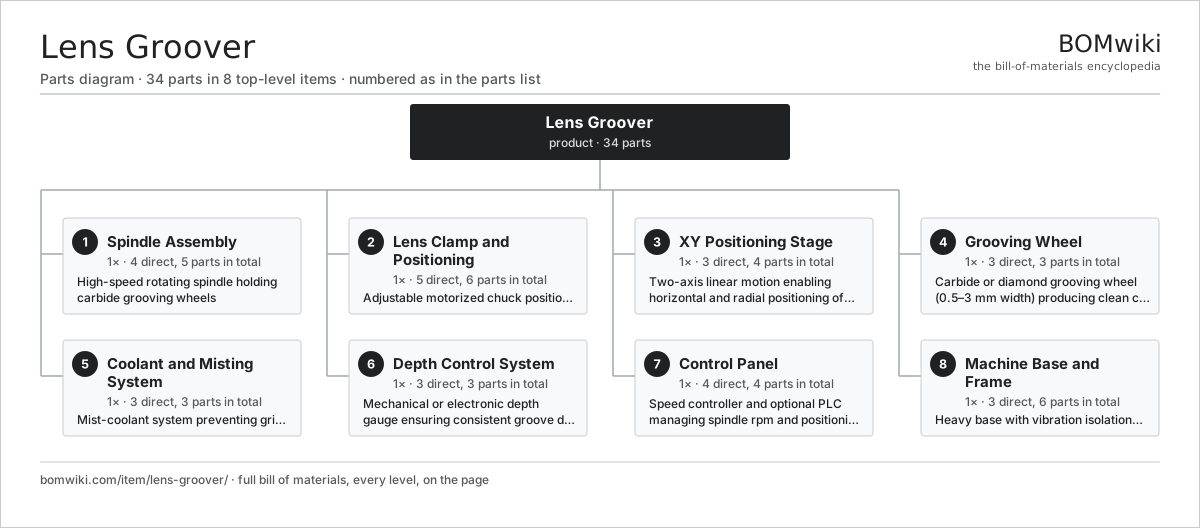
| # | Part | Qty | What it does |
|---|---|---|---|
| 1 | Spindle Assembly 4 parts | 1× | High-speed rotating spindle holding carbide grooving wheels |
| 2 | Lens Clamp and Positioning 5 parts | 1× | Adjustable motorized chuck positioning lens at precise depth and angle relative to groove tool |
| 3 | XY Positioning Stage 3 parts | 1× | Two-axis linear motion enabling horizontal and radial positioning of lens to tool |
| 4 | Grooving Wheel 3 parts | 1× | Carbide or diamond grooving wheel (0.5–3 mm width) producing clean channel |
| 5 | Coolant and Misting System 3 parts | 1× | Mist-coolant system preventing grinding heat and extending wheel life |
| 6 | Depth Control System 3 parts | 1× | Mechanical or electronic depth gauge ensuring consistent groove depth across multiple lenses |
| 7 | Control Panel 4 parts | 1× | Speed controller and optional PLC managing spindle rpm and positioning |
| 8 | Machine Base and Frame 3 parts | 1× | Heavy base with vibration isolation for smooth operation |
3D model
No 3D model yet. Have a CAD file of this? Add a 3D model. STL renders right on this page; STEP, FreeCAD, and OpenSCAD sources are welcome too (openly licensed, like all 3D models on BOMwiki).
Build & assembly graph
expand / collapse · shared sub-assemblies converge · links to related products · est. labourTap an assembly to expand/collapse · tap a part to open it · use “Open page” for any node · drag to pan, scroll to zoom.
Bill of materials for Lens Groover
8 top-level lines · 36 rows shown · 34 parts total · indented to 3 levels| # | Item / sub-assembly | Part no. | Qty/assy | Ext. qty | Parts | Type |
|---|---|---|---|---|---|---|
| 1 | Spindle Assembly 4 parts | lens-groover-spindle-assembly | 1× | 1 | 5 | assembly |
| 1.1 | Spindle Motor | lens-groover-spindle-motor | 1× | 1 | · | part |
| 1.2 | Spindle Bearings | lens-groover-spindle-bearings | 2× | 2 | · | part |
| 1.3 | Tool Holder | lens-groover-tool-holder | 1× | 1 | · | part |
| 1.4 | Spindle Cooling | lens-groover-spindle-cooling | 1× | 1 | · | part |
| 2 | Lens Clamp and Positioning 5 parts | lens-groover-lens-clamp | 1× | 1 | 6 | assembly |
| 2.1 | Lens Clamp Head | lens-groover-clamp-head | 1× | 1 | · | part |
| 2.2 | Vertical (Z) Motor | lens-groover-vertical-motor | 1× | 1 | · | part |
| 2.3 | Tilt (C) Motor | lens-groover-tilt-motor | 1× | 1 | · | part |
| 2.4 | Rotation (A) Motor | lens-groover-rotation-motor | 1× | 1 | · | part |
| 2.5 | Position Encoder | lens-groover-encoder-feedback | 2× | 2 | · | part |
| 3 | XY Positioning Stage 3 parts | lens-groover-xy-stage | 1× | 1 | 4 | assembly |
| 3.1 | X-Axis Radial Stage | lens-groover-x-axis-stage | 1× | 1 | · | part |
| 3.2 | Y-Axis Approach Stage | lens-groover-y-axis-stage | 1× | 1 | · | part |
| 3.3 | Servo Amplifiers | lens-groover-servo-drivers | 2× | 2 | · | part |
| 4 | Grooving Wheel 3 parts | lens-groover-groove-wheel | 1× | 1 | 3 | assembly |
| 4.1 | Wheel Arbor Shaft | lens-groover-wheel-arbor | 1× | 1 | · | part |
| 4.2 | Grooving Wheel Disk | lens-groover-wheel-disk | 1× | 1 | · | part |
| 4.3 | Wheel Safety Guard | lens-groover-wheel-guard | 1× | 1 | · | part |
| 5 | Coolant and Misting System 3 parts | lens-groover-coolant-spray | 1× | 1 | 3 | assembly |
| 5.1 | Coolant Pump | lens-groover-coolant-pump | 1× | 1 | · | part |
| 5.2 | Mist Nozzle | lens-groover-mist-nozzle | 1× | 1 | · | part |
| 5.3 | Coolant Tank | lens-groover-coolant-tank | 1× | 1 | · | part |
| 6 | Depth Control System 3 parts | lens-groover-depth-stop | 1× | 1 | 3 | assembly |
| 6.1 | Mechanical Depth Stop | lens-groover-mechanical-stop | 1× | 1 | · | part |
| 6.2 | Electronic Depth Probe | lens-groover-touch-probe | 1× | 1 | · | part |
| 6.3 | Depth Indicator | lens-groover-depth-readout | 1× | 1 | · | part |
| 7 | Control Panel 4 parts | lens-groover-control-panel | 1× | 1 | 4 | assembly |
| 7.1 | Spindle Speed Controller | lens-groover-speed-controller | 1× | 1 | · | part |
| 7.2 | Motion Controller | lens-groover-motor-controller | 1× | 1 | · | part |
| 7.3 | Control Display | lens-groover-control-display | 1× | 1 | · | part |
| 7.4 | Power Supply | power-supply | 1× | 1 | · | part |
| 8 | Machine Base and Frame 3 parts | lens-groover-frame-base | 1× | 1 | 6 | assembly |
| 8.1 | Base Casting | lens-groover-base-casting | 1× | 1 | · | part |
| 8.2 | Vibration Isolators | lens-groover-vibration-feet | 4× | 4 | · | part |
| 8.3 | Coolant Splash Guard | lens-groover-splash-guard | 1× | 1 | · | part |
Something wrong in this list? Report a problem with this BOM.
Related products
same domain, ranked by shared parts Adaptive Optics System
35 parts · shares 1 with this page
Adaptive Optics System
35 parts · shares 1 with this page
 Camera Motion Control Rig
210 parts · shares 1 with this page
Camera Motion Control Rig
210 parts · shares 1 with this page
 Digital Cinema Camera
305 parts · shares 1 with this page
Digital Cinema Camera
305 parts · shares 1 with this page
 Document Camera
247 parts · shares 1 with this page
Document Camera
247 parts · shares 1 with this page
 High-Speed Camera
183 parts · shares 1 with this page
High-Speed Camera
183 parts · shares 1 with this page
 Industrial 3D Scanner
149 parts · shares 1 with this page
Industrial 3D Scanner
149 parts · shares 1 with this page
Sourcing: possible vendors
Browse the supplier directory → Prices, MOQ, and lead times are algorithmic estimates, not quotes, and not claims about these companies. Company mappings are curated by keyword; est. price band $100–$8k. How estimates work| Vendor | HQ | Specialty | MOQ | Lead time |
|---|---|---|---|---|
|
🇯🇵Canon
canon.com ↗
|
Tokyo, JP | Imaging & optics | 500 units | 10–16 wks |
|
🇯🇵Nikon
nikon.com ↗
|
Tokyo, JP | Imaging & optics | 500 units | 10–16 wks |
|
🇩🇪ZEISS
zeiss.com ↗
|
Oberkochen, DE | Optics & optoelectronics | 500 units | 10–16 wks |
| leica-camera.com ↗ | Wetzlar, DE | Cameras & optics | 500 units | 10–16 wks |
| flir.com ↗ | Wilsonville, US | Thermal imaging | 500 units | 10–16 wks |
1,132-word article