Lensmeter
ProductOverview
The lensmeter (also called focimeter or phoropter in clinical settings) is the fundamental optical measurement tool in eyewear labs, clinics, and quality-control departments. It measures the optical power of a finished lens, both sphere (primary power), cylinder (astigmatic power), and axis, with ±0.12 diopter repeatability, essential for validating prescriptions and detecting manufacturing errors.
A lensmeter operates by locating the back focal plane of the measured lens and analyzing the convergence or divergence of light. The machine automatically adjusts internal compensating lenses to collimate the output beam, then reads the adjustment value to determine power. Modern automated lensmeters also measure prismatic deviation (up to ±20 prism diopters) and can mark the optical center with high precision, eliminating manual measurements and improving throughput.
How it works
Light Path and Optical Alignment
Light from the Illumination System (LED or tungsten-halogen lamp) is diffused by a Diffuser Screen and collimated to 4–6 mm diameter by a Aperture Diaphragm. This beam passes through the Lens Contact Rest where the measured lens is positioned. The measured lens either converges (plus power, hyperopic) or diverges (minus power, myopic) the beam; the amount of deviation determines the power in diopters.
The beam then travels through internal Alignment Mirror to the Objective Lens, which images the back focal plane of the measured lens onto an internal Graticule Pattern. The operator views this image through an Eyepiece and Magnification assembly offering 10×–20× magnification.
Power Measurement via Compensating Lenses
To measure power, the Power Drum Mechanism (a calibrated rotating stage) indexes a carousel of precision compensating lenses into the light path. The lensmeister automatically increments through compensating lenses (each 0.5 diopter steps) until the beam is collimated, that is, the Graticule Pattern pattern sharply focuses. At this point, the compensating lens power exactly cancels the measured lens power; the dial reading directly gives the lens power in diopters.
A fine Vernier Dial provides 0.25 D resolution between major 0.5 D steps, achieving ±0.12 D repeatability specified by ISO 8429. For cylindrical (astigmatic) lenses, the measurement is repeated at 90-degree rotation, yielding sphere and cylinder powers and axis.
Cylindrical Axis Measurement
For astigmatic lenses (where power varies with meridian), the Target Reticle provides alignment patterns: a circle (for spherical alignment) and a cross or prism dots (for astigmatism detection). A motorized Reticle Rotation Motor rotates the target pattern until the operator sees the sharpest focus; the Reticle Position Sensor encoder tracks the angle, displaying the axis on the Diopter Readout Display.
Modern lensmeters automate this: dual-axis compensation (sphere and cylinder motors) is driven by algorithms that analyze the focusing sharpness at multiple orientations, determining optimal power and axis without operator adjustment.
Prism Measurement
Many lensmeters incorporate a Prism Measurement System module using Risley prisms. This pair of high-index optical prisms can be tilted independently to deviate light in horizontal and vertical directions. During measurement, the prism motors rotate to minimize beam displacement; the encoder angles directly yield prism magnitude and direction (BD = base down, BI = base in, BU = base up, BO = base out).
Prism tolerance is critical in ophthalmic work: unintended prism causes eye strain and double vision. Specifications demand <0.5 ΔD prism error; modern automated lensmeters validate this to ±0.25 ΔD.
Marking the Optical Center
The Marking Arm Assembly (a motorized XY arm) positions a Marking Dispenser (paint applicator) to mark the optical center of the lens. For single-vision lenses, the optical center is the point of zero prism. For progressive lenses, three marks are typical: distance center (upper), reading center (lower), and bridge mark (for alignment during fitting).
The Marking X-Motor and Marking Y-Motor drive the marking arm to positions within ±1 mm of the calculated optical center, achieving manufacturing accuracy sufficient for most eyewear applications.
Measurement Principle
Focal Length Determination
A lens of power P (in diopters) has focal length f = 1/P (in meters). A +4 diopter lens has f = 0.25 m; a −2 diopter lens has f = −0.5 m. The lensmeter measures power indirectly by finding the lens's back focal length, the distance from the lens's back surface to its focal point.
The Objective Lens is positioned at a working distance (50–100 mm) from the measured lens; it images the back focal plane onto the graticule. By observing sharpness and adjusting compensating lenses, the instrument determines the back focal length, hence power.
Spectral Bandwidth and Trichromatic Considerations
Most lensmeters use visible white light (tungsten lamp, 400–700 nm) to mimic clinical viewing conditions. Some advanced instruments measure power at discrete wavelengths (e.g., 540 nm green, 613 nm red) to detect chromatic aberration, differences in measured power between wavelengths. This is important for high-index or crown-glass lenses, which exhibit slight wavelength dependence (dispersion).
Specifications and Standards
ISO 8429 (lensmeters) defines:
- Power repeatability: ±0.12 D for three consecutive measurements.
- Cylinder repeatability: ±0.12 D.
- Axis repeatability: ±2 degrees.
- Prism accuracy: ±0.5 ΔD.
ISO 21320 (automated phoropters) extends these tolerances for clinical subjective refraction devices used in eyecare practice.
Typical Workflow in a Lab
- Inspection receipt: Finished lens pair received from edger and polisher.
- Lensmeter measurement: Lens placed on rest; automated measurement (3–5 seconds) determines sphere, cylinder, axis, and prism.
- Pass/fail validation: Measured power compared to prescription tolerance (typically ±0.12 D for sphere, ±0.12 D for cylinder); if acceptable, proceeds to coating.
- Marking: Optical center marked with paint dot using motorized marking arm.
- Inspection for defects: Microscopic examination for scratches, coating defects, or edge chips.
A modern lab tests 100–300 lens pairs daily using 1–2 automated lensmeters, eliminating manual focal-length gauges and improving throughput.
Advanced Features in Modern Lensmeters
- Progressive lens detection: Measures power at multiple heights to map the power profile of progressive bifocals.
- High-index lens compensation: Software correction for thicker lenses (refractive index >1.6) where internal optical path is longer.
- Coating detection: Optical sensor detecting anti-reflective coatings and adjusting measurement algorithms to account for light loss.
- Traceability logging: Data logging of every measurement linked to patient ID or lot number for quality audit trails.
- Multi-user calibration: Daily warm-up and verification against calibration standards (test lens set) to maintain accuracy.
Maintenance and Calibration
Daily: Warm-up (15 minutes) allowing thermal stabilization; verification against calibration test lens set (typically ±0.25 D, ±0.5 D, and −2.0 D spheres).
Weekly: Cleaning objective lens and eyepieces; checking laser alignment if equipped.
Monthly: Visual inspection of graticule for dust or damage; verification of power drum mechanics.
Annually: Full calibration by manufacturer or qualified technician, checking all motor repeatability, prism accuracy, and optical alignment against ISO 8429 standards.
Lensmeters are among the most frequently used instruments in optical labs, and even small calibration drift (>±0.12 D) can cause incorrect lens shipments and customer dissatisfaction.
Lensmeter parts and their functions
8 top-level parts · 34 parts in total · full bill of materials below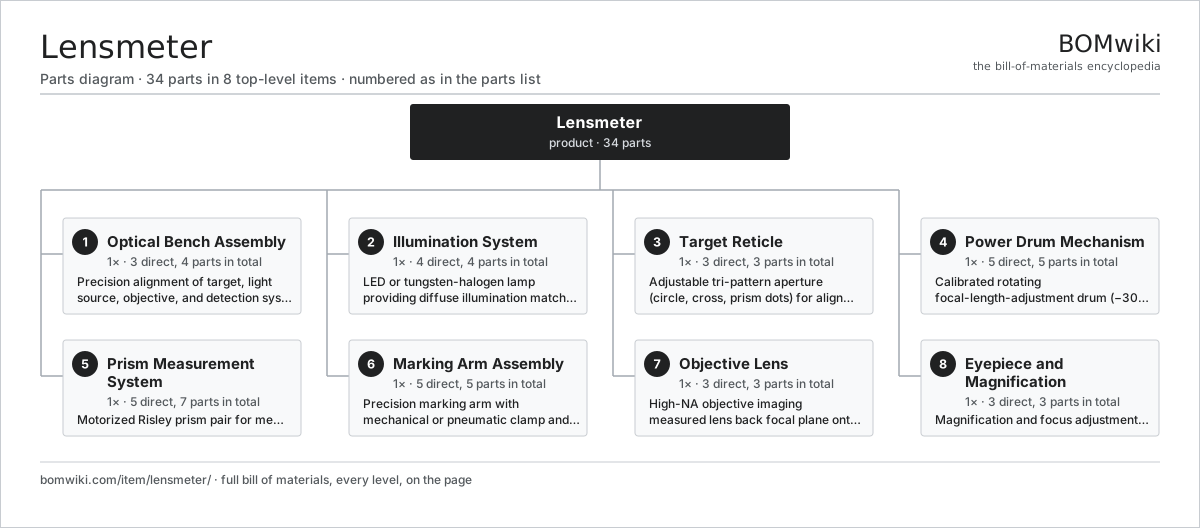
| # | Part | Qty | What it does |
|---|---|---|---|
| 1 | Optical Bench Assembly 3 parts | 1× | Precision alignment of target, light source, objective, and detection system |
| 2 | Illumination System 4 parts | 1× | LED or tungsten-halogen lamp providing diffuse illumination matched to near-point viewing |
| 3 | Target Reticle 3 parts | 1× | Adjustable tri-pattern aperture (circle, cross, prism dots) for alignment and measurement |
| 4 | Power Drum Mechanism 5 parts | 1× | Calibrated rotating focal-length-adjustment drum (−30 to +30 diopters) with vernier dial |
| 5 | Prism Measurement System 5 parts | 1× | Motorized Risley prism pair for measuring prism deviation up to ±20 prism diopters |
| 6 | Marking Arm Assembly 5 parts | 1× | Precision marking arm with mechanical or pneumatic clamp and paint-dot positioning |
| 7 | Objective Lens 3 parts | 1× | High-NA objective imaging measured lens back focal plane onto internal graticule |
| 8 | Eyepiece and Magnification 3 parts | 1× | Magnification and focus adjustment for operator viewing |
3D model
No 3D model yet. Have a CAD file of this? Add a 3D model. STL renders right on this page; STEP, FreeCAD, and OpenSCAD sources are welcome too (openly licensed, like all 3D models on BOMwiki).
Build & assembly graph
expand / collapse · shared sub-assemblies converge · links to related products · est. labourTap an assembly to expand/collapse · tap a part to open it · use “Open page” for any node · drag to pan, scroll to zoom.
Bill of materials for Lensmeter
8 top-level lines · 39 rows shown · 34 parts total · indented to 3 levels| # | Item / sub-assembly | Part no. | Qty/assy | Ext. qty | Parts | Type |
|---|---|---|---|---|---|---|
| 1 | Optical Bench Assembly 3 parts | lensmeter-optical-bench | 1× | 1 | 4 | assembly |
| 1.1 | Bench Base | lensmeter-bench-base | 1× | 1 | · | part |
| 1.2 | Lens Contact Rest | lensmeter-lens-rest | 1× | 1 | · | part |
| 1.3 | Alignment Mirror | lensmeter-alignment-mirrors | 2× | 2 | · | part |
| 2 | Illumination System 4 parts | lensmeter-light-source | 1× | 1 | 4 | assembly |
| 2.1 | Lamp Housing | lensmeter-lamp-housing | 1× | 1 | · | part |
| 2.2 | Diffuser Screen | lensmeter-diffuser-screen | 1× | 1 | · | part |
| 2.3 | Aperture Diaphragm | lensmeter-aperture-stop | 1× | 1 | · | part |
| 2.4 | Lamp Power Supply | lensmeter-lamp-power-supply | 1× | 1 | · | part |
| 3 | Target Reticle 3 parts | lensmeter-target-reticle | 1× | 1 | 3 | assembly |
| 3.1 | Reticle Pattern Disk | lensmeter-reticle-disk | 1× | 1 | · | part |
| 3.2 | Reticle Rotation Motor | lensmeter-reticle-motor | 1× | 1 | · | part |
| 3.3 | Reticle Position Sensor | lensmeter-reticle-position-sensor | 1× | 1 | · | part |
| 4 | Power Drum Mechanism 5 parts | lensmeter-power-drum | 1× | 1 | 5 | assembly |
| 4.1 | Drum Spindle | lensmeter-drum-spindle | 1× | 1 | · | part |
| 4.2 | Compensating Lens Carousel | lensmeter-compensating-lens-holder | 1× | 1 | · | part |
| 4.3 | Vernier Dial | lensmeter-vernier-dial | 1× | 1 | · | part |
| 4.4 | Drum Stepper Motor | lensmeter-drum-motor | 1× | 1 | · | part |
| 4.5 | Diopter Readout Display | lensmeter-drum-position-indicator | 1× | 1 | · | part |
| 5 | Prism Measurement System 5 parts | lensmeter-prism-compensator | 1× | 1 | 7 | assembly |
| 5.1 | Risley Prism | lensmeter-risley-prism-pair | 2× | 2 | · | part |
| 5.2 | Horizontal Prism Motor | lensmeter-prism-motor-h | 1× | 1 | · | part |
| 5.3 | Vertical Prism Motor | lensmeter-prism-motor-v | 1× | 1 | · | part |
| 5.4 | Prism Position Encoder | lensmeter-prism-encoder | 2× | 2 | · | part |
| 5.5 | Prism Readout Display | lensmeter-prism-dial-display | 1× | 1 | · | part |
| 6 | Marking Arm Assembly 5 parts | lensmeter-marking-device | 1× | 1 | 5 | assembly |
| 6.1 | Marking Arm Carriage | lensmeter-marking-arm-carriage | 1× | 1 | · | part |
| 6.2 | Lens Clamp | lensmeter-marking-clamp | 1× | 1 | · | part |
| 6.3 | Marking Dispenser | lensmeter-marking-dot-dispenser | 1× | 1 | · | part |
| 6.4 | Marking X-Motor | lensmeter-marking-motor-x | 1× | 1 | · | part |
| 6.5 | Marking Y-Motor | lensmeter-marking-motor-y | 1× | 1 | · | part |
| 7 | Objective Lens 3 parts | lensmeter-objective-lens | 1× | 1 | 3 | assembly |
| 7.1 | Objective Lens Element | lensmeter-objective-element | 1× | 1 | · | part |
| 7.2 | Objective Focus Knob | lensmeter-objective-focus-mechanism | 1× | 1 | · | part |
| 7.3 | Graticule Pattern | lensmeter-graticule-reticle | 1× | 1 | · | part |
| 8 | Eyepiece and Magnification 3 parts | lensmeter-eyepiece-optics | 1× | 1 | 3 | assembly |
| 8.1 | Eyepiece Magnification Changer | lensmeter-eyepiece-barrel | 1× | 1 | · | part |
| 8.2 | Adjustable Eyepiece | lensmeter-eyepiece-lens | 1× | 1 | · | part |
| 8.3 | Field Lens | lensmeter-eyepiece-field-lens | 1× | 1 | · | part |
Something wrong in this list? Report a problem with this BOM.
Sourcing: possible vendors
Browse the supplier directory → Prices, MOQ, and lead times are algorithmic estimates, not quotes, and not claims about these companies. Company mappings are curated by keyword; est. price band $100–$8k. How estimates work| Vendor | HQ | Specialty | MOQ | Lead time |
|---|---|---|---|---|
|
🇯🇵Canon
canon.com ↗
|
Tokyo, JP | Imaging & optics | 500 units | 10–16 wks |
|
🇯🇵Nikon
nikon.com ↗
|
Tokyo, JP | Imaging & optics | 500 units | 10–16 wks |
|
🇩🇪ZEISS
zeiss.com ↗
|
Oberkochen, DE | Optics & optoelectronics | 500 units | 10–16 wks |
| leica-camera.com ↗ | Wetzlar, DE | Cameras & optics | 500 units | 10–16 wks |
| flir.com ↗ | Wilsonville, US | Thermal imaging | 500 units | 10–16 wks |
1,164-word article