Library RFID Gate
ProductOverview
An RFID exit gate is a security system protecting library collections from theft. Unlike older mechanical gates triggered by electromagnetic security strips, RFID gates detect active RFID tags embedded in items themselves, determining in real time whether an item has been checked out or is unauthorized. When an active (non-deactivated) tag passes through the portal, the gate sounds an alarm and alerts staff, allowing interception before the item leaves the building.
Modern libraries view RFID gates as both security and operational visibility: they count legitimate exits, log traffic patterns, and integrate with the library's Integrated Library System (ILS) to ensure checkout accuracy.
How It Works
The gate consists of two antenna panels, left and right, mounted 1.5–2.0 meters apart spanning the library's primary exit lane. Each Left & Right Antenna Panels operates at 865–928 MHz (UHF RFID band) and can detect tags from 1.0–2.0 meters away depending on tag orientation and shielding.
When a patron exits carrying books, the RFID Reader IC Module rapidly switches between the two antennas (20–100 Hz multiplexing), interrogating any RFID tags present. Tags respond with their Electronic Product Code (EPC), a unique identifier stored in the tag IC.
The Counter & Intelligence Module MCU receives each EPC and compares it against a list of recently-deactivated tags stored in local Tag Status NVRAM NVRAM. If a tag has been deactivated (its security bit cleared by a RFID Security Gate Deactivator at checkout), the MCU allows the patron to pass.
If a tag is still active (security bit set), the Alarm & Alert System triggers: the Piezo Siren sounds and the LED Strobe Light flashes red. Library staff respond to the alarm, verifying the item's checkout status via the ILS and either completing checkout or recovering the item.
The Ethernet & Status Reporting periodically syncs the deactivated tag list with the ILS (every 1–5 minutes), ensuring the gate recognizes newly-checked-out items without lag.
RFID Tag Architecture & Deactivation
Library RFID tags conform to ISO 18000-3 (Mode 3) or EPC Gen2 Class 1 standards. Each tag contains:
- A unique EPC (96 bits typical)
- User memory for optional metadata
- A security bit configuration register
When an item is checked out via Library Self-Checkout-like systems, the deactivator emits a high-field RF pulse (1–2 kW) that flips the security bit, marking the tag as "deactivated." The EPC itself is not erased; the security bit is merely a permission flag.
At check-in (returns desk or automated sorter), a matching deactivator re-activates the tag, restoring the security bit. This allows indefinite reuse.
Antenna Panel Design
Each Left & Right Antenna Panels is a planar array 1.5 m wide × 0.5 m tall, tuned to 865–928 MHz resonance. The left and right panels are spaced 1.5–2.0 meters apart, creating a "gate" between them.
The antenna orientation and Antenna Mounting Bracket angle (±45 degrees) are critical for detecting tags at all orientations, a book spine parallel to the antenna plane reads weakly; positioned perpendicular, it reads strongly. By tilting both antennas outward, the system achieves consistent reads regardless of how a patron carries items.
Each antenna is isolated by a Antenna Faraday Enclosure Faraday enclosure, reducing cross-talk between panels and preventing external RF from triggering false alarms.
Reader Electronics & Multiplexing
The RFID Reader IC Module is a standalone RFID reader IC (e.g., Zebra FX7500, Impinj R700) capable of 2–4 watt output. It cannot address both antennas simultaneously; instead, the RF Antenna Switch rapidly switches the antenna connection 20–100 times per second, allowing a single reader to interrogate both panels.
The switching rate (slew speed) must be fast enough that the reader re-acquires antenna resonance before losing readability; typical systems toggle at 50 Hz (20 ms dwell time per antenna).
Intelligence & Local Decision Logic
The Counter & Intelligence Module MCU executes the deactivation check locally, not via network, to avoid latency. Every time a tag is deactivated at checkout, its EPC is added to the gate's Tag Status NVRAM list (stored in battery-backed NVRAM or flash). Tags are retained for 24–48 hours, then aged out.
When a tag passes through the gate:
- Reader reports EPC to MCU
- MCU searches local deactivation list
- If found: allow (no alarm)
- If not found AND security bit is active: sound alarm
- Log event to Ethernet & Status Reporting and ILS
This local approach provides <100 ms response time and eliminates dependency on network latency.
Alarm & Stopper Systems
When an active tag is detected, the Alarm & Alert System activates:
- Piezo Siren: 100–120 dB piezo siren
- LED Strobe Light: Red strobe at 1–2 Hz
Some systems add a Solenoid Gate Latch, a solenoid-driven gate lock preventing further passage until staff disarms the alarm. This is controversial because it can cause patron embarrassment or panic in high-volume traffic; most libraries favor audible alarm alone, allowing staff to respond.
Throughput & False Alarm Rates
At 500 items/hour checkout (300 legitimate exits + some false negatives), gate performance matters. Legitimate reads should exceed 99% with deactivated tags recognized reliably. False positive (alarming deactivated items) rates should be <0.5%.
Common failure modes:
- Tag deactivation fails (reader power loss, incomplete pulse) → item alarms despite checkout
- Tag goes dormant (battery failure in active tags) → item passes undetected
- Antenna multipath (metal structures near gate) → intermittent reads
Network Integration & Status Reporting
The Ethernet & Status Reporting connects via Ethernet to the library's ILS or a centralized gate management server. The MCU periodically uploads:
- Alarm events with timestamp, EPC, and patron info (if correlated)
- Traffic count (total exits per hour)
- Deactivation list synchronization requests
The server responds with:
- Updated deactivation list (new checkouts not yet cached locally)
- Alarm override commands (resolving disputes)
- System configuration updates (antenna power, alarm sensitivity)
Network outages degrade gracefully: the gate continues to function with cached deactivation data, though recent checkouts may not be recognized until network restores.
Design Variants
Smaller libraries may use single-panel gates (one antenna), sufficient for narrow aisles. Higher-security facilities add secondary gates at staff exits or add metal detector integration.
Some newer systems integrate RFID gate logic into self-checkout kiosks themselves, eliminating the need for a separate exit gate; checkout deactivation triggers immediately, and the kiosk logs both transaction and exit intent.
Library RFID Gate parts and their functions
8 top-level parts · 46 parts in total · full bill of materials below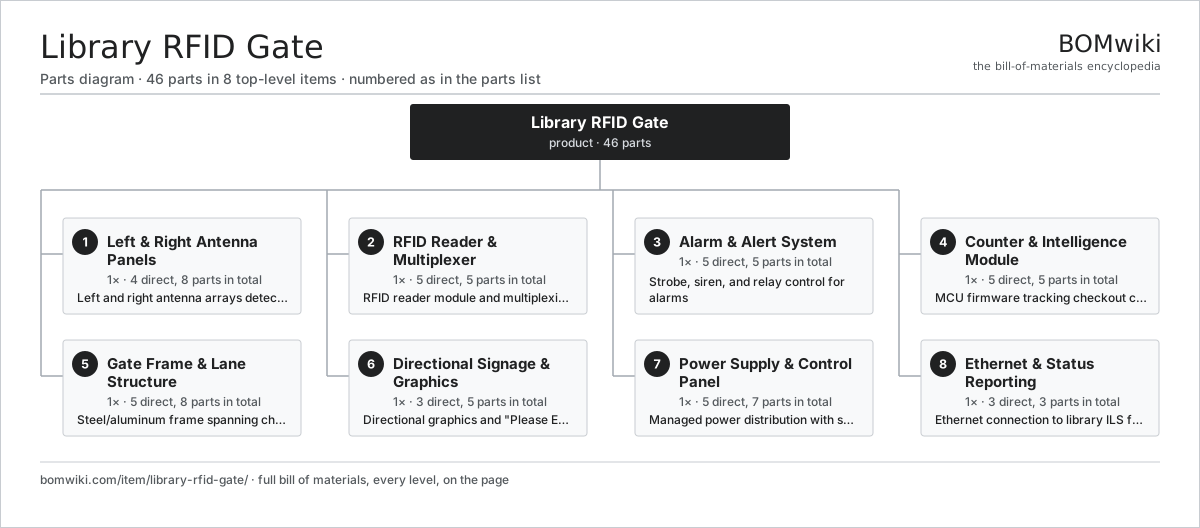
| # | Part | Qty | What it does |
|---|---|---|---|
| 1 | Left & Right Antenna Panels 4 parts | 1× | Left and right antenna arrays detecting RFID tags |
| 2 | RFID Reader & Multiplexer 5 parts | 1× | RFID reader module and multiplexing circuit |
| 3 | Alarm & Alert System 5 parts | 1× | Strobe, siren, and relay control for alarms |
| 4 | Counter & Intelligence Module 5 parts | 1× | MCU firmware tracking checkout count and traffic |
| 5 | Gate Frame & Lane Structure 5 parts | 1× | Steel/aluminum frame spanning checkout lane width |
| 6 | Directional Signage & Graphics 3 parts | 1× | Directional graphics and "Please Exit Here" messaging |
| 7 | Power Supply & Control Panel 5 parts | 1× | Managed power distribution with surge protection |
| 8 | Ethernet & Status Reporting 3 parts | 1× | Ethernet connection to library ILS for tag status sync |
3D model
No 3D model yet. Have a CAD file of this? Add a 3D model. STL renders right on this page; STEP, FreeCAD, and OpenSCAD sources are welcome too (openly licensed, like all 3D models on BOMwiki).
Build & assembly graph
expand / collapse · shared sub-assemblies converge · links to related products · est. labourTap an assembly to expand/collapse · tap a part to open it · use “Open page” for any node · drag to pan, scroll to zoom.
Bill of materials for Library RFID Gate
8 top-level lines · 43 rows shown · 46 parts total · indented to 3 levels| # | Item / sub-assembly | Part no. | Qty/assy | Ext. qty | Parts | Type |
|---|---|---|---|---|---|---|
| 1 | Left & Right Antenna Panels 4 parts | library-rfid-gate-antenna-panels | 1× | 1 | 8 | assembly |
| 1.1 | Linear Antenna Array | library-rfid-gate-antenna-assembly | 2× | 2 | · | part |
| 1.2 | Antenna Tuning Circuit | library-rfid-gate-antenna-resonator | 2× | 2 | · | part |
| 1.3 | Antenna Faraday Enclosure | library-rfid-gate-antenna-shield | 2× | 2 | · | part |
| 1.4 | Antenna Mounting Bracket | library-rfid-gate-antenna-mount | 2× | 2 | · | part |
| 2 | RFID Reader & Multiplexer 5 parts | library-rfid-gate-reader-electronics | 1× | 1 | 5 | assembly |
| 2.1 | RFID Reader IC Module | library-rfid-gate-reader-module | 1× | 1 | · | part |
| 2.2 | RF Antenna Switch | library-rfid-gate-antenna-multiplexer | 1× | 1 | · | part |
| 2.3 | Reader Control PCB | library-rfid-gate-reader-pcb | 1× | 1 | · | part |
| 2.4 | Impedance Coupling Network | library-rfid-gate-coupling-network | 1× | 1 | · | part |
| 2.5 | SMD Passive (R/C/L) | smd-passives | 1× | 1 | · | part |
| 3 | Alarm & Alert System 5 parts | library-rfid-gate-alarm-system | 1× | 1 | 5 | assembly |
| 3.1 | Piezo Siren | library-rfid-gate-siren | 1× | 1 | · | part |
| 3.2 | LED Strobe Light | library-rfid-gate-strobe-light | 1× | 1 | · | part |
| 3.3 | Relay Driver Module | library-rfid-gate-relay-module | 1× | 1 | · | part |
| 3.4 | Alarm Control PCB | library-rfid-gate-alarm-pcb | 1× | 1 | · | part |
| 3.5 | Solenoid Gate Latch | library-rfid-gate-solenoid-latch | 1× | 1 | · | part |
| 4 | Counter & Intelligence Module 5 parts | library-rfid-gate-counter-logic | 1× | 1 | 5 | assembly |
| 4.1 | MCU Carrier Board | library-rfid-gate-mcu-board | 1× | 1 | · | part |
| 4.2 | Tag Status NVRAM | library-rfid-gate-tag-database | 1× | 1 | · | part |
| 4.3 | Real-Time Clock IC | library-rfid-gate-clock-rtc | 1× | 1 | · | part |
| 4.4 | Logic Control PCB | library-rfid-gate-logic-pcb | 1× | 1 | · | part |
| 4.5 | Encoder | encoder | 1× | 1 | · | part |
| 5 | Gate Frame & Lane Structure 5 parts | library-rfid-gate-lane-structure | 1× | 1 | 8 | assembly |
| 5.1 | Vertical Support Post | library-rfid-gate-vertical-post | 2× | 2 | · | part |
| 5.2 | Horizontal Span Beam | library-rfid-gate-horizontal-beam | 2× | 2 | · | part |
| 5.3 | Base Mounting Platform | library-rfid-gate-base-platform | 1× | 1 | · | part |
| 5.4 | Diagonal Cross Brace | library-rfid-gate-cross-brace | 2× | 2 | · | part |
| 5.5 | Fastener Set | fastener-set | 1× | 1 | · | part |
| 6 | Directional Signage & Graphics 3 parts | library-rfid-gate-signage | 1× | 1 | 5 | assembly |
| 6.1 | Sign Board Panel | library-rfid-gate-sign-panel | 2× | 2 | · | part |
| 6.2 | Sign Mounting Bracket | library-rfid-gate-sign-mount | 2× | 2 | · | part |
| 6.3 | LED Backlight Strip | library-rfid-gate-led-backlight | 1× | 1 | · | part |
| 7 | Power Supply & Control Panel 5 parts | library-rfid-gate-power-control | 1× | 1 | 7 | assembly |
| 7.1 | Multi-Output Power Supply | library-rfid-gate-power-supply | 1× | 1 | · | part |
| 7.2 | Main Power Relay | library-rfid-gate-relay-contactor | 1× | 1 | · | part |
| 7.3 | Status Indicator Light | library-rfid-gate-status-lamp | 3× | 3 | · | part |
| 7.4 | Control Equipment Cabinet | library-rfid-gate-control-enclosure | 1× | 1 | · | part |
| 7.5 | AC Surge Protection | library-rfid-gate-surge-suppressor | 1× | 1 | · | part |
| 8 | Ethernet & Status Reporting 3 parts | library-rfid-gate-network-interface | 1× | 1 | 3 | assembly |
| 8.1 | Ethernet Interface Module | library-rfid-gate-ethernet-module | 1× | 1 | · | part |
| 8.2 | Network Interface PCB | library-rfid-gate-network-pcb | 1× | 1 | · | part |
| 8.3 | Connector | connector | 1× | 1 | · | part |
Something wrong in this list? Report a problem with this BOM.
Related products
same domain, ranked by shared parts Cash Deposit Machine
64 parts · shares 2 with this page
Coin Counting Kiosk
63 parts · shares 2 with this page
Cash Deposit Machine
64 parts · shares 2 with this page
Coin Counting Kiosk
63 parts · shares 2 with this page
 Guillotine Paper Cutter
261 parts · shares 2 with this page
Paper Folding Machine
177 parts · shares 2 with this page
Guillotine Paper Cutter
261 parts · shares 2 with this page
Paper Folding Machine
177 parts · shares 2 with this page
Sourcing: possible vendors
Browse the supplier directory → Prices, MOQ, and lead times are algorithmic estimates, not quotes, and not claims about these companies. Company mappings are curated by keyword; est. price band $50–$15k. How estimates work| Vendor | HQ | Specialty | MOQ | Lead time |
|---|---|---|---|---|
|
🇯🇵Canon
canon.com ↗
|
Tokyo, JP | Imaging & optics | 500 units | 8–12 wks |
|
🇯🇵Ricoh
ricoh.com ↗
|
Tokyo, JP | Office imaging | 500 units | 8–12 wks |
|
🇺🇸Xerox
xerox.com ↗
|
Norwalk, US | Printers & copiers | 500 units | 8–12 wks |
|
🇯🇵Epson
epson.com ↗
|
Suwa, JP | Printers & projectors | 500 units | 8–12 wks |
|
🇯🇵Brother
brother.com ↗
|
Nagoya, JP | Printers & sewing | 500 units | 8–12 wks |
1,099-word article