Life Jacket (PFD)
ProductOverview
A life jacket (or Personal Flotation Device / PFD) is survival equipment that keeps a wearer afloat in water by providing positive buoyancy greater than their body weight. The critical design principle is that the buoyancy force must exceed the wearer's weight in freshwater (specifically, seawater is denser and provides slightly more buoyancy), allowing them to stay at or above the waterline indefinitely while awaiting rescue.
A typical adult human weighs approximately 750 N (75 kg) in air. Water density is 1000 kg/m³, so a 75 kg human displaces 75 liters of water when fully submerged. A human body is slightly less dense than water (contains air in lungs), so even without a life jacket, an unconscious person with lungs filled with air will float at a slight angle. However, conscious swimmers often panic and thrash, preventing efficient flotation, or water enters the mouth during rough seas, causing drowning despite positive buoyancy.
The life jacket provides several critical functions:
Positive buoyancy: The foam core provides 50–70 N of buoyancy (equivalent to 5–7 kg of lift), ensuring the wearer floats even with lungs waterlogged.
High-visibility marking: The reflective tape and bright orange color enable rescue responders to locate the wearer in water from 1+ km away (aerial search) or 100+ meters (boat search).
Signaling capability: The integrated whistle allows the wearer to produce a loud, distinctive signal detectable above wind and wave noise.
Secure fit: The closure straps and buckles keep the jacket on during water entry and swimming, preventing loss.
Buoyancy Calculation & Foam Selection
Archimedes' Principle & Net Buoyancy
The buoyancy force is determined by Archimedes' principle: a body immersed in fluid experiences an upward force equal to the weight of displaced fluid.
Buoyancy force = ρ × g × V
Where:
- ρ = fluid density (freshwater: 1000 kg/m³; saltwater: 1025 kg/m³)
- g = gravitational acceleration (9.81 m/s²)
- V = submerged volume
For a 75 kg human wearing a life jacket:
- Human body volume ≈ 75 liters (humans are slightly less dense than water due to lung air; density ≈ 1.0 kg/L including lungs)
- Life jacket foam volume ≈ 6–8 liters (typical)
- Total submerged volume ≈ 81–83 liters
Buoyancy force = 1000 kg/m³ × 9.81 m/s² × 0.082 m³ ≈ 804 N
Net buoyancy = Buoyancy force - Weight = 804 N - 750 N = 54 N
This 54 N (approximately 5.4 kg-force) is the net upward force, ensuring the wearer floats at the waterline with approximately 5–10 cm of the head above water, allowing breathing.
Foam Material Selection
Life jacket buoyancy foam is closed-cell polyethylene (PE) foam, not open-cell foam. The distinction is critical:
- Closed-cell foam: Individual foam cells are sealed; water cannot penetrate into cell interiors. Even if the outer shell cracks, the foam core remains buoyant indefinitely.
- Open-cell foam: Cells are connected; water gradually penetrates into cells over hours or days, reducing buoyancy.
Closed-cell PE foam (typical density 0.04–0.06 g/cm³) provides approximately 15–20 N of buoyancy per kilogram of foam. A life jacket with 3–4 kg of foam provides 45–80 N of buoyancy, sufficient for a 75 kg adult.
PE foam properties:
- Non-oil-soluble: Exposure to gasoline, diesel, or motor oil does not cause swelling or degradation, unlike some PU or neoprene foams.
- Hydrophobic: PE molecules are nonpolar; water does not dissolve or penetrate the foam matrix.
- UV-sensitive: PE degrades under prolonged UV exposure (loses 10–20% buoyancy after 5+ years of sun exposure). The shell fabric prevents direct sun, protecting foam.
- Temperature-sensitive: PE foam becomes slightly less rigid at elevated temperatures (>60 °C) and more brittle at low temperatures (<-20 °C), but maintains buoyancy across this range.
Fit & Safety
Flotation Orientation
A critical design goal is that the wearer floats with their face upward, enabling breathing. A poorly designed life jacket might float a wearer face-down (buoyancy too high on the back) or face-sideways (uneven buoyancy distribution).
Modern Type III PFDs are designed so that the primary foam mass is distributed across the chest and sides. This orientation creates:
- High buoyancy at the chest: When submerged, the upward force on the chest tilts the wearer's head back (toward the surface), rotating the face upward naturally.
- Lower buoyancy at the lower back: This asymmetry is intentional, preventing a head-first submersion position.
In practice, most wearers experience a slight forward tilt (head back at ~30° angle from vertical), which is acceptable and safe for breathing.
Strap Design & Secure Fit
The closure straps must be tight enough that the jacket does not slip off during water entry or swimming. A loose jacket can shift upward, slipping off the wearer's head, or slide downward, separating from the body.
USCG testing standards specify that straps must prevent jacket movement >5 cm vertically or horizontally during simulated rough water conditions. In practice, this requires:
- Shoulder straps (over the shoulders, tightened to 3–5 cm of slack tolerance)
- Waist strap (cinched around the torso, pulled tight enough that 2 fingers cannot fit between jacket and torso)
- Optional side straps (vertical straps on each side, tightened independently)
Most drowning incidents involving life jackets occur when the jacket is worn loosely or unfastened. A properly fitted and fastened life jacket has a drowning risk <0.1%.
Visibility & Rescue
The reflective tape coverage and base color are critical for rescue operations.
Daytime visibility: International orange (ISO 14726) is the mandated color for maritime rescue equipment. The human eye can detect orange from approximately 1–2 km away in clear conditions. Bright yellow (alternate color) is similarly visible.
Night visibility: The retroreflective tape (3M Scotchlite or equivalent) reflects flashlight beams back to the source. A rescue spotlight at 500 meters can illuminate a life jacket with retroreflective tape from 1+ km away, depending on tape area and intensity.
USCG Type III specifications require minimum 0.1 m² (120 cm²) of retroreflective tape. Modern designs use 0.15–0.20 m² for enhanced nighttime visibility.
Maintenance & Lifespan
A life jacket's effective lifespan is 10+ years if stored and maintained properly:
- Storage: Keep in a cool, dry location (not in direct sunlight). Store uncompressed (do not sit on the jacket); compressed foam loses ~5% buoyancy per year of compression.
- Saltwater use: After saltwater immersion, rinse thoroughly with freshwater (salt deposits accelerate foam degradation) and air-dry completely before storage.
- Damage inspection: Annually inspect for shell cracks, foam compression, or delamination. If >10% buoyancy loss is visible (foam compression, shell damage), retire the jacket.
- Wet storage: Never store a wet jacket; mold will grow within 24–48 hours, degrading foam and lining.
USCG recommends professional inspection every 5 years to certify buoyancy via water displacement test. If the jacket fails to meet buoyancy standards (<50 N for Type III), it must be retired.
Type Classification
Life jackets are classified by USCG Type based on intended use and buoyancy:
- Type I: Offshore use, 22+ lbf buoyancy, turns wearer face-up even unconscious
- Type II: Coastal/boat use, 15.5+ lbf buoyancy, may not turn unconscious wearer face-up
- Type III: General water recreation, 15.5+ lbf buoyancy (this product), comfortable for extended wear
- Type IV: Throwable device (ring buoy), not worn
- Type V: Hybrid/inflatable, minimal bulk for storage
Most recreational water activities (boating, kayaking, water sports) use Type II or Type III. Commercial fishing and offshore work mandate Type I or II. This product is a Type III, suitable for leisure boating, swimming, and water sports where prolonged wear and comfort are important.
Life Jacket (PFD) parts and their functions
8 top-level parts · 28 parts in total · full bill of materials below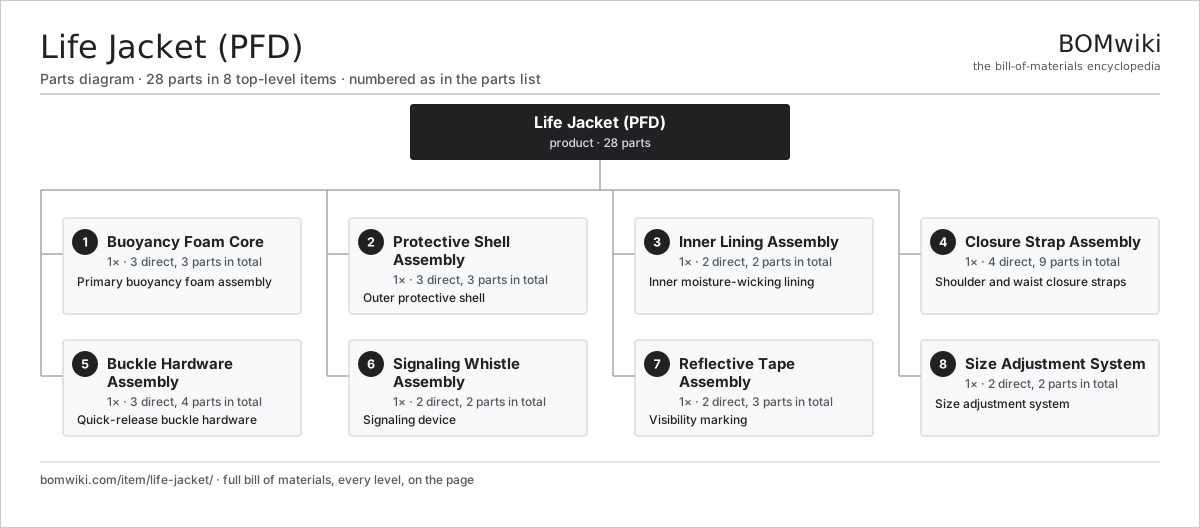
| # | Part | Qty | What it does |
|---|---|---|---|
| 1 | Buoyancy Foam Core 3 parts | 1× | Primary buoyancy foam assembly |
| 2 | Protective Shell Assembly 3 parts | 1× | Outer protective shell |
| 3 | Inner Lining Assembly 2 parts | 1× | Inner moisture-wicking lining |
| 4 | Closure Strap Assembly 4 parts | 1× | Shoulder and waist closure straps |
| 5 | Buckle Hardware Assembly 3 parts | 1× | Quick-release buckle hardware |
| 6 | Signaling Whistle Assembly 2 parts | 1× | Signaling device |
| 7 | Reflective Tape Assembly 2 parts | 1× | Visibility marking |
| 8 | Size Adjustment System 2 parts | 1× | Size adjustment system |
3D model
No 3D model yet. Have a CAD file of this? Add a 3D model. STL renders right on this page; STEP, FreeCAD, and OpenSCAD sources are welcome too (openly licensed, like all 3D models on BOMwiki).
Build & assembly graph
expand / collapse · shared sub-assemblies converge · links to related products · est. labourTap an assembly to expand/collapse · tap a part to open it · use “Open page” for any node · drag to pan, scroll to zoom.
Bill of materials for Life Jacket (PFD)
8 top-level lines · 29 rows shown · 28 parts total · indented to 3 levels| # | Item / sub-assembly | Part no. | Qty/assy | Ext. qty | Parts | Type |
|---|---|---|---|---|---|---|
| 1 | Buoyancy Foam Core 3 parts | life-jacket-foam-core | 1× | 1 | 3 | assembly |
| 1.1 | PE Foam Block | life-jacket-pe-foam-block | 1× | 1 | · | part |
| 1.2 | Foam Adhesive | life-jacket-foam-adhesive | 1× | 1 | · | part |
| 1.3 | Foam Barrier Mesh | life-jacket-foam-cover-panel | 1× | 1 | · | part |
| 2 | Protective Shell Assembly 3 parts | life-jacket-shell-fabric | 1× | 1 | 3 | assembly |
| 2.1 | Shell Fabric | life-jacket-shell-material | 1× | 1 | · | part |
| 2.2 | Reinforced Seams | life-jacket-shell-seams | 1× | 1 | · | part |
| 2.3 | Cargo Pocket | life-jacket-shell-pockets | 1× | 1 | · | part |
| 3 | Inner Lining Assembly 2 parts | life-jacket-lining | 1× | 1 | 2 | assembly |
| 3.1 | Lining Fabric | life-jacket-lining-material | 1× | 1 | · | part |
| 3.2 | Lining Padding | life-jacket-lining-padding | 1× | 1 | · | part |
| 4 | Closure Strap Assembly 4 parts | life-jacket-straps | 1× | 1 | 9 | assembly |
| 4.1 | Shoulder Strap | life-jacket-shoulder-strap | 2× | 2 | · | part |
| 4.2 | Waist Strap | life-jacket-waist-strap | 1× | 1 | · | part |
| 4.3 | Side Strap | life-jacket-side-strap | 2× | 2 | · | part |
| 4.4 | Strap Adjuster | life-jacket-strap-adjuster | 4× | 4 | · | part |
| 5 | Buckle Hardware Assembly 3 parts | life-jacket-buckles | 1× | 1 | 4 | assembly |
| 5.1 | Chest Buckle | life-jacket-chest-buckle | 1× | 1 | · | part |
| 5.2 | Waist Buckle | life-jacket-waist-buckle | 1× | 1 | · | part |
| 5.3 | Side Release Clip | life-jacket-side-release | 2× | 2 | · | part |
| 6 | Signaling Whistle Assembly 2 parts | life-jacket-whistle | 1× | 1 | 2 | assembly |
| 6.1 | Whistle | life-jacket-whistle-core | 1× | 1 | · | part |
| 6.2 | Whistle Lanyard | life-jacket-whistle-lanyard | 1× | 1 | · | part |
| 7 | Reflective Tape Assembly 2 parts | life-jacket-reflective-tape | 1× | 1 | 3 | assembly |
| 7.1 | Reflective Tape Strip | life-jacket-reflective-strip | 2× | 2 | · | part |
| 7.2 | Jacket Base Color | life-jacket-reflective-dye | 1× | 1 | · | part |
| 8 | Size Adjustment System 2 parts | life-jacket-adjustment-panels | 1× | 1 | 2 | assembly |
| 8.1 | Adjustable Foam Insert | life-jacket-foam-insert | 1× | 1 | · | part |
| 8.2 | Panel Slot System | life-jacket-panel-slots | 1× | 1 | · | part |
Something wrong in this list? Report a problem with this BOM.
Sourcing: possible vendors
Browse the supplier directory → Prices, MOQ, and lead times are algorithmic estimates, not quotes, and not claims about these companies. Company mappings are curated by keyword; est. price band $20–$2k. How estimates work| Vendor | HQ | Specialty | MOQ | Lead time |
|---|---|---|---|---|
|
🇺🇸Coleman
coleman.com ↗
|
Chicago, US | Camping gear | 1,000 units | 6–10 wks |
| thenorthface.com ↗ | Denver, US | Outdoor apparel & gear | 1,000 units | 6–10 wks |
|
🇺🇸YETI
yeti.com ↗
|
Austin, US | Coolers & drinkware | 1,000 units | 6–10 wks |
| decathlon.com ↗ | Villeneuve-d'Ascq, FR | Sporting goods | 1,000 units | 6–10 wks |
|
🇺🇸Garmin
garmin.com ↗
|
Olathe, US | GPS & wearables | 1,000 units | 6–10 wks |
1,305-word article