SAD Light Therapy Lamp
ProductOverview
Light therapy lamps are medical-grade light sources designed to treat seasonal affective disorder (SAD), a mood disorder triggered by reduced sunlight exposure during winter months. By delivering 10,000 lux of full-spectrum light, mimicking natural morning daylight, at a safe distance (typically 30 cm), the lamp resets the user's circadian rhythm and suppresses melatonin production, alleviating depression, fatigue, and sleep disruption.
The LED panel assembly contains a high-density array of high-CRI (>95) LEDs specifically tuned to emit across the full visible spectrum: strong blue peaks (460 nm) to maximize circadian photoreceptor sensitivity, deep red (630 nm) for visual comfort, and continuous green and yellow fill for naturalistic color rendering. This high color rendering index is critical, standard cool-white LEDs with CRI 70–80 would appear bleached and cause eye strain during the 20–30 minute daily therapy session.
The LEDs are soldered onto a metal-core PCB, then thermally bonded via conductive interface compound directly to the aluminum enclosure back-plate, which features internal finned heatsink geometry. This direct passive cooling allows the panel to maintain stable lux output even as ambient room temperature fluctuates, a critical requirement for consistent daily therapy dosing.
Light from the LED array is first scattered by a frosted acrylic diffusion layer, eliminating the appearance of discrete LED hot spots. Behind this, a micro-louvre array at 45° angle blocks specular reflections visible from extreme angles, reducing perceived glare while maintaining consistent luminance when viewed straight-on. This optical design prevents the user's pupils from constricting (which would reduce effectiveness), while keeping the perceived brightness comfortable for sustained viewing.
The regulated power supply accepts universal AC input (90–265 VAC), isolates the load from mains, and outputs a stable low-voltage DC rail. The control board with MCU and PWM dimmer allows continuous brightness adjustment from 10 to 100% without flicker, and a programmable timer triggers automatic shutdown after a preset interval (1–60 minutes).
The adjustable stand positions the panel at eye level, 30 cm from the user, the distance at which 10,000 lux (the therapeutic threshold) is reliably delivered. The panel can be tilted and panned, allowing users to position it during breakfast, desk work, or other morning activities while maintaining optimal light exposure.
How it works: Light and circadian biology
The human circadian system is regulated primarily by the suprachiasmatic nucleus (SCN), a tiny cluster of neurons in the hypothalamus that responds to light input from the retina. The SCN contains specialized photoreceptor cells sensitive to blue wavelengths around 460 nm. When exposed to bright light (10,000 lux or greater) in the blue spectrum during morning hours, the SCN suppresses melatonin production from the pineal gland, advancing the circadian phase and promoting wakefulness.
The LED array is specifically engineered to deliver peak irradiance in the 460 nm blue region while maintaining high overall color rendering. The diffusion film scatters this blue-rich light across the 300 × 200 mm to 500 × 300 mm panel area without significant wavelength distortion, ensuring the SCN receives the correct spectral signal. This blue-dominant spectrum is why light therapy lamps differ from ordinary white LEDs: they trade some visual comfort (neutral white 4000 K) for therapeutic efficacy (daylight-spectrum 5700 K with strong blue).
At 10,000 lux, a 20–30 minute exposure session provides adequate photonic dosage to reset circadian timing. Higher lux values (15,000+) can compress session duration to 15 minutes, while lower lux (5000) requires 45–60 minute sessions. The timer feature assists users in maintaining consistency: programming a 30-minute session ensures proper dosing without requiring manual off-switch remembrance.
Optical design and user comfort
Direct exposure to a 10,000 lux light source would cause pupil constriction and visual discomfort, potentially triggering headaches or eye strain. The optics assembly solves this by distributing light evenly across the panel face and eliminating specular reflections.
The diffusion film is an opal acrylic sheet (3–5 mm thick) with a micro-textured surface scattering light through multiple diffraction events. This transforms the discrete point sources of the LEDs into a soft, uniform glow appearing to emanate from the entire panel surface. A follow-up louver array with 3–5 mm fins at 45° blocks rays traveling at shallow angles (>60° from perpendicular), eliminating the specular hot spot visible when viewing the panel from off-angle. This louver design maintains high transmittance for on-axis viewing (~85%) while cutting glare reflections to <5%.
The result is a panel that appears uniformly bright when viewed straight-on (30 cm distance, directly in front of the eyes), but dims dramatically when viewed from the side, preventing reflections from mirrors, windows, or nearby screens from overwhelming the user.
Power supply and regulation
Universal AC input (90–265 VAC, 50–60 Hz) connects to the input bulk capacitor, which absorbs inrush transients and limits startup current surges to <10 A. This soft-start behavior is important: therapy lamps are often plugged into bedroom power strips that may have limited inrush capacity, and exceeding 10 A can trip GFCI or circuit breaker protection.
The supply board feeds the incoming AC to an isolated switch-mode power supply module (typically 30–40 W rating), which steps the voltage down to a stable 24 V or 48 V DC bus. This bus supplies both the LED panel (through the PWM dimmer) and the control MCU logic.
The PWM MOSFET is driven by a 1–100 kHz PWM signal from the MCU, linearly modulating the average current delivered to the LED panel from 10% to 100%. By varying the duty cycle without changing frequency, the panel brightness appears smooth and flicker-free to the human eye (flicker fusion threshold is ~70 Hz; PWM at 100+ kHz is imperceptible). The control board's touch interface allows the user to adjust brightness in 10% increments via capacitive touch buttons or a slider, with the current brightness percentage displayed on the small OLED readout.
Timer and circadian optimization
The MCU's real-time clock tracks elapsed time, allowing the user to program therapy sessions of 1–60 minutes. Once the preset duration expires, the MCU commands the dimmer MOSFET to gradually ramp down the LED current over 2–3 seconds, dimming the panel to off without abrupt blackout. This soft shutdown is more physiologically gentle than an instant on-off, reducing the brief pupil dilation and adaptation stress.
Advanced models support dawn-simulation modes: the MCU progressively increases LED brightness over 15–30 minutes, mimicking a natural sunrise. Studies show that gradual dawn simulation improves sleep-wake transitions and enhances subjective mood compared to instant-on therapy. The Status Display updates the remaining time in real-time, allowing users to read the current session duration at a glance.
Thermal management and lifespan
The LED panel array generates 25–40 W of heat during full-brightness operation. Unlike incandescent or halogen lamp therapy lights (which generated 100+ W of waste heat), LED-based therapy lamps are thermally efficient, but passive cooling is still critical to maintain color consistency and long lifespan.
The aluminum MCPCB substrate directly contacts the aluminum back-plate via conductive TIM, creating a low-thermal-resistance path (~0.5–1 K/W junction to frame back). The back-plate itself features internal finned heatsink geometry, increasing its surface area for convective cooling. Heat dissipates passively from the back and edges of the lamp to the surrounding room air, maintaining LED junction temperatures typically 20–30 K above ambient.
At +25 °C room temperature, LED junctions stabilize around 45–55 °C, well below the 85 °C absolute maximum rating. This thermal headroom extends the LED array lifespan to 40,000+ hours L80 (lumens at 80% of initial output), translating to ~5 years of daily 30-minute use before perceptible dimming occurs. The sealed aluminum enclosure protects the internal PCB and electronics from dust accumulation, which would otherwise degrade thermal conductivity over time.
Safety and standards
Light therapy lamps for SAD treatment must balance efficacy with eye safety. The 10,000 lux specification is just below the threshold for potential phototoxicity (which occurs at >15,000 lux for blue-heavy spectra), and the 30 cm recommended viewing distance ensures that direct-eye irradiance remains within safe limits.
Standards governing light therapy devices include:
- IEC 62471 (photobiological safety of lamps and lamp systems)
- FDA 510(k) (medical device pre-market notification; many therapy lamps are Class II medical devices in North America)
- CE marking (EU conformity for medical devices, typically Class IIa)
- IEC 60601-1 (general requirements for medical electrical equipment)
A properly designed light therapy lamp is used at 30 cm distance, 20–30 minutes daily, preferably in the early morning (6–9 AM). Session timing is critical: therapy in the evening can suppress melatonin at the wrong circadian phase, paradoxically worsening insomnia. Users with bipolar disorder, certain eye conditions (retinal damage, photosensitive epilepsy), or medications increasing light sensitivity (e.g., some psychiatric drugs) should consult a physician before initiating therapy.
SAD Light Therapy Lamp parts and their functions
7 top-level parts · 29 parts in total · full bill of materials below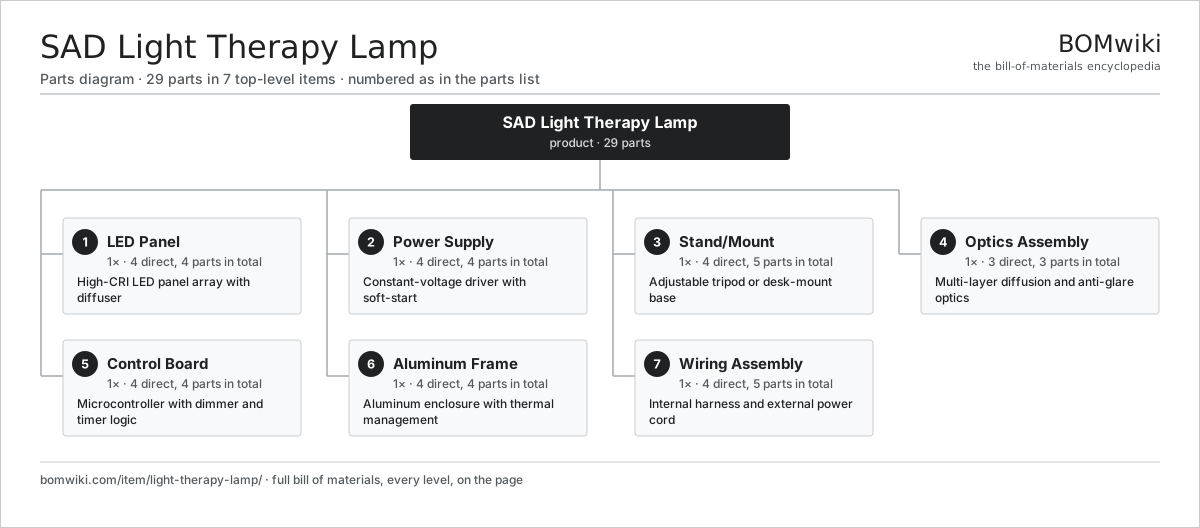
| # | Part | Qty | What it does |
|---|---|---|---|
| 1 | LED Panel 4 parts | 1× | High-CRI LED panel array with diffuser |
| 2 | Power Supply 4 parts | 1× | Constant-voltage driver with soft-start |
| 3 | Stand/Mount 4 parts | 1× | Adjustable tripod or desk-mount base |
| 4 | Optics Assembly 3 parts | 1× | Multi-layer diffusion and anti-glare optics |
| 5 | Control Board 4 parts | 1× | Microcontroller with dimmer and timer logic |
| 6 | Aluminum Frame 4 parts | 1× | Aluminum enclosure with thermal management |
| 7 | Wiring Assembly 4 parts | 1× | Internal harness and external power cord |
3D model
No 3D model yet. Have a CAD file of this? Add a 3D model. STL renders right on this page; STEP, FreeCAD, and OpenSCAD sources are welcome too (openly licensed, like all 3D models on BOMwiki).
Build & assembly graph
expand / collapse · shared sub-assemblies converge · links to related products · est. labourTap an assembly to expand/collapse · tap a part to open it · use “Open page” for any node · drag to pan, scroll to zoom.
Bill of materials for SAD Light Therapy Lamp
7 top-level lines · 34 rows shown · 29 parts total · indented to 3 levels| # | Item / sub-assembly | Part no. | Qty/assy | Ext. qty | Parts | Type |
|---|---|---|---|---|---|---|
| 1 | LED Panel 4 parts | light-therapy-lamp-panel | 1× | 1 | 4 | assembly |
| 1.1 | LED Array | light-therapy-lamp-led-array | 1× | 1 | · | part |
| 1.2 | Panel Substrate | light-therapy-lamp-panel-substrate | 1× | 1 | · | part |
| 1.3 | Current Limiter | light-therapy-lamp-current-limiter | 1× | 1 | · | part |
| 1.4 | Thermal Interface | light-therapy-lamp-thermal-interface | 1× | 1 | · | part |
| 2 | Power Supply 4 parts | light-therapy-lamp-power-supply | 1× | 1 | 4 | assembly |
| 2.1 | Supply PCB | light-therapy-lamp-supply-pcb | 1× | 1 | · | part |
| 2.2 | Power Supply | power-supply | 1× | 1 | · | part |
| 2.3 | Fuse Holder | light-therapy-lamp-fuse-holder | 1× | 1 | · | part |
| 2.4 | Bypass Capacitor | light-therapy-lamp-bypass-cap | 1× | 1 | · | part |
| 3 | Stand/Mount 4 parts | light-therapy-lamp-stand | 1× | 1 | 5 | assembly |
| 3.1 | Base/Clamp | light-therapy-lamp-base-foot | 1× | 1 | · | part |
| 3.2 | Extension Pole | light-therapy-lamp-extension-pole | 1× | 1 | · | part |
| 3.3 | Tilt Joint | light-therapy-lamp-tilt-joint | 1× | 1 | · | part |
| 3.4 | Grip Pads | light-therapy-lamp-grip-pad | 2× | 2 | · | part |
| 4 | Optics Assembly 3 parts | light-therapy-lamp-optics | 1× | 1 | 3 | assembly |
| 4.1 | Diffusion Film | light-therapy-lamp-diffusion-film | 1× | 1 | · | part |
| 4.2 | Anti-Glare Louver | light-therapy-lamp-anti-glare-louver | 1× | 1 | · | part |
| 4.3 | Lens Frame | light-therapy-lamp-lens-frame | 1× | 1 | · | part |
| 5 | Control Board 4 parts | light-therapy-lamp-control-board | 1× | 1 | 4 | assembly |
| 5.1 | MCU Board | light-therapy-lamp-mcu-board | 1× | 1 | · | part |
| 5.2 | Dimmer MOSFET | light-therapy-lamp-dimmer-mosfet | 1× | 1 | · | part |
| 5.3 | Touch Interface | light-therapy-lamp-touch-sensor | 1× | 1 | · | part |
| 5.4 | Status Display | light-therapy-lamp-status-display | 1× | 1 | · | part |
| 6 | Aluminum Frame 4 parts | light-therapy-lamp-frame | 1× | 1 | 4 | assembly |
| 6.1 | Back Plate | light-therapy-lamp-back-plate | 1× | 1 | · | part |
| 6.2 | Side Rails | light-therapy-lamp-side-rails | 1× | 1 | · | part |
| 6.3 | Mounting Boss | light-therapy-lamp-mounting-boss | 1× | 1 | · | part |
| 6.4 | Fastener Set | fastener-set | 1× | 1 | · | part |
| 7 | Wiring Assembly 4 parts | light-therapy-lamp-wiring | 1× | 1 | 5 | assembly |
| 7.1 | Internal Harness | light-therapy-lamp-internal-harness | 1× | 1 | · | part |
| 7.2 | External Power Cord | light-therapy-lamp-external-cord | 1× | 1 | · | part |
| 7.3 | Connector | connector | 2× | 2 | · | part |
| 7.4 | Cord Retention | light-therapy-lamp-cord-retention | 1× | 1 | · | part |
Something wrong in this list? Report a problem with this BOM.
Related products
same domain, ranked by shared parts Aviation Obstruction Light
192 parts · shares 1 with this page
Canopy Light
26 parts · shares 1 with this page
Cleanroom Luminaire
22 parts · shares 1 with this page
Explosion-Proof Light Fixture
31 parts · shares 1 with this page
Aviation Obstruction Light
192 parts · shares 1 with this page
Canopy Light
26 parts · shares 1 with this page
Cleanroom Luminaire
22 parts · shares 1 with this page
Explosion-Proof Light Fixture
31 parts · shares 1 with this page
 Heliport Beacon
39 parts · shares 1 with this page
Industrial UV Curing Lamp
300 parts · shares 1 with this page
Heliport Beacon
39 parts · shares 1 with this page
Industrial UV Curing Lamp
300 parts · shares 1 with this page
Sourcing: possible vendors
Browse the supplier directory → Prices, MOQ, and lead times are algorithmic estimates, not quotes, and not claims about these companies. Company mappings are curated by keyword; est. price band $3–$2k. How estimates work| Vendor | HQ | Specialty | MOQ | Lead time |
|---|---|---|---|---|
|
🇳🇱Signify
signify.com ↗
|
Eindhoven, NL | Lighting (Philips Hue) | 2,000 units | 6–10 wks |
| acuitybrands.com ↗ | Atlanta, US | Lighting & controls | 2,000 units | 6–10 wks |
|
🇦🇹Zumtobel
zumtobelgroup.com ↗
|
Dornbirn, AT | Lighting | 2,000 units | 6–10 wks |
| creelighting.com ↗ | Racine, US | LED lighting | 2,000 units | 6–10 wks |
|
🇮🇳Havells
havells.com ↗
|
Noida, IN | Electrical & lighting | 2,000 units | 6–10 wks |
1,698-word article