Indirect Line Heater
ProductOverview
Gas leaving a high-pressure wellhead has to be cut down to gathering-line pressure, and that pressure cut comes with a hidden penalty: Joule-Thomson cooling. Natural gas chills roughly 4–5 °C for every 1,000 psi of pressure drop, so choking a 6,000 psi well down to 1,000 psi can pull the gas 25 °C below its inlet temperature. Combine that chill with the water vapor the gas carries and methane hydrates form, crystalline ice-like plugs that can block a choke or flowline solid in minutes. The indirect line heater exists to defeat this: it warms the gas before and between pressure cuts so the stream never falls into the hydrate region. It is among the most common pieces of equipment on high-pressure gas wells, particularly in winter operations.
"Indirect" describes the heat path. The flame never touches the process pipe. The Main Burner fires into a Fire U-Tube immersed in a bath of water and glycol, the bath stores and spreads the heat, and the high-pressure gas picks it up while flowing through the immersed Process Coil Bundle. The bath's thermal mass smooths out burner cycling, holds the coil surface temperature at a level that cannot crack or coke the fluid, and keeps every ignition source isolated from the wellstream.
How it works
Well fluid enters the Coil Header and snakes through the Coil Pass runs, seamless extra-heavy pipe rated to full shut-in wellhead pressure, joined by forged Return Bend fittings. The first passes preheat the gas at full pressure. Then comes the heater's defining trick: the pressure-reducing Choke Section is plumbed into the middle of the coil, inside the vessel, so the Joule-Thomson temperature crash happens at the point of maximum heat input. A typical arrangement preheats the gas to 60–70 °C, takes the first cut across a Choke Bean, lets the chilled stream rewarm through more passes, takes a second cut, and reheats again before the outlet. Splitting the drop across two stages halves the cooling at each step and keeps the minimum metal temperature comfortably above hydrate formation, which for a typical gas at 1,000 psi sits near 15–18 °C.
The beans themselves are replaceable carbide orifices reached through the Choke Bonnet without pulling the coil; operators change them seasonally as reservoir pressure declines or rates change. Pressure Sensor taps at the coil inlet and outlet and a Dial Thermometer on the gas outlet confirm the heater is winning against the JT effect.
Bath and combustion
The bath is plain water mixed with 30–50 % ethylene glycol so an unattended heater cannot freeze during a burner outage. The Heater Shell is atmospheric, boiling sets the absolute temperature ceiling, and the Expansion Section gives the bath room to swell the several percent it gains between cold fill and 85 °C operation. Bath level matters more than it looks: the Bath Level Gauge must show both the fire tube and coil submerged, because an exposed fire tube overheats within minutes. The Low-Level Switch enforces this by cutting fuel automatically.
Combustion is deliberately simple, since most line heaters run unattended on unpowered sites. A slipstream of the heated sales gas drops through the Fuel Gas Scrubber and two stages of Fuel Regulator to feed an inspirating natural-draft burner, no fan, no electricity. The Pilot Burner proves itself with a thermocouple before the Bath Thermostat is allowed to open the main fuel valve, and the burner cycles on-off or high-low to hold the bath near its setpoint. The Flame Arrestor on the combustion air intake and the Stack Arrestor on the Exhaust Stack keep the flame contained from the hazardous area around it, and the High-Temperature Switch backs up the thermostat against a stuck fuel valve.
Heat flux on the fire tube is held near 10 kW/m², conservative on purpose. Produced water occasionally carried into the bath, plus the bath's own hardness, scales the tube over years; low flux means a scaled tube degrades efficiency before it fails. The Fire Tube Flange and the Hammer Union connections on the coil let both bundles be pulled for inspection, the coil being subject to wall-thickness checks since it is the only pressure-containing element exposed to erosive wellstream flow.
Application and sizing
Sizing balances three numbers: gas rate, total pressure cut, and the coldest ambient day. The duty is the heat needed to keep outlet temperature above the hydrate curve after all JT cooling, typically 15–30 Btu per Mscf per psi of drop; a 10 MMscfd well taking a 4,000 psi cut lands in the 1–2 MMBtu/h class. Beyond wellhead service, the same units heat gas ahead of city-gate regulator stations and warm viscous crude at transfer points. Where line power exists, electric immersion or heat-medium designs replace the fire tube, but on a remote pad the gas-fired water bath remains the default because its entire energy and control system is the well itself.
Indirect Line Heater parts and their functions
7 top-level parts · 72 parts in total · full bill of materials below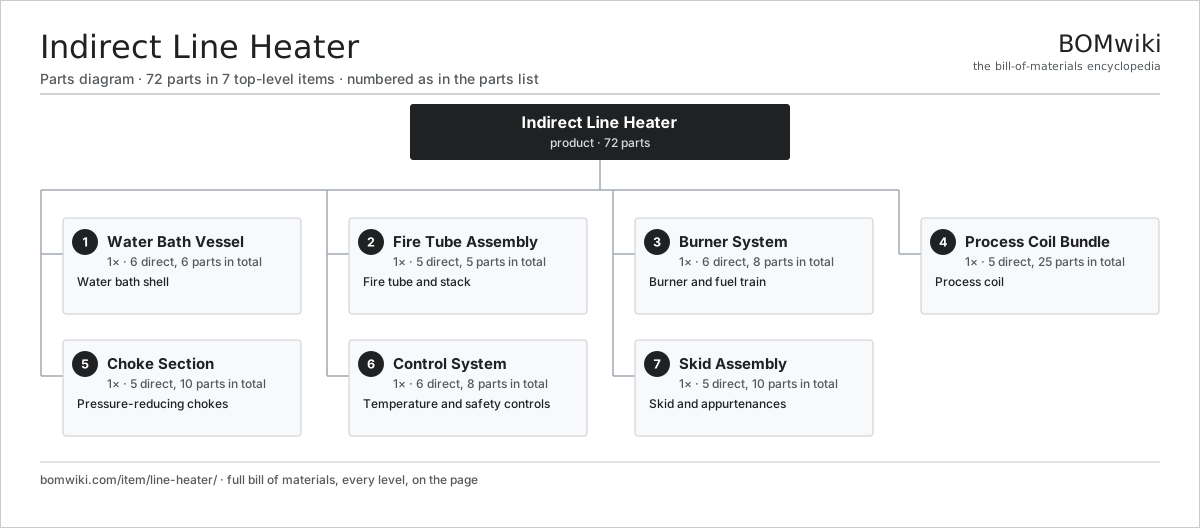
| # | Part | Qty | What it does |
|---|---|---|---|
| 1 | Water Bath Vessel 6 parts | 1× | Water bath shell |
| 2 | Fire Tube Assembly 5 parts | 1× | Fire tube and stack |
| 3 | Burner System 6 parts | 1× | Burner and fuel train |
| 4 | Process Coil Bundle 5 parts | 1× | Process coil |
| 5 | Choke Section 5 parts | 1× | Pressure-reducing chokes |
| 6 | Control System 6 parts | 1× | Temperature and safety controls |
| 7 | Skid Assembly 5 parts | 1× | Skid and appurtenances |
3D model
No 3D model yet. Have a CAD file of this? Add a 3D model. STL renders right on this page; STEP, FreeCAD, and OpenSCAD sources are welcome too (openly licensed, like all 3D models on BOMwiki).
Build & assembly graph
expand / collapse · shared sub-assemblies converge · links to related products · est. labourTap an assembly to expand/collapse · tap a part to open it · use “Open page” for any node · drag to pan, scroll to zoom.
Bill of materials for Indirect Line Heater
7 top-level lines · 45 rows shown · 72 parts total · indented to 3 levels| # | Item / sub-assembly | Part no. | Qty/assy | Ext. qty | Parts | Type |
|---|---|---|---|---|---|---|
| 1 | Water Bath Vessel 6 parts | line-heater-vessel | 1× | 1 | 6 | assembly |
| 1.1 | Heater Shell | line-heater-shell | 1× | 1 | · | part |
| 1.2 | Expansion Section | line-heater-expansion-section | 1× | 1 | · | part |
| 1.3 | Fill Hatch | line-heater-fill-hatch | 1× | 1 | · | part |
| 1.4 | Bath Level Gauge | line-heater-level-gauge | 1× | 1 | · | part |
| 1.5 | Drain Valve | line-heater-drain-valve | 1× | 1 | · | part |
| 1.6 | Shell Insulation | line-heater-insulation | 1× | 1 | · | part |
| 2 | Fire Tube Assembly 5 parts | line-heater-firetube | 1× | 1 | 5 | assembly |
| 2.1 | Fire U-Tube | line-heater-utube | 1× | 1 | · | part |
| 2.2 | Fire Tube Flange | line-heater-firetube-flange | 1× | 1 | · | part |
| 2.3 | Exhaust Stack | line-heater-stack | 1× | 1 | · | part |
| 2.4 | Stack Arrestor | line-heater-stack-arrestor | 1× | 1 | · | part |
| 2.5 | O-Ring Set | oring-set | 1× | 1 | · | part |
| 3 | Burner System 6 parts | line-heater-burner-system | 1× | 1 | 8 | assembly |
| 3.1 | Main Burner | line-heater-main-burner | 1× | 1 | · | part |
| 3.2 | Pilot Burner | line-heater-pilot | 1× | 1 | · | part |
| 3.3 | Fuel Gas Scrubber | line-heater-fuel-scrubber | 1× | 1 | · | part |
| 3.4 | Fuel Regulator | line-heater-fuel-regulator | 2× | 2 | · | part |
| 3.5 | Flame Arrestor | line-heater-flame-arrestor | 1× | 1 | · | part |
| 3.6 | Relay | relay | 2× | 2 | · | part |
| 4 | Process Coil Bundle 5 parts | line-heater-coil-bundle | 1× | 1 | 25 | assembly |
| 4.1 | Coil Pass | line-heater-coil-pass | 8× | 8 | · | part |
| 4.2 | Return Bend | line-heater-return-bend | 7× | 7 | · | part |
| 4.3 | Coil Header | line-heater-coil-header | 2× | 2 | · | part |
| 4.4 | Coil Support | line-heater-coil-support | 4× | 4 | · | part |
| 4.5 | Hammer Union | line-heater-plug-union | 4× | 4 | · | part |
| 5 | Choke Section 5 parts | line-heater-choke-section | 1× | 1 | 10 | assembly |
| 5.1 | Choke Body | line-heater-choke-body | 2× | 2 | · | part |
| 5.2 | Choke Bean | line-heater-choke-bean | 2× | 2 | · | part |
| 5.3 | Choke Bonnet | line-heater-choke-bonnet | 2× | 2 | · | part |
| 5.4 | O-Ring Set | oring-set | 2× | 2 | · | part |
| 5.5 | Fastener Set | fastener-set | 2× | 2 | · | part |
| 6 | Control System 6 parts | line-heater-controls | 1× | 1 | 8 | assembly |
| 6.1 | Bath Thermostat | line-heater-thermostat | 1× | 1 | · | part |
| 6.2 | High-Temperature Switch | line-heater-high-temp-switch | 1× | 1 | · | part |
| 6.3 | Low-Level Switch | line-heater-low-level-switch | 1× | 1 | · | part |
| 6.4 | Dial Thermometer | line-heater-thermometer | 2× | 2 | · | part |
| 6.5 | Pressure Sensor | pressure-sensor | 2× | 2 | · | part |
| 6.6 | Wire Bundle | wire-bundle | 1× | 1 | · | part |
| 7 | Skid Assembly 5 parts | line-heater-skid | 1× | 1 | 10 | assembly |
| 7.1 | Skid Frame | line-heater-skid-frame | 1× | 1 | · | part |
| 7.2 | Vessel Saddle | line-heater-saddle | 2× | 2 | · | part |
| 7.3 | Lifting Lug | line-heater-lifting-lug | 4× | 4 | · | part |
| 7.4 | Sheet Metal Panel | sheet-panel | 1× | 1 | · | part |
| 7.5 | Fastener Set | fastener-set | 2× | 2 | · | part |
Something wrong in this list? Report a problem with this BOM.
Related products
same domain, ranked by shared parts Amine Gas Sweetening Unit
3,543 parts · shares 1 with this page
Choke Manifold
179 parts · shares 1 with this page
CO2 Injection Pump
463 parts · shares 1 with this page
Amine Gas Sweetening Unit
3,543 parts · shares 1 with this page
Choke Manifold
179 parts · shares 1 with this page
CO2 Injection Pump
463 parts · shares 1 with this page
 Condensate Stabilizer Column
2,234 parts · shares 1 with this page
Condensate Stabilizer Column
2,234 parts · shares 1 with this page
 Delayed Coker Drum
208 parts · shares 1 with this page
Delayed Coker Drum
208 parts · shares 1 with this page
 Drilling Mud Degasser
154 parts · shares 1 with this page
Drilling Mud Degasser
154 parts · shares 1 with this page
Sourcing: possible vendors
Browse the supplier directory → Prices, MOQ, and lead times are algorithmic estimates, not quotes, and not claims about these companies. Company mappings are curated by keyword; est. price band $10k–$50M. How estimates work| Vendor | HQ | Specialty | MOQ | Lead time |
|---|---|---|---|---|
|
🇺🇸SLB
slb.com ↗
|
Houston, US | Oilfield services & equipment | made to order | 24–48 wks |
| halliburton.com ↗ | Houston, US | Oilfield services | made to order | 24–48 wks |
| bakerhughes.com ↗ | Houston, US | Energy technology | made to order | 24–48 wks |
|
🇺🇸NOV
nov.com ↗
|
Houston, US | Drilling equipment | made to order | 24–48 wks |
| technipfmc.com ↗ | London, GB | Subsea & surface systems | made to order | 24–48 wks |
883-word article