Linkspan Ramp
ProductOverview
The linkspan ramp (or vehicle ramp, or ro-ro ramp) is a semi-fixed quayside system enabling the rapid boarding and disembarking of wheeled vehicles (cars, trucks, trailers) from roll-on/roll-off (ro-ro) cargo vessels. Unlike passive ramps that remain at fixed angles, the linkspan is hydraulically or pneumatically leveled to adjust for tidal variation, vessel draft changes, and cargo loading conditions, ensuring the ramp remains approximately horizontal as the vessel rises and falls or settles deeper in the water.
Linkspans are essential infrastructure at ro-ro terminals and vehicle ports, where dozens of trucks per hour must traverse the ramp in both directions. The system combines structural rigidity (to support heavy vehicle loads), flexibility (articulating spandrel structure), and precision control (hydraulic leveling) to maintain safe, level access regardless of environmental conditions.
How It Works
A ro-ro vessel approaches the quay and ties up alongside the linkspan location. The ship's hold contains hundreds of vehicles parked on internal deck plates. The linkspan begins in a horizontal or slightly angled position on the quay.
The shore-side operator, monitoring the Height Sensor position feedback, observes the vessel's vertical location relative to the quay. As the vessel settles and shifts due to tidal changes, cargo loading, or wind, the Height Sensor detects the change in ramp height relative to the ship's deck opening.
The operator initiates Proportional Valve control via the Operator Pendant remote, adjusting the hydraulic pressure directed to the Lift Cylinders. The cylinders extend or retract slightly, raising or lowering the ramp. The Main Ramp Structure (the deck) tilts about the Deck Hinge Point, which acts as the pivoting fulcrum. The Spandrel Beams below the ramp articulate, changing angle to support the new ramp elevation.
As the ramp tilts, the Rubber Bumpers (large elastomer pads at the ramp tip) compress or relax against the vessel's rail or opening edge, cushioning the contact and absorbing small impact loads as vehicles drive across. The Weather Seal System (flexible rubber gasket) compresses against the vessel opening, sealing the gap between the ramp and ship to prevent cargo or liquids from spilling into the quay.
Once the ramp is properly positioned (horizontally level, typically within ±2–3 degrees), the linkspan is ready for vehicle traffic. A vehicle driver approaches from the quay, drives onto the ramp, crosses safely (with side guidance from Wheel Guide Rails and handholds from Handrails), and drives into the vessel's hold. Other vehicles follow in sequence. When all vehicles are loaded, the process reverses: vehicles drive off the vessel, down the ramp, and onto the quay.
As the ship rises (due to ballast discharge during loading) or sinks (due to ballast intake), the Height Sensor continuously feeds position data to the PLC Controller, which automatically adjusts Proportional Valve pressure to maintain the ramp level. This automatic compensation eliminates the need for manual operator intervention during the loading sequence.
When loading is complete, the operator retracts the lift cylinders, lowering the ramp back to its stowed position. The ramp rests on the quay, and the linkspan is ready for the next vessel.
Subsystems
Main Ramp Structure
The Main Ramp Structure is the primary load-bearing deck. The Ramp Deck Plating (steel plate or steel-and-rubber composite, 25–30mm thick) forms the vehicle-traveling surface, with welded traction ribs or open-grip design preventing tire slip. The Ramp Stringers (three heavy steel I-beams or box sections, typically 60–80cm deep) run longitudinally, forming the primary load path. The Ramp Cross-Members (transverse beams welded to stringers) distribute vehicle wheel loads laterally.
The Wheel Guide Rails (steel channel or angle rails, 15–20cm height) line both sides of the ramp, laterally constraining vehicle wheels and preventing accidental drive-off. The Ramp Edge Beam (reinforced at the free edge) provides additional rigidity and edge containment. Total ramp width is typically 8–12 meters, accommodating two vehicle lanes or one large semi-trailer.
Typical design load is 60 tonnes per axle (vehicle weight distributed across four wheels or dual-axle configuration), ensuring safe passage of heavy trucks and trailers. Ramp length is 10–25 meters (typically 15–20m), sufficient to span the horizontal distance from quay edge to vessel deck opening.
Lift Cylinders
The Lift Cylinders (two large double-acting hydraulic cylinders, bore 20–30cm) provide vertical height adjustment. The Cylinder Base Mount (trunnion or pin-joint bracket) fixes the cylinder base to the quay foundation or to a fixed support structure. The Cylinder Rod Mount (clevis or pin bracket on the cylinder rod end) attaches to the ramp structure.
As the cylinders extend, the ramp is pushed upward; as they retract, the ramp lowers. Height adjustment range is typically ±1.5–3.0 meters, compensating for tidal variation (typically 2–3 meters in most ports) and vessel draft changes. The Pressure Hose supplies high-pressure hydraulic fluid from the proportional control valve.
Spandrel Beam Structure
The Spandrel Beams (two heavy steel box sections, 40–60cm deep) provide structural support beneath the ramp, articulating at the Deck Hinge Point. The Spandrel Box Beams extends from the hinge point (at the quay edge) to the ramp, a span of 8–15 meters. The Spandrel Cross Bracing (diagonal struts or X-bracing) prevents lateral racking and provides torsional rigidity.
As the ramp lifts, the spandrel angle changes (tilting upward from its base). The End Stop Device (mechanical bumper or wedge) limits the spandrel motion near horizontal position, preventing over-extension. This hinged structure is critical: it allows the entire ramp to rise and fall while maintaining structural support and constraining movement to the vertical axis.
Hinge and Articulation
The Deck Hinge Point is the pivot axis where the ramp and spandrel articulate. The Hinge Bearing (large roller or ball bearing, similar to a slew ring bearing) supports the combined load of the ramp, vehicles, and dynamic loads. The Hinge Pin Assembly (large-diameter steel pin with precision machining and integral sealing) allows smooth rotation without binding.
The Hinge Cover Plate (steel guard) protects the bearing from damage and debris, and prevents personnel from accessing pinch points. The Hinge Lubrication (grease fittings and internal channels) ensures the bearing remains lubricated, extending its life. Regular greasing is essential; bearing life is typically 10–15 years with proper maintenance.
Rubber Bumpers
The Rubber Bumpers (large elastomer pads, one on each side of the ramp tip, typically 10–15cm thick) cushion the contact between the ramp and the vessel's rail or opening edge. The Bumper Rubber Pad is typically natural rubber or polyurethane, chosen for resilience and durability in marine environments. The Bumper Steel Backing (50–75mm thick steel channel or plate) is bonded to the rubber, distributing impact loads across the ramp edge beam.
As the vessel rises or falls and the ramp adjusts height, the rubber bumpers compress and relax, absorbing small impacts from vehicle vibration or vessel motion. The Bumper Shims (tapered steel shims) allow gradual height compensation as the rubber wears, extending bumper life before replacement (typically every 3–5 years).
Weather Seal
The Weather Seal System is a flexible gasket system sealing the gap between the ramp tip and the vessel opening, preventing cargo spillage and water/weather ingress. The Seal Rubber Profile (elastomer profile, typically EPDM or natural rubber, 15–20cm tall) compresses against the vessel edge as the ramp is brought into position. The compression force is typically 20–50 kPa (gentle enough not to damage the vessel, yet sufficient to seal the gap).
The Seal Mounting Frame (steel angle or channel) supports the rubber profile. The Seal Guide Channels (aluminum or steel channels) guide the seal frame as the ramp rises and falls, maintaining alignment. The Cleaning Brush (nylon brush on the moving seal) dislodges debris (dirt, ice, salt) from the seal surface during ramp motion, maintaining seal effectiveness.
Handrails
The Handrails provide safety and guidance for personnel and vehicle operators. The Handrail Posts (steel tube, 5–8cm diameter) are spaced 1.5–2.0m apart along both sides of the ramp. The Handrail Tubes (3–4cm diameter horizontal tubes) are positioned at 100–110cm height (upper handrail) and 50cm height (lower safety rail), meeting international safety standards (typically ISO 1435 or equivalent).
The Handrail End Cap (terminal cap at the ramp tip) has smooth geometry preventing snagging. The Handrail Fasteners (bolted or welded connections) secure the railings to the ramp deck and to each other. While ro-ro vehicles do not require handrail contact for egress (vehicles drive themselves off), the railings provide pedestrian safety if crew members walk across the ramp.
Hydraulic System
The Hydraulic System powers the height adjustment. The Hydraulic Pump (variable-displacement pump, 30–60 LPM at 250 bar) is driven by the Pump Drive Motor (electric motor, 20–40 kW, or small diesel engine). The pump supplies pressure to the Proportional Valve (proportional spool valve), which distributes flow to the lift cylinders based on the operator's command via the pendant or the PLC's automatic control signal.
The Hydraulic Reservoir (200–400 liters) provides fluid storage with integral return filtration and suction strainer. The Relief Valve (set at 250–280 bar) protects the system from overpressure. The Hose Distribution (SAE-rated hoses with quick-disconnect couplers) routes hydraulic pressure to the lift cylinders and back to tank.
Control System
The Control System automates ramp height management. The Height Sensor (linear transducer or string potentiometer) continuously measures the vertical position of the ramp. The Pressure Transducer (electronic sensor) monitors hydraulic pressure in the lift cylinders, providing load feedback.
The PLC Controller (programmable logic controller) compares the measured height against a setpoint (target height, typically 0cm, meaning perfectly level with the vessel deck). If the ramp drifts above or below setpoint, the controller adjusts the Proportional Valve to raise or lower the ramp automatically, maintaining level position even as the vessel moves.
The Operator Pendant (wireless or hardwired remote control) allows manual height adjustment if needed (e.g., to compensate for unusual vessel configurations). The Emergency Lower Valve (solenoid-actuated proportional valve) provides controlled descent in case of power loss, allowing personnel to safely lower the ramp.
The Level Alarm System (audible and visual alarm) alerts operators if the ramp height exceeds safe limits (typically ±15 degrees from horizontal), indicating a dangerous approach angle that could damage vehicles or cause accidents.
Performance and Operational Characteristics
Linkspans enable rapid vehicle throughput: with proper traffic control, vehicles can traverse the ramp at 30–60 second intervals, achieving 60–120 vehicles per hour per ramp. A typical ro-ro vessel (3000–5000 vehicles capacity) can be fully loaded or discharged in 6–20 hours depending on size and terminal efficiency.
Ramp positioning is critical: vehicles are sensitive to excessive approach angle. Most vehicle operators will not attempt to drive at angles exceeding ±10 degrees; slopes greater than ±15 degrees risk cargo shift and vehicle stability. Automatic PLC control maintains level positioning within ±2–3 degrees, providing safe operation.
Maintenance is rigorous: hydraulic fluid sampling every 6 months, oil changes every 500–1000 operating hours, filter replacements annually, cylinder seal kits replaced every 5 years, bearing greasing every 3–6 months, and rubber bumper and seal inspections quarterly. Weather seals are replaced every 3–5 years depending on wear and environmental exposure.
Environmental factors significantly impact linkspan operation: high winds (exceeding 15–20 m/s) may prevent vehicle operations due to lateral ramp movement and vehicle sway risk. Heavy rain or snow requires careful vehicle speed management. Icing conditions require either heating elements in the ramp surface or operational suspension until conditions improve. Salt spray corrosion (in coastal environments) necessitates protective coatings and regular maintenance inspections.
Modern linkspans integrate telematics: height sensors feed data to port traffic management systems, allowing real-time adjustment of vehicle loading sequences to maintain optimal ramp angle. Some installations include load cells measuring vehicle axle loads, providing data for cargo documentation and weight verification.
The linkspan represents a balance between fixed and mobile equipment: unlike mobile ramps (which can be repositioned), linkspans are permanent installations, more robust and lower-cost to operate. Unlike passive fixed ramps, linkspans actively adapt to environmental change via hydraulic leveling, providing safe, level access regardless of tide or vessel condition. This balance makes them the standard solution at high-volume ro-ro terminals worldwide.
Linkspan Ramp parts and their functions
9 top-level parts · 86 parts in total · full bill of materials below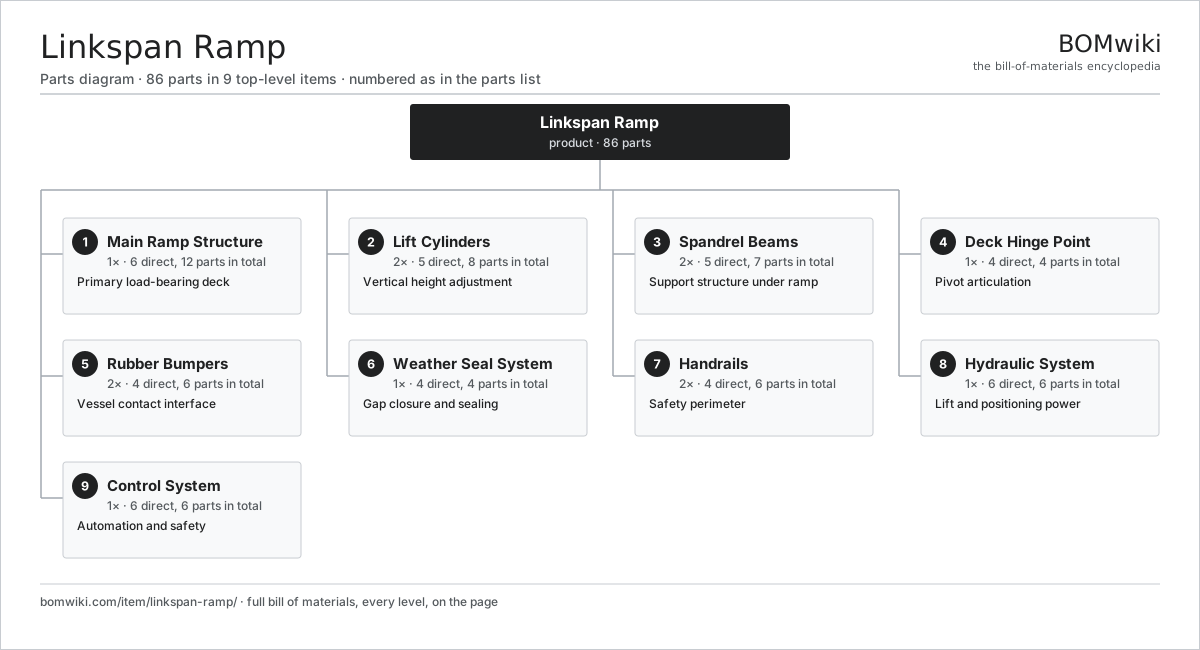
| # | Part | Qty | What it does |
|---|---|---|---|
| 1 | Main Ramp Structure 6 parts | 1× | Primary load-bearing deck |
| 2 | Lift Cylinders 5 parts | 2× | Vertical height adjustment |
| 3 | Spandrel Beams 5 parts | 2× | Support structure under ramp |
| 4 | Deck Hinge Point 4 parts | 1× | Pivot articulation |
| 5 | Rubber Bumpers 4 parts | 2× | Vessel contact interface |
| 6 | Weather Seal System 4 parts | 1× | Gap closure and sealing |
| 7 | Handrails 4 parts | 2× | Safety perimeter |
| 8 | Hydraulic System 6 parts | 1× | Lift and positioning power |
| 9 | Control System 6 parts | 1× | Automation and safety |
3D model
No 3D model yet. Have a CAD file of this? Add a 3D model. STL renders right on this page; STEP, FreeCAD, and OpenSCAD sources are welcome too (openly licensed, like all 3D models on BOMwiki).
Build & assembly graph
expand / collapse · shared sub-assemblies converge · links to related products · est. labourTap an assembly to expand/collapse · tap a part to open it · use “Open page” for any node · drag to pan, scroll to zoom.
Bill of materials for Linkspan Ramp
9 top-level lines · 53 rows shown · 86 parts total · indented to 3 levels| # | Item / sub-assembly | Part no. | Qty/assy | Ext. qty | Parts | Type |
|---|---|---|---|---|---|---|
| 1 | Main Ramp Structure 6 parts | linkspan-main-ramp-structure | 1× | 1 | 12 | assembly |
| 1.1 | Ramp Deck Plating | linkspan-ramp-deck-plating | 1× | 1 | · | part |
| 1.2 | Ramp Stringers | linkspan-ramp-stringers | 3× | 3 | · | part |
| 1.3 | Ramp Cross-Members | linkspan-ramp-crossmembers | 2× | 2 | · | part |
| 1.4 | Wheel Guide Rails | linkspan-wheel-guide-rails | 2× | 2 | · | part |
| 1.5 | Ramp Edge Beam | linkspan-ramp-edge-beam | 1× | 1 | · | part |
| 1.6 | Fastener Set | fastener-set | 3× | 3 | · | part |
| 2 | Lift Cylinders 5 parts | linkspan-lift-cylinders | 2× | 2 | 8 | assembly |
| 2.1 | Double-Acting Cylinder | linkspan-cyl-double-acting | 2× | 4 | · | part |
| 2.2 | Cylinder Base Mount | linkspan-cyl-base-mount | 2× | 4 | · | part |
| 2.3 | Cylinder Rod Mount | linkspan-cyl-rod-mount | 2× | 4 | · | part |
| 2.4 | Pressure Hose | linkspan-cyl-pressure-hose | 1× | 2 | · | part |
| 2.5 | O-Ring Set | oring-set | 1× | 2 | · | part |
| 3 | Spandrel Beams 5 parts | linkspan-spandrel-beams | 2× | 2 | 7 | assembly |
| 3.1 | Spandrel Box Beams | linkspan-spandrel-box-beam | 2× | 4 | · | part |
| 3.2 | Spandrel Cross Bracing | linkspan-spandrel-cross-bracing | 1× | 2 | · | part |
| 3.3 | Spandrel Hinge Pin | linkspan-spandrel-hinge-pin | 1× | 2 | · | part |
| 3.4 | End Stop Device | linkspan-spandrel-end-stop | 1× | 2 | · | part |
| 3.5 | Fastener Set | fastener-set | 2× | 4 | · | part |
| 4 | Deck Hinge Point 4 parts | linkspan-deck-hinge-point | 1× | 1 | 4 | assembly |
| 4.1 | Hinge Bearing | linkspan-hinge-bearing | 1× | 1 | · | part |
| 4.2 | Hinge Pin Assembly | linkspan-hinge-pin-assembly | 1× | 1 | · | part |
| 4.3 | Hinge Cover Plate | linkspan-hinge-cover-plate | 1× | 1 | · | part |
| 4.4 | Hinge Lubrication | linkspan-hinge-lubrication | 1× | 1 | · | part |
| 5 | Rubber Bumpers 4 parts | linkspan-rubber-bumpers | 2× | 2 | 6 | assembly |
| 5.1 | Bumper Rubber Pad | linkspan-bumper-rubber-pad | 2× | 4 | · | part |
| 5.2 | Bumper Steel Backing | linkspan-bumper-steel-backing | 2× | 4 | · | part |
| 5.3 | Bumper Fasteners | linkspan-bumper-fasteners | 1× | 2 | · | part |
| 5.4 | Bumper Shims | linkspan-bumper-replacement-shims | 1× | 2 | · | part |
| 6 | Weather Seal System 4 parts | linkspan-weather-seal | 1× | 1 | 4 | assembly |
| 6.1 | Seal Rubber Profile | linkspan-seal-rubber-profile | 1× | 1 | · | part |
| 6.2 | Seal Mounting Frame | linkspan-seal-mounting-frame | 1× | 1 | · | part |
| 6.3 | Seal Guide Channels | linkspan-seal-guide-channels | 1× | 1 | · | part |
| 6.4 | Cleaning Brush | linkspan-seal-cleaning-brush | 1× | 1 | · | part |
| 7 | Handrails 4 parts | linkspan-handrails | 2× | 2 | 6 | assembly |
| 7.1 | Handrail Posts | linkspan-handrail-posts | 2× | 4 | · | part |
| 7.2 | Handrail Tubes | linkspan-handrail-tubes | 2× | 4 | · | part |
| 7.3 | Handrail End Cap | linkspan-handrail-end-cap | 1× | 2 | · | part |
| 7.4 | Handrail Fasteners | linkspan-handrail-fasteners | 1× | 2 | · | part |
| 8 | Hydraulic System 6 parts | linkspan-hydraulic-system | 1× | 1 | 6 | assembly |
| 8.1 | Hydraulic Pump | linkspan-hydraulic-pump | 1× | 1 | · | part |
| 8.2 | Pump Drive Motor | linkspan-hydraulic-motor | 1× | 1 | · | part |
| 8.3 | Hydraulic Reservoir | linkspan-hydraulic-tank | 1× | 1 | · | part |
| 8.4 | Proportional Valve | linkspan-proportional-valve | 1× | 1 | · | part |
| 8.5 | Relief Valve | linkspan-relief-valve | 1× | 1 | · | part |
| 8.6 | Hose Distribution | linkspan-hose-distribution | 1× | 1 | · | part |
| 9 | Control System 6 parts | linkspan-control-system | 1× | 1 | 6 | assembly |
| 9.1 | Height Sensor | linkspan-height-sensor | 1× | 1 | · | part |
| 9.2 | Pressure Transducer | linkspan-pressure-transducer | 1× | 1 | · | part |
| 9.3 | PLC Controller | linkspan-plc-controller | 1× | 1 | · | part |
| 9.4 | Operator Pendant | linkspan-operator-pendant | 1× | 1 | · | part |
| 9.5 | Emergency Lower Valve | linkspan-emergency-lowering-valve | 1× | 1 | · | part |
| 9.6 | Level Alarm System | linkspan-level-alarm | 1× | 1 | · | part |
Something wrong in this list? Report a problem with this BOM.
Related products
same domain, ranked by shared parts Articulated Forklift
2,417 parts · shares 1 with this page
Automated Mooring System
81 parts · shares 1 with this page
Articulated Forklift
2,417 parts · shares 1 with this page
Automated Mooring System
81 parts · shares 1 with this page
 Bag Dump Station
134 parts · shares 1 with this page
Bag Dump Station
134 parts · shares 1 with this page
 Bale Grab Handler
75 parts · shares 1 with this page
Bulk Bag Discharger
178 parts · shares 1 with this page
Coal Yard Stacker
571 parts · shares 1 with this page
Bale Grab Handler
75 parts · shares 1 with this page
Bulk Bag Discharger
178 parts · shares 1 with this page
Coal Yard Stacker
571 parts · shares 1 with this page
Sourcing: possible vendors
Browse the supplier directory → Prices, MOQ, and lead times are algorithmic estimates, not quotes, and not claims about these companies. Company mappings are curated by keyword; est. price band $2k–$300k. How estimates work| Vendor | HQ | Specialty | MOQ | Lead time |
|---|---|---|---|---|
| toyota-industries.com ↗ | Kariya, JP | Forklifts & logistics | 20 units | 10–16 wks |
| kiongroup.com ↗ | Frankfurt, DE | Forklifts (Linde, STILL) | 20 units | 10–16 wks |
| jungheinrich.com ↗ | Hamburg, DE | Warehouse trucks | 20 units | 10–16 wks |
| crown.com ↗ | New Bremen, US | Forklifts | 20 units | 10–16 wks |
|
🇨🇳Hangcha
hcforklift.com ↗
|
Hangzhou, CN | Forklifts & material handling | 20 units | 10–16 wks |
2,116-word article