Litter Vacuum Truck
ProductOverview
The litter vacuum truck, also called a street sweeper or pavement cleaner, is a specialized municipal vehicle designed to clean streets, gutters, sidewalks, and park areas by using a powerful centrifugal blower (50–100 m³/min) to create a vacuum that sucks up litter, leaves, broken glass, and debris. Unlike traditional broom-based sweepers, vacuum trucks eliminate airborne dust dispersal and enable collection of heavier, damp debris.
The truck features an articulated hydraulic boom (2–4 m reach) with a removable suction nozzle, allowing operators to target litter in difficult-to-reach locations: tight gutters, under parked cars, and against curbs. A multi-stage filtration system (cyclone pre-separator + HEPA cartridges) prevents dust and fine particulates from escaping into the air, protecting air quality and operator respiratory health.
Litter vacuum trucks emerged in the 1970s–1980s as cities sought alternatives to labour-intensive manual street sweeping. Modern vehicles are highly effective at maintaining cleanliness in urban areas, parks, and highways. A single truck can clean 1–3 km of street per hour depending on debris density and operator skill, making it economically viable for municipalities serving hundreds of thousands of residents.
How it Works
The truck operates during early morning or off-peak hours to avoid traffic congestion. The driver maneuvers along a street or alley where litter has accumulated: fallen leaves, discarded papers, beverage containers, cigarette butts, and other small debris.
The diesel engine drives a large centrifugal blower (50–100 m³/min displacement) via power-take-off (PTO). The blower creates a vacuum of 50–80 kPa (relative, or roughly 30–50% below atmospheric pressure). This vacuum is drawn from a large flexible hose (75–100 mm diameter) that routes suction to an articulated boom with a removable nozzle attachment.
From the cabin, the operator controls the boom via a proportional multi-axis joystick. The joystick simultaneously controls:
- Boom lift: Vertical angle of the articulated arm (0–45 degrees above horizontal).
- Boom articulation: Bending of the middle joint for precise height and angle control.
- Boom rotation: 360-degree sweep across the street width.
As the operator manipulates the joystick, hydraulic cylinders smoothly extend and retract, positioning the nozzle precisely over debris. The nozzle is moved slowly over the target area: litter on the pavement, leaves in the gutter, or small stones near the curb. The powerful suction (50–80 kPa vacuum) dislodges and pulls the debris up the hose into a collection hopper mounted on the truck bed.
Inside the hopper (3–6 m³), a multi-stage filtration system processes the incoming air stream. First, a cyclone separator creates centrifugal force that throws heavier debris (stones, leaves, metal) outward against the hopper walls, where it falls by gravity to the bottom. Lighter material (dust, fine particles) continues upward through HEPA filter cartridges (typically two or three, 3–5 micron efficiency, 99.97% capture at 0.3 micron).
As the filter cartridges clog with dust, the pressure differential across them rises. A pressure transducer detects this and triggers a filter-cleaning pulse: a solenoid valve briefly opens, allowing compressed air (stored in a small tank or engine-driven compressor) to jet backward through the filter cartridges, dislodging accumulated dust. This reverse-cleaning pulse happens automatically every few minutes, extending filter life and maintaining consistent vacuum.
Clean air exits the filters and is drawn through the blower discharge, exiting via a silencer (noise attenuator) to the atmosphere. The result: all litter and dust are collected in the hopper; the discharged air is nearly dust-free (<0.1% particulate), meeting air quality standards.
The truck makes multiple passes along a street. When the hopper approaches capacity (typically after 1–2 hours of continuous operation), the operator backs to a designated waste transfer station or landfill. The hopper discharge gate (hinged or swing-gate at the bottom) is manually opened, and collected debris falls into a large dumpster or receiving bin.
Operator efficiency is paramount: a skilled driver can clean 1–3 km of street per shift at full-width coverage (gutter to gutter). Slower speeds (5–15 km/h) are typical; the truck stops frequently for debris concentration areas.
Hydraulic power for the boom is modest: a 25 cc/rev pump provides flow to proportional directional valves controlling lift, articulation, and rotation cylinders. Load sensing ensures smooth, responsive control without wasting fuel.
Safety and air quality features include:
- HEPA filtration preventing dust and allergen dispersal.
- Proportional controls enabling gradual, precise nozzle movement (preventing sudden debris ejection).
- Audible alarm during reverse motion and audible depth-alert horn during operation.
- Hopper level indicator preventing overfill and spillage.
- Filter clogging indicator alerting operator when cartridge cleaning is needed.
- Discharge silencer reducing noise to <90 dB.
Subsystems
The chassis is a medium-duty truck platform: 4 or 6-cylinder diesel (120–180 kW) with PTO (power-take-off) capability enabling the engine to drive the centrifugal blower. Automatic transmission suits frequent city stop-start operation.
The centrifugal blower is the core: a high-displacement impeller (50–100 m³/min) creating 50–80 kPa vacuum. Driven by engine PTO, it runs continuously during collection. A filter protects the blower inlet; a discharge silencer reduces noise.
The articulated boom and wand is a 2–4 m reach arm with three degrees of freedom (lift, articulation, rotation), powered by three independent hydraulic cylinders. A removable nozzle attachment is quick-disconnected, allowing different nozzle sizes for various debris types.
The debris hopper is a 3–6 m³ steel tank where suction pulls litter and air. A cyclone separator creates primary debris/air separation; HEPA filter cartridges capture fine particles before air exits.
Dust control combines a cyclone pre-separator (removing 80–90% of debris), HEPA filtration (capturing 99.97% of remaining particles), and an exhaust silencer, achieving <0.1% particulate emissions.
The collection hose is a 75–100 mm flexible tube connecting boom to hopper, with quick-disconnect couplers enabling rapid nozzle changes. A motorized or manual hose reel manages deployment and storage.
The hydraulic system is a 25 cc/rev pump with proportional directional manifold powering boom cylinders. Load sensing ensures efficient operation and smooth control.
The control interface includes a proportional multi-axis joystick for boom, blower speed control (0–100% PTO), and displays for vacuum pressure, filter status, and hopper level.
Applications and Variants
Litter vacuum trucks serve:
- Urban streets and avenues: High-traffic areas with frequent litter and leaf fall.
- Parks and recreational areas: Pathway and grounds maintenance.
- Parking lots and driveways: Commercial properties requiring periodic cleaning.
- Highways and toll roads: Debris and vegetation cleanup.
- Gutter and curb cleaning: Pre-storm drainage maintenance.
Variants include:
- Regenerative air sweepers: Older technology using air to dislodge debris without physical contact; less efficient than vacuum trucks.
- Truck-mounted broom sweepers: Rotating brush supplementing vacuum; effective for very fine dust.
- Tandem vacuum/water spray systems: Combo units spraying water while vacuuming, useful for muddy or heavily soiled areas.
- High-pressure wash + vacuum: Integrated pressure washing and suction for deep pavement cleaning.
- Automated route vehicles: GPS-guided autonomous or semi-autonomous vacuum trucks (emerging, limited current deployment).
Environmental and Health Impacts
Traditional mechanical sweepers stir up dust and allergens, contributing to air pollution and respiratory problems. Vacuum trucks eliminate this: HEPA filtration captures 99.97% of particles, significantly improving air quality. Studies show neighbourhoods served by vacuum trucks have measurably lower ambient dust and particulate concentrations compared to areas using traditional brooms.
Operator respiratory health benefits substantially from HEPA-equipped trucks. Workers experience reduced asthma and occupational respiratory disease incidence.
Economic Model
A single vacuum truck can service an area equivalent to 5–10 manual sweepers, providing strong incentive for capital investment. Operating cost (fuel, maintenance, labour) is typically $50–100 per kilometre of street cleaned. Cities typically allocate 5–15% of sanitation budgets to street cleaning; vacuum trucks offer the best cost-per-kilometre ratio for high-traffic urban areas.
Maintenance and Design Life
The centrifugal blower's impeller experiences abrasion from sand and stones; inspection every 500 operating hours and replacement every 2,000–3,000 hours is typical. HEPA filter cartridges clog progressively; replacement every 6–12 months (or 200–500 operating hours) is normal. The hydraulic system requires annual fluid and filter changes. Hose replacement is needed every 3–5 years due to abrasion and UV exposure.
A well-maintained litter vacuum truck achieves 10–15 years in service, with mid-life blower impeller replacement typical at 5–7 years.
Regulatory Standards
Design follows NFPA 1901 (refuse vehicle safety) and local air quality and noise ordinances. Some jurisdictions limit daytime operation (6 am–6 pm windows), require silencers reducing discharge noise below 85 dB, or mandate emission controls (particulate filters) on diesel engines. OSHA occupational health standards cover blower safety, noise exposure, and dust hazards.
Litter Vacuum Truck parts and their functions
8 top-level parts · 101 parts in total · full bill of materials below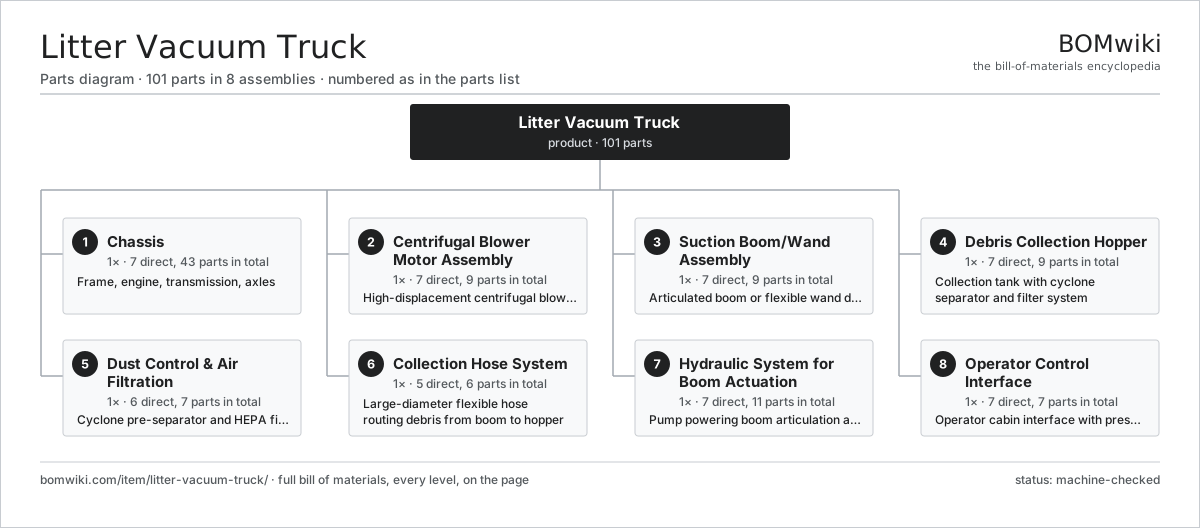
| # | Part | Qty | What it does |
|---|---|---|---|
| 1 | Chassis 7 parts | 1× | Frame, engine, transmission, axles |
| 2 | Centrifugal Blower Motor Assembly 7 parts | 1× | High-displacement centrifugal blower generating 50–80 kPa vacuum |
| 3 | Suction Boom/Wand Assembly 7 parts | 1× | Articulated boom or flexible wand directing suction to debris |
| 4 | Debris Collection Hopper 7 parts | 1× | Collection tank with cyclone separator and filter system |
| 5 | Dust Control & Air Filtration 6 parts | 1× | Cyclone pre-separator and HEPA filtration preventing dust escape |
| 6 | Collection Hose System 5 parts | 1× | Large-diameter flexible hose routing debris from boom to hopper |
| 7 | Hydraulic System for Boom Actuation 7 parts | 1× | Pump powering boom articulation and boom rotation |
| 8 | Operator Control Interface 7 parts | 1× | Operator cabin interface with pressure and flow monitoring |
3D model
No 3D model yet. Have a CAD file of this? Add a 3D model — STL renders right on this page; STEP, FreeCAD, and OpenSCAD sources are welcome too (openly licensed, like all 3D models on BOMwiki).
Build & assembly graph
expand / collapse · shared sub-assemblies converge · links to related products · est. labourTap an assembly to expand/collapse · tap a part to open it · use “Open page” for any node · drag to pan, scroll to zoom.
Bill of materials for Litter Vacuum Truck
8 top-level lines · 66 rows shown · 101 parts total · indented to 3 levels| # | Item / sub-assembly | Part no. | Qty/assy | Ext. qty | Parts | Type |
|---|---|---|---|---|---|---|
| 1 | Chassis 7 parts | litter-vacuum-truck-chassis | 1× | 1 | 43 | assembly |
| 1.1 | Truck Frame Assembly | litter-vacuum-truck-frame | 1× | 1 | · | part |
| 1.2 | Diesel Engine | litter-vacuum-truck-engine | 1× | 1 | · | part |
| 1.3 | Transmission | litter-vacuum-truck-transmission | 1× | 1 | · | part |
| 1.4 | Axles | litter-vacuum-truck-axles | 2× | 2 | · | part |
| 1.5 | Operator Cabin | litter-vacuum-truck-cab | 1× | 1 | · | part |
| 1.6 | Wheel Assembly 5 parts | wheel-assembly | 4× | 4 | 9 | assembly |
| 1.6.1 | Alloy Wheel | alloy-wheel | 1× | 4 | · | part |
| 1.6.2 | Tire | tire | 1× | 4 | · | part |
| 1.6.3 | TPMS Sensor | tpms-sensor | 1× | 4 | · | part |
| 1.6.4 | Lug Nut | lug-nut | 5× | 20 | · | part |
| 1.6.5 | Valve Stem | valve-stem | 1× | 4 | · | part |
| 1.7 | Fuel Tank | litter-vacuum-truck-fuel-tank | 1× | 1 | · | part |
| 2 | Centrifugal Blower Motor Assembly 7 parts | litter-vacuum-truck-blower-motor | 1× | 1 | 9 | assembly |
| 2.1 | Centrifugal Blower Impeller | litter-vacuum-truck-blower-impeller | 1× | 1 | · | part |
| 2.2 | Blower Housing | litter-vacuum-truck-blower-housing | 1× | 1 | · | part |
| 2.3 | Blower Bearing | litter-vacuum-truck-blower-bearing | 2× | 2 | · | part |
| 2.4 | Blower Mechanical Seal | litter-vacuum-truck-blower-seal | 1× | 1 | · | part |
| 2.5 | Blower Inlet Filter | litter-vacuum-truck-blower-filter-element | 1× | 1 | · | part |
| 2.6 | Discharge Silencer | litter-vacuum-truck-blower-discharge-silencer | 1× | 1 | · | part |
| 2.7 | Pressure Sensor | pressure-sensor | 2× | 2 | · | part |
| 3 | Suction Boom/Wand Assembly 7 parts | litter-vacuum-truck-boom-wand | 1× | 1 | 9 | assembly |
| 3.1 | Lower Boom Segment | litter-vacuum-truck-boom-section-1 | 1× | 1 | · | part |
| 3.2 | Upper Boom Segment | litter-vacuum-truck-boom-section-2 | 1× | 1 | · | part |
| 3.3 | Lower Boom Cylinders | litter-vacuum-truck-boom-cylinder-lower | 2× | 2 | · | part |
| 3.4 | Upper Boom Cylinder | litter-vacuum-truck-boom-cylinder-upper | 1× | 1 | · | part |
| 3.5 | Suction Nozzle | litter-vacuum-truck-boom-wand-nozzle | 1× | 1 | · | part |
| 3.6 | Boom Rotary Bearing | litter-vacuum-truck-boom-guides | 1× | 1 | · | part |
| 3.7 | Pressure Sensor | pressure-sensor | 2× | 2 | · | part |
| 4 | Debris Collection Hopper 7 parts | litter-vacuum-truck-debris-hopper | 1× | 1 | 9 | assembly |
| 4.1 | Hopper Tank Body | litter-vacuum-truck-hopper-body | 1× | 1 | · | part |
| 4.2 | Cyclone Separator | litter-vacuum-truck-cyclone-separator | 1× | 1 | · | part |
| 4.3 | Filter Cartridge | litter-vacuum-truck-filter-cartridge | 2× | 2 | · | part |
| 4.4 | Filter Cleaning Shaker | litter-vacuum-truck-filter-shaker | 1× | 1 | · | part |
| 4.5 | Hopper Drain Gate | litter-vacuum-truck-hopper-drain-plug | 1× | 1 | · | part |
| 4.6 | Level Indicator | litter-vacuum-truck-hopper-sight-gauge | 1× | 1 | · | part |
| 4.7 | O-Ring Set | oring-set | 2× | 2 | · | part |
| 5 | Dust Control & Air Filtration 6 parts | litter-vacuum-truck-dust-control | 1× | 1 | 7 | assembly |
| 5.1 | Cyclone Inlet Chamber | litter-vacuum-truck-cyclone-inlet | 1× | 1 | · | part |
| 5.2 | HEPA Filter Cartridge | litter-vacuum-truck-hepa-filter-cartridge | 2× | 2 | · | part |
| 5.3 | Pulse Cleaning Valve | litter-vacuum-truck-pulse-valve | 1× | 1 | · | part |
| 5.4 | Exhaust Silencer | litter-vacuum-truck-exhaust-muffler | 1× | 1 | · | part |
| 5.5 | Filter Baghouse | litter-vacuum-truck-baghouse-compartment | 1× | 1 | · | part |
| 5.6 | Pressure Sensor | pressure-sensor | 1× | 1 | · | part |
| 6 | Collection Hose System 5 parts | litter-vacuum-truck-collection-hose | 1× | 1 | 6 | assembly |
| 6.1 | Main Collection Hose | litter-vacuum-truck-hose-main | 1× | 1 | · | part |
| 6.2 | Hose Reel | litter-vacuum-truck-hose-reel | 1× | 1 | · | part |
| 6.3 | Inlet Quick Coupler | litter-vacuum-truck-quick-coupler-inlet | 1× | 1 | · | part |
| 6.4 | Hopper Quick Coupler | litter-vacuum-truck-quick-coupler-hopper | 1× | 1 | · | part |
| 6.5 | Hose Guide Bracket | litter-vacuum-truck-hose-guide | 2× | 2 | · | part |
| 7 | Hydraulic System for Boom Actuation 7 parts | litter-vacuum-truck-hydraulics | 1× | 1 | 11 | assembly |
| 7.1 | Hydraulic Pump | litter-vacuum-truck-hydraulic-pump | 1× | 1 | · | part |
| 7.2 | Proportional Valve Manifold | litter-vacuum-truck-proportional-manifold | 1× | 1 | · | part |
| 7.3 | Hydraulic Filter | litter-vacuum-truck-filter | 1× | 1 | · | part |
| 7.4 | Hydraulic Accumulator | litter-vacuum-truck-accumulator | 1× | 1 | · | part |
| 7.5 | Hydraulic Reservoir | litter-vacuum-truck-tank | 1× | 1 | · | part |
| 7.6 | Pressure Sensor | pressure-sensor | 2× | 2 | · | part |
| 7.7 | Connector | connector | 4× | 4 | · | part |
| 8 | Operator Control Interface 7 parts | litter-vacuum-truck-controls | 1× | 1 | 7 | assembly |
| 8.1 | Proportional Joystick | litter-vacuum-truck-proportional-joystick | 1× | 1 | · | part |
| 8.2 | Blower Speed Control | litter-vacuum-truck-motor-speed-control | 1× | 1 | · | part |
| 8.3 | Vacuum Pressure Gauge | litter-vacuum-truck-pressure-gauge | 1× | 1 | · | part |
| 8.4 | Filter Status Light | litter-vacuum-truck-filter-status-indicator | 1× | 1 | · | part |
| 8.5 | Hopper Level Gauge | litter-vacuum-truck-hopper-level-gauge | 1× | 1 | · | part |
| 8.6 | Audible Warning System | litter-vacuum-truck-audible-alarm | 1× | 1 | · | part |
| 8.7 | Microcontroller | mcu | 1× | 1 | · | part |
Related products
same domain, ranked by shared parts Coupe Car
1,617 parts · shares 8 with this page
Coupe Car
1,617 parts · shares 8 with this page
 Food Truck
197 parts · shares 8 with this page
Food Truck
197 parts · shares 8 with this page
 Food Waste Collection Truck
95 parts · shares 8 with this page
Food Waste Collection Truck
95 parts · shares 8 with this page
 Front Loader Refuse Truck
131 parts · shares 8 with this page
Front Loader Refuse Truck
131 parts · shares 8 with this page
 Grapple Truck
146 parts · shares 8 with this page
Grapple Truck
146 parts · shares 8 with this page
 Medical Waste Truck
107 parts · shares 8 with this page
Medical Waste Truck
107 parts · shares 8 with this page
Sourcing: possible vendors
Prices, MOQ, and lead times are algorithmic estimates, not quotes, and not claims about these companies. Company mappings are curated by keyword; est. price band $8k–$90k. How estimates work| Vendor | HQ | Specialty | MOQ | Lead time |
|---|---|---|---|---|
|
🇯🇵Toyota
global.toyota ↗
|
Toyota City, JP | Automaker | made to order | 16–28 wks |
| volkswagen-group.com ↗ | Wolfsburg, DE | Automaker | made to order | 16–28 wks |
| gm.com ↗ | Detroit, US | Automaker | made to order | 16–28 wks |
| hyundai.com ↗ | Seoul, KR | Automaker | made to order | 16–28 wks |
|
🇨🇳BYD
byd.com ↗
|
Shenzhen, CN | EV & battery manufacturer | made to order | 16–28 wks |
1,497-word article