Rotary Lobe Pump
ProductOverview
A rotary lobe pump moves liquid with two counter-rotating Lobe Rotors turning inside the intersecting bores of a Rotorcase Body. Unlike a gear pump, the rotors never touch: they are synchronized by external timing gears, so the pump can handle shear-sensitive, abrasive, or chunky products that meshing elements would destroy. The design is the standard transfer pump of the dairy, food, beverage, pharmaceutical, and cosmetics industries, yoghurt, cream, chocolate, fruit preparations with whole pieces, fermentation broths, ointments, and a heavier-built variant pumps sludge in wastewater plants.
Pumping is gentle and metered. Each revolution displaces a fixed volume (0.05–2.5 L/rev across common frame sizes), flow is nearly proportional to speed, and the low rotor velocity keeps shear rates far below those of a centrifugal impeller, preserving particle integrity and product texture.
How it works
Liquid enters the suction port as a pair of lobes unmesh, opening an expanding cavity that fills at low velocity. Each pocket formed between two lobes and the casing wall then travels around the periphery of the bore to the discharge side. There the lobes re-mesh, and because the meshing zone is occupied by metal, the liquid is expelled through the discharge Port Connection. With tri-lobe rotors, six pockets discharge per revolution, giving low pulsation; bi-lobe rotors trade smoothness for larger pockets that pass bigger solids.
The rotors cannot drive each other, they never touch, so synchronization comes from the Timing Gearbox. A hardened helical Helical Gear Pair at 1:1 ratio links the Drive Shaft and Lay Shaft, running in an oil bath inside the Gearcase. Each gear is locked to its shaft by a keyless Gear Clamp Ring, which lets the fitter time the rotors to within a few hundredths of a millimetre of equal backlash on both flanks. Typical rotor-to-rotor and rotor-to-case clearances are 0.1–0.2 mm; this clearance is the slip path, so volumetric efficiency rises from roughly 80% on water-thin liquids to above 98% on viscous products that cannot leak back quickly.
Pressure load on the rotors is reacted by widely spaced bearings, a front taper-roller Ball Bearing pair near the rotorcase and a Rear Roller Bearing at the gear end of each shaft, sized so shaft deflection at 16 bar stays smaller than the running clearance. Axial position is set during assembly with the ground Bearing Shim Set against the Rotorcase Wear Plate.
Construction
Everything wetted is 316L stainless or food-grade elastomer. The rotorcase is machined from solid or cast and electropolished to Ra ≤ 0.8 µm; the Rotor Retaining Nut is domed and crevice-free so no thread is exposed to product. The Front Cover comes off with four capped Cover Nuts for inspection, sealed by a profile Cover Gasket in EPDM. For chocolate and other products that solidify, the cover and case carry a heating jacket fed through Heating Jacket Ports.
Shaft sealing is the dominant maintenance item. Each shaft passes through a single hygienic Mechanical Seal Cartridge, silicon carbide running on carbon with EPDM secondaries, seated in the Seal Housing at the rotorcase back face. A Seal Flush Port allows a water flush or steam quench on crystallizing media such as sugar syrups; double mechanical seals with barrier fluid are fitted for aseptic or hazardous duty.
The complete unit mounts a Geared Motor on a stainless Baseplate through a flexible Drive Coupling. Because displacement is fixed, flow control is by variable-frequency drive, and a pressure relief path (external valve or rupture protection) is mandatory, a lobe pump dead-headed against a closed valve will raise pressure until something yields.
Operating practice
The pump is self-priming when wetted and tolerates dry running briefly since the rotors touch nothing, though the mechanical seals do not: dry-run protection watches seal temperature or motor power. CIP is performed in place at 1.5–2 m/s line velocity with the pump turning slowly to clean the meshing zone; SIP steam at 140 °C is within the elastomer rating. Rotor clearances are checked with feeler gauges at service intervals, wear shows up as falling flow at constant speed long before anything fails outright. Under EHEDG and 3-A rules, gaskets and seal elastomers are replaced on a fixed calendar schedule regardless of condition.
Rotary Lobe Pump parts and their functions
7 top-level parts · 72 parts in total · full bill of materials below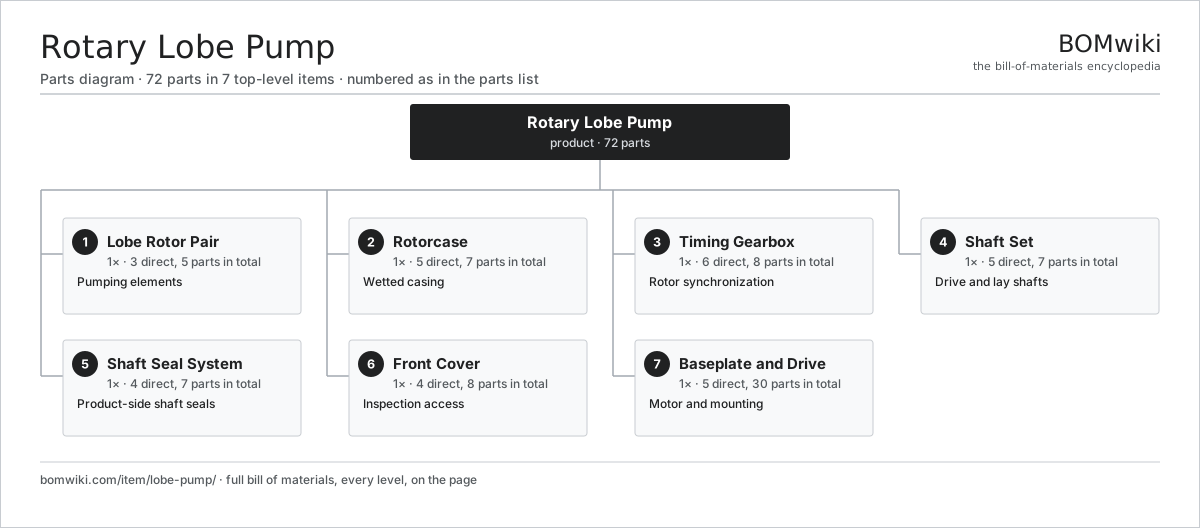
| # | Part | Qty | What it does |
|---|---|---|---|
| 1 | Lobe Rotor Pair 3 parts | 1× | Pumping elements |
| 2 | Rotorcase 5 parts | 1× | Wetted casing |
| 3 | Timing Gearbox 6 parts | 1× | Rotor synchronization |
| 4 | Shaft Set 5 parts | 1× | Drive and lay shafts |
| 5 | Shaft Seal System 4 parts | 1× | Product-side shaft seals |
| 6 | Front Cover 4 parts | 1× | Inspection access |
| 7 | Baseplate and Drive 5 parts | 1× | Motor and mounting |
3D model
No 3D model yet. Have a CAD file of this? Add a 3D model. STL renders right on this page; STEP, FreeCAD, and OpenSCAD sources are welcome too (openly licensed, like all 3D models on BOMwiki).
Build & assembly graph
expand / collapse · shared sub-assemblies converge · links to related products · est. labourTap an assembly to expand/collapse · tap a part to open it · use “Open page” for any node · drag to pan, scroll to zoom.
Bill of materials for Rotary Lobe Pump
7 top-level lines · 44 rows shown · 72 parts total · indented to 3 levels| # | Item / sub-assembly | Part no. | Qty/assy | Ext. qty | Parts | Type |
|---|---|---|---|---|---|---|
| 1 | Lobe Rotor Pair 3 parts | lobe-pump-rotor-pair | 1× | 1 | 5 | assembly |
| 1.1 | Lobe Rotor | lobe-pump-rotor | 2× | 2 | · | part |
| 1.2 | Rotor Retaining Nut | lobe-pump-rotor-nut | 2× | 2 | · | part |
| 1.3 | O-Ring Set | oring-set | 1× | 1 | · | part |
| 2 | Rotorcase 5 parts | lobe-pump-rotorcase | 1× | 1 | 7 | assembly |
| 2.1 | Rotorcase Body | lobe-pump-rotorcase-body | 1× | 1 | · | part |
| 2.2 | Port Connection | lobe-pump-port-flange | 2× | 2 | · | part |
| 2.3 | Rotorcase Wear Plate | lobe-pump-wear-plate | 1× | 1 | · | part |
| 2.4 | Case Dowel Pin | lobe-pump-case-dowel | 2× | 2 | · | part |
| 2.5 | Fastener Set | fastener-set | 1× | 1 | · | part |
| 3 | Timing Gearbox 6 parts | lobe-pump-timing-gearbox | 1× | 1 | 8 | assembly |
| 3.1 | Gearcase | lobe-pump-gearcase | 1× | 1 | · | part |
| 3.2 | Helical Gear Pair | gear-pair | 1× | 1 | · | part |
| 3.3 | Gear Clamp Ring | lobe-pump-gear-clamp-ring | 2× | 2 | · | part |
| 3.4 | Oil Sight Glass | lobe-pump-sight-glass | 1× | 1 | · | part |
| 3.5 | Oil Seal | oil-seal | 2× | 2 | · | part |
| 3.6 | Gearcase Breather | lobe-pump-breather | 1× | 1 | · | part |
| 4 | Shaft Set 5 parts | lobe-pump-shaft-set | 1× | 1 | 7 | assembly |
| 4.1 | Drive Shaft | lobe-pump-drive-shaft | 1× | 1 | · | part |
| 4.2 | Lay Shaft | lobe-pump-lay-shaft | 1× | 1 | · | part |
| 4.3 | Ball Bearing | ball-bearing | 2× | 2 | · | part |
| 4.4 | Rear Roller Bearing | lobe-pump-rear-bearing | 2× | 2 | · | part |
| 4.5 | Bearing Shim Set | lobe-pump-bearing-shim-set | 1× | 1 | · | part |
| 5 | Shaft Seal System 4 parts | lobe-pump-seal-system | 1× | 1 | 7 | assembly |
| 5.1 | Mechanical Seal Cartridge | lobe-pump-mech-seal | 2× | 2 | · | part |
| 5.2 | Seal Housing | lobe-pump-seal-housing | 2× | 2 | · | part |
| 5.3 | Seal Flush Port | lobe-pump-flush-port | 2× | 2 | · | part |
| 5.4 | O-Ring Set | oring-set | 1× | 1 | · | part |
| 6 | Front Cover 4 parts | lobe-pump-front-cover | 1× | 1 | 8 | assembly |
| 6.1 | Cover Plate | lobe-pump-cover-plate | 1× | 1 | · | part |
| 6.2 | Cover Gasket | lobe-pump-cover-seal | 1× | 1 | · | part |
| 6.3 | Cover Nut | lobe-pump-cover-nut | 4× | 4 | · | part |
| 6.4 | Heating Jacket Port | lobe-pump-jacket-port | 2× | 2 | · | part |
| 7 | Baseplate and Drive 5 parts | lobe-pump-baseplate-drive | 1× | 1 | 30 | assembly |
| 7.1 | Geared Motor 5 parts | lobe-pump-geared-motor | 1× | 1 | 26 | assembly |
| 7.1.1 | Stator Assembly 3 parts + deeper › | stator-assembly | 1× | 1 | 3 | assembly |
| 7.1.2 | Rotor Assembly 4 parts + deeper › | rotor-assembly | 1× | 1 | 19 | assembly |
| 7.1.3 | Motor Housing | motor-housing | 1× | 1 | · | part |
| 7.1.4 | Helical Gear Pair | gear-pair | 1× | 1 | · | part |
| 7.1.5 | Ball Bearing | ball-bearing | 2× | 2 | · | part |
| 7.2 | Drive Coupling | lobe-pump-coupling | 1× | 1 | · | part |
| 7.3 | Coupling Guard | lobe-pump-coupling-guard | 1× | 1 | · | part |
| 7.4 | Baseplate | lobe-pump-baseplate | 1× | 1 | · | part |
| 7.5 | Fastener Set | fastener-set | 1× | 1 | · | part |
Something wrong in this list? Report a problem with this BOM.
Related products
same domain, ranked by shared parts Centrifugal Compressor
338 parts · shares 3 with this page
Centrifugal Compressor
338 parts · shares 3 with this page
 Gear Pump
57 parts · shares 3 with this page
Gear Pump
57 parts · shares 3 with this page
 Peristaltic Pump
59 parts · shares 3 with this page
Peristaltic Pump
59 parts · shares 3 with this page
 Progressive Cavity Pump
54 parts · shares 3 with this page
Progressive Cavity Pump
54 parts · shares 3 with this page
 Radial Spillway Gate
264 parts · shares 3 with this page
Radial Spillway Gate
264 parts · shares 3 with this page
 Irrigation Pump Station
1,881 parts · shares 2 with this page
Irrigation Pump Station
1,881 parts · shares 2 with this page
Sourcing: possible vendors
Browse the supplier directory → Prices, MOQ, and lead times are algorithmic estimates, not quotes, and not claims about these companies. Company mappings are curated by keyword; est. price band $50–$50k. How estimates work| Vendor | HQ | Specialty | MOQ | Lead time |
|---|---|---|---|---|
|
🇩🇰Grundfos
grundfos.com ↗
|
Bjerringbro, DK | Pumps | 200 units | 6–12 wks |
|
🇺🇸Xylem
xylem.com ↗
|
Washington, US | Water technology | 200 units | 6–12 wks |
| flowserve.com ↗ | Irving, US | Pumps & valves | 200 units | 6–12 wks |
|
🇩🇪KSB
ksb.com ↗
|
Frankenthal, DE | Pumps & valves | 200 units | 6–12 wks |
| parker.com ↗ | Cleveland, US | Motion & fluid control | 200 units | 6–12 wks |
761-word article