Lock Pick Set
ProductOverview
A lock pick set is a collection of specialized tools for manipulating pin-tumbler locks without the original key. Professional locksmiths use picks as an alternative to destructive entry (drilling, cutting, prying) when they need to preserve the lock. The technique, called lock picking, works by individually lifting each pin to the shear line, the boundary between the rotating plug and stationary housing, so the cylinder can turn and the lock opens.
Unlike rekeying kits, which disassemble locks, picks work from outside the keyway. Picking is faster than rekeying (minutes vs. hours) but requires significant skill and is only effective on simpler locks. Modern security pins and anti-pick designs have reduced picking vulnerability, but older residential locks (common in rental properties and used homes) remain vulnerable.
Professional locksmiths carry pick sets for emergencies (lost keys, locked safes, jammed mechanisms) where rekeying is not an option and destructive entry would damage the property.
Pin-tumbler manipulation
A pin-tumbler lock has 5–6 stacked pins per chamber. The bottom pins (key pins) rest directly in the plug, and the top pins (driver pins) sit in the housing. When the correct key is inserted, the cuts lift the pins to exact heights, aligning all shear lines so the plug rotates. Picking mimics this by manually lifting each driver pin to the shear line one at a time.
The lock picker inserts two tools:
- A lock-pick-set-tension-wrench applies constant rotational torque to the plug (typically 1–5 Nm).
- A Hook Pick or similar blade lifts individual driver pins.
When a driver pin reaches the shear line under the combination of the picker's lift force and the wrench's torque, the pin "sets" (binds against the housing). The picker then moves to the next pin, repeating until all pins are set. The plug then rotates freely, opening the lock.
Tension wrenches
The lock-pick-set-tension-wrench is the critical foundation. It is a thin, bent steel bar (typically 0.8–1.5 mm thick) that inserts into the keyway bottom or top, applying rotational force. The bend angle and insert position depend on the specific lock:
- Bottom Wrench: Inserts below the keyway, typically with a 45° or 90° bend.
- Top Wrench: Inserts above, used on locks with narrow or blocked bottom keyways.
- Side Wrench: Applies side-to-side (rather than rotational) torque, used on locks with side chambers or security pins.
The wrench tension is critical. Too light (~0.5 Nm) and pins won't stay set. Too heavy (~10 Nm) and the picker cannot overcome friction to lift individual pins. A skilled picker adjusts pressure dynamically, reducing torque when probing for the next pin and increasing it when lifting.
Pick blade profiles
Different pick profiles suit different locks and picking styles:
Hook Pick: The most common profile. A thin shaft ending in a sharp right-angle hook. The picker inserts the hook into the keyway, raising it vertically to lift one pin at a time. This is the classic "precision picking" technique, allowing tactile feedback. Suitable for most residential locks.
Rake Pick: A sawtooth or wavy blade profile. Rather than lifting pins individually, the picker rapidly moves the rake back-and-forth in a scrubbing motion, bouncing all pins randomly. On simple locks, one or more pins may accidentally reach the shear line, opening the lock. Fast but unreliable; only works on weak locks.
Diamond Pick: A hybrid between hook and rake. The profile starts thin (like a hook) and gradually widens into a shallow ramp. This allows both precision lifting and some scrubbing action. Useful for locks resistant to pure hook picking.
Ball Pick: A rounded tip providing gentle, distributed pressure. Less likely to damage pins or cause false sets. Preferred for older locks with worn pins or security pins designed to resist hooks.
Bogota Pick: A specialized forked or double-tip design allowing simultaneous manipulation of two pins. Rare and advanced, used on specific lock types (e.g., certain Medeco cylinders).
Feedback and sensing
Skilled picking relies on tactile feedback. As the picker raises a pin toward the shear line, several sensations occur:
- Spring pressure buildup: The driver spring compresses, creating increasing resistance.
- Slight binding: As the pin reaches near-shear, it may catch slightly on the keyway edge or housing bore, providing a "click" or "crunch" sensation.
- Sudden relief: When the pin passes shear and sets, friction drops noticeably, allowing the tool to move freely to the next pin.
A picker with trained fingers can distinguish these signals and know exactly which pin is set and which remain. This skill takes hundreds of practice hours on practice locks (locks with transparent sides, allowing visual confirmation of pin movement).
Tension wrench manipulation is equally critical: the picker applies just enough torque to bind the unpicked pins against the housing, preventing them from falling back down when lifted to shear. Too much torque interferes with lifting; too little allows pins to slip back.
Practice and technique
Beginners typically train on practice locks, transparent cylinders with large, wear-resistant pins, before attempting real locks. Learning involves:
- Identifying which pin is binding (often the last one set, which creates the most friction).
- Applying graduated lift pressure, not sudden force.
- Recognizing the tactile "set" sensation.
- Adjusting tension-wrench pressure in real time.
- Recovering from "false sets" (a pin slipping back down due to insufficient wrench tension).
A skilled picker can open a basic 5-pin residential lock in 30–120 seconds. More complex locks (multiple drivers per chamber, security pins) may take minutes or prove unpickable.
Security pins and anti-picking designs
Modern security pins defeat basic picking:
- Serrated pins: Multiple grooves along the pin shaft catch on the keyway edge, creating false sets. The picker lifts a pin partway, feels a catch, applies more tension, and the pin binds, but is not actually at shear. This misdirection wastes time and frustration.
- Mushroom/spool pins: A wider section at the top catches under the housing ledge, again mimicking the set sensation at a false height.
- Shallow-cut pins: Paired pins at the same height, requiring simultaneous lifting to avoid binding.
Professional locksmiths recognize when a lock has security pins after a few attempts and often switch to rekeying or other non-picking methods.
Professional applications
Locksmiths use picks in specific scenarios:
- Lost key + no rekeying kit: A customer locked out can be opened in minutes with picks (if the lock is pickable).
- Jammed mechanism: Picking can help diagnose whether the jam is in the pin stack or the bolt mechanism.
- Combination lock recovery: On locks where the combination was forgotten but the cylinder is known to be functional.
- Demonstration/training: Locksmiths use picks to teach security awareness to customers.
In most professional contexts, picking is a backup skill. Rekeying, destructive entry, or replacement are often faster and more reliable for business-critical locks.
Carrying case and organization
The Pick Case keeps tools organized and secure. A typical case (leather or plastic) holds 15–25 tools in custom slots. Professional cases include:
- Compartments for each pick type.
- A tension-wrench organizer (often a spring clip or magnetic bar).
- Padding to protect tools and prevent rattle.
- A Case Lock for security during transport.
Many locksmiths keep a kit in their van and a backup at the office, ensuring access regardless of location.
Legal and ethical considerations
In many jurisdictions, lock picks are legal to own and use by licensed locksmiths, security professionals, and locksport hobbyists. However, some regions restrict or regulate pick possession, requiring proof of professional credentials or prior authorization.
Professional locksmiths follow a code of ethics: picks are only used on locks the user has legitimate authority to open (keys provided by owner, emergency access request documented, etc.). Using picks to gain unauthorized entry is a crime in most jurisdictions.
The locksport community (hobbyists who pick locks for sport and education) has established transparent practice protocols and works closely with law enforcement and legislators to maintain legitimate use.
Cost and availability
Retail lock pick sets range from €30 (basic practice sets) to €200+ (professional kits with 20+ specialty tools). Bulk industrial picks cost €2–10 per tool; locksmiths often assemble custom kits with their preferred profiles and wrench types, rather than buying pre-packaged sets.
High-end picks use hardened spring steel with careful tempering to withstand thousands of uses without dulling or deformation. Lower-cost picks use softer steel and dull quickly, becoming less effective for tactile feedback.
Lock Pick Set parts and their functions
3 top-level parts · 17 parts in total · full bill of materials below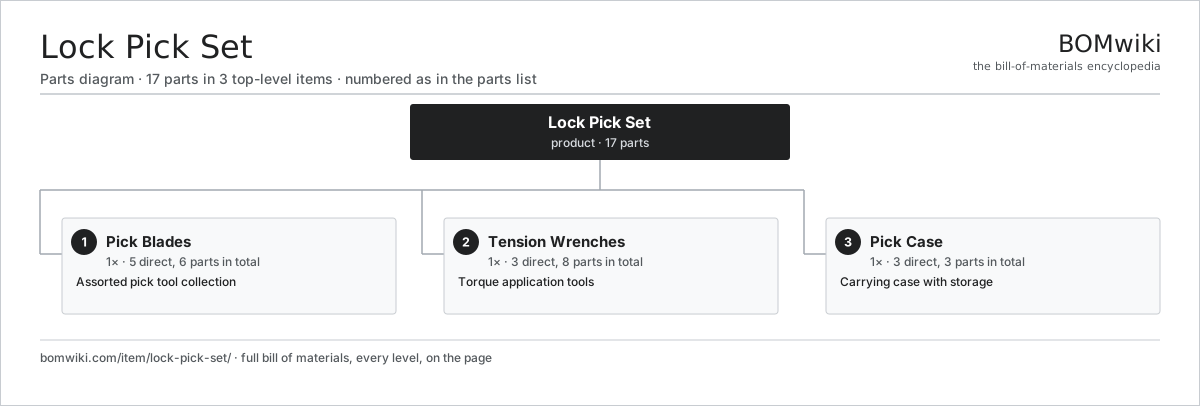
| # | Part | Qty | What it does |
|---|---|---|---|
| 1 | Pick Blades 5 parts | 1× | Assorted pick tool collection |
| 2 | Tension Wrenches 3 parts | 1× | Torque application tools |
| 3 | Pick Case 3 parts | 1× | Carrying case with storage |
3D model
No 3D model yet. Have a CAD file of this? Add a 3D model. STL renders right on this page; STEP, FreeCAD, and OpenSCAD sources are welcome too (openly licensed, like all 3D models on BOMwiki).
Build & assembly graph
expand / collapse · shared sub-assemblies converge · links to related products · est. labourTap an assembly to expand/collapse · tap a part to open it · use “Open page” for any node · drag to pan, scroll to zoom.
Bill of materials for Lock Pick Set
3 top-level lines · 14 rows shown · 17 parts total · indented to 3 levels| # | Item / sub-assembly | Part no. | Qty/assy | Ext. qty | Parts | Type |
|---|---|---|---|---|---|---|
| 1 | Pick Blades 5 parts | lock-pick-set-pick-blades | 1× | 1 | 6 | assembly |
| 1.1 | Hook Pick | lock-pick-set-hook-pick | 2× | 2 | · | part |
| 1.2 | Rake Pick | lock-pick-set-rake-pick | 1× | 1 | · | part |
| 1.3 | Diamond Pick | lock-pick-set-diamond-pick | 1× | 1 | · | part |
| 1.4 | Ball Pick | lock-pick-set-ball-pick | 1× | 1 | · | part |
| 1.5 | Bogota Pick | lock-pick-set-bogota-pick | 1× | 1 | · | part |
| 2 | Tension Wrenches 3 parts | lock-pick-set-tension-wrenches | 1× | 1 | 8 | assembly |
| 2.1 | Bottom Wrench | lock-pick-set-bottom-tension-wrench | 3× | 3 | · | part |
| 2.2 | Top Wrench | lock-pick-set-top-tension-wrench | 3× | 3 | · | part |
| 2.3 | Side Wrench | lock-pick-set-side-tension-wrench | 2× | 2 | · | part |
| 3 | Pick Case 3 parts | lock-pick-set-pick-case | 1× | 1 | 3 | assembly |
| 3.1 | Case Box | lock-pick-set-case-box | 1× | 1 | · | part |
| 3.2 | Foam Dividers | lock-pick-set-foam-dividers | 1× | 1 | · | part |
| 3.3 | Case Lock | lock-pick-set-case-lock | 1× | 1 | · | part |
Something wrong in this list? Report a problem with this BOM.
Sourcing: possible vendors
Browse the supplier directory → Prices, MOQ, and lead times are algorithmic estimates, not quotes, and not claims about these companies. Company mappings are curated by keyword; est. price band $50–$10k. How estimates work| Vendor | HQ | Specialty | MOQ | Lead time |
|---|---|---|---|---|
| assaabloy.com ↗ | Stockholm, SE | Locks & access | 1,000 units | 8–12 wks |
|
🇺🇸Allegion
allegion.com ↗
|
Dublin, US | Security products (Schlage) | 1,000 units | 8–12 wks |
| dormakaba.com ↗ | Rümlang, CH | Access & door systems | 1,000 units | 8–12 wks |
| honeywell.com ↗ | Charlotte, US | Building & safety tech | 1,000 units | 8–12 wks |
| hikvision.com ↗ | Hangzhou, CN | Surveillance & security | 1,000 units | 8–12 wks |
1,461-word article