LoRaWAN Gateway
ProductOverview
A LoRaWAN gateway is the wireless access point for Internet-of-Things sensor networks, receiving long-range, low-power transmissions from potentially thousands of LoRa endpoints (sensors, trackers, meters) and relaying them to the network server for processing. Unlike Wi-Fi or cellular gateways, LoRa emphasizes range and battery life: a single AA battery in a sensor can last 5–10 years sending occasional readings. The gateway is the base station that makes this possible, using a specialized Semtech SX1302 multi-channel receiver that can demodulate up to 8 LoRa packets simultaneously on overlapping channels and spreading factors.
The gateway's core is a Linux-based processor running a packet forwarder (the Semtech Basics Station or LoRa Packet Forwarder open-source software), which pushes all received frames to a network server (backend) over Ethernet or LTE. The concentrator card houses the SX1302 baseband demodulator and the RX LNA, TX power amplifier, and antenna pair. A GPS receiver provides 1 PPS sync for time-of-arrival localization across multiple gateways.
How it works
The RX low-noise amplifier boosts the weak signal from the antenna by 20–30 dB. This goes to the SX1257 transceiver, which shifts the RF to an intermediate frequency. The SX1302 demodulator IC is the heart: it contains 8 parallel demodulators, each capable of decoding a LoRa chirp signal. Each demodulator can lock onto one spreading factor (SF), so the gateway can receive SF7 on one channel and SF12 on another simultaneously on the same frequency.
The demodulation process extracts the payload bits and headers, computes a CRC, and forwards good packets to the processor via SPI. The processor runs the packet forwarder daemon, which wraps each received frame in JSON and sends it via UDP to the network server (hosted in the cloud or on-premises). The server deduplicates frames received by multiple gateways (join request in LoRaWAN always involves redundancy), performs join authentication, and routes downlink commands back through this gateway.
Downlink (gateway-to-device) traffic is less common but supported: the server sends a downlink frame to the gateway, which uses the TX power amplifier to retransmit it. LoRaWAN Class A (default) endpoints cannot receive downlinks; Class B and C can, but Class C consumes more battery.
Coverage and capacity
A single LoRaWAN gateway can cover a few square kilometers in urban areas or dozens of kilometers in rural line-of-sight. The antenna design (height, gain, placement) is critical: mounting the gateway on a tall mast or rooftop increases range dramatically.
The SX1302's 8-channel simultaneous reception is key to capacity. In a dense deployment (e.g., a parking lot of asset trackers), many devices transmit uncoordinated (pure ALOHA access method); the gateway catches all of them using its multi-channel receiver. If more than 8 devices transmit on the same frequency and spreading factor in the same 1 ms window, collisions occur, and those frames are lost, unavoidable in uncoordinated access. But with a well-planned frequency plan (different devices use different channels and SFs), collisions are rare.
Network integration
The gateway's backhaul link must reach the LoRaWAN network server. In urban areas, Ethernet is typical (RJ45 port); in remote sites, LTE backhaul is common. The server manages all the intelligence: device authentication (LoRaWAN uses AES keys), address translation, duplicate detection, and application routing.
Timing synchronization is optional but valuable. The GPS module provides a 1 PPS signal that the packet forwarder can use to timestamp incoming frames to microsecond precision. When multiple gateways receive the same packet, the network server can compare arrival times and estimate the device location (trilateration), a feature known as RSSI/TDoA (Time Difference of Arrival) localization.
Deployment and operations
A LoRaWAN deployment typically uses multiple gateways (3–5 minimum for redundancy and better coverage). Each gateway is typically managed by an operator or service provider who ensures power availability (PoE or AC), network connectivity, and antenna placement. The packet forwarder software is stateless, it can be restarted without affecting the network, so updates and maintenance are straightforward.
The weatherproof enclosure is essential for outdoor deployment. The passive thermal design keeps the electronics within temperature range despite summer heat, and the drain pan prevents water pooling from shortening component life.
LoRaWAN Gateway parts and their functions
7 top-level parts · 219 parts in total · full bill of materials below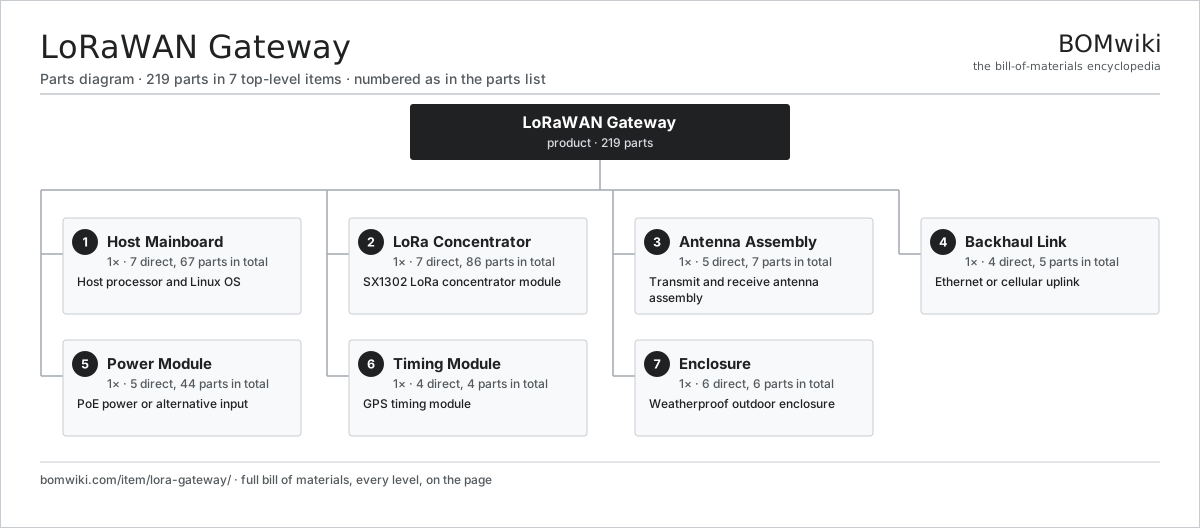
| # | Part | Qty | What it does |
|---|---|---|---|
| 1 | Host Mainboard 7 parts | 1× | Host processor and Linux OS |
| 2 | LoRa Concentrator 7 parts | 1× | SX1302 LoRa concentrator module |
| 3 | Antenna Assembly 5 parts | 1× | Transmit and receive antenna assembly |
| 4 | Backhaul Link 4 parts | 1× | Ethernet or cellular uplink |
| 5 | Power Module 5 parts | 1× | PoE power or alternative input |
| 6 | Timing Module 4 parts | 1× | GPS timing module |
| 7 | Enclosure 6 parts | 1× | Weatherproof outdoor enclosure |
3D model
No 3D model yet. Have a CAD file of this? Add a 3D model. STL renders right on this page; STEP, FreeCAD, and OpenSCAD sources are welcome too (openly licensed, like all 3D models on BOMwiki).
Build & assembly graph
expand / collapse · shared sub-assemblies converge · links to related products · est. labourTap an assembly to expand/collapse · tap a part to open it · use “Open page” for any node · drag to pan, scroll to zoom.
Bill of materials for LoRaWAN Gateway
7 top-level lines · 45 rows shown · 219 parts total · indented to 3 levels| # | Item / sub-assembly | Part no. | Qty/assy | Ext. qty | Parts | Type |
|---|---|---|---|---|---|---|
| 1 | Host Mainboard 7 parts | lora-host-mainboard | 1× | 1 | 67 | assembly |
| 1.1 | Host SoC | lora-host-soc | 1× | 1 | · | part |
| 1.2 | Host RAM | lora-host-ram | 1× | 1 | · | part |
| 1.3 | Storage | lora-host-storage | 1× | 1 | · | part |
| 1.4 | Serial UART Port | lora-host-uart | 2× | 2 | · | part |
| 1.5 | Ethernet Jack | lora-host-ethernet | 1× | 1 | · | part |
| 1.6 | SPI Bus | lora-host-spi | 1× | 1 | · | part |
| 1.7 | SMD Passive (R/C/L) | smd-passives | 60× | 60 | · | part |
| 2 | LoRa Concentrator 7 parts | lora-concentrator-card | 1× | 1 | 86 | assembly |
| 2.1 | SX1302 Demod | lora-sx1302-chip | 1× | 1 | · | part |
| 2.2 | SX1257 Transceiver | lora-sx1257-modem | 1× | 1 | · | part |
| 2.3 | TX Amplifier | lora-phy-tx | 1× | 1 | · | part |
| 2.4 | RX LNA | lora-phy-rx | 1× | 1 | · | part |
| 2.5 | Clock Module | lora-clock | 1× | 1 | · | part |
| 2.6 | RF Filter | lora-filter-network | 1× | 1 | · | part |
| 2.7 | SMD Passive (R/C/L) | smd-passives | 80× | 80 | · | part |
| 3 | Antenna Assembly 5 parts | lora-antenna-set | 1× | 1 | 7 | assembly |
| 3.1 | RX Antenna | lora-antenna-rx | 1× | 1 | · | part |
| 3.2 | TX Antenna | lora-antenna-tx | 1× | 1 | · | part |
| 3.3 | Antenna Mount | lora-antenna-mount | 1× | 1 | · | part |
| 3.4 | Antenna Cable | lora-antenna-cable | 2× | 2 | · | part |
| 3.5 | RF Connector | lora-antenna-connector | 2× | 2 | · | part |
| 4 | Backhaul Link 4 parts | lora-backhaul | 1× | 1 | 5 | assembly |
| 4.1 | Ethernet Port | lora-ethernet-interface | 1× | 1 | · | part |
| 4.2 | LTE Modem | lora-cellular-modem | 1× | 1 | · | part |
| 4.3 | Cellular Antenna | lora-cellular-antenna | 2× | 2 | · | part |
| 4.4 | Connector | connector | 1× | 1 | · | part |
| 5 | Power Module 5 parts | lora-poe-module | 1× | 1 | 44 | assembly |
| 5.1 | PoE Controller | lora-poe-controller | 1× | 1 | · | part |
| 5.2 | PoE Decoupler | lora-poe-decoupler | 1× | 1 | · | part |
| 5.3 | DC/DC Converter | lora-dcdc-converter | 1× | 1 | · | part |
| 5.4 | PoE Jack | lora-poe-connector | 1× | 1 | · | part |
| 5.5 | SMD Passive (R/C/L) | smd-passives | 40× | 40 | · | part |
| 6 | Timing Module 4 parts | lora-timing | 1× | 1 | 4 | assembly |
| 6.1 | GPS Receiver | lora-gps-module | 1× | 1 | · | part |
| 6.2 | GPS Antenna | lora-gps-antenna | 1× | 1 | · | part |
| 6.3 | RTC | lora-gps-backup | 1× | 1 | · | part |
| 6.4 | Connector | connector | 1× | 1 | · | part |
| 7 | Enclosure 6 parts | lora-enclosure | 1× | 1 | 6 | assembly |
| 7.1 | Enclosure Shell | lora-enclosure-shell | 1× | 1 | · | part |
| 7.2 | Access Door | lora-enclosure-door | 1× | 1 | · | part |
| 7.3 | Thermal Fin | lora-enclosure-heatsink | 1× | 1 | · | part |
| 7.4 | Drain Pan | lora-enclosure-drip-tray | 1× | 1 | · | part |
| 7.5 | Mount Bracket | lora-enclosure-mount-bracket | 1× | 1 | · | part |
| 7.6 | Fastener Set | fastener-set | 1× | 1 | · | part |
Something wrong in this list? Report a problem with this BOM.
Related products
same domain, ranked by shared parts 5G Base Station
436 parts · shares 1 with this page
5G CPE Router
407 parts · shares 1 with this page
5G Base Station
436 parts · shares 1 with this page
5G CPE Router
407 parts · shares 1 with this page
 Carrier Core Router
1,039 parts · shares 1 with this page
Data Center Switch (Spine)
3,264 parts · shares 1 with this page
Carrier Core Router
1,039 parts · shares 1 with this page
Data Center Switch (Spine)
3,264 parts · shares 1 with this page
 DECT Base Station
192 parts · shares 1 with this page
DECT Base Station
192 parts · shares 1 with this page
 DOCSIS Cable Modem
442 parts · shares 1 with this page
DOCSIS Cable Modem
442 parts · shares 1 with this page
Sourcing: possible vendors
Browse the supplier directory → Prices, MOQ, and lead times are algorithmic estimates, not quotes, and not claims about these companies. Company mappings are curated by keyword; est. price band $30–$50k. How estimates work| Vendor | HQ | Specialty | MOQ | Lead time |
|---|---|---|---|---|
|
🇺🇸Cisco
cisco.com ↗
|
San Jose, US | Networking | 500 units | 8–14 wks |
|
🇺🇸Juniper
juniper.net ↗
|
Sunnyvale, US | Networking | 500 units | 8–14 wks |
| arista.com ↗ | Santa Clara, US | Networking | 500 units | 8–14 wks |
|
🇫🇮Nokia
nokia.com ↗
|
Espoo, FI | Telecom equipment | 500 units | 8–14 wks |
|
🇨🇳Huawei
huawei.com ↗
|
Shenzhen, CN | Networking & telecom | 500 units | 8–14 wks |
769-word article