Luge Sled
ProductOverview
A luge sled is a lightweight single-person gravity-powered racing sled where the pilot lies supine (on their back) during the entire run down the icy track. Unlike bobsled, which uses ropes and mechanical steering, luge relies on subtle weight shifts and heel pressure to steer the sled. The modern luge sled combines a smooth Pod Shell made from fiberglass or carbon-fiber composite, a rigid internal Frame Structure, precision Runner Assembly steel blades, and a Steering Bridge mechanical linkage connecting the pilot's feet to the front runners.
Luge is an ancient winter sport with origins in Switzerland, evolving from natural ice slides. Modern competitive luge races are timed to the hundredth of a second; a difference of 0.001 seconds can mean the difference between gold and silver. The sport demands exceptional balance, strength, and mental focus. Athletes must memorize every inch of the track before racing and execute steering with millimeter precision while experiencing forces up to 5 G in turns.
How it works
At the start line, the pilot sits upright on the sled, gripping the Push Handles. At the signal, the pilot and crew (typically two or more pushers) accelerate the sled forward by running and pushing. After approximately 30–50 meters, the pilot lies back onto the Seat Liner, positioning themselves supine, and the crew releases the sled.
Steering is accomplished through the Steering Bridge: the pilot presses and releases their heels on the Runner Boot, a Boot Plate under the pilot's feet. Pressure on the heels flexes the Steering Rod, which rotates the front Runner Assembly runners left or right via the Steering Pivot. The angle of the runners determines the sled's path on the ice.
Unlike bobsled, where steering is continuous and deliberate, luge steering is subtle and intuitive. The pilot leans slightly and shifts weight left or right, simultaneously using heel pressure to fine-tune the angle. The goal is to maintain the optimal "racing line" through each turn while building and maintaining maximum speed.
The Runner Assembly runners contact the ice in a thin line, similar to skates or luge runners worldwide. The runners are hardened steel, typically 40–50 mm wide and 1–2 mm thick at the edge. The runners are precisely curved (called "kufens") to match the pilot's weight distribution and the specific track's geometry.
As the sled descends the track, gravity pulls it faster. The pilot continuously steers to optimize the line, minimize friction, and maintain control. The sled may reach speeds of 120–150 km/h (75–90 mph), depending on the track and run quality. At the finish line, some sleds deploy a Brake Assembly by raising the back (raising the Brake Rake to contact the ice), but this is optional and not used on all tracks.
Materials and construction
The Pod Shell is constructed from multiple layers of fiberglass or carbon-fiber fabric impregnated with Shell Resin. Carbon-fiber is preferred for racing sleds, as it offers higher stiffness-to-weight ratio than fiberglass, allowing lighter sleds that still maintain rigidity. The shell is typically laid up by hand in a mold, with fibers oriented to resist bending and torsion.
The Frame Structure internal skeleton is typically welded chromoly or aluminum tubing, providing additional rigidity while remaining lightweight. The frame is welded to provide a rigid structure that distributes loads from steering and acceleration forces across the shell.
The Runner Assembly consists of two hardened steel kufens. The runners are precisely curved and ground to extremely tight tolerances, runners must be matched within micrometers to ensure the sled tracks straight and remains controllable. The Runner Spacing between the runners is fixed and rigid; the runners do not flex or adjust.
The runners are the most critical component affecting sled performance. Different runners are selected for different track conditions and temperatures. Warmer tracks require softer runner profiles; colder tracks require harder profiles. Runner selection can provide hundredths of a second of advantage. Professional luge athletes often have multiple sets of runners, which are carefully maintained and tuned by specialists.
The Steering Bridge connects the Runner Boot to the front runners via a Steering Rod. The linkage must be rigid yet responsive; any slack in the system causes delayed steering response, which at high speeds can be dangerous. The Steering Spring returns the front runners to neutral position when heel pressure is released.
The Seat Liner is custom-molded to fit the specific pilot's body dimensions. Elite athletes often have multiple sleds with seats fitted to their unique physiology, optimizing weight distribution and comfort (though comfort in luge is a relative term; the sled must be tight to minimize movement during high-G turns). The seat is a composite structure, with the shell forming the outer surface and Seat Foam padding covering the interior.
Weight and sled optimization
Luge sled weight is minimized through design and material selection. Professional sleds range from 20–25 kg including the pilot's weight; entry-level or recreational sleds may be slightly heavier. The weight limits are set by international regulations; skids must be above a minimum weight to ensure safety margins. Sled designers balance weight reduction against stiffness and durability.
The Shell Finish is polished or waxed to reduce aerodynamic drag. Professional teams invest in aerodynamic optimization, refining shell shapes and surface finishes to minimize drag at high speeds. Some sleds use textured surfaces or designs inspired by high-speed vehicles.
Sled design evolves over time as manufacturers explore new materials, shapes, and steering mechanisms. Carbon-fiber composites have become standard in competitive sleds; some teams experiment with advanced composites or hybrid constructions. The International Luge Federation maintains strict regulations on sled design to prevent arms races and maintain competitive equity.
Steering sensitivity and control
Steering in luge is far more sensitive than in bobsled, due to the direct mechanical connection between heel pressure and runner angle. A pressure difference of just a few hundred grams can change the sled's trajectory. This sensitivity requires exceptional proprioceptive awareness from the pilot; elite lugers are trained to maintain pressure within narrow ranges at high speeds while experiencing strong g-forces.
The Steering Bridge mechanical advantage (the ratio of heel movement to runner angle) is critical to performance. Different bridges offer different sensitivities; some pilots prefer direct, sensitive steering, while others prefer a more forgiving, progressive response. Individual sled and bridge tuning is part of the athlete's competitive preparation.
Track conditions and sled performance
Ice temperature and texture significantly affect sled performance. Warm ice is slower and requires softer runner profiles; cold ice is faster and requires harder profiles. Professional tracks maintain specific ice conditions, and competitor sleds and runners are selected to match those conditions.
Humidity, air temperature, and time of day all affect ice properties. Morning runs on the same track may produce different speeds than afternoon runs due to ice temperature changes. Teams closely monitor track conditions and adjust runner selection accordingly.
Safety considerations
Luge racing is high-risk; athletes travel at speeds exceeding 100 km/h while lying supine on a thin sled. Steering mistakes or mechanical failures can result in crashes. Modern tracks include protective bumpers and run-out zones to prevent serious injuries. Athletes wear full-face helmets and leather suits with impact protection.
The Steering Bridge mechanical integrity is critical for safety. Any looseness or failure in the steering linkage could render the sled uncontrollable. Regular inspection and maintenance are essential.
Cost and competition
Professional luge sleds cost $3,000–$15,000 or more, depending on the builder and customization level. Elite athletes often have multiple sleds available for different track conditions. The sled is a precision instrument, and success in luge racing depends equally on the athlete's skill and the sled's design and tune.
National luge programs are supported by Olympic committees or private sponsors. Training involves both on-track practice (building muscle memory for steering and line selection) and off-ice training (strength, balance, and reaction time exercises).
Luge Sled parts and their functions
8 top-level parts · 23 parts in total · full bill of materials below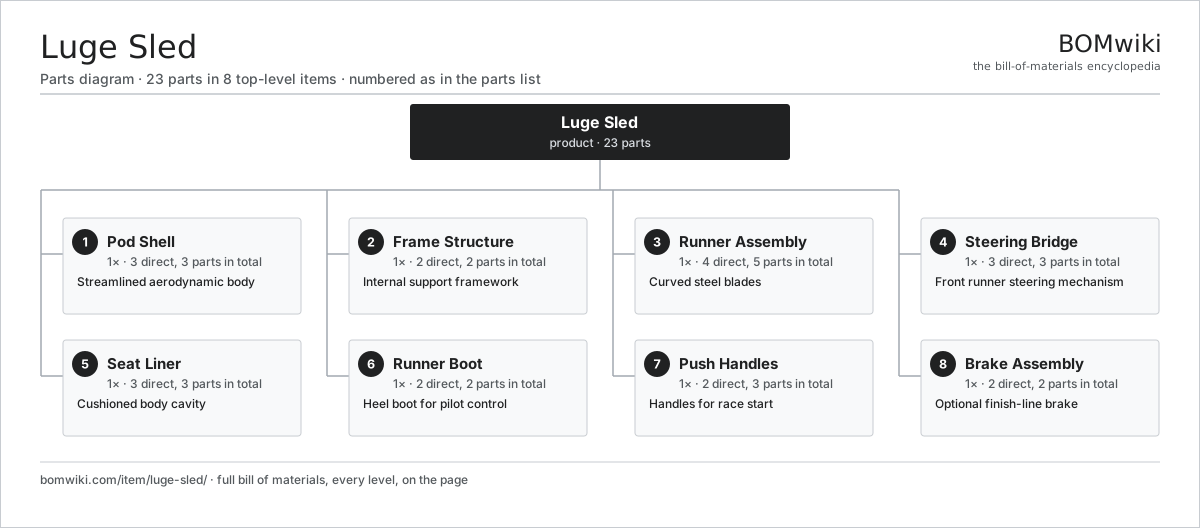
| # | Part | Qty | What it does |
|---|---|---|---|
| 1 | Pod Shell 3 parts | 1× | Streamlined aerodynamic body |
| 2 | Frame Structure 2 parts | 1× | Internal support framework |
| 3 | Runner Assembly 4 parts | 1× | Curved steel blades |
| 4 | Steering Bridge 3 parts | 1× | Front runner steering mechanism |
| 5 | Seat Liner 3 parts | 1× | Cushioned body cavity |
| 6 | Runner Boot 2 parts | 1× | Heel boot for pilot control |
| 7 | Push Handles 2 parts | 1× | Handles for race start |
| 8 | Brake Assembly 2 parts | 1× | Optional finish-line brake |
3D model
No 3D model yet. Have a CAD file of this? Add a 3D model. STL renders right on this page; STEP, FreeCAD, and OpenSCAD sources are welcome too (openly licensed, like all 3D models on BOMwiki).
Build & assembly graph
expand / collapse · shared sub-assemblies converge · links to related products · est. labourTap an assembly to expand/collapse · tap a part to open it · use “Open page” for any node · drag to pan, scroll to zoom.
Bill of materials for Luge Sled
8 top-level lines · 29 rows shown · 23 parts total · indented to 3 levels| # | Item / sub-assembly | Part no. | Qty/assy | Ext. qty | Parts | Type |
|---|---|---|---|---|---|---|
| 1 | Pod Shell 3 parts | luge-pod-shell | 1× | 1 | 3 | assembly |
| 1.1 | Shell Composite | luge-shell-composite | 1× | 1 | · | part |
| 1.2 | Shell Resin | luge-shell-resin | 1× | 1 | · | part |
| 1.3 | Shell Finish | luge-shell-finish | 1× | 1 | · | part |
| 2 | Frame Structure 2 parts | luge-frame-structure | 1× | 1 | 2 | assembly |
| 2.1 | Frame Tube | luge-frame-tube | 1× | 1 | · | part |
| 2.2 | Frame Reinforcement | luge-frame-reinforcement | 1× | 1 | · | part |
| 3 | Runner Assembly 4 parts | luge-runner-assembly | 1× | 1 | 5 | assembly |
| 3.1 | Runner Blade | luge-runner-blade | 2× | 2 | · | part |
| 3.2 | Runner Profile | luge-runner-profile | 1× | 1 | · | part |
| 3.3 | Runner Mount | luge-runner-mount | 1× | 1 | · | part |
| 3.4 | Runner Spacing | luge-runner-spacing | 1× | 1 | · | part |
| 4 | Steering Bridge 3 parts | luge-steering-bridge | 1× | 1 | 3 | assembly |
| 4.1 | Steering Pivot | luge-steering-pivot | 1× | 1 | · | part |
| 4.2 | Steering Rod | luge-steering-rod | 1× | 1 | · | part |
| 4.3 | Steering Spring | luge-steering-spring | 1× | 1 | · | part |
| 5 | Seat Liner 3 parts | luge-seat-liner | 1× | 1 | 3 | assembly |
| 5.1 | Seat Foam | luge-seat-foam | 1× | 1 | · | part |
| 5.2 | Seat Cover | luge-seat-cover | 1× | 1 | · | part |
| 5.3 | Seat Mold | luge-seat-mold | 1× | 1 | · | part |
| 6 | Runner Boot 2 parts | luge-runner-boot | 1× | 1 | 2 | assembly |
| 6.1 | Boot Plate | luge-boot-plate | 1× | 1 | · | part |
| 6.2 | Boot Contact | luge-boot-contact | 1× | 1 | · | part |
| 7 | Push Handles 2 parts | luge-push-handles | 1× | 1 | 3 | assembly |
| 7.1 | Handle Bar | luge-handle-bar | 2× | 2 | · | part |
| 7.2 | Handle Grip | luge-handle-grip | 1× | 1 | · | part |
| 8 | Brake Assembly 2 parts | luge-brake-assembly | 1× | 1 | 2 | assembly |
| 8.1 | Brake Rake | luge-brake-rake | 1× | 1 | · | part |
| 8.2 | Brake Actuator | luge-brake-actuator | 1× | 1 | · | part |
Something wrong in this list? Report a problem with this BOM.
Sourcing: possible vendors
Browse the supplier directory → Prices, MOQ, and lead times are algorithmic estimates, not quotes, and not claims about these companies. Company mappings are curated by keyword; est. price band $20–$2k. How estimates work| Vendor | HQ | Specialty | MOQ | Lead time |
|---|---|---|---|---|
|
🇺🇸Coleman
coleman.com ↗
|
Chicago, US | Camping gear | 1,000 units | 6–10 wks |
| thenorthface.com ↗ | Denver, US | Outdoor apparel & gear | 1,000 units | 6–10 wks |
|
🇺🇸YETI
yeti.com ↗
|
Austin, US | Coolers & drinkware | 1,000 units | 6–10 wks |
| decathlon.com ↗ | Villeneuve-d'Ascq, FR | Sporting goods | 1,000 units | 6–10 wks |
|
🇺🇸Garmin
garmin.com ↗
|
Olathe, US | GPS & wearables | 1,000 units | 6–10 wks |
1,366-word article