Magnetic Lock
ProductOverview
A magnetic lock (or mag lock) is a stationary electromagnetic door-locking device mounted on the door frame header. Unlike a strike lock, which acts on a moving latch bolt, a mag lock uses a powerful electromagnet to attract and grip a ferrous armature plate bolted to the top of the door itself. The magnetic force creates a mechanical bond strong enough to hold a standard single-leaf door against typical human push force.
Mag locks are among the most robust and tamper-resistant locks in physical security. They offer no latching mechanism, no moving parts under load, and no mechanical adjustments, the holding force is purely magnetic attraction between the coil and the armature. They are widely deployed on high-security facilities, hospitals, data centers, and emergency exits where reliability and simplicity matter more than the continuous power draw.
How it works
The electromagnet assembly contains a multi-turn copper coil wound around a laminated iron core. When 24 VDC is applied, current flows through the coil, generating a magnetic field. The strength of this field is proportional to current and coil turns; typical units produce 3000–5000 N of holding force when fully energized.
The armature plate is a hardened steel rectangle bolted to the top edge of the door. When the electromagnet is energized, the iron armature is attracted toward the magnet's pole face and held in firm contact. This magnetic attraction creates a mechanical lock independent of any mechanical latch or strike.
The force is purely attractive and holds the armature passively; no solenoid plunger or mechanical keeper is required. This simplicity eliminates the mechanical wear, adjustment, and failure modes of strike locks. The mounting brackets ensure the magnet and armature remain parallel and aligned within the nominal 6–8 mm working gap.
Fail-safe and fail-secure operation
Like strike locks, mag locks can be configured in two modes, controlled by the fail-safe mechanism:
- Fail-safe: When power is removed, an internal spring-loaded release lever mechanically separates the magnet from the armature, allowing the door to swing open. This mode is required on life-safety doors (fire exits, stairwells) to ensure occupants can evacuate during a power outage.
- Fail-secure: No mechanical release; the door remains locked until 24 VDC is actively applied. Loss of power locks the door permanently until power is restored and the magnet is re-energized. This mode secures high-security access points (server rooms, vaults, executive offices).
A fail-safe mag lock typically includes a secondary solenoid that acts as a mechanical release latch. When the main magnet is de-energized, the secondary solenoid is spring-loaded to the RELEASED position, pushing the armature away from the magnet. This ensures that occupants cannot be trapped if power fails.
Electrical characteristics and power management
The electromagnet coil is inductive; when 24 VDC is first applied, inrush current can be 3–5 times the steady-state holding current. Protection circuits in the power supply module include:
- Current limiting resistors or active current limiting to reduce inrush stress on the power supply.
- Transient suppression diodes across the coil to absorb voltage spikes when the magnet is de-energized.
- Thermal fuses that open the coil circuit if temperature exceeds 80–90 °C (preventing runaway overheating).
Continuous power draw for a typical mag lock is 20–30 W, higher than strike locks. Large installations often use separate 24 VDC supplies for mag locks to prevent voltage sag that affects reader circuits or control panels. Some systems use "buzz" mode: the controller energizes the magnet only during the door release window (e.g., 5–10 seconds) to reduce power consumption and heat generation.
Installation and mechanical design
The electromagnet mounts horizontally on the door frame header, directly above the door opening. The armature plate mounts on the top edge of the door, aligned with the magnet pole face. Proper alignment is critical: even 2–3 mm misalignment can reduce holding force by 30–50%. The mounting brackets provide shims and adjustment slots to fine-tune alignment.
The status module includes a Hall sensor or reed switch that detects whether the armature is in contact with the magnet. This sensor provides feedback to the access control system: if the door is held closed, the sensor indicates "locked"; if the armature separates (door forced open or magnet de-energized), the sensor shows "unlocked."
For exterior or wet-environment installations, the magnet enclosure is stainless steel or powder-coated aluminum. The cable harness uses UV-resistant insulation and shielded twisted pair to prevent voltage drops over long runs (more than 30 meters).
Advantages and limitations
Mag locks excel in high-security and high-traffic scenarios:
- No moving latches: No mechanical wear, adjustment, or alignment issues over millions of open/close cycles.
- Simple, robust: Fewer components means fewer failure points and lower maintenance.
- Powerful: 5000 N holding force resists forced-entry techniques like ramming or prying.
- Retrofitable: Can be installed on standard hinged doors without modification.
Limitations include:
- Power consumption: Continuous 24 VDC draw (20–30 W) is higher than strike locks; requires robust backup power for fail-safe operation.
- Visible exterior magnet: The electromagnet is mounted openly on the door frame, making it a visual security indicator (both a feature and a vulnerability).
- Armature gap sensitivity: The magnetic force drops sharply if the armature separates by more than a few millimeters, requiring precise alignment and periodic maintenance.
- Sustained force only: The magnet cannot function as a lock if the door is already open and the armature removed; it is only useful when holding a closed door.
Maintenance and diagnostics
Periodic cleaning of the magnet pole face and armature surface prevents dust and oxidation from reducing holding force. A corrosion layer or magnetized dust can weaken the magnetic bond by 10–20%.
The status sensor should be tested regularly to ensure it reliably detects the locked state. A faulty sensor can result in false "unlocked" signals, causing alarms or access denial even though the door is physically held closed by the magnet.
Power supply monitoring is important: if the supply voltage drops below 18 VDC, holding force degrades significantly. Many modern controllers include voltage supervision and will trigger an alarm if mag lock voltage strays outside acceptable limits.
Magnetic Lock parts and their functions
8 top-level parts · 24 parts in total · full bill of materials below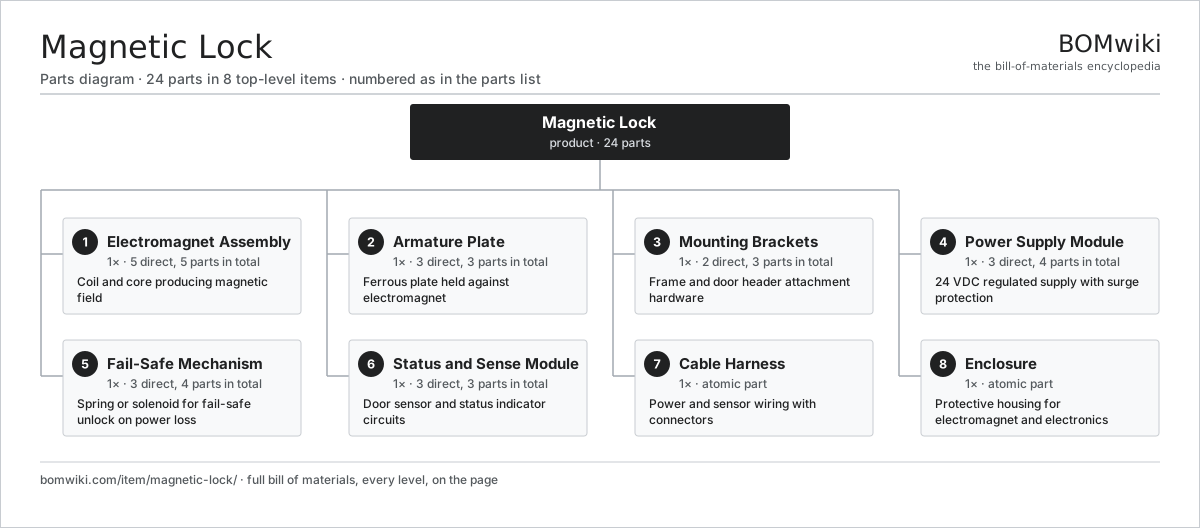
| # | Part | Qty | What it does |
|---|---|---|---|
| 1 | Electromagnet Assembly 5 parts | 1× | Coil and core producing magnetic field |
| 2 | Armature Plate 3 parts | 1× | Ferrous plate held against electromagnet |
| 3 | Mounting Brackets 2 parts | 1× | Frame and door header attachment hardware |
| 4 | Power Supply Module 3 parts | 1× | 24 VDC regulated supply with surge protection |
| 5 | Fail-Safe Mechanism 3 parts | 1× | Spring or solenoid for fail-safe unlock on power loss |
| 6 | Status and Sense Module 3 parts | 1× | Door sensor and status indicator circuits |
| 7 | Cable Harness | 1× | Power and sensor wiring with connectors |
| 8 | Enclosure | 1× | Protective housing for electromagnet and electronics |
3D model
No 3D model yet. Have a CAD file of this? Add a 3D model. STL renders right on this page; STEP, FreeCAD, and OpenSCAD sources are welcome too (openly licensed, like all 3D models on BOMwiki).
Build & assembly graph
expand / collapse · shared sub-assemblies converge · links to related products · est. labourTap an assembly to expand/collapse · tap a part to open it · use “Open page” for any node · drag to pan, scroll to zoom.
Bill of materials for Magnetic Lock
8 top-level lines · 27 rows shown · 24 parts total · indented to 3 levels| # | Item / sub-assembly | Part no. | Qty/assy | Ext. qty | Parts | Type |
|---|---|---|---|---|---|---|
| 1 | Electromagnet Assembly 5 parts | magnetic-lock-electromagnet-assembly | 1× | 1 | 5 | assembly |
| 1.1 | Copper Winding | copper-winding | 1× | 1 | · | part |
| 1.2 | Motor Housing | motor-housing | 1× | 1 | · | part |
| 1.3 | Neodymium Magnet | neodymium-magnet | 1× | 1 | · | part |
| 1.4 | Thermal Fuse | thermal-fuse | 1× | 1 | · | part |
| 1.5 | SMD Passive (R/C/L) | smd-passives | 1× | 1 | · | part |
| 2 | Armature Plate 3 parts | magnetic-lock-armature-plate | 1× | 1 | 3 | assembly |
| 2.1 | Sheet Metal Panel | sheet-panel | 1× | 1 | · | part |
| 2.2 | Fastener Set | fastener-set | 1× | 1 | · | part |
| 2.3 | O-Ring Set | oring-set | 1× | 1 | · | part |
| 3 | Mounting Brackets 2 parts | magnetic-lock-mounting-brackets | 1× | 1 | 3 | assembly |
| 3.1 | Sheet Metal Panel | sheet-panel | 2× | 2 | · | part |
| 3.2 | Fastener Set | fastener-set | 1× | 1 | · | part |
| 4 | Power Supply Module 3 parts | magnetic-lock-power-supply | 1× | 1 | 4 | assembly |
| 4.1 | Power Supply | power-supply | 1× | 1 | · | part |
| 4.2 | Connector | connector | 2× | 2 | · | part |
| 4.3 | SMD Passive (R/C/L) | smd-passives | 1× | 1 | · | part |
| 5 | Fail-Safe Mechanism 3 parts | magnetic-lock-fail-safe-mechanism | 1× | 1 | 4 | assembly |
| 5.1 | Coil Spring | coil-spring | 2× | 2 | · | part |
| 5.2 | Sheet Metal Panel | sheet-panel | 1× | 1 | · | part |
| 5.3 | Fastener Set | fastener-set | 1× | 1 | · | part |
| 6 | Status and Sense Module 3 parts | magnetic-lock-status-module | 1× | 1 | 3 | assembly |
| 6.1 | Hall Sensor | hall-sensor | 1× | 1 | · | part |
| 6.2 | Connector | connector | 1× | 1 | · | part |
| 6.3 | SMD Passive (R/C/L) | smd-passives | 1× | 1 | · | part |
| 7 | Cable Harness | magnetic-lock-cable-harness | 1× | 1 | · | part |
| 8 | Enclosure | magnetic-lock-enclosure | 1× | 1 | · | part |
Something wrong in this list? Report a problem with this BOM.
Used in 1 assembly
Related products
same domain, ranked by shared parts Mantrap Interlock Portal
82 parts · shares 18 with this page
Mantrap Interlock Portal
82 parts · shares 18 with this page
 Automatic Swing Door Operator
43 parts · shares 5 with this page
Automatic Swing Door Operator
43 parts · shares 5 with this page
 Smart Parcel Locker
278 parts · shares 5 with this page
Smart Parcel Locker
278 parts · shares 5 with this page
 Air Dancer
46 parts · shares 4 with this page
Electric Strike
23 parts · shares 7 with this page
Air Dancer
46 parts · shares 4 with this page
Electric Strike
23 parts · shares 7 with this page
 Precast Concrete Mold
493 parts · shares 7 with this page
Precast Concrete Mold
493 parts · shares 7 with this page
Sourcing: possible vendors
Browse the supplier directory → Prices, MOQ, and lead times are algorithmic estimates, not quotes, and not claims about these companies. Company mappings are curated by keyword; est. price band $50–$10k. How estimates work| Vendor | HQ | Specialty | MOQ | Lead time |
|---|---|---|---|---|
| assaabloy.com ↗ | Stockholm, SE | Locks & access | 1,000 units | 8–12 wks |
|
🇺🇸Allegion
allegion.com ↗
|
Dublin, US | Security products (Schlage) | 1,000 units | 8–12 wks |
| dormakaba.com ↗ | Rümlang, CH | Access & door systems | 1,000 units | 8–12 wks |
| honeywell.com ↗ | Charlotte, US | Building & safety tech | 1,000 units | 8–12 wks |
| hikvision.com ↗ | Hangzhou, CN | Surveillance & security | 1,000 units | 8–12 wks |
1,085-word article