Manual Pallet Jack
ProductOverview
The manual pallet jack (hand pallet truck) is the simplest powered-lift machine in logistics: two forks slide into a pallet, a dozen strokes of the handle raise the load about 120 mm clear of the floor, and one person wheels away up to 2,500 kg. Invented in roughly its present form in the early twentieth century and perfected by the Swedish maker BT in the 1940s–50s, the design has barely changed since because there is little left to remove. Some tens of millions are in service; it is the default machine for trailer unloading, retail back rooms and any floor-level pallet move too short to justify a powered truck.
The machine divides into the Hydraulic Pump Unit hydraulic unit, the Fork Frame, the Tiller Handle that both steers and pumps, the Steer Wheel Set under the pump, the Load Roller Set near the fork tips, and the Lift Linkage connecting ram to rollers.
How it works
The hydraulics are a textbook force multiplier. The Handle Arm is a lever stroking the small-bore Pump Plunger; the plunger displaces oil through a delivery Check Valve into the large-bore Lift Ram chamber. The combination of handle leverage (around 10:1) and piston-to-ram area ratio (around 10:1) means roughly 200–300 N of hand force generates the 16 MPa or so needed to lift two tonnes, at the cost of stroke, so 12–15 full pumps are needed for the 120 mm lift. On each up-stroke the suction check refills the pump bore from the reservoir cast into the Pump Body Casting; the trapped oil under the ram holds the load indefinitely.
Lifting the chassis is only half the problem: the fork tips, 1.15 m away, must rise too. As the ram extends it tilts the chassis up on the steer-wheel bogie, and simultaneously drives the Push Rod running inside each fork. At the tip, a Bell Crank Lever converts the rod's push into downward rotation of the Tandem Roller Rocker, forcing the Load Roller pair down through openings in the fork underside. Heel and tip therefore rise together and the forks stay level; the threaded Rod Adjuster on each rod synchronises the two ends. This linkage, not the pump, is the cleverest part of the machine.
The Control Lever on the grip has three positions. Lift engages the pump on every handle stroke. Neutral disconnects the pump so the handle can swing freely for steering and pumping motions do nothing, the travel setting. Lower pulls the Control Rod to crack open the Release Valve, bleeding oil back to reservoir at a rate proportional to lever pressure, so a load can be feathered down. A spring-set Pressure Relief Valve bypasses pump flow above rated pressure, making it physically impossible to pump up a gross overload.
Wheels and steering
The handle steers the whole pump-and-bogie unit through about 200 degrees on the Steering Turntable thrust bearing, giving the truck a turning radius shorter than its own length, it can rotate a pallet almost in place. The 180 mm Steer Wheel pair carries roughly 40% of the load; the tandem load rollers carry the rest. Tandem rockers matter on real floors: when one roller drops into a gap between pallet bottom-boards or an expansion joint, its partner bridges the gap and the rocker shares the load, roughly halving rolling resistance over single-roller designs. Polyurethane tyres are the standard compromise, quieter and floor-friendlier than nylon, lower drag than rubber; nylon is substituted in wet or cold-store duty.
Entry into a closed-bottom pallet is eased by the Pallet Entry Roller at each tip, which rides up and over the bottom boards as the lowered forks (80–85 mm high) slide into the 100 mm pallet opening.
Variants and practice
Standard forks are 1,150 × 160 mm on 540 mm spread, matching the 1,200 × 800 mm EUR pallet entered from the short side; 685 mm spread suits the 1,219 × 1,016 mm North American GMA pallet. Variants include low-profile (51 mm) trucks for display pallets, galvanised and stainless trucks for food and chemical washdown, weighing-scale trucks with load cells in the forks, and high-lift scissor versions that raise a pallet 800 mm for use as a workbench. The powered successor, the electric pallet truck, replaces the pump with a small hydraulic power pack and adds a drive motor, but the fork frame, linkage and roller layout are inherited directly from the manual machine. Maintenance is minimal: oil top-up, bleeding air after seal changes from the O-Ring Set, and replacing worn wheels; EN ISO 3691-5 governs design and ISO 509 fixes the pallet-entry dimensions the truck is built around.
Manual Pallet Jack parts and their functions
6 top-level parts · 60 parts in total · full bill of materials below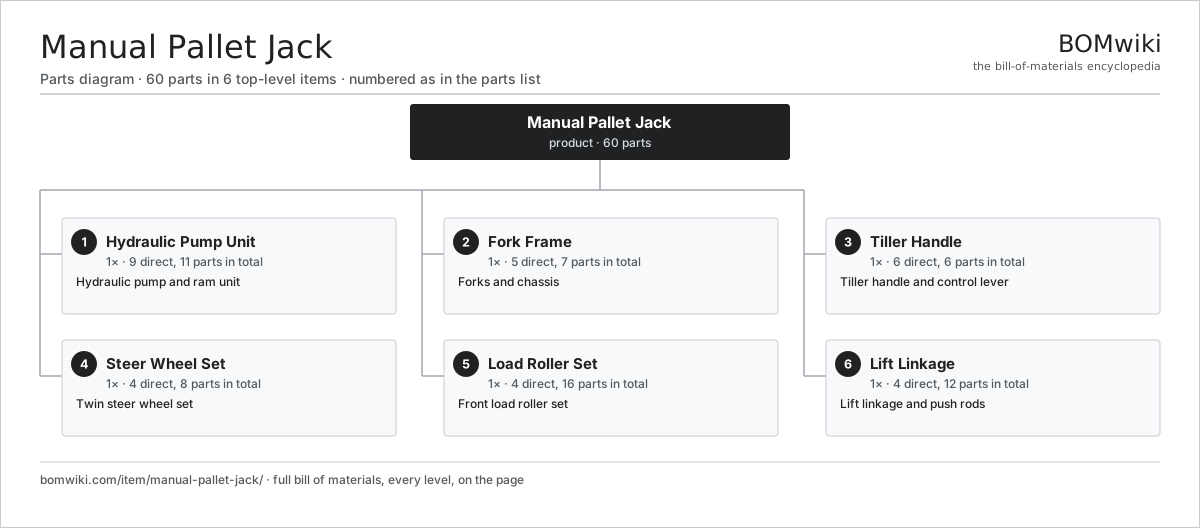
| # | Part | Qty | What it does |
|---|---|---|---|
| 1 | Hydraulic Pump Unit 9 parts | 1× | Hydraulic pump and ram unit |
| 2 | Fork Frame 5 parts | 1× | Forks and chassis |
| 3 | Tiller Handle 6 parts | 1× | Tiller handle and control lever |
| 4 | Steer Wheel Set 4 parts | 1× | Twin steer wheel set |
| 5 | Load Roller Set 4 parts | 1× | Front load roller set |
| 6 | Lift Linkage 4 parts | 1× | Lift linkage and push rods |
3D model
No 3D model yet. Have a CAD file of this? Add a 3D model. STL renders right on this page; STEP, FreeCAD, and OpenSCAD sources are welcome too (openly licensed, like all 3D models on BOMwiki).
Build & assembly graph
expand / collapse · shared sub-assemblies converge · links to related products · est. labourTap an assembly to expand/collapse · tap a part to open it · use “Open page” for any node · drag to pan, scroll to zoom.
Bill of materials for Manual Pallet Jack
6 top-level lines · 38 rows shown · 60 parts total · indented to 3 levels| # | Item / sub-assembly | Part no. | Qty/assy | Ext. qty | Parts | Type |
|---|---|---|---|---|---|---|
| 1 | Hydraulic Pump Unit 9 parts | manual-pallet-jack-pump | 1× | 1 | 11 | assembly |
| 1.1 | Pump Body Casting | manual-pallet-jack-pump-body | 1× | 1 | · | part |
| 1.2 | Pump Plunger | manual-pallet-jack-pump-piston | 1× | 1 | · | part |
| 1.3 | Lift Ram | manual-pallet-jack-ram | 1× | 1 | · | part |
| 1.4 | Release Valve | manual-pallet-jack-release-valve | 1× | 1 | · | part |
| 1.5 | Pressure Relief Valve | manual-pallet-jack-relief-valve | 1× | 1 | · | part |
| 1.6 | Check Valve | manual-pallet-jack-check-valve | 2× | 2 | · | part |
| 1.7 | O-Ring Set | oring-set | 1× | 1 | · | part |
| 1.8 | Oil Seal | oil-seal | 2× | 2 | · | part |
| 1.9 | Hydraulic Oil Fill | manual-pallet-jack-hydraulic-oil | 1× | 1 | · | part |
| 2 | Fork Frame 5 parts | manual-pallet-jack-fork-frame | 1× | 1 | 7 | assembly |
| 2.1 | Fork Arm | manual-pallet-jack-fork | 2× | 2 | · | part |
| 2.2 | Head Plate Weldment | manual-pallet-jack-head-plate | 1× | 1 | · | part |
| 2.3 | Pallet Entry Roller | manual-pallet-jack-exit-roller | 2× | 2 | · | part |
| 2.4 | Sheet Metal Panel | sheet-panel | 1× | 1 | · | part |
| 2.5 | Fastener Set | fastener-set | 1× | 1 | · | part |
| 3 | Tiller Handle 6 parts | manual-pallet-jack-handle | 1× | 1 | 6 | assembly |
| 3.1 | Handle Arm | manual-pallet-jack-handle-arm | 1× | 1 | · | part |
| 3.2 | Control Lever | manual-pallet-jack-control-lever | 1× | 1 | · | part |
| 3.3 | Control Rod | manual-pallet-jack-control-rod | 1× | 1 | · | part |
| 3.4 | Handle Grip | manual-pallet-jack-handle-grip | 1× | 1 | · | part |
| 3.5 | Coil Spring | coil-spring | 1× | 1 | · | part |
| 3.6 | Handle Pivot | manual-pallet-jack-handle-pivot | 1× | 1 | · | part |
| 4 | Steer Wheel Set 4 parts | manual-pallet-jack-steer-wheels | 1× | 1 | 8 | assembly |
| 4.1 | Steer Wheel | manual-pallet-jack-steer-wheel | 2× | 2 | · | part |
| 4.2 | Ball Bearing | ball-bearing | 4× | 4 | · | part |
| 4.3 | Steer Wheel Axle | manual-pallet-jack-steer-axle | 1× | 1 | · | part |
| 4.4 | Steering Turntable | manual-pallet-jack-turntable | 1× | 1 | · | part |
| 5 | Load Roller Set 4 parts | manual-pallet-jack-load-rollers | 1× | 1 | 16 | assembly |
| 5.1 | Load Roller | manual-pallet-jack-load-roller | 4× | 4 | · | part |
| 5.2 | Ball Bearing | ball-bearing | 8× | 8 | · | part |
| 5.3 | Load Roller Axle | manual-pallet-jack-roller-axle | 2× | 2 | · | part |
| 5.4 | Tandem Roller Rocker | manual-pallet-jack-roller-carrier | 2× | 2 | · | part |
| 6 | Lift Linkage 4 parts | manual-pallet-jack-linkage | 1× | 1 | 12 | assembly |
| 6.1 | Push Rod | manual-pallet-jack-push-rod | 2× | 2 | · | part |
| 6.2 | Bell Crank Lever | manual-pallet-jack-bell-crank | 2× | 2 | · | part |
| 6.3 | Linkage Pin | manual-pallet-jack-link-pin | 6× | 6 | · | part |
| 6.4 | Rod Adjuster | manual-pallet-jack-adjuster | 2× | 2 | · | part |
Something wrong in this list? Report a problem with this BOM.
Related products
same domain, ranked by shared parts Articulated Forklift
2,417 parts · shares 3 with this page
Articulated Forklift
2,417 parts · shares 3 with this page
 Container Handler
552 parts · shares 3 with this page
Pop-Up Wheel Sorter
705 parts · shares 3 with this page
Container Handler
552 parts · shares 3 with this page
Pop-Up Wheel Sorter
705 parts · shares 3 with this page
 Reach Truck
832 parts · shares 3 with this page
Reach Truck
832 parts · shares 3 with this page
 Rough-Terrain Forklift
247 parts · shares 3 with this page
Rough-Terrain Forklift
247 parts · shares 3 with this page
 Telescopic Handler
380 parts · shares 3 with this page
Telescopic Handler
380 parts · shares 3 with this page
Sourcing: possible vendors
Browse the supplier directory → Prices, MOQ, and lead times are algorithmic estimates, not quotes, and not claims about these companies. Company mappings are curated by keyword; est. price band $2k–$300k. How estimates work| Vendor | HQ | Specialty | MOQ | Lead time |
|---|---|---|---|---|
| toyota-industries.com ↗ | Kariya, JP | Forklifts & logistics | 20 units | 10–16 wks |
| kiongroup.com ↗ | Frankfurt, DE | Forklifts (Linde, STILL) | 20 units | 10–16 wks |
| jungheinrich.com ↗ | Hamburg, DE | Warehouse trucks | 20 units | 10–16 wks |
| crown.com ↗ | New Bremen, US | Forklifts | 20 units | 10–16 wks |
|
🇨🇳Hangcha
hcforklift.com ↗
|
Hangzhou, CN | Forklifts & material handling | 20 units | 10–16 wks |
854-word article