Master Key System
ProductOverview
A master key system is a hierarchical collection of locks and keys where multiple keys can open the same lock, and a single master key can open all or many locks in a facility. Rather than each lock having a unique key (which is impractical for large buildings), a master key system uses specially engineered pin-tumbler cylinders with additional "master pins" that create multiple shear lines. This allows both the master key (which lifts pins across all lines) and individual tenant keys (which lift pins only at specific lines) to operate the same lock.
Master key systems are standard in apartment buildings, office parks, hotels, hospitals, schools, and any facility with 50+ locks requiring hierarchical access control. The system balances security (tenants cannot access other units), convenience (managers carry one key rather than dozens), and maintenance (new tenants are quickly rekeyed by selecting new bottom pins).
Master pin concept
A standard pin-tumbler lock uses five pin pairs, each with a primary shear line where the plug and bible meet. When the correct key is inserted, all bottom pins are lifted to this shear line, allowing the plug to rotate.
A master key system introduces secondary shear lines by using master pins, special wafer pins that split the space between the primary shear line and the cylinder boundary. For example, in a lock position, a standard pin might be:
- Bottom pin (key pin) ending at height 3.0 mm
- Driver pin starting at height 3.0 mm
- Shear line at 3.0 mm
With a master pin system, the same position becomes:
- Bottom pin ending at 2.0 mm
- Master pin from 2.0 to 2.5 mm
- Driver pin starting at 2.5 mm
- Primary shear line at 2.5 mm (for individual key)
- Secondary shear line at 2.0 mm (for master key)
When a tenant key is inserted (cut to lift pins to 2.5 mm), the master pin remains partially in the plug, and the lock works. When the master key is inserted (cut to lift pins to 2.0 mm), it pushes the master pin up, clearing both shear lines, and the lock opens.
Hierarchical organization
Master key systems are typically organized in levels:
- Master Key (MK): Opens all locks in the facility. Typically kept in a safe, not for daily use.
- Sub-Master or Floor Keys: Open 10–50 locks (all units on a floor, all offices in a wing). Held by maintenance staff or floor managers.
- Individual or Tenant Keys: Open a single lock or paired locks (one unit or one office). Issued to residents or occupants.
A 100-unit apartment building might have:
- 1 master key (facility manager)
- 4 sub-master keys (one per floor)
- 100+ individual keys (one per apartment, plus spares)
The Key Matrix documents which key opens which locks, essential for lost-key procedures and access audits.
Design and pinning
Designing a master key system requires careful planning. The Pinning Chart is a technical schematic showing:
- Each lock's identification (e.g., "Unit 101").
- The bottom pin grades (1–5) for the tenant key.
- The master pin type and position (e.g., "Serrated, 2–4 position").
- The driver pin grades (matching driver pins to prevent binding).
The locksmith uses this chart to assemble each cylinder with the correct pins. A mistake, using a grade 2 driver pin instead of grade 3, can cause the lock to bind or allow picking.
Modern master key system design uses specialized CAD software (such as System Diagram) that automatically calculates pin grades, master pin positions, and key cuts to avoid pin-stacking conflicts (where two keys lift pins to incompatible heights).
Manufacturing and installation
Once designed, each cylinder is manufactured with:
- Plug and bible components
- Five bottom pins (tenant key stack)
- Five master pins (intermediate locks)
- Five driver pins
- Five springs
The cylinders are then installed in mortise locks, deadbolts, padlocks, or other hardware as specified by the building design.
Keys are cut to match the system. The master key is cut to the deepest cuts (lifting all pins maximally). Floor keys are cut to intermediate depths. Tenant keys are cut to shallow depths.
Rekeying and maintenance
A major advantage of master key systems is selective rekeying. If a tenant moves out, the locksmith:
- Removes the cylinder from the lock.
- Disassembles it (removing bottom pins only).
- Selects new bottom pins from the Spare Pins kit, matching the new tenant key cuts.
- Reassembles the cylinder and reinstalls it.
The master pins and drivers remain unchanged. The new cylinder still responds to the master key and floor key, but the old tenant key no longer works. This process takes 15–30 minutes per lock, making multi-unit rekeying practical and cost-effective.
Security considerations
Master key systems introduce security trade-offs:
Vulnerabilities:
- If a tenant key is stolen, only that lock is compromised (not others), but if a floor key is stolen, multiple units are exposed. The master key must be carefully controlled.
- A sophisticated attacker might analyze the master pin positions (via drilling or manipulation) and fabricate a master key. High-security master systems use serrated pins or additional countermeasures (blind master pins, multiple master key versions) to mitigate this risk.
Advantages:
- Tenants cannot easily rekey or alter their locks (they lack the master pins and technical knowledge).
- Lost keys can be addressed without replacing entire cylinders.
- Emergency access (fire department, police) can be granted quickly using a controlled master key.
Key control and audit
A well-managed master key system maintains a Key Matrix and maintenance log:
- Every key issued is documented with date, recipient, and lock access.
- Lost or stolen keys are recorded and the affected locks rekeyed.
- Regular audits verify that only authorized keys are in circulation.
Large facilities (hotels, hospitals, corporate offices) employ dedicated key control managers who oversee issuance, revocation, and destruction of keys.
Specialized pins and designs
High-security master key systems use additional PIN types:
- Serrated pins: Pins with multiple grooves, resisting manipulation and drilling.
- Mushroom pins: Wide-top pins that jam under certain drill angles, preventing drill-out attacks.
- Blind master pins: Non-obvious secondary shear lines, complicating reverse-engineering.
- Multi-level master systems: Multiple independent master keys (e.g., one for facilities, another for security) each with subset access.
These advanced designs cost 2–3x more than standard master systems but are used in high-security applications (banks, government buildings, military facilities).
Comparison with modern alternatives
Electronic key cards: Hotels and modern offices often use electronic access instead of master keys. This offers audit trails, temporary key revocation, and entry logging. However, electronic systems require power, maintenance, and software support, master keys are mechanical and fail-safe.
Access control systems: Large buildings may combine mechanical master keys with electronic locks on critical areas (server rooms, executive offices), using mechanical as a backup.
System expansion and modification
As a building grows (new wings added, additional locks installed), the master key system can be expanded. New locks can be pinned to the existing master key hierarchy if planned in advance. However, unplanned expansions often require professional locksmith re-design to avoid incompatibilities.
Facilities that anticipate growth typically design larger master key systems upfront (e.g., 200 locks capacity for a 100-unit building) to allow future additions without redesign.
Cost and timeline
Designing and implementing a master key system for a 100-lock facility typically costs:
- Design: €500–1500 (CAD analysis, pinning chart, key matrix)
- Hardware: €3000–5000 (5–6 cylinders per lock × 100 locks, plus assembly labor)
- Installation: €1000–2000 (locksmith labor to install cylinders, cut keys, test)
- Documentation: €200–500 (print charts, maintain logs)
Total: €5000–9000 for a 100-lock system, or €50–90 per lock.
Timeline is 3–6 weeks from design to full implementation, depending on hardware availability and locksmith labor capacity.
Professional standards and compliance
Master key systems are regulated by:
- ANSI/BHMA Standards: Guidelines for design, materials, and security testing.
- Building codes: Some jurisdictions mandate master key systems for multi-family residential to enable emergency access.
- Industry best practices: Professional locksmith associations (ALOA, IKM) publish standards for key control, documentation, and security.
A professionally designed and maintained master key system, combined with proper physical hardware (Grade 1–2 locks, reinforced strikes) and key control procedures, provides a balanced security posture suitable for most commercial and residential applications.
Master Key System parts and their functions
6 top-level parts · 167 parts in total · full bill of materials below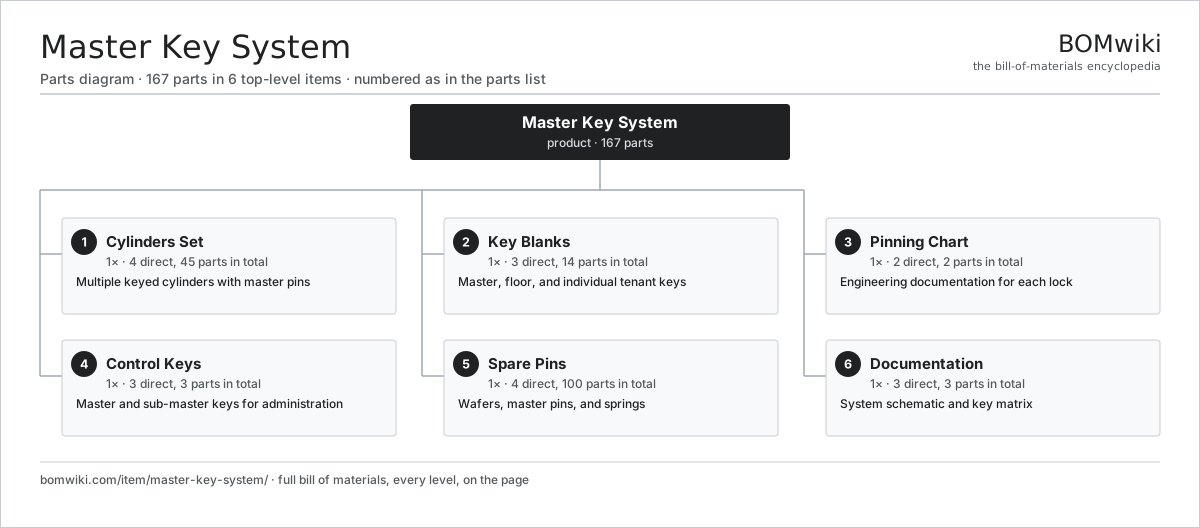
| # | Part | Qty | What it does |
|---|---|---|---|
| 1 | Cylinders Set 4 parts | 1× | Multiple keyed cylinders with master pins |
| 2 | Key Blanks 3 parts | 1× | Master, floor, and individual tenant keys |
| 3 | Pinning Chart 2 parts | 1× | Engineering documentation for each lock |
| 4 | Control Keys 3 parts | 1× | Master and sub-master keys for administration |
| 5 | Spare Pins 4 parts | 1× | Wafers, master pins, and springs |
| 6 | Documentation 3 parts | 1× | System schematic and key matrix |
3D model
No 3D model yet. Have a CAD file of this? Add a 3D model. STL renders right on this page; STEP, FreeCAD, and OpenSCAD sources are welcome too (openly licensed, like all 3D models on BOMwiki).
Build & assembly graph
expand / collapse · shared sub-assemblies converge · links to related products · est. labourTap an assembly to expand/collapse · tap a part to open it · use “Open page” for any node · drag to pan, scroll to zoom.
Bill of materials for Master Key System
6 top-level lines · 25 rows shown · 167 parts total · indented to 3 levels| # | Item / sub-assembly | Part no. | Qty/assy | Ext. qty | Parts | Type |
|---|---|---|---|---|---|---|
| 1 | Cylinders Set 4 parts | master-key-system-cylinders-set | 1× | 1 | 45 | assembly |
| 1.1 | Plug | master-key-system-plug | 5× | 5 | · | part |
| 1.2 | Bible | master-key-system-bible | 5× | 5 | · | part |
| 1.3 | Master Pin Set | master-key-system-master-pin-set | 5× | 5 | · | part |
| 1.4 | Coil Spring | coil-spring | 30× | 30 | · | part |
| 2 | Key Blanks 3 parts | master-key-system-key-blanks | 1× | 1 | 14 | assembly |
| 2.1 | Master Key | master-key-system-master-key | 1× | 1 | · | part |
| 2.2 | Floor Key | master-key-system-floor-key | 3× | 3 | · | part |
| 2.3 | Tenant Key | master-key-system-tenant-key | 10× | 10 | · | part |
| 3 | Pinning Chart 2 parts | master-key-system-pinning-chart | 1× | 1 | 2 | assembly |
| 3.1 | Chart Document | master-key-system-chart-document | 1× | 1 | · | part |
| 3.2 | Diagram Notes | master-key-system-diagram-notes | 1× | 1 | · | part |
| 4 | Control Keys 3 parts | master-key-system-control-keys | 1× | 1 | 3 | assembly |
| 4.1 | Master Key | master-key-system-master-key-cut | 1× | 1 | · | part |
| 4.2 | Change Key | master-key-system-change-key | 1× | 1 | · | part |
| 4.3 | Temporary Key | master-key-system-temporary-key | 1× | 1 | · | part |
| 5 | Spare Pins 4 parts | master-key-system-spare-pins | 1× | 1 | 100 | assembly |
| 5.1 | Spare Bottom Pins | master-key-system-spare-bottom-pins | 20× | 20 | · | part |
| 5.2 | Spare Top Pins | master-key-system-spare-top-pins | 20× | 20 | · | part |
| 5.3 | Spare Master Pins | master-key-system-spare-master-pins | 20× | 20 | · | part |
| 5.4 | Coil Spring | coil-spring | 40× | 40 | · | part |
| 6 | Documentation 3 parts | master-key-system-documentation | 1× | 1 | 3 | assembly |
| 6.1 | Key Matrix | master-key-system-key-matrix | 1× | 1 | · | part |
| 6.2 | System Diagram | master-key-system-system-diagram | 1× | 1 | · | part |
| 6.3 | Maintenance Log | master-key-system-maintenance-log | 1× | 1 | · | part |
Something wrong in this list? Report a problem with this BOM.
Related products
same domain, ranked by shared parts Access Control Panel
52 parts · shares 1 with this page
Automatic Smoke Vent
60 parts · shares 1 with this page
Access Control Panel
52 parts · shares 1 with this page
Automatic Smoke Vent
60 parts · shares 1 with this page
 Automatic Swing Door Operator
43 parts · shares 1 with this page
Automatic Swing Door Operator
43 parts · shares 1 with this page
 Clay Brick Extruder
154 parts · shares 1 with this page
Concrete Pipe Making Machine
154 parts · shares 1 with this page
Clay Brick Extruder
154 parts · shares 1 with this page
Concrete Pipe Making Machine
154 parts · shares 1 with this page
 Deadbolt Assembly
41 parts · shares 1 with this page
Deadbolt Assembly
41 parts · shares 1 with this page
Sourcing: possible vendors
Browse the supplier directory → Prices, MOQ, and lead times are algorithmic estimates, not quotes, and not claims about these companies. Company mappings are curated by keyword; est. price band $50–$10k. How estimates work| Vendor | HQ | Specialty | MOQ | Lead time |
|---|---|---|---|---|
| assaabloy.com ↗ | Stockholm, SE | Locks & access | 1,000 units | 8–12 wks |
|
🇺🇸Allegion
allegion.com ↗
|
Dublin, US | Security products (Schlage) | 1,000 units | 8–12 wks |
| dormakaba.com ↗ | Rümlang, CH | Access & door systems | 1,000 units | 8–12 wks |
| honeywell.com ↗ | Charlotte, US | Building & safety tech | 1,000 units | 8–12 wks |
| hikvision.com ↗ | Hangzhou, CN | Surveillance & security | 1,000 units | 8–12 wks |
1,459-word article