Matte Box
ProductOverview
Matte boxes are the standard lens accessory system on cinema productions, providing a modular platform for ND filters, diffusion, creative mattes, and light-shaping flags. The system clamps onto the front of the camera lens and is supported by the camera's 15 mm rod rails, keeping it light and balanced.
Unlike a simple lens hood, a matte box enables rapid filter swaps during shooting. The Swing-Away Arm arm rotates 90°, pulling the entire filter tray assembly out of the way. This allows the cinematographer to swap an ND filter without disturbing focus or camera framing, essential when conditions change (sun goes behind a cloud) and a different filter strength is needed.
Baseplate and Lens Clamping
The Baseplate Assembly aluminum die-cast assembly is the heart of the system. The Lens Clamp Lever quick-action lever tightens around the lens barrel via a Clamp Pad Ring rubber-lined ring, clamping gently to avoid damaging lens coatings. The clamp is adjustable for lens diameters from 60 to 110 mm, accommodating most cinema prime and zoom lenses.
The Rod Support Block on the baseplate provides two 15 mm rod socket mounting points. The Rod Clamp Set dual clamp blocks secure the matte box to the camera's standard support rod rails, distributing the load evenly and preventing tilting under the weight of filters and shade bellows.
Filter Staging and Access
The Filter Stages mechanism is a rotating tray with detent positions at 90° intervals. Typically, 2–3 filter stages are mounted (allowing 4–6 filter slots when both stages are populated). Each stage holds magnetic Magnetic Frame Holder A and Magnetic Frame Holder B holders, which snap 4x5" Filter Frame 4x5" frames or 6x6" Filter Frame 6x6" frames into place.
A typical setup might be:
- Stage A: ND 0.6 (2-stop ND) and ND 1.2 (4-stop ND) on a rotating mount
- Stage B: Diffusion (silk or nets) and creative effects (grads, star filters) on a separate rotating stage
The operator simply rotates each stage to select the desired filter, avoiding the need to remove and re-insert frames. For a full filter change (say, from ND 0.6 to ND 1.2), a single rotation of Stage A is required, taking 2 seconds.
Swing-Away Arm Design
The Swing-Away Arm is the signature feature of modular matte boxes. The entire filter tray assembly is mounted on an articulated aluminum Swing Arm Shaft pivot. A friction Friction Knob controls the pivot tension, tight enough that the arm holds position but loose enough to swing with light hand pressure.
When the operator needs to adjust a filter, they pull the arm 90° out of the optical path, accessing the filter frame magnets directly. Once the new filter is positioned (or rotated to), the arm swings back to the locked position, and the new filter is immediately in the light path. This design eliminates the need to un-clamp the matte box from the lens or disturb the camera setup.
Sunshade Bellows and Flare Control
The Sunshade Bellows accordion bellows is made of black light-blocking canvas. It extends 80–150 mm in front of the filter stages, providing a light shade that prevents off-axis light and reflected glare from reaching the lens front. This reduces lens flare, ghosting, and haze in backlit scenes.
The bellows is flexible: it can be compressed if the matte box is positioned too close to an object, or extended for maximum flare control. Bellows Fabric stretchy canvas with Bellows Frame Ring A and Bellows Frame Ring B aluminum rings allows this adjustment without tearing.
Flag Support and Matte Control
The Flag Holder Assembly 4-way flag frame interface extends from the top of the matte box, providing a platform for light-shaping accessories. The 4-Way Flag Frame rotating frame holds Flag Slot Adapter adapters for various matte shapes:
- Barn doors: Metal flaps blocking light from specific directions (e.g., blocking light from entering from the top of frame)
- Mattes: Cut-out shapes (circular, rectangular) creating silhouettes in the frame
- Iris matte: Adjustable circular aperture controlling vignetting
The Flag Arm Extension extends the frame away from the lens, allowing precise shadow positioning relative to subject position. On a bright day, a simple black matte placed in the flag frame can darken a white wall or sky, balancing exposure.
Filter Frame Types and Material
Standard filter frames (4x5" and 6x6") are reusable aluminum holders securing optical glass or acetate filter sheets via Filter Retaining Kit spring gaskets and retaining clips. Interchangeable magnetic corners allow the cinematographer to build custom filter stacks:
- ND filters: Neutral density acetate or glass reducing light transmission (0.3, 0.6, 0.9, 1.2, 1.5, 1.8 ND corresponding to 1, 2, 3, 4, 5, 6-stop reduction)
- Diffusion: Silk, nets, or diffusion gel softening light and reducing contrast
- Graduated filters: Density gradient (e.g., dark at top, clear at bottom) for sky/foreground balance
- Color correction: Warm (CTO), cool (CTB), or specialty color filters
- Effects: Star filters, prism, or cross-screen diffraction grating
The frames are interchangeable; a cinematographer can quickly swap between glass ND filters (superior optical quality, reusable) and disposable acetate diffusion sheets (cost-effective for one-time use).
Rod Mounting and Integration
The Rod Clamp Set dual 15 mm clamp blocks secure the matte box to the camera's standard 15 mm rod rails. This keeps the matte box in fixed alignment relative to the lens, preventing accidental shift during takes. The rods also support the weight evenly, preventing torque on the lens clamp.
On a typical camera rig:
- Two 15 mm aluminum rods run from the camera baseplate (or follow focus unit) backward toward the rear support post
- The matte box's left and right clamp blocks grip these rods
- A follow-focus unit might also clamp to the same rods, sharing the load
This modular rod architecture allows rapid attachment and removal of matte boxes between camera changes, and easy repositioning if the optical axis shift during the day.
Typical Workflow and Filter Selection
Pre-production Planning: The cinematographer reviews the script and determines shooting conditions (indoor tungsten, outdoor daylight, mixed). They prepare a filter kit matching the expected conditions:
- Outdoor bright sun: ND 0.6 (2-stop), ND 1.2 (4-stop), ND 1.8 (6-stop) for exposure control
- Indoor tungsten: Possible diffusion (1/4 silk) to soften hard key lights
- Mixed interior/exterior: ND 0.3 (1-stop) for subtle exposure management
On Set: The matte box is clamped to the lens and mounted on the rod rails. The cinematographer tests exposure and looks through the monitor to confirm the chosen ND stops. If conditions change (sun clouds over), the first AC rotates the filter stage to a lighter ND, and the exposure adjusts immediately.
Dynamic Scenes: For scenes with varying light (a character moving from interior to sunlit window), multiple ND stages allow real-time filter swaps. The 1st AC watches the monitor and rotates the filter stage to maintain constant exposure, a technique called "exposure tracking."
Flare and Optical Considerations
The matte box adds glass surfaces in the light path (filter frames). High-quality optical glass is anti-reflective coated to minimize loss and flare, but even good glass reflects ~2% per surface. With 4 filter surfaces (two glass frames on two stages), approximately 8% of incident light is reflected. To minimize this effect:
- Use only one filter stage when possible
- Keep unused stages rotated out of the optical path (some designs support this)
- Use multi-coated optical glass (reduces reflection to <0.5% per surface)
In critical shots (establishing shot with visible sun or bright reflection), cinematographers often remove the matte box entirely, relying on the camera's built-in lens hood. For most interior and non-backlit shots, the matte box optical loss is imperceptible.
Maintenance and Durability
The aluminum baseplate and rod clamps are anodized for corrosion resistance but can scratch with heavy field use. Canvas bellows wear over time, especially if compressed into tight spaces repeatedly. Replacement bellows kits and clamp pads are available from matte box manufacturers.
Filter frames with magnetic corners are durable. Optical glass filters are delicate and prone to scratching. Professional crews treat glass filters as consumables, replacing them periodically (or more often if subject to careless handling).
The matte box is not waterproof; heavy rain will eventually seep into the mechanism. On wet locations, crews cover the matte box with a rain sleeve (clear plastic) or remove it entirely, relying on the lens hood for shade.
Matte Box parts and their functions
7 top-level parts · 39 parts in total · full bill of materials below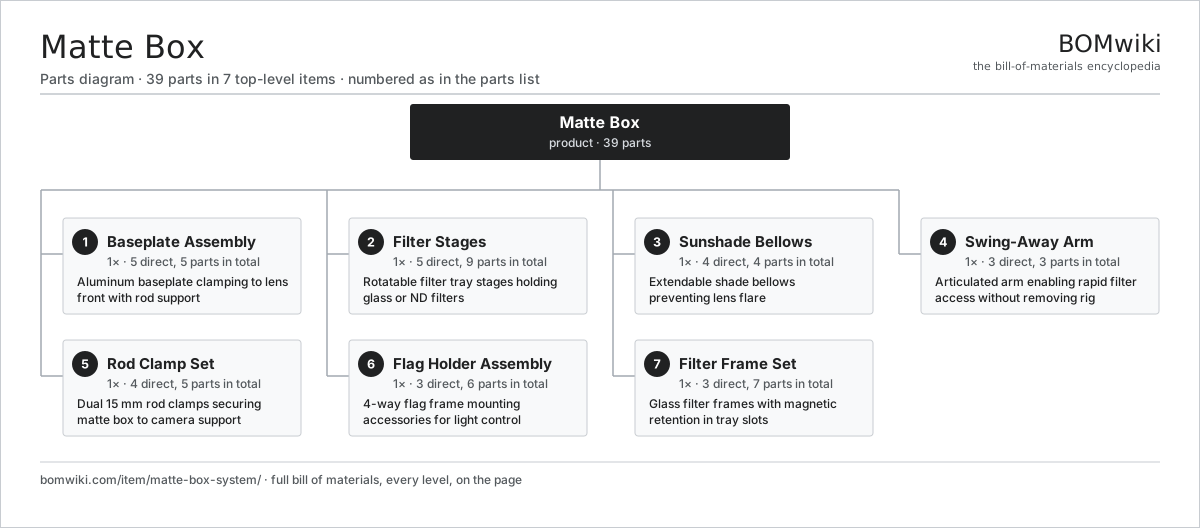
| # | Part | Qty | What it does |
|---|---|---|---|
| 1 | Baseplate Assembly 5 parts | 1× | Aluminum baseplate clamping to lens front with rod support |
| 2 | Filter Stages 5 parts | 1× | Rotatable filter tray stages holding glass or ND filters |
| 3 | Sunshade Bellows 4 parts | 1× | Extendable shade bellows preventing lens flare |
| 4 | Swing-Away Arm 3 parts | 1× | Articulated arm enabling rapid filter access without removing rig |
| 5 | Rod Clamp Set 4 parts | 1× | Dual 15 mm rod clamps securing matte box to camera support |
| 6 | Flag Holder Assembly 3 parts | 1× | 4-way flag frame mounting accessories for light control |
| 7 | Filter Frame Set 3 parts | 1× | Glass filter frames with magnetic retention in tray slots |
3D model
No 3D model yet. Have a CAD file of this? Add a 3D model. STL renders right on this page; STEP, FreeCAD, and OpenSCAD sources are welcome too (openly licensed, like all 3D models on BOMwiki).
Build & assembly graph
expand / collapse · shared sub-assemblies converge · links to related products · est. labourTap an assembly to expand/collapse · tap a part to open it · use “Open page” for any node · drag to pan, scroll to zoom.
Bill of materials for Matte Box
7 top-level lines · 34 rows shown · 39 parts total · indented to 3 levels| # | Item / sub-assembly | Part no. | Qty/assy | Ext. qty | Parts | Type |
|---|---|---|---|---|---|---|
| 1 | Baseplate Assembly 5 parts | matte-box-system-baseplate | 1× | 1 | 5 | assembly |
| 1.1 | Baseplate Body | matte-box-system-baseplate-body | 1× | 1 | · | part |
| 1.2 | Lens Clamp Lever | matte-box-system-lens-clamp | 1× | 1 | · | part |
| 1.3 | Clamp Pad Ring | matte-box-system-clamp-pad-ring | 1× | 1 | · | part |
| 1.4 | Rod Support Block | matte-box-system-rod-support-block | 1× | 1 | · | part |
| 1.5 | Fastener Set | fastener-set | 1× | 1 | · | part |
| 2 | Filter Stages 5 parts | matte-box-system-filter-stages | 1× | 1 | 9 | assembly |
| 2.1 | Rotating Tray | matte-box-system-tray-rotator | 1× | 1 | · | part |
| 2.2 | Magnetic Frame Holder A | matte-box-system-magnetic-frame-a | 1× | 1 | · | part |
| 2.3 | Magnetic Frame Holder B | matte-box-system-magnetic-frame-b | 1× | 1 | · | part |
| 2.4 | 4x5" Filter Frame | matte-box-system-filter-frame-4x5 | 4× | 4 | · | part |
| 2.5 | 6x6" Filter Frame | matte-box-system-filter-frame-6x6 | 2× | 2 | · | part |
| 3 | Sunshade Bellows 4 parts | matte-box-system-sunshade-extension | 1× | 1 | 4 | assembly |
| 3.1 | Bellows Fabric | matte-box-system-bellows-material | 1× | 1 | · | part |
| 3.2 | Bellows Frame Ring A | matte-box-system-bellows-frame-a | 1× | 1 | · | part |
| 3.3 | Bellows Frame Ring B | matte-box-system-bellows-frame-b | 1× | 1 | · | part |
| 3.4 | Shade Hardware | matte-box-system-shade-hardware | 1× | 1 | · | part |
| 4 | Swing-Away Arm 3 parts | matte-box-system-swing-away-arm | 1× | 1 | 3 | assembly |
| 4.1 | Swing Arm Shaft | matte-box-system-arm-shaft | 1× | 1 | · | part |
| 4.2 | Friction Knob | matte-box-system-friction-knob | 1× | 1 | · | part |
| 4.3 | Arm Mount Bracket | matte-box-system-arm-mount-bracket | 1× | 1 | · | part |
| 5 | Rod Clamp Set 4 parts | matte-box-system-rod-clamps | 1× | 1 | 5 | assembly |
| 5.1 | Left Rod Clamp Block | matte-box-system-clamp-block-left | 1× | 1 | · | part |
| 5.2 | Right Rod Clamp Block | matte-box-system-clamp-block-right | 1× | 1 | · | part |
| 5.3 | Support Rod Pair | matte-box-system-rod-pair | 2× | 2 | · | part |
| 5.4 | Fastener Set | fastener-set | 1× | 1 | · | part |
| 6 | Flag Holder Assembly 3 parts | matte-box-system-flag-holder-set | 1× | 1 | 6 | assembly |
| 6.1 | 4-Way Flag Frame | matte-box-system-flag-frame-4way | 1× | 1 | · | part |
| 6.2 | Flag Arm Extension | matte-box-system-flag-arm-extension | 1× | 1 | · | part |
| 6.3 | Flag Slot Adapter | matte-box-system-flag-slot-adapters | 4× | 4 | · | part |
| 7 | Filter Frame Set 3 parts | matte-box-system-filter-frames | 1× | 1 | 7 | assembly |
| 7.1 | 4x5" Frame Body | matte-box-system-frame-body-4x5 | 4× | 4 | · | part |
| 7.2 | 6x6" Frame Body | matte-box-system-frame-body-6x6 | 2× | 2 | · | part |
| 7.3 | Filter Retaining Kit | matte-box-system-filter-glass-holder | 1× | 1 | · | part |
Something wrong in this list? Report a problem with this BOM.
Sourcing: possible vendors
Browse the supplier directory → Prices, MOQ, and lead times are algorithmic estimates, not quotes, and not claims about these companies. Company mappings are curated by keyword; est. price band $100–$8k. How estimates work| Vendor | HQ | Specialty | MOQ | Lead time |
|---|---|---|---|---|
|
🇯🇵Canon
canon.com ↗
|
Tokyo, JP | Imaging & optics | 500 units | 10–16 wks |
|
🇯🇵Nikon
nikon.com ↗
|
Tokyo, JP | Imaging & optics | 500 units | 10–16 wks |
|
🇩🇪ZEISS
zeiss.com ↗
|
Oberkochen, DE | Optics & optoelectronics | 500 units | 10–16 wks |
| leica-camera.com ↗ | Wetzlar, DE | Cameras & optics | 500 units | 10–16 wks |
| flir.com ↗ | Wilsonville, US | Thermal imaging | 500 units | 10–16 wks |
1,491-word article