Meat Wrapping Machine
ProductOverview
The meat wrapping machine is a specialty tool used in supermarket deli and meat departments. It applies a plastic film wrap around trays of meat, poultry, or seafood and heat-seals the film to create a tamper-evident, moisture-barrier package. The process protects the product from oxidation, extends shelf life, and presents a professional appearance at retail.
A butcher or deli assistant places a tray of meat on the machine's tray support, pulls the film over the product to desired length, presses it against the heated seal plate, and the film adheres and shrinks slightly around the package. Some machines interface with the meat department scale, automatically retrieving weight and price data to print onto a label applied over the seal.
The machine is simple mechanically: a heated aluminum plate, a film unwind mechanism, and a cutter bar. Reliability and ease of maintenance are critical, as the machine operates continuously during deli hours and a breakdown can halt the entire meat department workflow.
How it Works
A deli worker takes a tray of fresh meat (typically 0.5–2 lbs on a white foam tray) and places it on the Tray Support Platform. The table is positioned directly under the Film Roller Assembly, which holds a large roll (2000–3000 m) of food-grade polyethylene or polypropylene film.
The worker grabs the film edge and pulls the desired length over the top of the tray, typically enough to wrap around both sides and form a seal overlap on the bottom. As the film is pulled, the Tension Brake Arm (a spring-loaded brake) maintains light tension on the film roll, preventing it from free-spooling while allowing smooth, controlled unwinding.
Once the film is pulled to the desired length, the worker positions the film overlap (the sealing edge) against the Heating & Sealing Plate. This plate is heated to 100–120°C (212–248°F) via an Electric Heating Element (800–1500W electric resistance heater). The heat immediately softens the polyethylene film, and the contact with the plate causes the two film layers to fuse together in 2–3 seconds.
The worker then pulls a Cutter Lever Arm (a mechanical lever), which swings a Cutting Blade (sharp stainless steel or heated nichrome wire) across the film path. The blade cleanly severs the film, leaving the wrapped package sealed and separated from the roll. A Film Advance Mechanism (ratchet or stepper) automatically advances the film roll one wrap length, positioning the next section ready for cutting.
The wrapped package is complete: the film is sealed, creating a barrier against oxygen and moisture, extending shelf life from 3–5 days to 7–10 days. The package is then labeled (manually or via automated label printer) with weight, price, and sell-by date, and placed on the deli counter.
Key Subsystems
The Film Roller Assembly must withstand high tension without slipping. The Film Roll Axle is a stainless steel shaft with spring-loaded flanges at each end, preventing the film roll from shifting laterally. The shaft is supported on sealed Film Axle Bearing (typically 6204 or 6205 deep-groove bearings) allowing smooth rotation. A Film Guide Idler (idler roller) positioned above the axle keeps the film centered as it unwinds.
Tension is critical: if the film is too loose, it unwraps or shifts during sealing; if too tight, the motor driving the cutter mechanism must work hard and the film may tear. The Tension Brake Arm applies controlled drag via a friction pad or brake spring. Most machines allow tension adjustment via a knob, allowing operators to tune for different film thicknesses.
The Heating & Sealing Plate is the functional core. An aluminum plate (typically 150 × 50 mm) is coated with Teflon (PTFE) to prevent film from sticking. Underneath, an Electric Heating Element (nichrome wire wound in a spiral pattern) generates heat. The element is powered via a relay controlled by a Thermostat Switch (bi-metal or electronic) set to 120°C. Once the plate reaches setpoint, the thermostat cuts power to the heater element, and the plate temperature is maintained by thermal mass.
A Temperature Sensor (NTC thermistor) continuously monitors plate temperature, optionally feeding to a digital display. If the plate temperature drops below ~100°C (e.g., because many large packages are being sealed in rapid succession), the thermostat re-energizes the heater until the setpoint is restored.
The Teflon coating is essential for non-stick performance. Over time, Teflon can wear or peel from the aluminum substrate. If the plate becomes sticky, wraps become difficult to pull off and may tear. Plate re-coating or replacement is a common maintenance task (every 2–3 years).
The Film Cutter & Dispenser mechanism cuts the film precisely. A lever-actuated blade or heated wire cuts cleanly, leaving no ragged edges. If a mechanical blade is used, it must be kept sharp; a dull blade tears the film instead of cutting it. Replacement blades cost $5–15. If a heated nichrome wire is used, it burns through the film cleanly, leaving no burrs, though the wire element can corrode over time and must be replaced periodically.
The optional Scale Integration Module adds automation. A weight scale in the deli department (where the product is weighed for pricing) has an RS-232 or Ethernet output. This signal is fed via shielded cable to an Interface Controller (microcontroller) that translates scale data into a format the label printer can understand. When a package is wrapped, the operator can press a button to automatically print a label with the weight, price, and date, eliminating manual entry.
The Tray Support Platform must be at ergonomic height (34–36 inches, same as counter height). If the table is too low, workers bend excessively and risk back strain; if too high, the film angle becomes awkward. Most machines have an Height Adjustment Screw (screw-drive mechanism) allowing fine-tuning. Some machines have mobile tables on Caster with Lock with locking brakes, allowing repositioning or removal for cleaning.
Maintenance
Daily maintenance includes wiping the Heating & Sealing Plate clean of film residue and meat juice. A non-abrasive cloth and warm soapy water are used; harsh chemicals or scrubbing can damage the Teflon coating. The plate should be wiped while still warm (not hot) for easiest cleaning.
Weekly inspection checks that the film advances properly, with no jams or slipping. If the film repeatedly breaks during pulling, it indicates high tension; the operator should reduce tension via the adjuster knob. If the film skips forward during unwind, the tension is too loose.
Monthly maintenance includes inspecting the cutter blade (or wire) for dullness or corrosion. A dull blade is replaced; a corroded wire element is cleaned with a wire brush or replaced. The meat-wrapping-machine-film-roller-bearing are inspected for smooth rotation; if they become stiff, they are removed, cleaned with a degreaser, repacked with food-grade bearing grease, and reinstalled.
The Electric Heating Element rarely fails, but over 5–10 years, internal corrosion or insulation breakdown can occur, requiring replacement. Power consumption will spike (heating time increases) as a sign of element degradation.
The Teflon plate coating develops worn spots after 3–5 years of use. If sticking becomes a problem despite daily cleaning, the plate must be re-coated (a service offered by machine vendors) or replaced (cost $50–150). A worn plate greatly slows operations, so replacement is often faster than waiting for re-coating.
Related Products
Meat wrapping machines are often used alongside meat-wrapping-machine-label-printer systems, which apply price labels over the sealed wrap. Some stores use a Price Labeling Gun for manual labeling, while others integrate an automatic printer with scale interface.
The Security Tag Detacher system is located nearby but is distinct, it handles cold items that need tag removal at checkout, whereas the wrapping machine is used at the meat counter during preparation.
Film rolls are a consumable supply, typically purchased in cases of 12–24 rolls per month depending on volume. Film width, thickness, and material composition vary; operators must use the correct film type (food-contact polyethylene or PP) for the machine's specifications.
Meat Wrapping Machine parts and their functions
8 top-level parts · 43 parts in total · full bill of materials below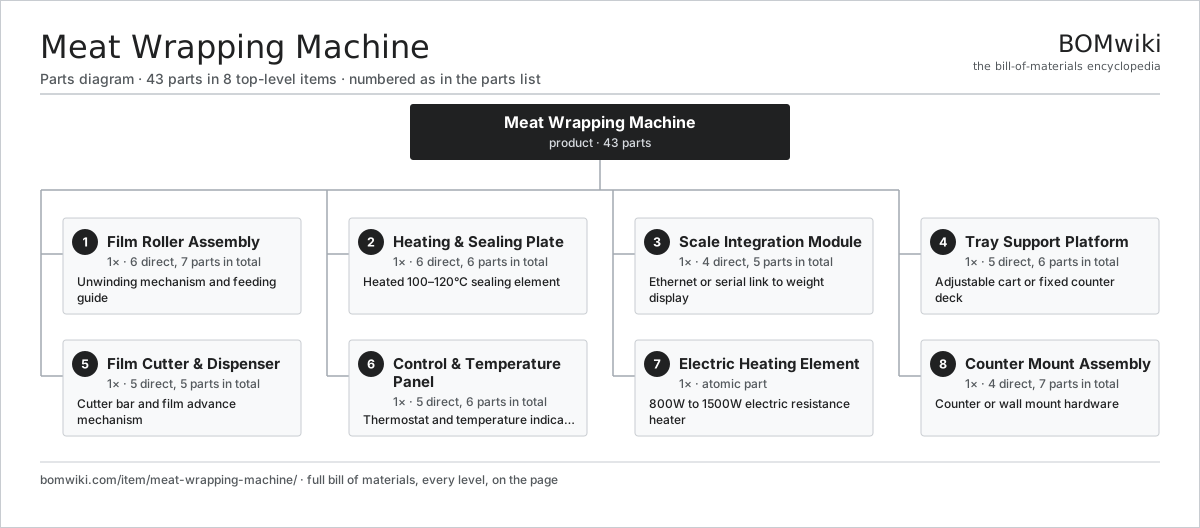
| # | Part | Qty | What it does |
|---|---|---|---|
| 1 | Film Roller Assembly 6 parts | 1× | Unwinding mechanism and feeding guide |
| 2 | Heating & Sealing Plate 6 parts | 1× | Heated 100–120°C sealing element |
| 3 | Scale Integration Module 4 parts | 1× | Ethernet or serial link to weight display |
| 4 | Tray Support Platform 5 parts | 1× | Adjustable cart or fixed counter deck |
| 5 | Film Cutter & Dispenser 5 parts | 1× | Cutter bar and film advance mechanism |
| 6 | Control & Temperature Panel 5 parts | 1× | Thermostat and temperature indicator |
| 7 | Electric Heating Element | 1× | 800W to 1500W electric resistance heater |
| 8 | Counter Mount Assembly 4 parts | 1× | Counter or wall mount hardware |
3D model
No 3D model yet. Have a CAD file of this? Add a 3D model. STL renders right on this page; STEP, FreeCAD, and OpenSCAD sources are welcome too (openly licensed, like all 3D models on BOMwiki).
Build & assembly graph
expand / collapse · shared sub-assemblies converge · links to related products · est. labourTap an assembly to expand/collapse · tap a part to open it · use “Open page” for any node · drag to pan, scroll to zoom.
Bill of materials for Meat Wrapping Machine
8 top-level lines · 43 rows shown · 43 parts total · indented to 3 levels| # | Item / sub-assembly | Part no. | Qty/assy | Ext. qty | Parts | Type |
|---|---|---|---|---|---|---|
| 1 | Film Roller Assembly 6 parts | meat-wrapping-machine-film-roller-system | 1× | 1 | 7 | assembly |
| 1.1 | Film Roll Axle | meat-wrapping-machine-film-roll-axle | 1× | 1 | · | part |
| 1.2 | Film Axle Bearing | meat-wrapping-machine-film-roll-bearing | 2× | 2 | · | part |
| 1.3 | Film Guide Idler | meat-wrapping-machine-film-guide-roller | 1× | 1 | · | part |
| 1.4 | Tension Brake Arm | meat-wrapping-machine-film-tension-arm | 1× | 1 | · | part |
| 1.5 | Roller Mount Bracket | meat-wrapping-machine-film-roller-bracket | 1× | 1 | · | part |
| 1.6 | Fastener Set | fastener-set | 1× | 1 | · | part |
| 2 | Heating & Sealing Plate 6 parts | meat-wrapping-machine-hot-sealer-plate | 1× | 1 | 6 | assembly |
| 2.1 | Electric Heating Element | meat-wrapping-machine-heating-element | 1× | 1 | · | part |
| 2.2 | Teflon Non-Stick Plate | meat-wrapping-machine-teflon-coating | 1× | 1 | · | part |
| 2.3 | Thermostat Switch | meat-wrapping-machine-thermostat-switch | 1× | 1 | · | part |
| 2.4 | Temperature Sensor | meat-wrapping-machine-temperature-sensor | 1× | 1 | · | part |
| 2.5 | Thermal Insulation | meat-wrapping-machine-plate-insulation | 1× | 1 | · | part |
| 2.6 | Fastener Set | fastener-set | 1× | 1 | · | part |
| 3 | Scale Integration Module 4 parts | meat-wrapping-machine-scale-interface | 1× | 1 | 5 | assembly |
| 3.1 | Scale Interface Connector | meat-wrapping-machine-scale-connector | 1× | 1 | · | part |
| 3.2 | Interface Controller | meat-wrapping-machine-interface-pcb | 1× | 1 | · | part |
| 3.3 | Scale Data Cable | meat-wrapping-machine-data-cable | 1× | 1 | · | part |
| 3.4 | Connector | connector | 2× | 2 | · | part |
| 4 | Tray Support Platform 5 parts | meat-wrapping-machine-tray-support-table | 1× | 1 | 6 | assembly |
| 4.1 | Table Frame | meat-wrapping-machine-table-frame | 1× | 1 | · | part |
| 4.2 | Table Top | meat-wrapping-machine-table-deck | 1× | 1 | · | part |
| 4.3 | Height Adjustment Screw | meat-wrapping-machine-height-adjuster | 1× | 1 | · | part |
| 4.4 | Caster with Lock | meat-wrapping-machine-caster-set | 2× | 2 | · | part |
| 4.5 | Fastener Set | fastener-set | 1× | 1 | · | part |
| 5 | Film Cutter & Dispenser 5 parts | meat-wrapping-machine-film-dispenser | 1× | 1 | 5 | assembly |
| 5.1 | Cutting Blade | meat-wrapping-machine-cutter-blade | 1× | 1 | · | part |
| 5.2 | Cutter Lever Arm | meat-wrapping-machine-cutter-arm | 1× | 1 | · | part |
| 5.3 | Cutter Return Spring | meat-wrapping-machine-cutter-spring | 1× | 1 | · | part |
| 5.4 | Film Advance Mechanism | meat-wrapping-machine-film-advance-gear | 1× | 1 | · | part |
| 5.5 | Fastener Set | fastener-set | 1× | 1 | · | part |
| 6 | Control & Temperature Panel 5 parts | meat-wrapping-machine-control-panel | 1× | 1 | 6 | assembly |
| 6.1 | Control Panel Housing | meat-wrapping-machine-panel-enclosure | 1× | 1 | · | part |
| 6.2 | Temperature Dial | meat-wrapping-machine-temperature-dial | 1× | 1 | · | part |
| 6.3 | Indicator Light | meat-wrapping-machine-power-indicator-light | 1× | 1 | · | part |
| 6.4 | Digital Temperature Display | meat-wrapping-machine-optional-display | 1× | 1 | · | part |
| 6.5 | Connector | connector | 2× | 2 | · | part |
| 7 | Electric Heating Element | meat-wrapping-machine-heating-element | 1× | 1 | · | part |
| 8 | Counter Mount Assembly 4 parts | meat-wrapping-machine-mounting-bracket | 1× | 1 | 7 | assembly |
| 8.1 | Counter Bracket | meat-wrapping-machine-bracket-arm | 1× | 1 | · | part |
| 8.2 | Clamp Fastener | meat-wrapping-machine-clamp-mechanism | 1× | 1 | · | part |
| 8.3 | Vibration Isolator | meat-wrapping-machine-vibration-pad | 4× | 4 | · | part |
| 8.4 | Fastener Set | fastener-set | 1× | 1 | · | part |
Something wrong in this list? Report a problem with this BOM.
Related products
same domain, ranked by shared parts Automatic Espresso Tamper
45 parts · shares 1 with this page
Automatic Filleting Machine
73 parts · shares 1 with this page
Bagel Former
43 parts · shares 1 with this page
Automatic Espresso Tamper
45 parts · shares 1 with this page
Automatic Filleting Machine
73 parts · shares 1 with this page
Bagel Former
43 parts · shares 1 with this page
 Bakery Deck Oven
44 parts · shares 1 with this page
Beverage Carbonator
95 parts · shares 1 with this page
Bin Sweep Auger
103 parts · shares 1 with this page
Bakery Deck Oven
44 parts · shares 1 with this page
Beverage Carbonator
95 parts · shares 1 with this page
Bin Sweep Auger
103 parts · shares 1 with this page
Sourcing: possible vendors
Browse the supplier directory → Prices, MOQ, and lead times are algorithmic estimates, not quotes, and not claims about these companies. Company mappings are curated by keyword; est. price band $1k–$500k. How estimates work| Vendor | HQ | Specialty | MOQ | Lead time |
|---|---|---|---|---|
| gea.com ↗ | Düsseldorf, DE | Process technology | 20 units | 12–20 wks |
| buhlergroup.com ↗ | Uzwil, CH | Food & materials processing | 20 units | 12–20 wks |
| tetrapak.com ↗ | Pully, CH | Food packaging & processing | 20 units | 12–20 wks |
| jbtc.com ↗ | Chicago, US | Food processing equipment | 20 units | 12–20 wks |
| alfalaval.com ↗ | Lund, SE | Heat transfer & separation | 20 units | 12–20 wks |
1,424-word article